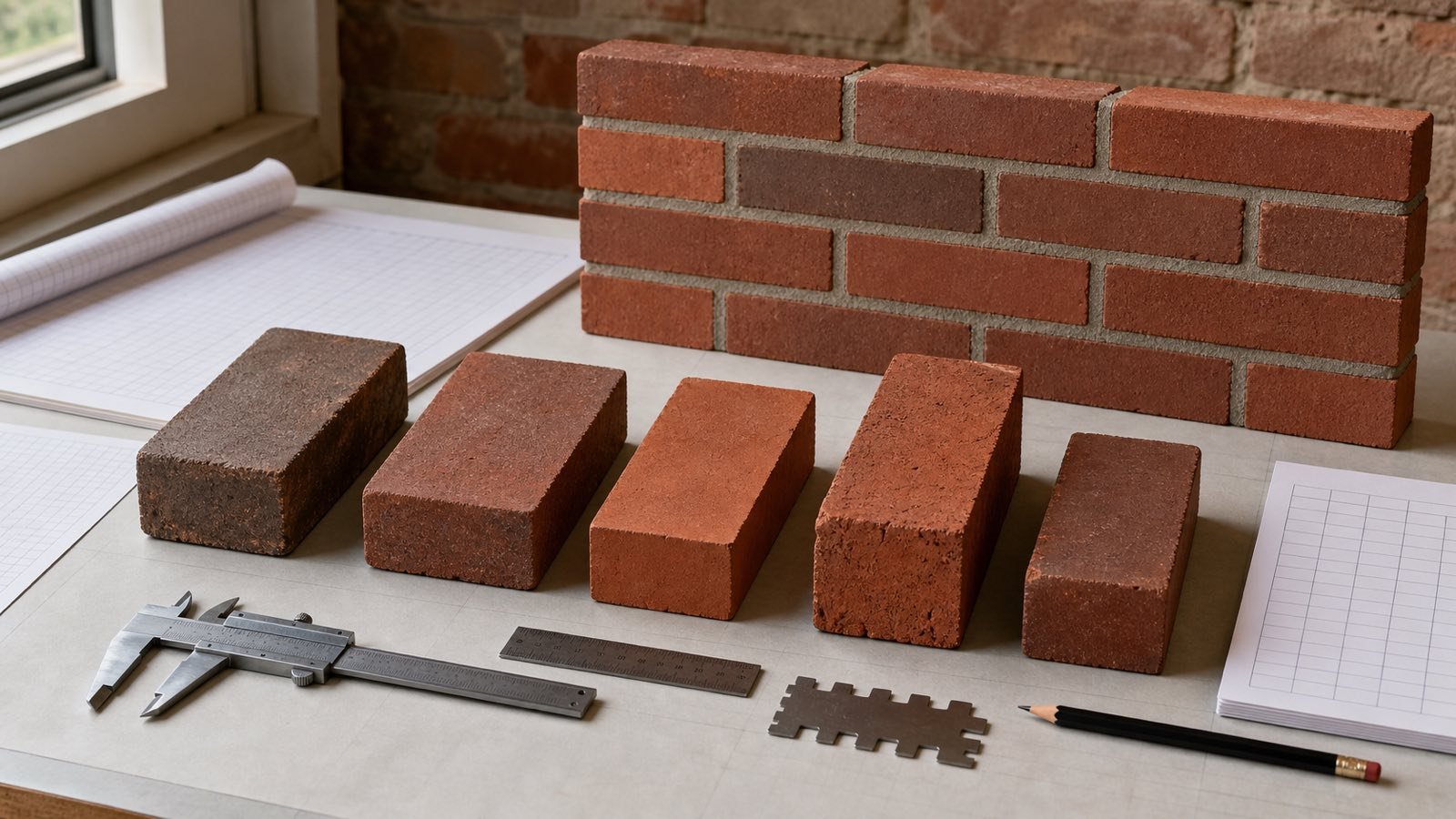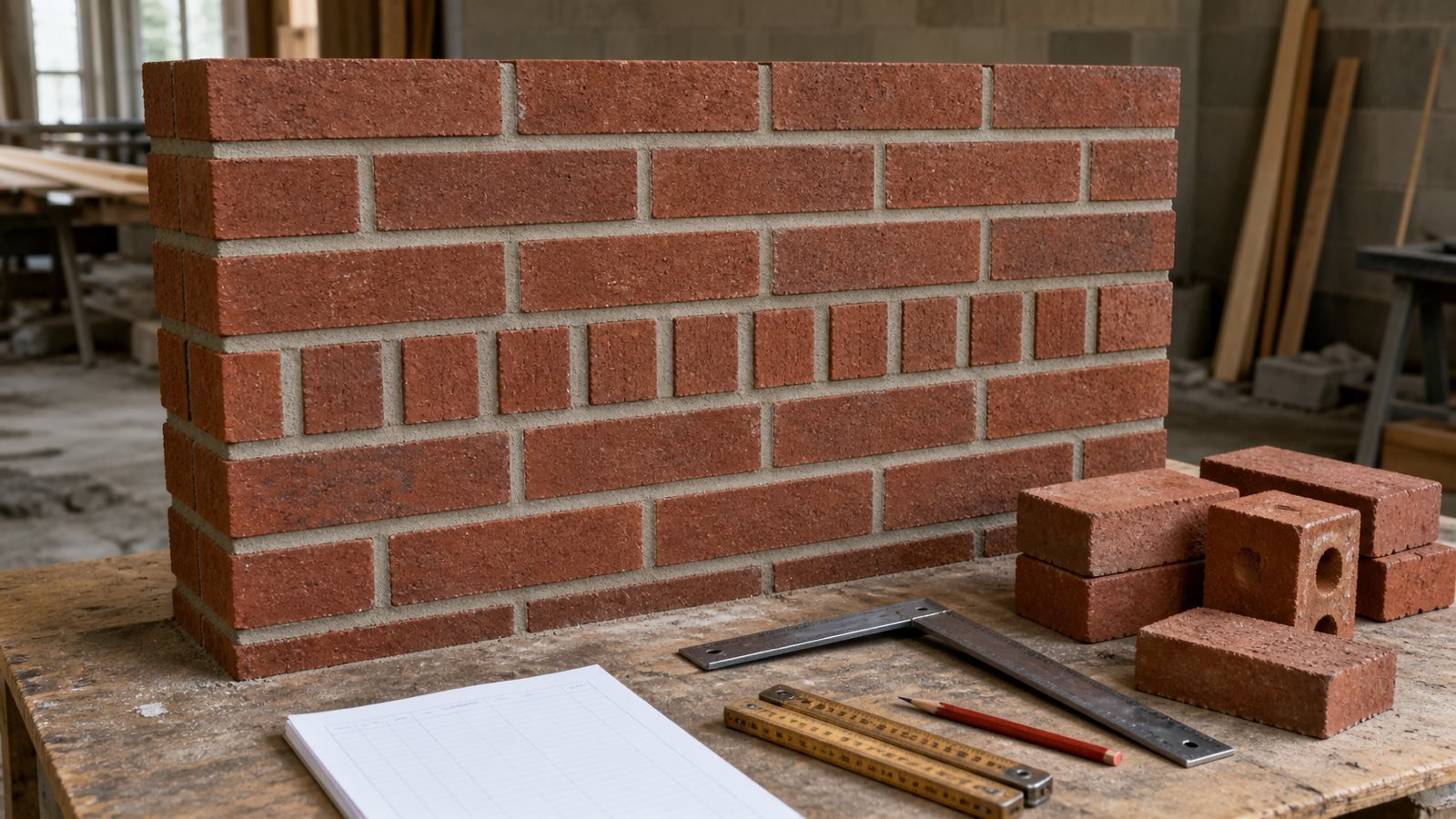
A brick bond can change the number of units needed for the same wall-face area when full headers turn through the wall. The estimator must identify the complete wall detail before applying a percentage.
Brick Industry Association Technical Note 10 gives net correction factors for several full-header bonds. Those factors apply before breakage or waste, and only under the brick-proportion limits stated with the table.
How does a brick bond change the brick quantity?
Running and stack bonds form the base of BIA's wall-area quantity table. A bond that introduces full headers can require more bricks than that base because each header exposes the short end while its length extends through the wall.
BIA Table 6 expresses the increase as a fraction of the base brick quantity. Common bond with full headers every fifth course uses a 1/5 correction. English bond uses 1/2, and Flemish bond uses 1/3 under the table's stated conditions.
Bond-corrected bricks = base bricks × (1 + brick correction fraction)
The bond factor changes the net units required by the wall arrangement. Waste or breakage allowance covers a different planning risk and follows the corrected net count.
Which BIA brick bond correction factors can be used?
Use a Table 6 factor only after the drawing or approved detail confirms the named full-header arrangement. The table also gives mortar factors, but the Brick Calculator applies only the brick correction percentage.
| Verified bond condition | Brick fraction | Calculator percentage | Mortar fraction |
|---|---|---|---|
| Common bond, full headers every fifth course only | 1/5 | 20% | 1/15 |
| Common bond, full headers every sixth course only | 1/6 | 16.666666...% | 1/18 |
| Common bond, full headers every seventh course only | 1/7 | 14.285714...% | 1/21 |
| English bond, full headers every second course | 1/2 | 50% | 1/6 |
| Flemish bond, alternate full headers and stretchers every course | 1/3 | 33.333333...% | 1/9 |
| Cross bond, Flemish headers every sixth course | 1/18 | 5.555555...% | 1/54 |
| Flemish cross bond, Flemish headers every second course | 1/6 | 16.666666...% | 1/18 |
| Double-stretcher garden wall bond | 1/5 | 20% | 1/15 |
| Triple-stretcher garden wall bond | 1/7 | 14.285714...% | 1/21 |
Preserve the fraction in the takeoff record. Entering 16.67% in place of 1/6 introduces a small rounding difference. The exact fraction is easier for another checker to reproduce.
The mortar fraction changes a theoretical mortar quantity from BIA Table 4. It does not select mortar type, product yield, batching method or site waste. Prepare a separate mortar takeoff from the current project specification and product data.
Which bond terms matter to an estimator?
BIA Technical Note 30 separates structural bond, pattern bond and mortar bond. Structural bond describes how masonry units, ties or grout connect the assembly. Pattern bond describes the arrangement visible on the wall face. Mortar bond describes adhesion.
A face pattern can be decorative and unrelated to the structural connection behind it. Record the visible pattern and the full-depth wall arrangement as separate fields.
| Bond | Visible arrangement | Quantity question |
|---|---|---|
| Running bond | All stretchers with vertical joints offset between courses | Does the selected coverage row already describe this face and joint? |
| Stack bond | All stretchers or headers with vertical joints aligned | Does the base table fit the exposed face, and what separate design is specified? |
| Common or American bond | Running-bond courses with a header course at a stated interval | Are those headers full depth, and is the interval fifth, sixth or seventh course? |
| English bond | Alternating courses of headers and stretchers | Are the header courses full depth or a face treatment? |
| Flemish bond | Alternating headers and stretchers within each course | Does each visible header consume a full brick through the wall? |
| English cross or Dutch bond | English-bond variation with alternate stretcher joints shifted | Which exact Table 6 row or direct repeat count matches the detail? |
BIA Technical Note 30 is dated March 1999. It supports the pattern terminology used here. Its old code and tie-spacing statements are not used as current requirements. Current codes, specifications, wall details and the responsible designer control structural decisions.
Worked example: common bond with fifth-course headers
BIA gives a published example for Standard brick with a ⅜ in joint. Table 4 lists 655 base bricks per 100 ft². The wall uses common bond with full headers every fifth course, so Table 6 supplies a 1/5 brick correction.
- Base quantity: 655 bricks.
- Bond correction: 655 × 1/5 = 131 bricks.
- Corrected net quantity: 655 + 131 = 786 bricks.
- Equivalent calculation: 655 × 1.20 = 786 bricks.
BIA's example stops at the corrected net quantity. Assume the project record separately supports a 5% breakage and waste allowance. The planning calculation becomes 786 × 1.05 = 825.3, rounded up to 826 whole bricks for that stated planning purpose.
Applying 5% to the 655-brick base first and then adding an unadjusted 131 bricks gives 818.75. That sequence misses the allowance on the header correction. Correct the net bond quantity first, then apply the allowance.
Why is a bond correction different from a waste factor?
The correction adds units required by the verified bond geometry. Waste and breakage cover supported losses, cuts and handling conditions after the net wall quantity has been calculated.
| Stage | What changes it | Record |
|---|---|---|
| Base brick count | Net wall area, brick size, exposed face and joint | Coverage source and unrounded base quantity |
| Bond correction | Full headers and a matching Table 6 or direct-count basis | Bond detail, fraction, limits and corrected net quantity |
| Special-unit schedule | Corners, closures, sills, soldiers, rowlocks, arches and shapes | Direct units, cuts and approved detail references |
| Planning allowance | Supported breakage, cuts, handling and project policy | Reason and percentage applied after net corrections |
| Supplier rounding | Current pack or selling increment | Supplier, product, quote date and split-pack terms |
BIA Technical Note 10 says to determine net brick quantities, including bond corrections, before adding waste or breakage. It gives at least 5% as a general rule and says project conditions can require a higher value. The calculator starts at 0% so the estimator must record the project decision.
Does a visible header always require the full-header correction?
A visible header can be a full brick, a cut brick or a special unit. BIA Technical Note 30 states that Flemish and English face patterns can use clipped or snap headers when the headers do not provide structural bonding.
The Table 6 English and Flemish rows name full headers. A photo or elevation pattern does not prove that each short face continues through the wall. Check wall sections, details, existing-wall probes where authorized, and the approved brick schedule.
Record header depth, cutting source and backing condition. Use a direct count when a full brick produces 2 or more visible headers or when a special shape changes the yield.
When can the BIA factor overstate the increase?
BIA Table 6 says the net increase can be smaller when one brick supplies multiple headers. Its correction factors also apply only when brick length equals twice its depth and 2½ to 3 times its height.
Brick size names do not prove those proportions. Confirm the nominal or specified dimensions associated with the source table. The brick sizes and coverage chart explains how nominal, specified and actual dimensions differ.
Use a direct pattern count for non-matching proportions, mixed sizes, clipped headers, specials, custom bonds or a detailed elevation whose repeat can be counted. Preserve whole-brick equivalents and purchase units as separate totals.
How is a direct pattern count prepared?
Choose one complete repeat whose boundaries can be reproduced. Count full stretchers, full headers, half or clipped units and specials. Then add non-repeating corners, ends, openings and transitions.
Pattern field units = complete repeats × whole-brick equivalents per repeat
Net bond units = pattern field units + boundary units + separately counted specials
| Record | Required entry | Check |
|---|---|---|
| Repeat limits | Course range, horizontal length and drawing reference | The repeat begins and ends at the same bond state |
| Full stretchers and headers | Count by orientation and depth | Short faces are traced to full units or stated cuts |
| Cut-unit yield | Pieces produced per full brick | Saw kerf, discarded pieces and approved reuse are recorded |
| Boundary pieces | Corners, closures, wall ends and changes in bond | They are not hidden inside a field percentage |
| Openings and features | Jambs, heads, sills, arches, soldiers and rowlocks | Each detail uses the correct face and unit type |
| Reconciliation | Field repeats plus boundaries plus specials | The quantity matches the marked elevation and section |
A percentage can estimate an early budget. The final takeoff should use the approved pattern and boundary details when they are available.
How large is the correction on the same base count?
Use the comparison only when each pattern meets the BIA conditions. A 2,477.25-brick running or stack base becomes 3,715.875 bricks under the 1/2 English-bond correction. The same base becomes 3,303 bricks under the 1/3 Flemish-bond correction.
| Condition | Fraction | Correction units | Corrected net bricks |
|---|---|---|---|
| Running or stack table base | 0 | 0 | 2,477.25 |
| Common, full headers every fifth course | 1/5 | 495.45 | 2,972.70 |
| Common, full headers every sixth course | 1/6 | 412.875 | 2,890.125 |
| English, full headers every second course | 1/2 | 1,238.625 | 3,715.875 |
| Flemish, alternate full headers and stretchers | 1/3 | 825.75 | 3,303.00 |
These figures show the effect of the correction only. They do not include special units, waste, supplier packs or a second independently counted wythe.
How should openings, corners and bond changes be handled?
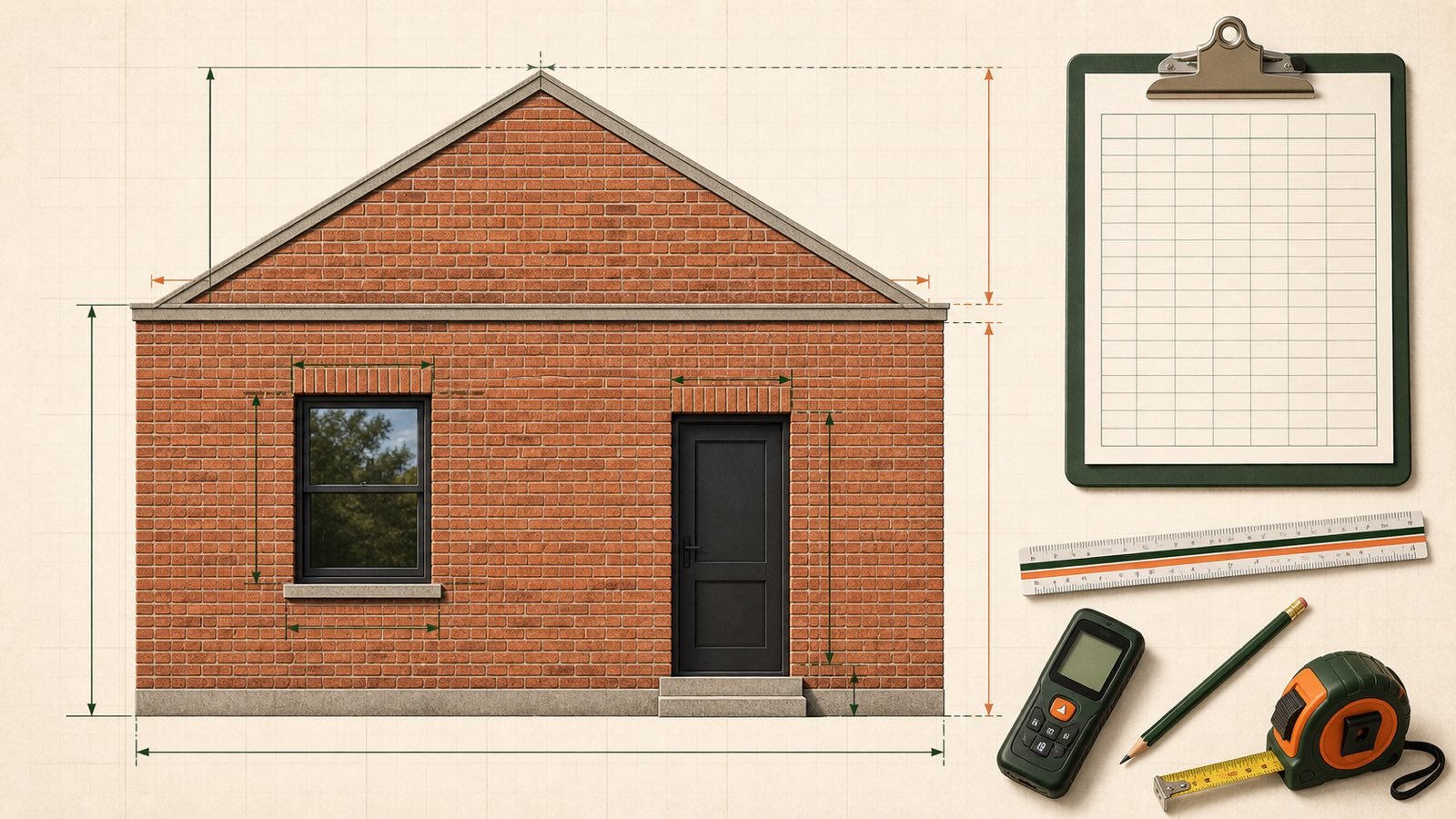
Split the wall where the bond, brick, header depth or source detail changes. Deduct compatible openings from the matching wall zone, then count boundary work around jambs, heads and sills from the detail.
BIA Technical Note 30 describes three-quarter and queen closures used to start some English and Flemish corners. A bond factor does not place those pieces or calculate their cutting yield. Record corners, returns, piers and wall ends separately.
The brick wall takeoff guide gives a face and opening ledger. Keep each bond zone tied to that net area instead of applying one correction to the full project total.
How do you enter a bond correction in the Brick Calculator?
Calculate the wall with a verified coverage rate or module first. Enter the exact Table 6 percentage only after the project detail confirms the named full-header condition and brick proportions.
- Enter compatible wall and opening dimensions.
- Choose the verified brick coverage or module basis.
- Record the unrounded base brick count.
- Enter 20 for 1/5, 50 for 1/2 or the full decimal supported by the chosen fraction.
- Check the bond-adjusted count against a separate calculation.
- Enter a supported allowance after the bond correction.
- Add or reconcile separately counted specials before approving the order.
The calculator's bond field accepts a percentage, so keep the source fraction beside the result. Run separate calculations for incompatible bond zones, then combine their unrounded corrected quantities.
Which bond-estimating mistakes change the order?
- Treating a bond correction as an automatic waste factor.
- Applying English or Flemish factors from a face photograph without checking header depth.
- Using a Table 6 factor when the brick proportions fall outside its note.
- Applying a correction to a base rate that already includes the complete pattern.
- Rounding 1/6 or 1/7 too early.
- Assuming one full brick for every clipped header, or one clipped header for every full brick.
- Using a wall-bond factor for herringbone or basketweave paving.
- Ignoring corners, closures, openings, soldiers, rowlocks and bond transitions.
- Multiplying the whole project when only one elevation or band changes bond.
- Adding supplier pack rounding before the net quantity and allowance are closed.
Structural, specification and purchasing limits
This guide calculates a material correction from a verified bond detail. It does not choose a structural bond, approve stack bond, design ties or reinforcement, establish wall thickness, inspect existing construction, set mortar joints or confirm code compliance.
Use current drawings, specifications, approved submittals, field records, local requirements and responsible qualified people. Confirm the manufacturer, product, dimensions, full-header condition, special shapes, pack quantity and delivery terms before placing an order.
Return to the brick quantity planning tools and guides for the category record. The calculation methodology explains source, precision and rounding checks. Report an error through the corrections route.
Sources and source scope
- Brick Industry Association Technical Note 10, Dimensioning and Estimating Brick Masonry, February 2009: running and stack base quantities, Table 6 brick and mortar correction factors, example, sequence, waste separation and factor limits.
- Brick Industry Association Technical Note 30, Bonds and Patterns in Brickwork, March 1999: bond terminology, named pattern descriptions, full and clipped headers, and corner-closure context.
- Glen-Gery Brick Bond Patterns: manufacturer visual reference used to cross-check named face patterns.
Source scope: BIA Technical Note 10 supports the stated estimating factors and limits. BIA Technical Note 30 supports pattern terminology from its 1999 edition; this page does not use its code or tie-spacing statements as current requirements. Glen-Gery supports the named visual pattern reference. The percentage translations, direct-count ledger and worked comparisons are original checked arithmetic and workflow.
Review responsibility: Saleem Sial owns the research and editorial record. Source verification, factor transcription, independent arithmetic, build validation, link crawl, schema review and rendered QA form the internal publication gate. Waseem Sial, External Reviewer and Engineer, remains listed for ongoing external review; no completed external-review date is claimed.