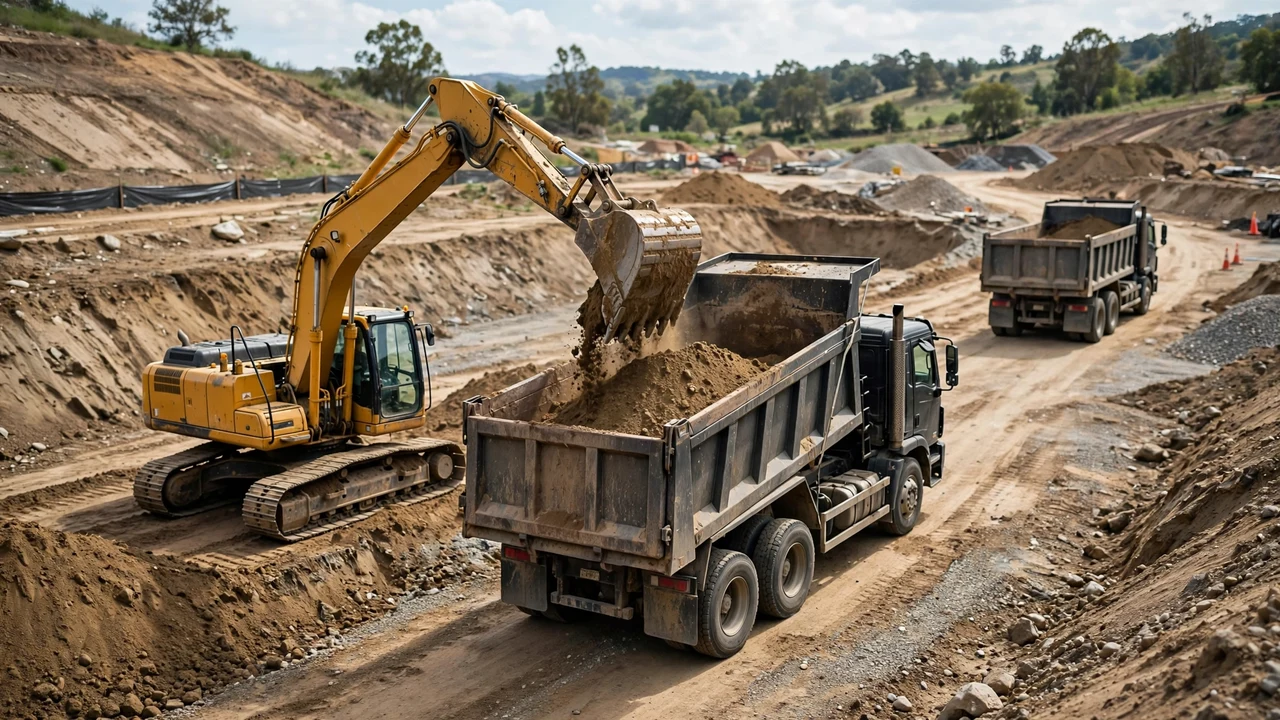
One dry well, start to finish. A rectangular pit gets measured in feet, converted to gross volume, reduced by the stone's void ratio for the real water storage, then converted back to a loose-stone order in cubic yards. A round-pit variant and a metric repeat close the chain.
What does this worked example cover?
This example covers the measurement arithmetic only: pit dimensions to gross volume, gross volume to water storage, and gross volume to the stone order. It does not size the well for a storm, select the stone, or run a percolation test. All dimensions, depths, and void ratios below are stated fixtures used to demonstrate the arithmetic. Copy the method and the record layout, and replace every number with your own project values. A dry well collects stormwater and returns it to the soil; it is a different structure from a drilled water well.
What are the starting measurements?
The pit is rectangular, measured after excavation at several points along each side. The stone is clean washed gravel with a stated void ratio of 0.35, the middle of the typical 0.30 to 0.40 range. That ratio is a fixture; the supplier or the project record sets the real value for the delivered stone.
| Item | Measurement | How taken |
|---|---|---|
| Plan length | 6 ft | Tape across the opening at three stations, averaged |
| Plan width | 6 ft | Tape across the opening at three stations, averaged |
| Excavated depth | 5 ft | Tape from the pit rim to the bottom at four corners, averaged |
| Stone void ratio | 0.35 | Stated fixture; typical clean gravel range 0.30 to 0.40 |
How do you get the gross pit volume?
Gross volume = length × width × depth.
Multiply: 6 × 6 × 5 = 180 ft³. Convert to cubic yards: 180 ÷ 27 = 6.6667, recorded as 6.67 yd³. Convert to gallons: 180 × 7.48052 = 1,346.5 gal.
The 1,346.5 gal figure is the pit's gross capacity, not the water it can store once stone goes in. The mistakes guide shows how often that number gets used as the storage figure, which overstates the real capacity by nearly three times.
How do you get the water storage number?
Storage = gross pit volume × void ratio.
The void ratio is the share of the pit that stays open water space once the stone is placed. Multiply: 180 × 0.35 = 63.0 ft³. Convert to gallons: 63.0 × 7.48052 = 471.3 gal.
Result: the pit stores 63.0 ft³ of water, about 471.3 gal. The ratio choice moves this number. The same pit at 0.30 stores 54.0 ft³ (403.9 gal); at 0.40 it stores 72.0 ft³ (538.6 gal). Record the ratio beside the storage figure so a later reader can see which one was used.
How do you get the stone order?
The order uses the gross pit volume, not the storage number. Bulk stone ships with its voids included, so the load that fills a 180 ft³ pit is 180 ft³ of loose stone. The dry well volume guide explains why storage is only part of the pit, and the ordering guide turns the yard figure into a supplier booking.
The gross volume in yards is 6.67 yd³ loose. The supplier sells whole yards, so the order rounds up to 7 yd³, a stated fixture decision on this example. Never shrink the order by the void ratio: ordering 63.0 ft³ (2.33 yd³) of stone would underfill the pit by nearly two thirds.
How does the same method work for a round pit?
Use the cylinder formula and the same chain. A round pit, 4 ft in diameter and 5 ft deep: radius = 4 ÷ 2 = 2 ft. Volume = π × r² × depth = π × 4 × 5 = 62.8 ft³.
Storage at the same stated void ratio: 62.8 × 0.35 = 22.0 ft³. Convert to gallons: 22.0 × 7.48052 = 164.5 gal. The gross volume in yards is 62.8 ÷ 27 = 2.33 yd³, which is the loose-stone order. Every step after the volume formula is identical to the rectangular example.
How does the same example work in metric?
A rectangular pit, 2.0 m × 2.0 m with a 1.5 m depth. Gross volume: 2.0 × 2.0 × 1.5 = 6.0 m³. Storage at the same stated void ratio: 6.0 × 0.35 = 2.1 m³. Convert to liters: 2.1 × 1,000 = 2,100 L. The loose-stone order is the gross 6.0 m³. The arithmetic closes in either unit system; keep one unit set through a calculation and convert only at the end.
What does the calculation record look like?
| Step | Number | State | Basis |
|---|---|---|---|
| Plan dimensions | 6 ft × 6 ft × 5 ft | Measured | Tape at several stations, averaged |
| Gross pit volume | 180 ft³ (6.67 yd³) | Gross, measured | Plan dimensions |
| Gross capacity | 1,346.5 gal | Gross, measured | 180 × 7.48052 |
| Void ratio | 0.35 | Stated fixture | Typical clean gravel range 0.30 to 0.40 |
| Water storage | 63.0 ft³ (471.3 gal) | Storage | Gross volume × void ratio |
| Loose stone order | 7 yd³ | Loose, delivered | Gross volume, rounded to whole yards |
| Ratio check | 0.30 → 403.9 gal; 0.40 → 538.6 gal | Storage | Records which ratio was used |
Keep the state beside every number. 180 ft³ is gross; 63.0 ft³ is storage; 7 yd³ is loose delivered stone. A mixed-state line breaks the record.
Where does this number go next?
The 63.0 ft³ storage figure is the capacity this pit provides, and the 7 yd³ order is the loose stone to fill it. The measuring guide covers how to take the pit dimensions; the dry well volume guide covers stone choice and soil decisions that set the real void ratio; the ordering guide turns the yard figure into the supplier booking.
Safety and professional scope
Contact 811 a few business days before digging and wait for buried utilities to be marked. Keep spoil and equipment away from the pit edge and take measurements from a safe position. This example covers quantity arithmetic only. Sizing the well for a storm, soil drainage, setbacks, and code compliance are separate steps for the project documents, applicable law, and responsible qualified people.
Sources and source scope
- Number Analytics, dry well installation guide: effective storage = gross volume × void ratio; gravel porosity typically 0.30 to 0.40; reviewed 2026-10-18.
- NIST Handbook 44, 2026 Appendix C: exact conversion constants used in the examples (ft³ to gallons 7.48052; 1 yd³ = 27 ft³; 1 m³ = 1,000 L).
- 811 Before You Dig: the free national before-you-dig service; contact a few business days before digging and wait for utility marking.
Scope: every dimension, depth, and void ratio in the examples is a stated fixture used to demonstrate the arithmetic; none is a stone, depth, or sizing recommendation. The 0.30 to 0.40 void range is a typical range for clean washed gravel, not a project value. The governing drawings, survey and measurement method, supplier certificate, soil information, contract provisions, applicable law, and responsible qualified people control the accepted project quantity.
Review responsibility: Saleem Sial owns the published calculation, source, and editorial checks. Waseem Sial, External Reviewer and Engineer, remains listed for ongoing external review; no completed external-review date is claimed.
For the measuring steps, see How to Measure for a Dry Well Volume. For stone and soil decisions, see the dry well volume guide. Next, return to the Earthwork & Drainage Calculators hub for the drainage tool set.
Use the Dry Well Volume Calculator to run the gross volume, storage, and stone order for your pit dimensions.