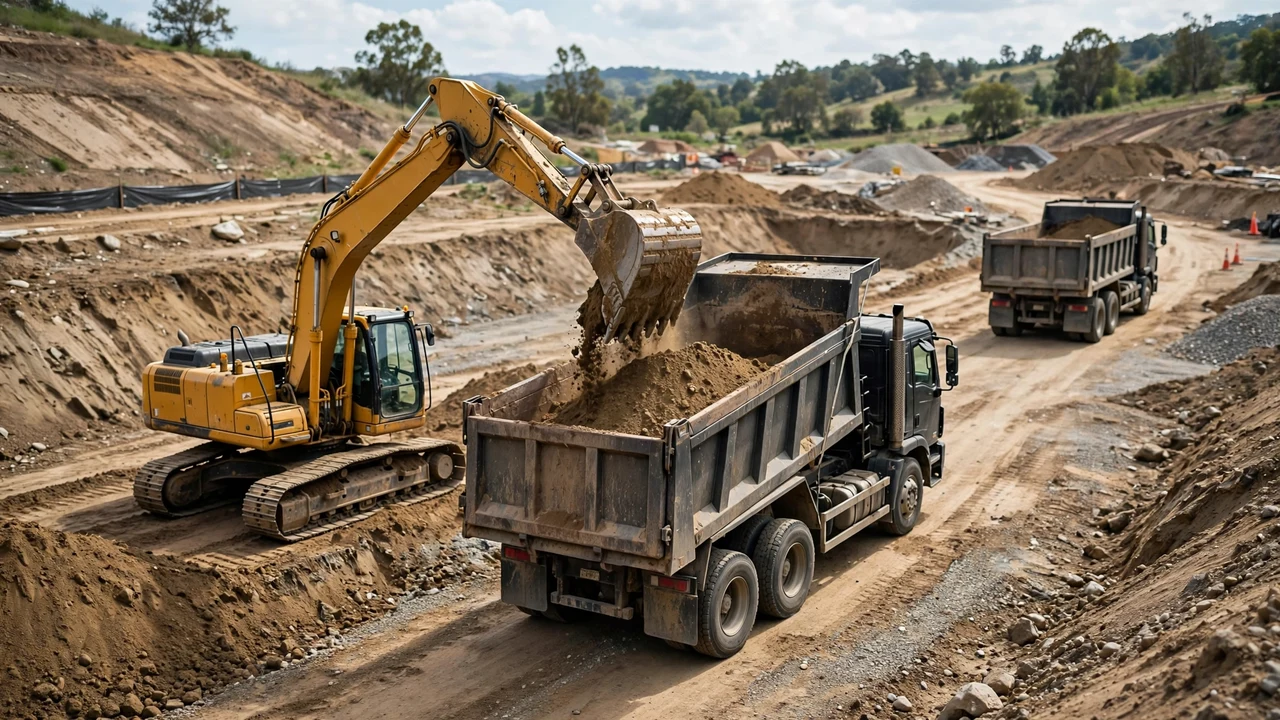
A sloped-trench order starts from the measured bank volume, not the drawing width. The slope adds soil above the bottom rectangle, and excavation loosens that soil, so the hauling quantity is larger than the bank takeoff and must be converted with a stated swell factor. The Sloped-Trench Excavation Calculator keeps the bank volume and the loose planning volume as separate results for that order.
Take the bank volume from the measurement guide method, using bottom width, depth, slope ratio, and length. This page turns that bank result into truck loads and delivery bookings. The soil guide covers choosing a slope ratio for the dig.
How much loose soil must be hauled away?
Multiply the bank volume by 1 plus the swell percentage written as a decimal. Bank yards describe soil in place; haulers and trucks work in loose yards.
Loose volume = bank volume × (1 + swell % ÷ 100)
Take the fixture from the measurement guide: bottom width 3 ft, depth 6 ft, 1:1 slopes, length 200 ft. The top width is 3 + 2 × 6 x 1 = 15 ft, the section area is (3 + 15) / 2 × 6 = 54 ft², and the bank volume is 54 × 200 = 10,800 ft³ = 400 yd³.
- State the swell factor. The record uses 25% for this soil and excavation method.
- Convert to a multiplier: 1 + 25 ÷ 100 = 1.25.
- Multiply: 400 × 1.25 = 500 yd³ loose.
Result: 400 yd³ bank becomes 500 yd³ loose to haul. The 25% is a recorded assumption from the project material record, not a universal factor.
Soil reused directly as backfill or kept in a stockpile never enters a truck. The spoil balance guide separates direct reuse, temporary storage, import, and export before the hauling total is fixed.
How many truck loads does the loose volume need?
Divide the loose volume by the usable body volume, then round a positive remainder up to a whole load. Keep the exact ratio beside the rounded count.
Loads = loose volume ÷ usable truck body volume, rounded up
For 500 yd³ loose and a stated usable body of 12 yd³: 500 ÷ 12 = 41.67, so the plan books 42 loads with a partial final load.
A 12 yd³ nominal body may load less depending on heaping, loading practice, and material. Ask the hauler for the usable loose volume per load and the legal payload for the route, and record both.
Check payload separately from volume. Per-load mass equals the loose volume per load times the loose bulk density from the hauler or project record, and it must stay within the legal payload. For the fixture, 500 ÷ 42 = 11.9 yd³ per load; with a stated loose density of 1.35 t/yd³ the per-load mass is about 16.1 t. If that exceeds the legal limit for the route, the load count rises even though the volume math stays the same.
What does the slope add to the order?
The slope widens the top of the trench, so the bank volume exceeds the bottom rectangle by the battered soil on both sides. In the 400 yd³ fixture, the bottom rectangle alone (3 ft x 6 ft x 200 ft = 3,600 ft³ = 133.3 yd³) is only one third of the excavation; the slopes add the remaining 266.7 yd³. Ordering from the bottom rectangle would miss two thirds of the dig.
Two slope details change the bank number before any conversion:
- Asymmetric slopes: top width = bottom width + depth x (left slope ratio + right slope ratio). Each side uses its own ratio.
- Trench ends and over-excavation beyond the design boundary belong on their own worksheet lines, with their own method and approval.
A metric check keeps the method honest across unit systems. Bottom width 1 m, depth 2 m, 1:1 slopes, length 60 m: top width = 1 + 2 × 2 x 1 = 5 m, section = (1 + 5) / 2 × 2 = 6 m², bank = 6 × 60 = 360 m³. A stated 20% swell gives 432 m³ loose; with 10 m³ usable bodies, 432 ÷ 10 = 43.2, so 44 loads.
How do you order imported backfill?
Order backfill from the compacted requirement, not from the excavation volume. Divide the compacted volume by 1 minus the shrinkage percentage written as a decimal to get the bank-equivalent quantity, then let the supplier convert that into their delivered state.
Bank-equivalent = compacted volume ÷ (1 − shrinkage % ÷ 100)
For 180 m³ compacted backfill with a stated 8% shrinkage: 180 / (1 - 0.08) = 180 ÷ 0.92 = 195.65 m³ bank-equivalent. The supplier quote states the delivered volume, selling unit, density basis, and moisture condition that turn this into truckloads.
Round the order up to the supplier selling increment and record the material specification, delivery address, access and tipping constraints, and the delivery schedule with the booking. The trench order-quantity guide covers the full conversion chain for mixed import and export jobs.
How do you keep the order checkable?
Put each quantity on its own line with its state, source, and unit. A reviewer should be able to follow the chain from measurement to booking without asking what any number means.
| Line | Quantity and state | Source |
|---|---|---|
| 1 | 400 yd³ bank | Measured trench geometry, approved method |
| 2 | Swell 25% | Project material record for this soil and method |
| 3 | 500 yd³ loose | Line 1 x (1 + line 2) |
| 4 | Minus direct reuse and retained soil | Spoil balance record |
| 5 | Net loose to haul | Line 3 - line 4 |
| 6 | Usable body 12 yd³, legal payload | Hauler record for the route |
| 7 | Loads booked, partial rounded up | Line 5 / line 6, rounded up |
| 8 | Backfill order in supplier increments | Compacted requirement / (1 - shrinkage), supplier quote |
Common sloped-trench ordering mistakes
- Ordering haulage in bank yards without the swell conversion.
- Using the bottom rectangle as the excavation volume and ignoring the sloped sides.
- Applying one swell percentage across different soil layers or moisture conditions.
- Using nominal truck body size instead of the usable loose volume per load.
- Skipping the payload check when soil is wet or dense.
- Counting stockpiled soil twice, once in the stockpile record and once in the export total.
- Rounding loads down, which leaves soil with no truck assigned.
- Burying the swell factor, reuse deduction, and truck rounding inside one unexplained total.
Safety and professional scope
Haulage and delivery planning does not select the slope ratio, protective system, equipment, haul routes, or loading limits. Those follow the project documents, applicable law, site conditions, and the responsible competent or qualified people.
For U.S. work, OSHA requires a protective system such as sloping for excavations 5 feet or deeper and keeps excavated material at least 2 feet from the trench edge under 29 CFR 1926.651. Keep spoil, trucks, and equipment at the distances and under the controls the governing safety plan requires, and keep haul routes inside the site traffic plan.
Sources and scope
- U.S. Office of Surface Mining Reclamation and Enforcement, Directive TSR-1 Appendix A: bank, loose, and compacted volume definitions and swell.
- Caterpillar, Material Density Tables to Help Estimate Earthwork Volumes: material-state definitions, load-factor context, and the need for project testing.
- Trimble Viewpoint Estimating Help, Enter Swell and Yield Factors: separate BCY, LCY, and CCY states.
- NIST Handbook 44, 2026 Appendix C: cubic-foot, cubic-yard, and cubic-metre relationships.
- OSHA Trenching and Excavation, 29 CFR 1926.651, and 29 CFR 1926.652: U.S. occupational excavation-safety context.
Scope: the formulas convert stated material states for ordering. The governing drawings, survey and testing methods, geotechnical information, contract measurement provisions, safety plan, vehicle limits, supplier or disposal records, applicable law, and responsible qualified people control the accepted factors and final quantities.
Review responsibility: Saleem Sial owns the published calculation, source, and editorial checks. Waseem Sial, External Reviewer and Engineer, remains listed for ongoing external review; no completed external-review date is claimed.
Next, review the measurement steps that produce the bank volume this ordering chain starts from, or return to the Earthwork & Drainage Calculators hub.