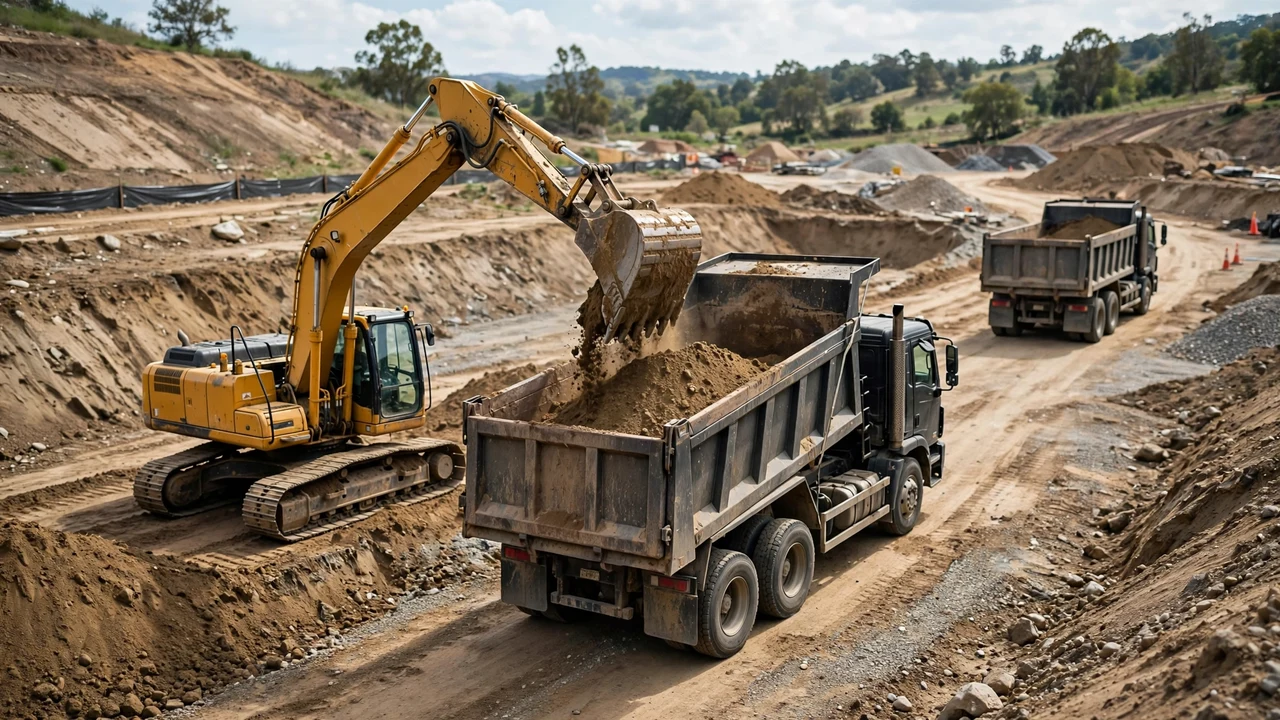
Soil type decides how steep a trench wall can stand, and the slope ratio decides how much soil the trench moves. A 6 ft deep trench with a 4 ft bottom holds 188.89 yd³ under a Type A slope and 288.89 yd³ under a Type C slope. Get the soil wrong and the quantity is wrong by 100 yd³ before the first truck arrives. Use the Sloped-Trench Excavation Calculator to run the same soil-slope comparison for a trench of your own dimensions.
How does soil type change a sloped trench?
Soil type sets the slope ratio you may assume, and the slope ratio sets the top width. A wider top width means a larger cross-section, more bank volume, more loose spoil, and more haulage for the same trench length and depth.
The measurement method stays the same for every soil. The sloped-trench measurement guide shows the trapezoid calculation; this guide covers what the soil does to the inputs.
What are the OSHA soil types?
OSHA 29 CFR 1926 Subpart P classifies excavation material into four groups, each with a maximum allowable slope. A competent person classifies each deposit from at least one visual and one manual analysis, such as a thumb penetration test or a pocket penetrometer reading.
| Type | Examples | Maximum slope |
|---|---|---|
| Stable rock | Natural solid mineral material that stays intact when excavated | Vertical (90°) |
| Type A | Cohesive soil at 1.5 tsf or stronger: clay, silty clay, hardpan | 3/4:1 (53°) |
| Type B | Cohesive soil 0.5 to 1.5 tsf; angular gravel, silt, silt loam, sandy loam; previously disturbed soil | 1:1 (45°) |
| Type C | Cohesive soil at 0.5 tsf or weaker; gravel, sand, loamy sand; submerged or freely seeping soil | 1-1/2:1 (34°) |
Two qualifications sit beside the table. A short-term slope of 1/2:1 (63°) is allowed in Type A soil for excavations 12 ft or shallower that stay open 24 hours or less. Sloping for any excavation deeper than 20 ft must be designed by a registered professional engineer.
What moves a soil into a weaker type?
Several conditions disqualify a soil from its stronger class. No soil is Type A when it is fissured, subject to vibration from heavy traffic or pile driving, previously disturbed, or part of a layered system that dips into the excavation at 4H:1V or steeper.
Water is the most common downgrade. Submerged soil or soil with water freely seeping from it is Type C. Granular material that looks cohesive when moist loses that cohesion when wet. An excavation exposed to rain or flooding after classification must be reclassified.
Layered ground is classified by its weakest relevant layer. Where layers dip toward the excavation, even strong-looking material is treated as less stable.
How much extra volume does a flatter slope add?
Compare one trench run: 100 ft long, 4 ft bottom width, 6 ft deep, uniform section. Only the soil type and its slope change.
| Soil type | Slope (H:V) | Top width | Bank volume |
|---|---|---|---|
| Type A | 3/4:1 | 13 ft | 188.89 yd³ |
| Type B | 1:1 | 16 ft | 222.22 yd³ |
| Type C | 1-1/2:1 | 22 ft | 288.89 yd³ |
The arithmetic for Type C: top width = 4 + 2 × 6 × 1.5 = 22 ft. Section area = (4 + 22) ÷ 2 × 6 = 78 ft². Volume = 78 × 100 = 7,800 ft³ = 7,800 ÷ 27 = 288.89 yd³.
The same trench in Type A holds 188.89 yd³. The soil classification alone creates a 100 yd³ gap. An estimator who plans Type A quantities for Type C ground under-plans haulage by more than half the trench volume.
Why does the swell factor depend on the soil?
Excavation fragments and loosens soil, so the loose volume is larger than the bank volume. How much larger depends on the material: a fractured clay, a clean sand, and a blasted rock do not break into the same void space.
Do not apply one swell percentage to every soil on a mixed project. Use a factor from the project record, a matched measurement, or an approved reference table, and keep bank and loose volumes labeled separately. The bank vs loose volume guide shows the conversion and checking process.
Caterpillar's earthwork reference warns that material weight and state vary with moisture, particle size, and compaction, and that exact characteristics need testing. A table value copied without project verification is a planning number, not a fact.
How do you treat rock and layered ground?
Stable rock can be excavated with vertical sides. Dry rock that is not stable falls into Type B, and submerged unstable rock into Type C. Fractured or blasted rock behaves as loose material: it occupies more space than the bank geometry and needs a material-specific conversion.
Calculate each distinct layer with its own slope and factor before adding. Mixing a rock layer and a soil layer under one ratio or one swell percentage loses the record that payment, haulage, and compaction checks need.
What does soil type change about spoil and backfill?
Looser soils slump in the stockpile, so they need more footprint per cubic yard of bank volume. Keep spoil back from the trench edge under the distances and controls the safety plan requires, because surcharge near the edge can force a flatter slope.
Backfill placement also follows the soil. Granular and cohesive soils need different placement and compaction methods to reach the specified density. Match the spoil's actual material to the trench spoil balance record instead of treating all excavated soil as identical fill.
How do you check the soil on site?
A competent person classifies the soil before sloping decisions are made. The classification uses at least one visual and one manual analysis, such as a thumb penetration test or a pocket penetrometer reading.
- Rain or flooding reaches the excavation after the first classification.
- New material appears at depth: different color, texture, or moisture.
- Fissures, slumping, or ravelling appear in the cut face.
- Vibration starts nearby: traffic, pile driving, or compaction equipment.
- Spoil or equipment is placed near the edge and adds surcharge.
- The excavation stays open past the planned period.
Record the classification, the tests used, the date, and the conditions with the quantity worksheet. A slope ratio without that record cannot be checked later.
Common soil and material mistakes
- Assuming soil type from appearance alone, without a visual and manual test.
- Keeping a Type A slope after rain, vibration, or fissures appear.
- Applying one swell percentage across clay, sand, and rock on the same project.
- Recording quantities without the material state: bank, loose, or compacted.
- Adding a loose spoil total to a bank excavation total.
- Placing spoil near the edge so surcharge forces a slope change.
- Using a short-term Type A slope beyond 24 hours or beyond 12 ft.
- Treating a reference-table factor as project-verified.
Safety and professional scope
Slope choice is a safety decision as well as a quantity decision. In the U.S., OSHA requires a protective system such as sloping for excavations 5 ft or deeper, and cave-ins are the main trench hazard. These slope ratios do not replace the project safety plan, geotechnical information, the competent person's judgment, or applicable law in other countries.
Quantity planning does not replace structural design, excavation safety engineering, permits, codes, or a qualified professional.
Sources and scope
- OSHA, Trenching and Excavation: U.S. protective-system requirements, competent-person duties, and sloping context.
- OSHA 29 CFR 1926.652: sloping and benching requirements; Subpart P Appendices A and B set soil classification and maximum allowable slopes by soil type.
- NIST Handbook 44, 2026 Appendix C: cubic-foot to cubic-yard relationship.
- U.S. Office of Surface Mining Reclamation and Enforcement, Directive TSR-1 Appendix A: bank, loose, and compacted volume definitions and swell context.
- Caterpillar, Material Density Tables to Help Estimate Earthwork Volumes: material-state definitions and the need for project testing of material characteristics.
Scope: the article explains how soil classification and material condition change the slope ratio, volume, and record-keeping for a sloped trench. The governing drawings, geotechnical information, survey and testing methods, contract measurement provisions, safety plan, applicable law, and responsible qualified people control the accepted slope and final project quantity.
Review responsibility: Saleem Sial owns the published calculation, source, and editorial checks. Waseem Sial, External Reviewer and Engineer, remains listed for ongoing external review; no completed external-review date is claimed.
Next, use the bank vs loose volume guide when converting the excavated quantity, or return to the Earthwork & Drainage Calculators hub.