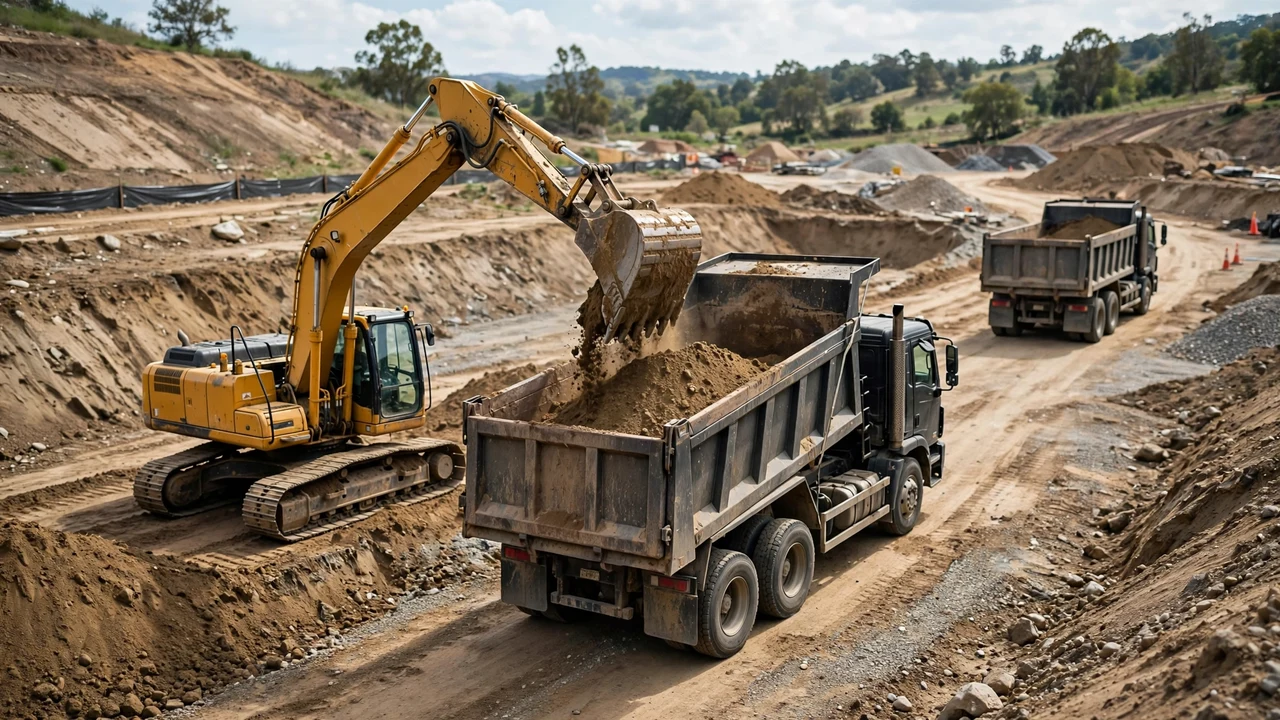
A trench with sloped sides is wider at the surface than at the bottom. A rectangular volume formula applied to either width alone gives the wrong quantity, so the measurement has to capture the slope and the calculation has to use the trapezoid cross-section. Enter those measurements in the Sloped-Trench Excavation Calculator to work out the top width, section area, and bank volume for one uniform run.
What is the volume of a sloped trench?
Multiply the trapezoidal cross-section area by the trench length. The area is the average of the bottom width and the top width, times the depth.
Top width = bottom width + 2 × depth × slope ratio
Section area = (bottom width + top width) ÷ 2 × depth
Volume = section area × length
The slope ratio is stated as horizontal run per unit of vertical rise (H:V). A 1.5:1 slope gains 1.5 ft of width per side for each foot of depth.
Which dimensions do you need?
Collect four measurements at each station: bottom width, depth, the side-slope ratio, and the run length. Measure the bottom width at the trench floor and the depth from the surface to the floor with a tape or rod.
Determine the slope ratio from the field rather than guessing it. Measure the horizontal offset from the trench-bottom edge to the surface edge on one side and divide by the depth. If the offset is 6 ft at a 6 ft depth, the ratio is 1:1.
When the two sides were cut to different slopes, record both ratios. The top width then becomes bottom width + depth × (left ratio + right ratio).
How do you work an imperial example?
A trench run is 120 ft long. The bottom width is 4 ft, the depth is 6 ft, and both sides were cut at a 1.5:1 slope.
- Top width: 4 + 2 × 6 × 1.5 = 22 ft.
- Section area: (4 + 22) ÷ 2 × 6 = 78 ft².
- Volume: 78 × 120 = 9,360 ft³.
- Convert to cubic yards: 9,360 ÷ 27 = 346.67 yd³.
Result: 346.67 yd³ bank volume for the 120 ft run. The same numbers through the compact form (bottom width × depth + slope × depth²) × length give (4 × 6 + 1.5 × 36) × 120 = 9,360 ft³, which closes the check.
| Slope (H:V) | Offset per side | Top width for 4 ft bottom |
|---|---|---|
| 0.75:1 | 4.5 ft | 13 ft |
| 1:1 | 6 ft | 16 ft |
| 1.5:1 | 9 ft | 22 ft |
| 2:1 | 12 ft | 28 ft |
How do you work a metric example?
A trench run is 60 m long. The bottom width is 1.2 m, the depth is 2.0 m, and both sides were cut at a 1:1 slope.
- Top width: 1.2 + 2 × 2.0 × 1 = 5.2 m.
- Section area: (1.2 + 5.2) ÷ 2 × 2.0 = 6.4 m².
- Volume: 6.4 × 60 = 384 m³.
Result: 384 m³ bank volume. The compact check (1.2 × 2.0 + 1 × 4) × 60 also gives 384 m³.
When is the trapezoid result exact?
When the cross-section is the same along the run, the trench is a prism and the trapezoid result is exact. It is not an approximation.
When the width, depth, or slope changes along the run, take a section at each change and use the average of the two end areas times the distance between them. The changing trench measurement guide covers that method.
Benched sides are handled the same way as separate stacked trapezoids. Measure each bench step as its own bottom width and depth, calculate each volume, and add them.
Which mistakes distort the quantity?
- Using the bottom width in a rectangular formula. On the imperial example this gives 2,880 ft³, which is 69% below the correct 9,360 ft³.
- Using the top width in a rectangular formula. On the same example this gives 15,840 ft³, which is 69% above the correct value.
- Reading the slope as vertical:horizontal instead of horizontal:vertical. A 1:1.5 input inverts the offset and doubles the error.
- Mixing units, for example depth in feet with a slope measured in inches per foot.
- Measuring the top width at a different station from the bottom width and depth.
- Forgetting the sloped ends. If the trench ends also slope, the run behaves like a four-sided pit and the prism formula does not apply; use end-area sections instead.
- Recording the result without the slope ratio. The quantity cannot be checked or revised later.
Use the Trench Excavation Calculator for rectangular sections. This guide covers the sloped-side case the rectangular tool does not calculate. Compare the field quantity against the overbreak guide when the excavation exceeds the design section.
Safety and professional scope
Sloping is a protective system, not a free choice of geometry. For U.S. construction work, OSHA requires a protective system such as sloping for excavations 5 ft or deeper, with maximum allowable slopes set by soil classification: 3/4:1 for Type A, 1:1 for Type B, and 1-1/2:1 for Type C. Excavations 20 ft or deeper need a registered professional engineer design. Other countries use their own workplace rules.
Quantity measurement does not select the slope, the protective system, equipment, or access. Those decisions follow the project documents, the competent person, applicable law, and site conditions. Keep surveyors and measuring staff clear of the trench edge and spoil piles.
Sources and scope
- OSHA, Trenching and Excavation: U.S. protective-system requirements, competent-person duties, and sloping context.
- OSHA 29 CFR 1926.652: sloping and benching requirements; maximum allowable slopes by soil type; 20 ft engineer-design rule.
- NIST Handbook 44, 2026 Appendix C: cubic-foot to cubic-yard relationship.
Scope: the formulas calculate the bank volume of a uniform sloped-side trench from measured dimensions. The governing drawings, survey method, geotechnical information, contract measurement provisions, safety plan, and applicable law control the accepted slope and final project quantity.
Review responsibility: Saleem Sial owns the published calculation, source, and editorial checks. Waseem Sial, External Reviewer and Engineer, remains listed for ongoing external review; no completed external-review date is claimed.
Next, use the changing trench measurement guide when the section varies along the run, or return to the Earthwork & Drainage Calculators hub.