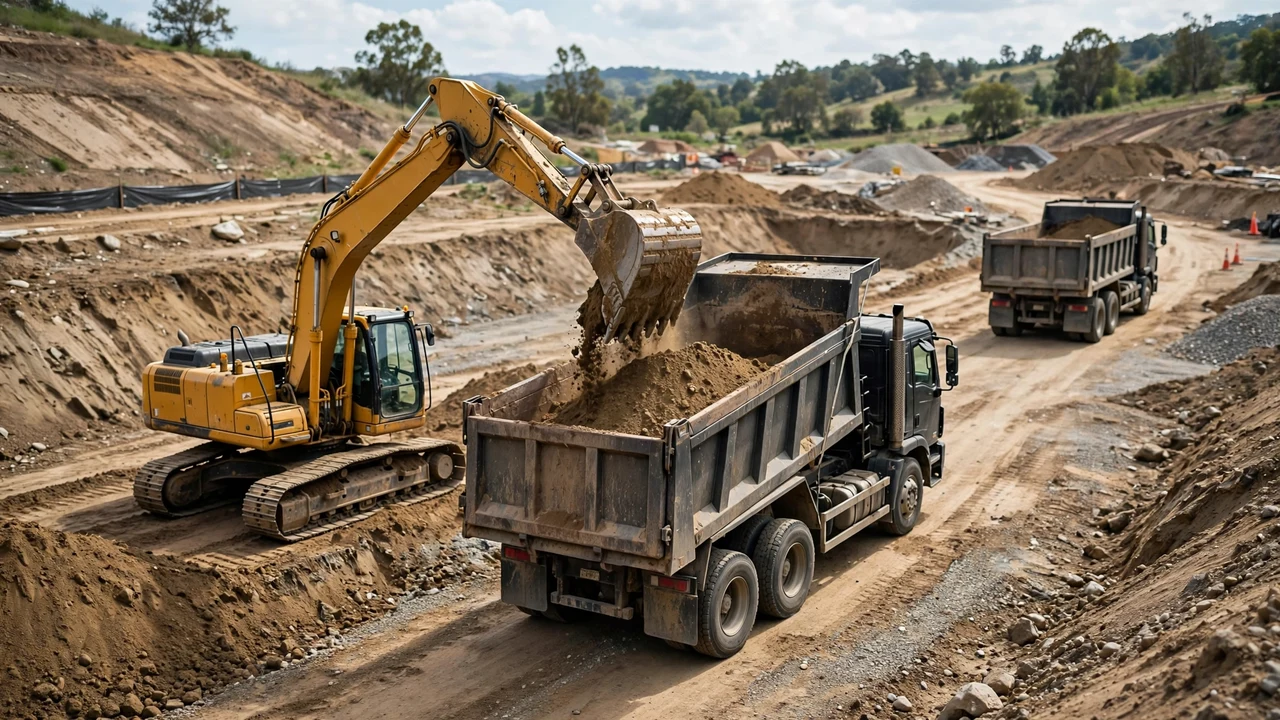
Order a swale ditch job only after the excavation volume is measured. The plan below turns that measurement into a haul-off quantity, whole truckloads, import orders, and a delivery schedule. Every line carries a material state: bank for the dig, loose for the spoil and the supplier deliveries. Start from the bank volume in the Swale Ditch Volume Calculator, then turn it into a loose haulage quantity with a project swell percentage.
What does a swale ditch order contain?
The order is five lines. It reuses the 60 m swale fixture from the measurement guide: a 39.0 m³ bank excavation from a 2.0 m top width, a 0.6 m bottom width, and a 0.5 m depth.
| Line | Quantity | State and basis | Where it goes |
|---|---|---|---|
| 1. Measured excavation | 39.0 m³ | Bank; from the swale measurement record | The quantity-control file, not the order |
| 2. Spoil to haul off | 46.8 m³ | Loose; 39.0 m³ bank × stated 20% swell | Disposal site or reuse stockpile |
| 3. Truckloads | 6 loads | Loose; hauler states 8 m³ usable capacity | The hauler booking |
| 4. Bed media | 6 m³ | Loose delivered; 60 m × 0.6 m × 0.15 m = 5.4 m³ | Supplier delivery in the selling unit |
| 5. Finish | 120 m² | Seed area; 60 m × 2.0 m top width | 1 × 5 kg bag at the stated 30 g/m² rate |
The swell, the truck capacity, and the seed rate are stated fixtures with their bases on the record. Replace each one with the project or supplier figure before ordering.
How do you convert the measured volume to a haul-off quantity?
Multiply the bank volume by 1 plus the swell percentage written as a decimal. Excavated soil occupies more volume because digging fragments the material and opens void space, so the spoil plan uses loose volume.
Loose spoil = bank volume × (1 + swell % ÷ 100)
For the fixture swale with a stated 20% swell: 39.0 × 1.20 = 46.8 m³ loose. The reverse check is 46.8 ÷ 1.20 = 39.0 m³. Keep the bank, loose, and placed states separate; the bank versus loose volume guide explains each state.
Write "46.8 m³ loose (20% swell, project record)" rather than 46.8 m³ alone. A factor copied without its material, moisture, and excavation basis is a guess, not a record.
How many truckloads does the spoil need?
Divide the loose spoil by the hauler's stated usable body volume, then round a positive remainder up to a whole truck. Use usable capacity, not the rated maximum: loading practice, material mass, and legal payload can set a smaller number.
Truckloads = loose spoil ÷ usable truck capacity, rounded up
For 46.8 m³ loose and a stated 8 m³ usable capacity, the ratio is 46.8 ÷ 8 = 5.85, so the booking is 6 truckloads; the 6th carries the remainder. Stage spoil where trucks can reach it. U.S. Army excavator manuals give the same practice in one line: "Place spoil piles for convenient truck loading or backfilling."
How does the order read in cubic yards?
The same fixture in U.S. customary units: 39.0 m³ × 1.30795 = 51.0 yd³ bank. With the stated 20% swell, 51.0 × 1.20 = 61.2 yd³ loose. A hauler stating 10 yd³ usable gives 61.2 ÷ 10 = 6.12, so 7 truckloads. The reverse check is 61.2 ÷ 1.20 = 51.0 yd³.
How do you order the imported bed material?
Size the import from the placed geometry and order it in the supplier's loose selling unit, because the truck delivers loose material. For a 0.15 m media bed over the 0.6 m swale bottom: 60 × 0.6 × 0.15 = 5.4 m³ loose delivered. Round up once, in the selling unit: order 6 m³.
Check the number against the supplier's coverage formula before ordering. Suppliers publish coverage tables built on area in square feet × depth in inches ÷ 324 = cubic yards: 387.5 ft² × 6 in ÷ 324 = 7.2 yd³, which matches 5.4 × 1.30795 = 7.06 yd³ within rounding. In yards the order line is about 7.5 yd³. The swale material guide covers which media and surface materials belong on the order.
How do you order the finish material?
Size seed or sod from the disturbed surface, not the bottom width. The swale surface is 60 m × 2.0 m = 120 m². At a stated 30 g/m² coverage, 120 × 30 = 3,600 g = 3.6 kg of seed, so the order is 1 × 5 kg bag. The supplier's stated coverage rate governs; the fixture rate here only demonstrates the arithmetic.
For sod, order 120 m² in the supplier's square-metre unit with the same rounding rule: one step, at the end. When the design calls for stone check dams, add them as a separate line with the stone size and quantity; they are not part of the media volume.
How do you schedule deliveries against excavation?
Match spoil removal to the excavation rate and deliver imports only when the site is ready for them. If the excavator moves about 20 m³ bank per day (a planning fixture, not a production norm), the 39.0 m³ dig takes about 2 days, so 3 of the 6 truckloads per day keeps the spoil moving. Confirm the rate with the equipment record for the actual soil.
- Book spoil trucks for the digging days, not before the first bucket.
- Deliver bed media only after the final grade is approved; early material gets moved twice.
- Order seed or sod for the day the surface work finishes.
- Reuse spoil on the berm or site fill first; every cubic metre reused reduces both the haul-off and the import lines. The spoil balance guide shows the bookkeeping.
What does the supplier need on the order?
Give the supplier one unambiguous record: the material specification (for example screened topsoil or the engineered media from the design), the quantity in the selling unit with its state ("6 m³ loose delivered"), the moisture basis, the delivery date and window, site access limits (truck size, turning, overhead lines), tipping instructions, and the ticket or purchase-order reference. Supplier delivery pages typically quote morning or afternoon windows and minimum orders; confirm the terms on the actual quote.
How do you check deliveries against the plan?
Reconcile every ticket against the five-line record: loads × stated capacity for spoil trucks, and delivered loose volume or bag count for imports. Note short loads, rejected material, and moisture changes that move tonnage. A running record that still matches the plan at the end of the job is the proof the order was right.
Common swale ordering mistakes
- Ordering the spoil removal in bank volume instead of loose volume.
- Planning trucks from nominal body capacity instead of the hauler's stated usable capacity.
- Using one swell figure for different soils, moisture, or excavation conditions.
- Delivering bed media before the final grade is approved.
- Sizing seed or sod from the bottom width instead of the disturbed surface.
- Mixing reused spoil quantities with import quantities in one total.
- Rounding mid-calculation instead of once, in the selling unit, at the end.
Safety and professional scope
Quantity planning does not select excavation geometry, protective systems, equipment, haul routes, or disposal sites. Excavation work follows the project safety plan; in covered U.S. work, OSHA treats cave-ins as the main excavation hazard and sets the protective-system and competent-person context. Keep spoil, vehicles, and equipment at the distances the safety plan requires, check for underground services before digging, and leave stormwater design and spoil-disposal permitting to the responsible engineer and authority.
Sources and scope
- U.S. Office of Surface Mining Reclamation and Enforcement, Directive TSR-1 Appendix A: bank, loose, and compacted volume definitions and swell context.
- Caterpillar, Material Density Tables to Help Estimate Earthwork Volumes: material-state definitions; density varies with moisture, particle size, and compaction, so project testing confirms exact values.
- NIST Handbook 44, 2026 Appendix C: cubic-foot, cubic-yard, litre, and cubic-metre relationships.
- U.S. Army excavator operator manuals TM 5-3805-294-10 and TM 5-3805-281-10 (via the tpub.com archive): spoil-pile planning, including placing spoil for convenient truck loading or backfilling.
- PNNL Building America Solution Center, "Swales, Drains, and Site Grading for Stormwater Control" (citing EPA 1999): swale definition and side-slope and no-compaction guidance used for design context.
- Hello Gravel, topsoil delivery page and Cal Blend Soils, topsoil delivery page: supplier coverage formula (area in square feet × depth in inches ÷ 324 = cubic yards), minimum-order and delivery-window practice.
- OSHA Trenching and Excavation: U.S. occupational excavation-safety context.
Scope: the fixtures are worked arithmetic on the 60 m sibling measurement, not recommended project values. The governing drawings, survey and testing methods, geotechnical information, contract measurement provisions, safety plan, vehicle limits, supplier records, applicable law, and responsible qualified people control the accepted factors and final project quantities.
Review responsibility: Saleem Sial owns the published calculation, source, and editorial checks. Waseem Sial, External Reviewer and Engineer, remains listed for ongoing external review; no completed external-review date is claimed.
Next, use the swale ditch measurement guide to check the bank volume this plan builds on, or return to the Earthwork & Drainage Calculators hub.