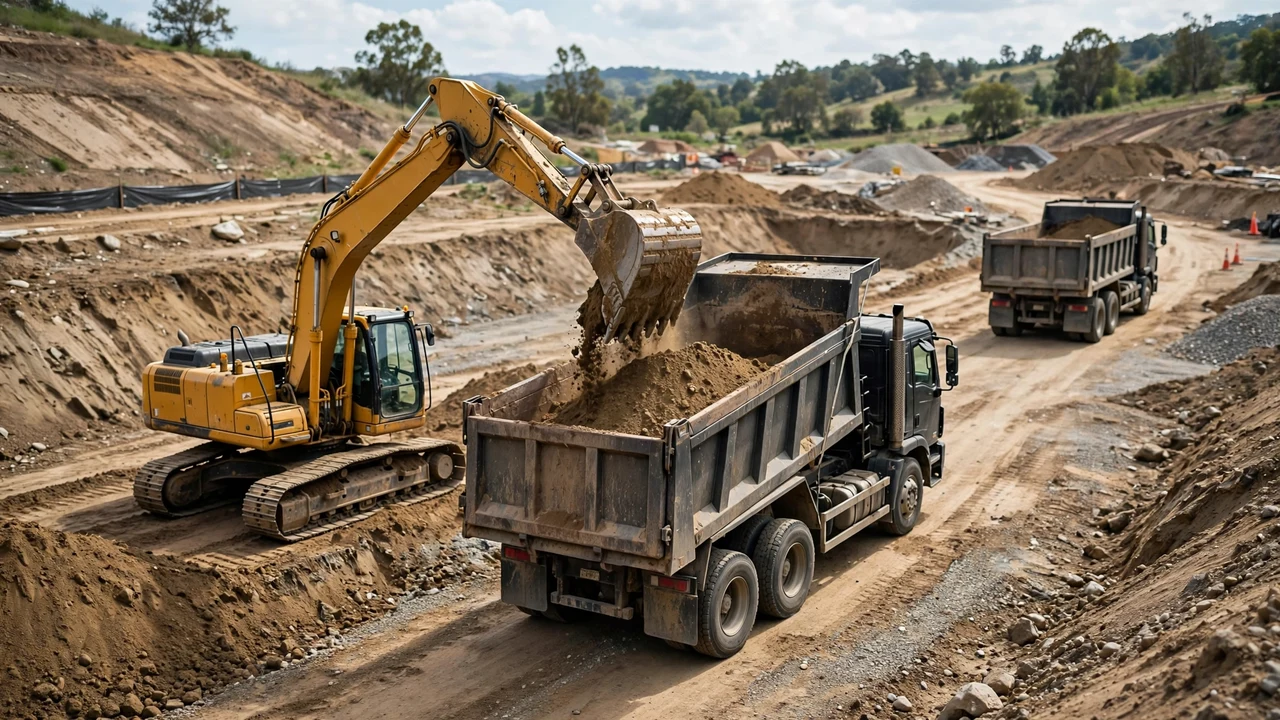
A swale or ditch measurement records the cross-section the excavator will cut. This guide takes the three cross-section dimensions, the run length, and the station record that keeps the numbers honest. Enter those numbers in the Swale Ditch Volume Calculator to work out the section area and bank volume for one uniform run.
How do you measure a swale ditch for excavation volume?
Stake the centerline and measure the run length along it. Take the top width, the bottom width, and the vertical depth at a representative section. Compute the trapezoidal section area, multiply by the length, and record the result in cubic metres or cubic yards. A 60 m swale with a 2.0 m top width, a 0.6 m bottom width, and a 0.5 m depth gives 39.0 m³, as the worked example below shows.
What do you need before measuring?
Get the design or the job brief first. It fixes the intended depth and the swale location; the field check confirms the ground, not the design. Bring a tape long enough to span the top width, a depth rod or a marked stake, marking stakes with string, and a notebook. For an existing ditch you are cleaning out, fix the record on the original design bottom; the cleanout volume is the material above that bottom, not the full original section.
Excavation work follows the project safety plan. In covered U.S. work, OSHA's excavation requirements set the protective-system and competent-person context. Shallow ditches still put people and machines in the same space, so mark the work area and keep clear of swinging equipment.
How do you set the run length?
Drive stakes along the swale centerline and measure between them. Follow the curve: on a bend, break the run into straight segments and add their lengths. Measure the length at grade along the centerline and state that basis; a length read along a slope is longer than the plan length.
Which three numbers define the cross-section?
The top width is the distance from one ground edge of the ditch to the other. The bottom width is the width of the flat floor; use 0 for a V-shaped swale. The depth is the vertical distance from the ground surface at the edge to the bottom of the ditch.
How do you take each measurement?
Stretch the tape level across the top at the ground level of both edges. Measure the bottom width at the floor of the ditch. Read the depth vertically with the rod; a reading taken along the side slope is longer than the true depth. Take each dimension twice at every station and keep the average.
Slope-distance readings overstate depth. Drop the rod plumb, read the scale at the ground line, and record the vertical number.
Section area = (top width + bottom width) / 2 × depth
V-shaped section area = top width / 2 × depth
Swale volume = section area × run length
What if the section changes along the run?
Add stations. Measure a full section wherever the width or depth visibly changes, then combine each pair of neighbouring stations with the average-end-area method: add the two section areas, halve the sum, and multiply by the distance between the stations. The method assumes the section changes evenly between stations, so keep the spacing short where the ground changes fast.
A two-station check: station 0 gives (2.0 + 0.6) / 2 × 0.5 = 0.65 m². Station 1, 30 m on, gives (2.2 + 0.6) / 2 × 0.55 = 0.77 m². The segment volume is (0.65 + 0.77) / 2 × 30 = 21.3 m³. A uniform 60 m run at 0.65 m² gives 39.0 m³, which matches the single-section check below.
Worked example: 60 m trapezoidal swale
A staked swale runs 60 m. The measured section is 2.0 m across the top, 0.6 m across the floor, and 0.5 m deep.
- Section area = (2.0 + 0.6) / 2 × 0.5 = 0.65 m².
- Volume = 60 × 0.65 = 39.0 m³.
- Independent check through cubic feet: 39.0 × 35.314666721 = 1,377.27 ft³; divide by 27 = 51.01 yd³.
- Direct factor path: 39.0 × 1.307950376 = 51.01 yd³. The two paths agree.
| Record | Length (m) | Top width (m) | Bottom width (m) | Depth (m) | Area (m²) | Volume (m³) |
|---|---|---|---|---|---|---|
| Main run | 60 | 2.0 | 0.6 | 0.5 | 0.65 | 39.0 |
| Total measured excavation | 39.0 |
How does the result read in imperial units?
A 200 ft run, 6 ft across the top, 2 ft across the floor, and 1.5 ft deep gives a section area of (6 + 2) / 2 × 1.5 = 6 ft². The volume is 200 × 6 = 1,200 ft³. Divide by 27 for cubic yards: 44.44 yd³. The metric check confirms the arithmetic: 1,200 / 35.314666721 = 33.98 m³.
What stays out of the volume record?
Keep the earthwork record to soil in place:
- Standing water or soft mud at the bottom. The earthwork record covers soil; pumping is a separate item.
- Stripped topsoil, if removed before the cut. Record it separately with its own depth.
- Lining, geotextile, or riprap. These are material records, not excavation volume.
- Overdig beyond the design section. Record design and actual as two lines; the difference is a control issue, not part of the planned volume.
The earthwork record holds the soil in place. Materials, water, and allowances each hold their own record. One total never carries two kinds of quantity.
Common swale ditch measurement mistakes
- Taking the depth along the side slope instead of vertically.
- Measuring the top width at the water line instead of the ground edge.
- Multiplying the nominal design depth without checking it in the field.
- Running the tape straight instead of following the curve of the swale.
- Mixing feet and metres inside one multiplication instead of converting first.
- Averaging one section over a run whose section visibly changes.
- Counting standing water or stripped topsoil in the earthwork volume.
- Rounding the measured number before the order record uses it.
Measured record versus order record
The measured record stays untouched at 39.0 m³. Swell, haul quantities, and any ordering allowance belong in the order record with their own basis, never edited into the measurement. This page sets no swell or allowance figure, because the correct factor depends on the soil, the equipment, and the contract terms.
Sources and scope
- NIST Handbook 44, 2026 Appendix C: cubic-metre, cubic-foot, and cubic-yard relationships.
- OSHA, Trenching and Excavation: U.S. excavation safety context, protective systems, and competent-person duties.
- OSHA 29 CFR 1926.652: sloping and benching requirements for covered U.S. excavations.
Source scope: the formulas calculate the in-place volume of the stated swale geometry. The worked fixtures verify the arithmetic independently. NIST supports the unit relationships. OSHA supports the excavation safety context in covered U.S. work. None of these sources sets the design depth, the side slopes, a swell factor, or an ordering allowance.
Review note: Saleem Sial owns the research and editorial record. Formula fixtures, source checks, build validation, and rendered QA form the internal publication gate. Waseem Sial, External Reviewer, Engineer, is listed for ongoing external review; no completed review date is claimed.
The sloped trench measurement guide covers the same trapezoid method on a different excavation, and the drainage trench gravel guide covers measuring the material that fills a trench. Use the trench excavation calculator for trench totals, and browse the Earthwork & Drainage calculators for the related tools and guides.