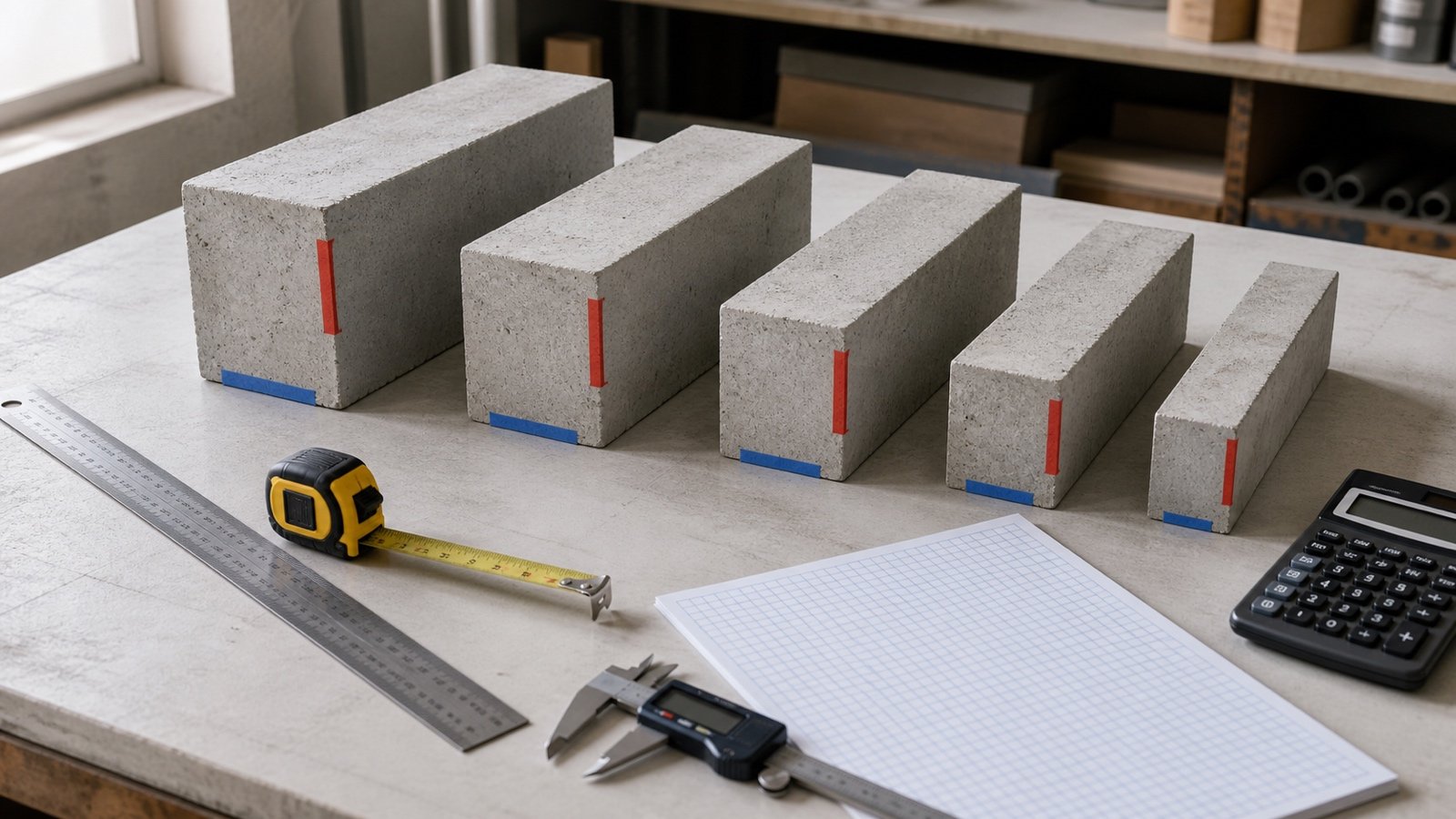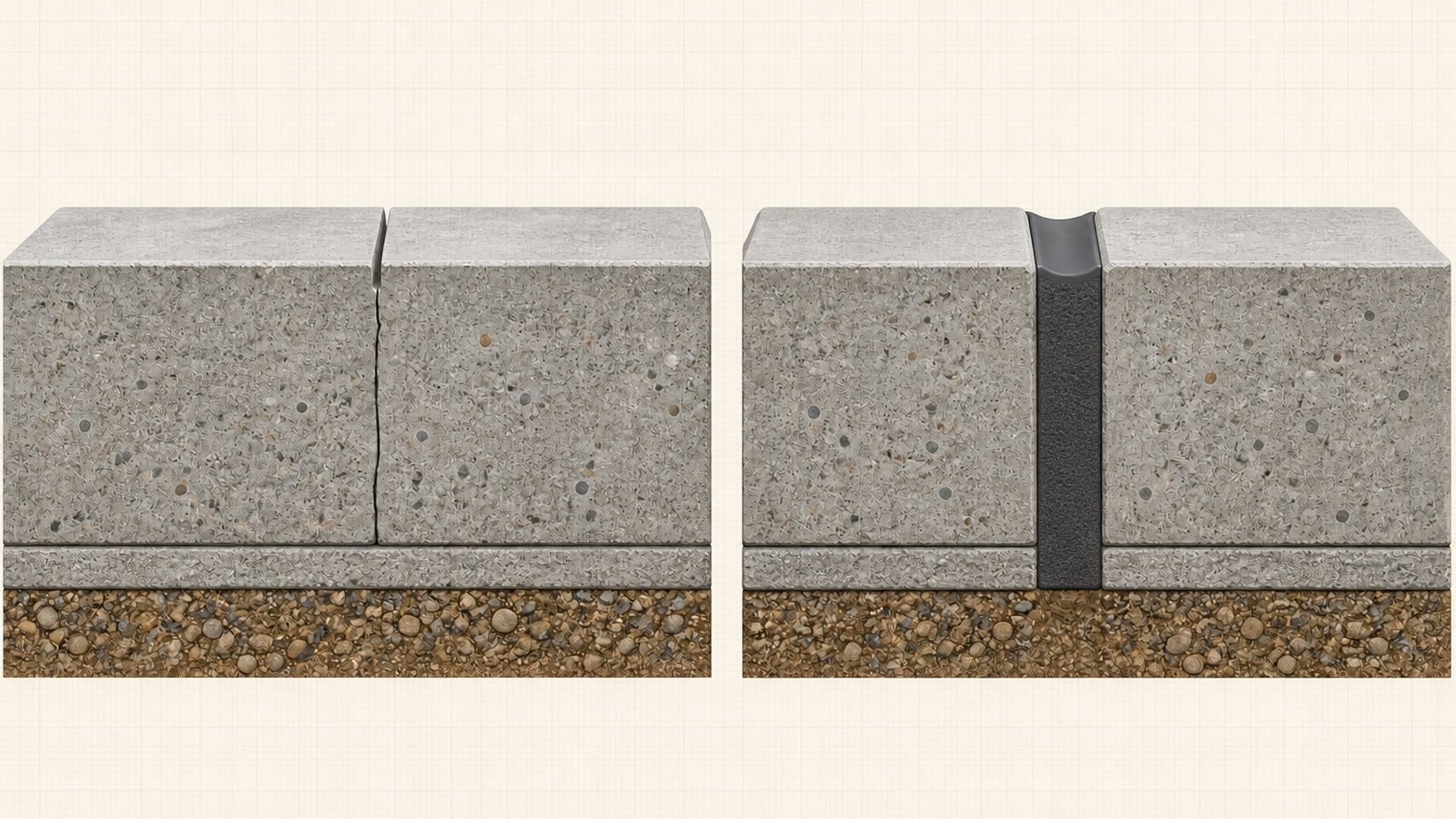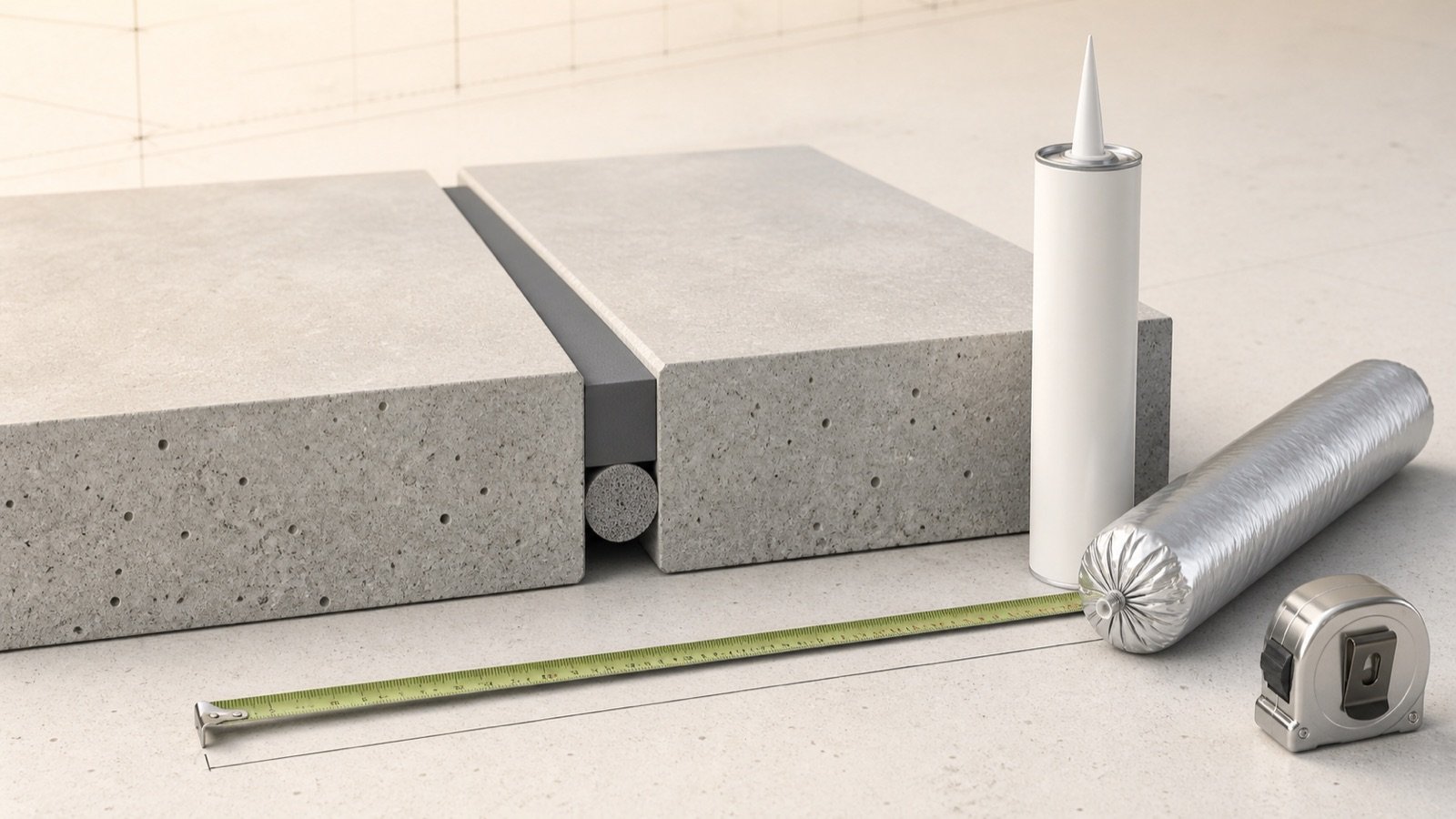
A tube of joint sealant can cover 3 ft, 24 ft or another distance because the installed bead has 3 dimensions: length, width and depth. Package volume alone cannot give a linear coverage figure.
Use the charts below for rectangular-volume checks. Confirm the bead profile and published yield for the exact sealant before buying materials.
How many linear feet does one tube of sealant cover?
A nominal 10.1 US fl oz cartridge theoretically fills about 24.30 ft of a 1/4 in wide × 1/4 in deep rectangular joint. The same cartridge covers about 12.15 ft at 1/2 in × 1/4 in and 3.04 ft at 1 in × 1/2 in.
These results use the package's nominal liquid volume with no residue, leakage, tooling loss or allowance. A current Sika 411 product page publishes a comparable typical-yield chart for its named 10.1 fl oz product, including 24.3 ft at 1/4 in × 1/4 in. Use that table only for that product and its stated conditions.
| Installed width | Installed depth | Theoretical coverage | Nominal bead volume per foot |
|---|---|---|---|
| 1/4 in | 1/4 in | 24.30 ft | 0.75 in³ |
| 3/8 in | 1/4 in | 16.20 ft | 1.125 in³ |
| 1/2 in | 1/4 in | 12.15 ft | 1.50 in³ |
| 3/4 in | 3/8 in | 5.40 ft | 3.375 in³ |
| 1 in | 1/2 in | 3.04 ft | 6.00 in³ |
Use only a width and sealant depth shown by the project detail and allowed by the current product data. Split joints into separate takeoff groups when either dimension changes.
What is the sealant coverage formula?
For a rectangular bead, divide nominal package volume by the cross-sectional area of the installed sealant. Keep every dimension in a compatible unit before dividing.
US coverage (ft) = package fl oz × 1.8046875 ÷ (width in × depth in × 12)
Metric coverage (m) = package mL ÷ (width mm × depth mm)
A 10.1 US fl oz cartridge contains a nominal 18.22734375 in³ by exact conversion. A 1/4 in × 1/4 in bead uses 0.75 in³ per foot, so 18.22734375 ÷ 0.75 = 24.303125 ft.
The metric formula is short because 1 mL equals 1,000 mm³ and 1 m equals 1,000 mm. Those 2 factors cancel when width and depth are entered in millimetres and coverage is reported in metres.
How much do 300 mL and 600 mL packages cover?
A nominal 300 mL package theoretically covers 4.17 m at 12 mm wide × 6 mm deep. A 600 mL sausage doubles that volume and covers 8.33 m under the same rectangular geometry.
| Installed width × depth | 300 mL package | 600 mL package |
|---|---|---|
| 6 × 6 mm | 8.33 m | 16.67 m |
| 10 × 5 mm | 6.00 m | 12.00 m |
| 12 × 6 mm | 4.17 m | 8.33 m |
| 20 × 10 mm | 1.50 m | 3.00 m |
| 25 × 13 mm | 0.92 m | 1.85 m |
The last row is arithmetic, not a recommendation for a 25 × 13 mm profile. Product limits, movement, traffic, slope and the project detail still control.
Can you convert a 300 mL label into exactly 10.1 US fl oz?
Do not expect the 2 rounded label quantities to convert into the same exact number. A nominal 10.1 US fl oz converts to about 298.7 mL, while 300 mL converts to about 10.144 US fl oz.
Use the package basis published for your market. Where a manufacturer supplies a coverage table, treat that named product table as the purchasing reference instead of creating false precision from the rounded secondary unit on the label.
| Package basis | Nominal cubic volume | Coverage at 1/4 in × 1/4 in | Use |
|---|---|---|---|
| 10.1 US fl oz | 18.2273 in³ | 24.30 ft | US-label arithmetic check |
| 20 US fl oz | 36.0938 in³ | 48.13 ft | Only when the package contains 20 US fl oz |
| 29 US fl oz | 52.3359 in³ | 69.78 ft | Only when the package contains 29 US fl oz |
| 300 mL | 300,000 mm³ | 8.33 m at 6 × 6 mm | Metric-label arithmetic check |
| 600 mL | 600,000 mm³ | 16.67 m at 6 × 6 mm | Metric-label arithmetic check |
How do you calculate tubes for a complete project?
Calculate raw sealant volume for each unchanged joint group, apply one documented planning allowance, divide by the selected package volume and round the final package count upward.
Raw US fl oz = length ft × 12 × width in × depth in ÷ 1.8046875
Raw metric mL = length m × width mm × depth mm
Whole packages = ceiling(raw volume × (1 + allowance ÷ 100) ÷ package volume)
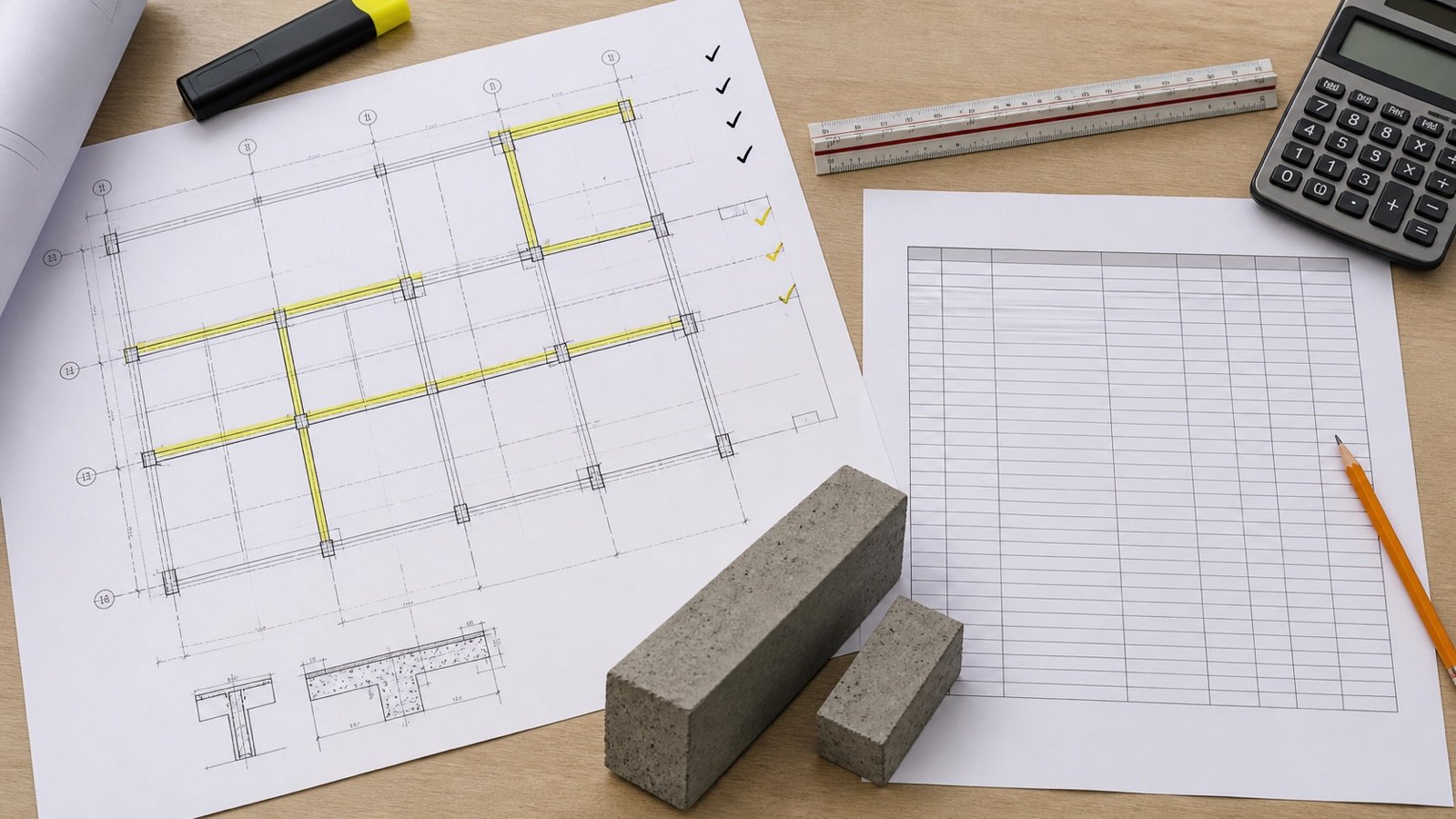
Use the Expansion Joint Calculator once the measured length, approved installed width, approved depth and actual package volume are known. It keeps raw volume, allowance and whole-package rounding in separate result lines.
Worked example: 96 ft of concrete joint
A drawing and selected product establish a 1/2 in wide × 1/4 in deep rectangular sealant profile. The measured group is 96 ft long, the cartridge contains 10.1 US fl oz and the estimator documents an 8% allowance.
- Raw cubic volume: 96 × 12 × 0.5 × 0.25 = 144 in³.
- Raw liquid volume: 144 ÷ 1.8046875 = 79.792 US fl oz.
- Planned liquid volume: 79.792 × 1.08 = 86.176 US fl oz.
- Exact packages: 86.176 ÷ 10.1 = 8.532.
- Purchase quantity: ceiling(8.532) = 9 cartridges.
Dividing 96 ft by the chart's 12.1516 ft per cartridge gives 7.900 packages before allowance. Both calculation paths agree before display rounding. Do not calculate from a displayed 12.15 ft value when the unrounded formula is available.
Worked example: 24 m with 600 mL sausages
An approved joint group is 24 m long with a 12 mm wide × 6 mm deep rectangular profile. The package contains 600 mL and the estimator records a 10% allowance.
- Raw volume: 24 × 12 × 6 = 1,728 mL.
- Planned volume: 1,728 × 1.10 = 1,900.8 mL.
- Exact packages: 1,900.8 ÷ 600 = 3.168.
- Purchase quantity: ceiling(3.168) = 4 sausages.
The theoretical 8.3333 m coverage from one sausage gives 2.88 packages before allowance. The result rises to 4 because the adjusted demand exceeds 3 complete packages.
How should changing joint sizes be measured?
Make a separate takeoff line whenever installed width, depth, package, sealant, exposure or application method changes. Add raw volumes from compatible groups before applying a shared allowance and package rounding only when the purchasing basis matches.
| Group | Measured length | Approved width × depth | Raw volume | Keep separate because |
|---|---|---|---|---|
| A | 40 ft | 1/4 × 1/4 in | 30 in³ | Small rectangular profile |
| B | 32 ft | 1/2 × 1/4 in | 48 in³ | Width differs from A |
| C | 24 ft | 3/4 × 3/8 in | 81 in³ | Width and depth differ |
| D | 18 ft | Product-specific profile | Use product method | Rectangular chart may not apply |
Trace joint length along the installed route. Count each physical run once, including a shared boundary between 2 slab regions. Measure curves along their centerline path rather than across the straight chord.
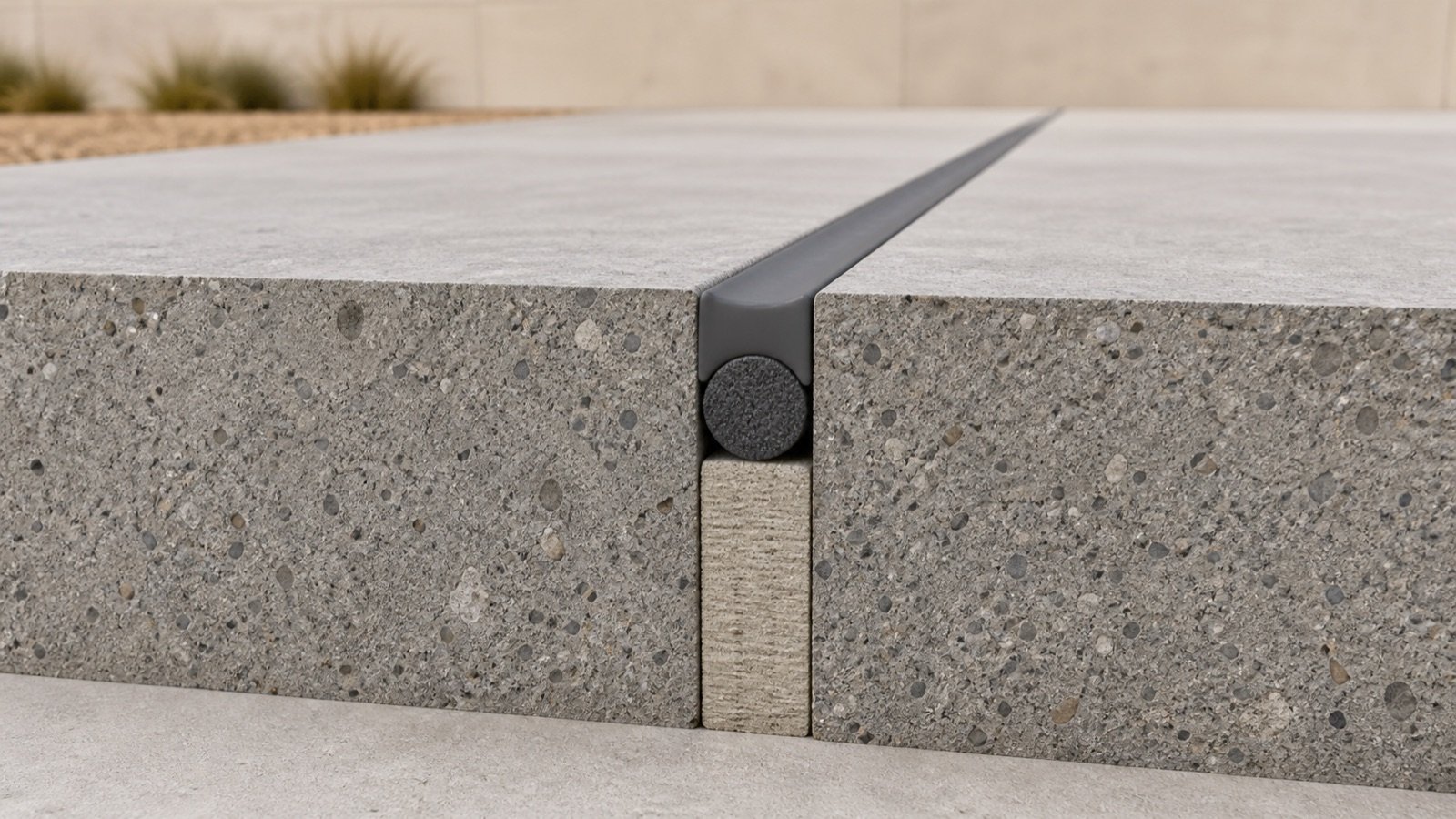
For an existing repair, record representative widths by section and inspect the approved repair detail. The visible cavity can be deeper than the intended sealant bead because backer rod or bond-breaker tape controls the installed sealant depth.
Does a concave or triangular bead use the same chart?
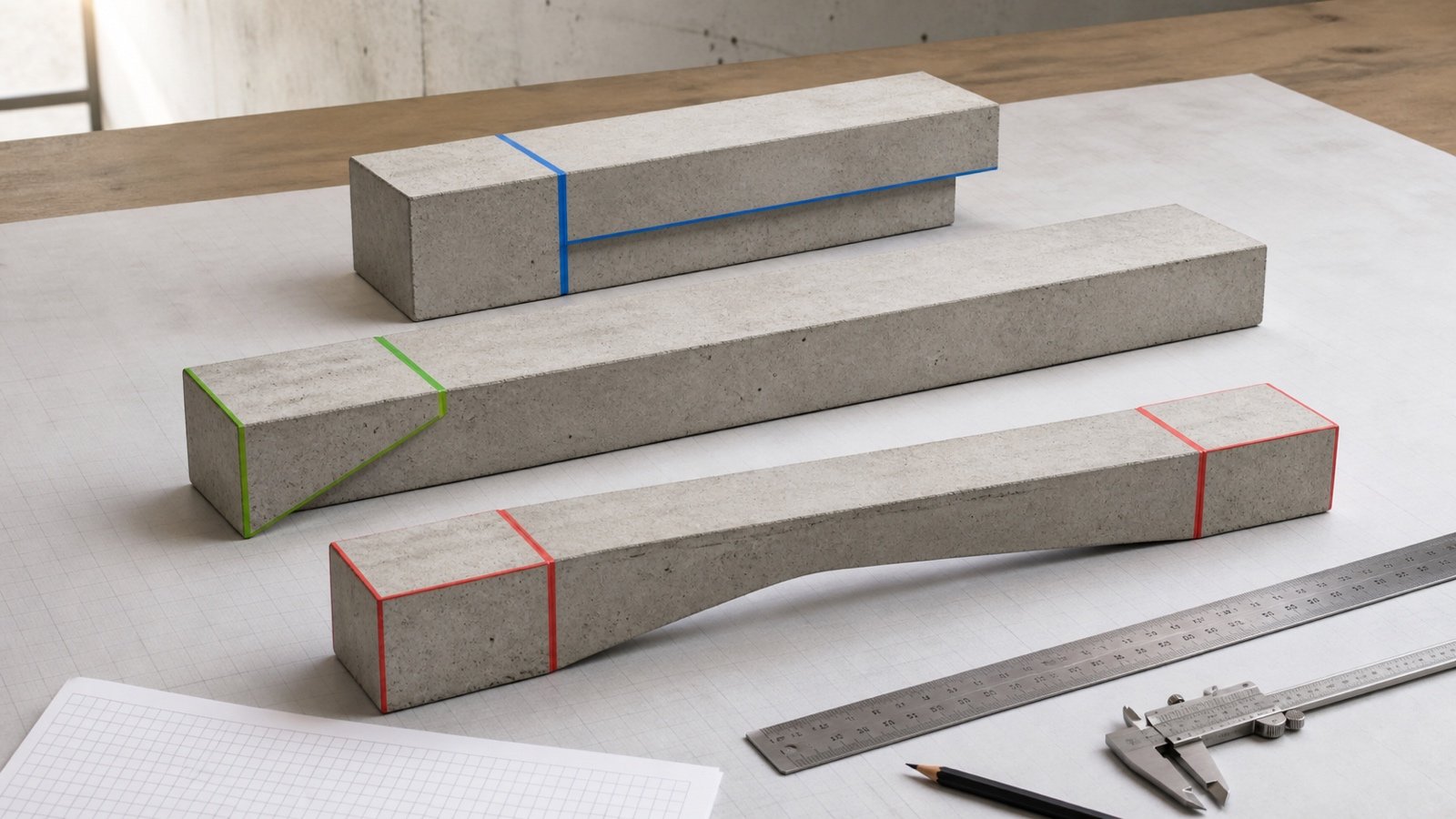
The chart assumes a fully filled rectangle. A tooled concave face, triangular fillet, hourglass profile or irregular repair cavity has a different cross-sectional area.
Tremco separates rectangular expansion-joint calculations from triangular bead calculations. ASTM C1193-25 also directs designers and applicators to consider the selected materials, backing, primer, preparation, installation and environmental conditions, then consult the sealant manufacturer for proper use.
Use the selected product's published coverage or approved calculation for another bead shape. Do not apply a guessed reduction factor to the rectangular table.
Why can installed coverage be lower than the chart?
The chart allocates every unit of nominal package volume to a uniform joint. Field work can leave material in the nozzle, gun, foil ends or mixing equipment. Tooling can remove material, start-stop work can drip, and opened material can become unusable.
Everkem lists tooling removal, nozzle drip and cured material among its waste examples. Its calculator also warns that laboratory-based values, fill variation, ambient conditions and rounding can change yields. Those observations explain possible differences; they do not set a required allowance for another product or job.
- Joint width or depth varies from the takeoff profile.
- Spalled edges increase the filled cross-section.
- Backing sits too deep or moves during placement.
- Surface voids and roughness consume extra material.
- Mixing, purging, nozzle changes and partial packages leave residue.
- Leaks occur at open ends, intersections or failed backing.
How should you choose an allowance?
Start with 0% in the calculation, then enter a percentage or direct quantity supported by the product, project estimating policy, joint survey, crew records and purchasing conditions. Keep the reason beside the number.
A larger arbitrary percentage cannot repair missing measurements or an unapproved profile. Resolve unknown width, depth, joint type, product, backing and access before using allowance.
Apply the allowance once. Adding extra length to the field measurement and then entering the same loss percentage in the calculator counts the adjustment twice.
How should opened packages and field use be reconciled?
Record accepted joint length by profile and the equivalent full packages consumed. Compare observed coverage with the original theoretical or product-published basis at a stable checkpoint.
Observed coverage = accepted completed length ÷ equivalent full packages consumed
If a crew completes 60 ft of one unchanged profile using 5.5 equivalent cartridges, observed coverage is 10.91 ft per cartridge. Compare that figure with the approved planning basis and inspect width, depth, backing position, edge condition, residue and tally accuracy before revising the remaining order.
Count unopened, usable, in-date stock separately. Preserve the original estimate and create a dated remaining-work revision rather than replacing the initial package yield.
Common sealant coverage mistakes
- Using package volume as a linear coverage number without width and depth.
- Reading full joint depth as installed sealant depth.
- Using one average profile for sections with different dimensions.
- Assuming 300 mL and 10.1 US fl oz are exact equivalents.
- Applying a rectangular chart to a triangular or irregular bead.
- Using a product table for another sealant, market or package.
- Rounding coverage before calculating total project volume.
- Rounding each short run to a full package before compatible raw volumes are combined.
- Adding an allowance twice.
- Ignoring partial packages, nozzle residue, leaks and unusable opened material.
The Expansion Joint Filler, Backer Rod and Sealant guide explains the material layers that control the reservoir. Read the Control Joint vs Expansion Joint guide when the joint type or drawing label is unclear.
What product and project checks still control?
Confirm the exact sealant, movement capability, substrate, orientation, traffic, water or chemical exposure, approved width and depth, backing, primer, preparation, temperature, cure time, reopening time and package size.
Sika's current 411 page, for example, limits that named self-leveling product to horizontal use and publishes its own width, depth, backing, preparation and temperature instructions. Those values cannot approve a different product or project.
Joint cutting, routing, grinding and removal can involve silica, rotating equipment, hidden reinforcement, utilities, chemical residues and traffic. Follow the current drawings, specifications, safety data, site controls and responsible professional direction.
This page calculates material volume. It does not design movement, choose joint spacing, approve a sealant, certify compatibility or replace a waterproofing, fire, traffic, bridge or structural joint system. The Concrete Planning hub links the related quantity tools and guides.
Sources and source scope
- ASTM C1193-25 public page: current general guidance scope for joint-sealant design, materials, backing, primer, preparation, installation and environmental conditions.
- Sikaflex-411 Hybrid Self-leveling Sealant: one current US product's 10.1 fl oz/300 mL typical-yield table and its profile, backing, preparation and application limits.
- Tremco Sealant Calculator: rectangular expansion-joint volume from entered length, width and depth, plus separate bead-shape context.
- Tremco Backer Rod Types and Installation: backing functions and three-sided adhesion context.
- Everkem Caulk Yield Calculator: field-loss examples, whole-package rounding and yield limitations.
- NIST Guide to the SI, Appendix B: unit-conversion framework used for the US and metric arithmetic.
Source scope: ASTM supports general design and application context. Manufacturer pages support only their named tools, products and stated conditions. NIST supports unit conversion. Project drawings, specifications, current product data, field measurements and responsible professionals control the installed joint and purchasing record.
Review note: Saleem Sial owns the research and editorial record. Source checks, independent formula fixtures, editorial review, build validation, link crawl, schema review and rendered QA form the internal publication gate. Waseem Sial, External Reviewer and Engineer, is listed for ongoing external review; no completed review date is claimed.