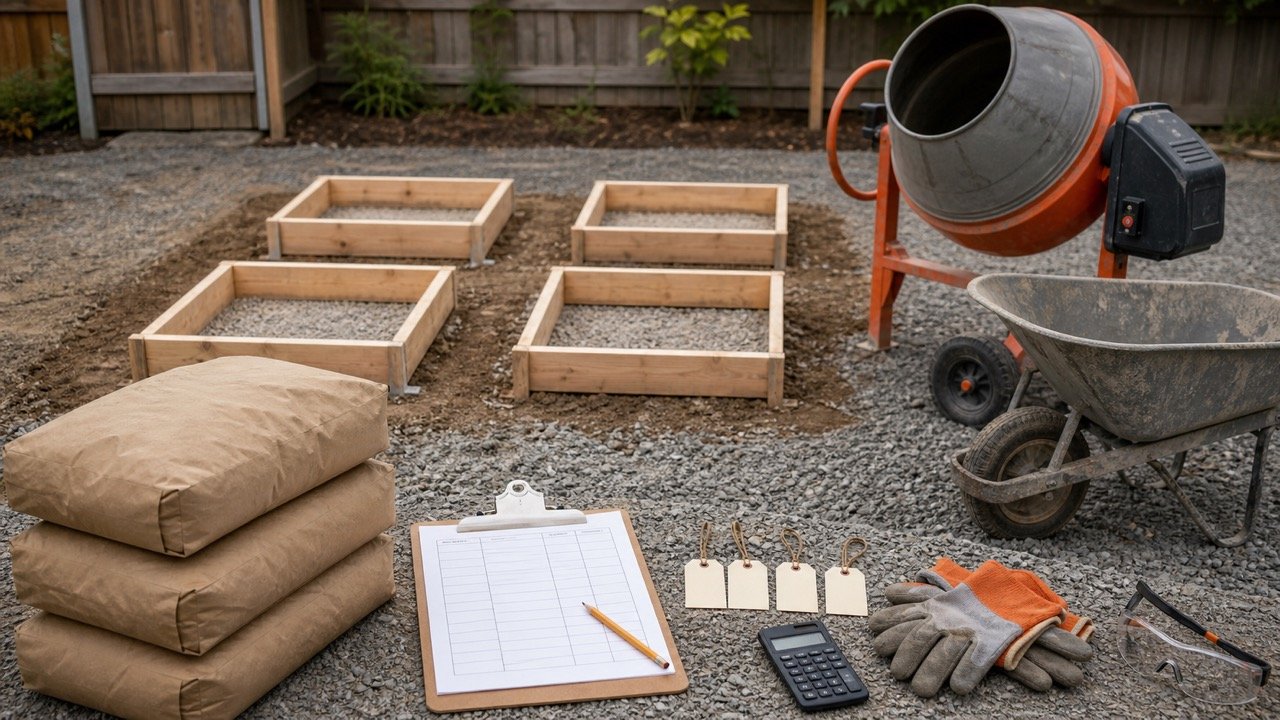
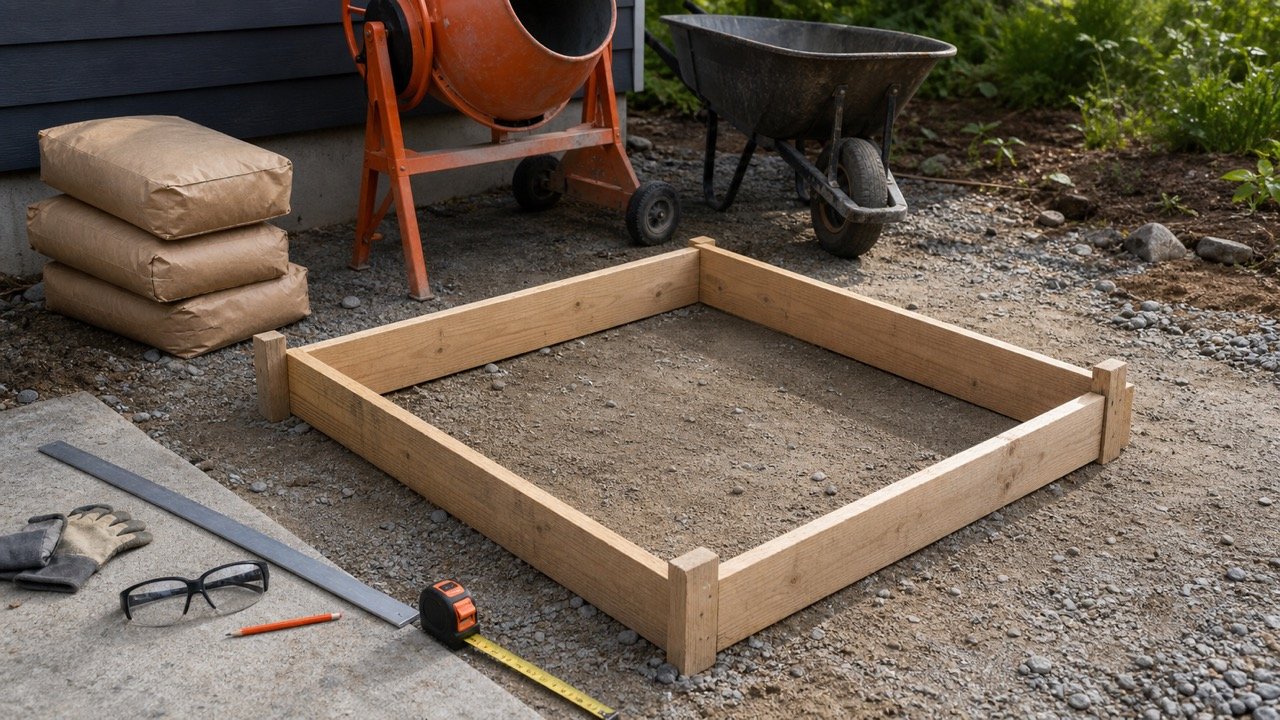
Packaged concrete is sold by dry package mass, while a pour is measured by finished volume. The bridge between those quantities is the mixed yield printed for the exact product and package.
This calculator keeps geometry, allowance, package yield, whole-bag rounding, and optional dry package mass visible as separate steps. It does not assume a universal yield or waste percentage.
How many bags of concrete do you need?
Calculate the finished volume of the pour, apply any documented planning allowance, and divide that planning volume by the product's current mixed yield per package. Round the final package quotient up to a whole bag.
Enter the yield in litres per package for metric mode or cubic feet per package for imperial mode. The result includes the exact quotient, whole packages, and the mixed capacity purchased after rounding.
Which calculation mode should you use?
Use rectangular mode for a uniform slab, pad, strip, step section, or rectangular footing whose dimensions have already been approved. Use round mode for a cylindrical pour with a constant diameter and depth. Use known-volume mode when a checked drawing, takeoff, or separate calculation already gives the finished concrete volume.
| Mode | Required geometry | Volume per pour |
|---|---|---|
| Rectangular pour | Length, width, and uniform depth | Length × width × depth |
| Round pour | Diameter and uniform depth | π × (diameter ÷ 2)² × depth |
| Known finished volume | Checked volume in m³ or ft³ | Entered volume |
The tool multiplies volume per pour by the entered number of identical pours. Calculate changing-depth, tapered, bell-shaped, stepped, or irregular sections separately with geometry suited to their actual shape.
What inputs control the bag count?
Geometry controls measured finished volume. Quantity controls the number of identical sections. Allowance changes planning volume. Current mixed yield controls how many packages supply that planning volume.
Package mass is optional and affects only the reported total dry package mass. A 40 lb, 60 lb, 80 lb, 20 kg, or 25 kg label describes mass. The calculator still needs mixed yield because mass alone cannot supply finished volume.
How does the concrete bag formula work?
Total measured volume = volume per pour × quantity
Planning volume = measured volume × (1 + allowance ÷ 100)
Exact package quotient = planning volume ÷ current mixed yield per package
Whole packages = ceiling(exact package quotient)
Purchased mixed capacity = whole packages × current mixed yield
Metric geometry converts centimetres to metres, then reports cubic metres and litres. Imperial geometry converts inches to feet, then reports cubic yards and cubic feet. NIST sources support those unit relationships. They do not select a concrete product, thickness, allowance, or package yield.
Worked metric rectangular-pour example
A checked rectangular pad measures 3.6 m by 2.4 m with a uniform 10 cm concrete depth. The selected product data gives 17 L of mixed yield per package. A separately documented allowance is 5%.
- Convert depth: 10 cm = 0.10 m.
- Measured volume: 3.6 × 2.4 × 0.10 = 0.864 m³, or 864 L.
- Planning volume: 864 × 1.05 = 907.2 L.
- Exact package quotient: 907.2 ÷ 17 = 53.365.
- Whole-package result: 54 bags.
- Purchased mixed capacity: 54 × 17 = 918 L.
- Capacity above the planning quantity: 918 − 907.2 = 10.8 L.
If each current package has a dry mass of 36.3 kg, 54 packages have a total listed dry mass of 1,960.2 kg. That mass is a handling and procurement figure. It is not the mass of placed or hardened concrete.
Worked imperial round-pour example
Three identical round pours each have a checked diameter of 2 ft and depth of 24 in. The selected product yields 0.60 ft³ per package, and the documented allowance is 10%.
- Convert depth: 24 in = 2 ft.
- Volume per pour: π × (2 ÷ 2)² × 2 = 6.283 ft³.
- Total measured volume: 6.283 × 3 = 18.850 ft³, or 0.698 yd³.
- Planning volume: 18.850 × 1.10 = 20.735 ft³, or 0.768 yd³.
- Exact package quotient: 20.735 ÷ 0.60 = 34.558.
- Whole-package result: 35 bags, with 21 ft³ of purchased mixed capacity.
The example dimensions demonstrate arithmetic only. Drawings, footing schedules, post details, frost requirements, soil conditions, structural design, and local codes determine whether the geometry is suitable.
Why can't bag weight determine concrete yield?
Package mass and mixed yield measure different things. Mass identifies how much dry material is in the package. Mixed yield states the approximate finished volume produced when that product is mixed at the required consistency and handled as directed.
Current manufacturer information shows why the product record matters. QUIKRETE Concrete Mix No. 1101 lists approximate yields of 0.30 ft³ for its 40 lb package, 0.45 ft³ for 60 lb, and 0.60 ft³ for 80 lb. Sakrete lists the same three yield values for specified packages of its High-Strength Concrete Mix. These are product-specific examples, not universal bag-size conversions.
| Information on the package or data sheet | Use in this calculator |
|---|---|
| Net dry mass | Optional total package-mass check |
| Approximate mixed yield | Required bag-count divisor |
| Mixing water and consistency instructions | Follow during mixing; do not enter as yield |
| Application limits and strength information | Product-selection and specification checks outside the quantity formula |
Copy the yield for the exact product name, item number, package, market, and current revision. Check whether the stated value is approximate and whether the instructions attach conditions to it.
What does capacity above planning quantity mean?
Whole-package rounding usually buys slightly more mixed capacity than the planning volume. The result labelled capacity above planning quantity shows that final rounding increment.
It is separate from the allowance. Allowance is added before division by package yield and needs a project reason. Whole-bag capacity appears after the quotient is rounded up because a partial package may not be a practical purchasing unit.
Do not subtract this displayed capacity from a later calculation unless every section uses the same product, yield basis, allowance basis, mixing conditions, and pour plan. Opened, damaged, wet, expired, or partly used material also needs product-specific handling.
How should several pours be combined?
Use the identical-pours field when every section has the same geometry, product, yield, and allowance basis. The calculator multiplies unrounded volume per pour, then rounds the final combined package quotient once.
Run separate calculations when dimensions, products, yields, allowances, placement times, or specifications differ. Add unrounded planning volumes only when one package basis legitimately applies to the combined work.
| Site condition | Calculation treatment |
|---|---|
| 12 identical round forms | Use quantity 12 and round the combined quotient once |
| Forms with different depths | Calculate each depth group separately |
| Two packaged products | Keep each product and label yield in its own record |
| One continuous irregular pour | Divide it into valid geometric sections and add unrounded volumes |
| Existing takeoff volume | Use known-volume mode after confirming its unit and finished state |
Rounding each hole or pad before combining can add a full rounding increment to every section. Keep the unrounded volumes and exact quotient visible for checking.
When should you enter a planning allowance?
The default is 0%. Enter a value only when drawings, specifications, measured tolerance, form condition, subgrade variation, placement method, or another documented project basis supports it.
Allowance should not conceal an unknown thickness, unmeasured excavation, uncertain product yield, or unsuitable geometry. Measure or resolve those items directly. Keep the measured and planning volumes side by side so the added quantity remains reviewable.
Manufacturer calculators sometimes state that their approximate results exclude uneven subgrade or waste. That warning identifies possible project variation; it does not establish one percentage for every pour.
What must a known volume represent?
Known-volume mode expects finished concrete volume per pour. Confirm whether a drawing or takeoff includes openings, embedded items, recesses, thickened edges, steps, grade beams, or other sections. Confirm its unit before entry.
Dry ingredient volume, package volume before mixing, excavated volume, wet concrete mass, and ready-mix ticket quantity are different records. Convert or reconcile them only with a supported method and matching material state.
What should you check on the product information?
- Exact product name, item number, package mass, market, and data-sheet revision.
- Approximate mixed yield and the unit used for that yield.
- Required water range, mixing sequence, mixer capacity, mixing time, and target consistency.
- Minimum or maximum application depth and approved uses.
- Temperature, weather, placement, finishing, curing, and protection instructions.
- Strength class, relevant standard, and any project specification approval.
- Safety data sheet, storage requirements, shelf life, and damaged-package instructions.
Use the product label and current technical data as one record. Contact the manufacturer when the package and data sheet disagree or when the planned use falls outside their stated scope.
What construction decisions remain outside this calculator?
The calculator converts approved geometry and package yield into quantity. It does not design a slab, footing, post foundation, pier, beam, wall, stair, reinforcement layout, joint pattern, cover, subbase, drainage system, form, shoring, or curing plan.
Use the governing drawings, specifications, permits, codes, soil information, manufacturer instructions, and qualified professionals. Excavation and structural work can involve collapse, utility, load, fall, impalement, lifting, silica, cement, equipment, and access hazards that a volume calculation cannot assess.
How do handling and placement affect the plan?
Whole-bag count does not prove that the crew, mixer, power supply, water source, tools, access, sequence, or finishing capacity can place the concrete correctly. The American Cement Association describes mixing, transporting, placing, and finishing as a coordinated, time-sensitive operation.
Review package mass, bags per mixer batch, number of batches, travel distance, lifting method, placement rate, working time, weather, and backup arrangements before work starts. Compare a current ready-mix quote when bag count, labour, mixer throughput, continuity, access, or specification makes packaged mixing impractical. The calculator does not impose a universal crossover quantity.
What safety limits apply?
OSHA states that wet portland cement can cause caustic burns and irritant or allergic dermatitis. Follow the current product SDS, employer hazard assessment, applicable rules, and required controls for dust, eyes, skin, lifting, mixing equipment, electrical supply, housekeeping, and washing facilities.
Keep people out of unsupported excavations and away from moving equipment. Locate services before digging. A bag estimate cannot approve an excavation, form, access route, lifting plan, or work method.
Common concrete bag calculation mistakes
- Using package mass as though it were mixed yield.
- Choosing a universal 40 lb, 60 lb, 80 lb, 20 kg, or 25 kg conversion without checking the exact product.
- Entering inches as feet or litres as cubic metres.
- Rounding every small section before the volumes are combined.
- Adding an automatic allowance without recording its basis.
- Using excavation volume without accounting for the approved concrete geometry and exclusions.
- Subtracting posts, reinforcement, or embedded items without a supported takeoff rule.
- Treating purchased mixed capacity as guaranteed field yield.
- Assuming bag count confirms product suitability, strength, placement capacity, or code compliance.
What should the quantity record contain?
- Drawing, sketch, revision, pour identifier, geometry, dimensions, unit, and measurement date.
- Volume per pour, number of identical pours, and total measured finished volume.
- Allowance, reason, and planning volume.
- Product name, item number, market, package mass, mixed yield, data-sheet revision, and access date.
- Exact package quotient, whole packages, purchased mixed capacity, and capacity above planning quantity.
- Supplier stock, selling increment, pallet details, price basis, delivery or collection plan, and final ordered quantity.
- Mixing, placement, finishing, curing, safety, and contingency records required by the project.
Use the concrete planning hub to keep this packaged-concrete quantity with related tools. The calculation methodology explains the site's measurement, assumption, and rounding approach.
Sources and scope
- NIST Guide to the SI, Appendix B and NIST Handbook 133, 2026 Appendix E: unit relationships only.
- QUIKRETE Concrete Mix No. 1101 SPEC-DATA and Sakrete High-Strength Concrete Mix: named-product yield and instruction examples only.
- OSHA concrete-products hazard guidance: wet-cement skin hazard context.
- American Cement Association, Working with Concrete: general handling, placing, and safety context.
Review note: Saleem Sial owns the research and editorial record. Formula fixtures, source checks, build validation, and rendered QA form the internal publication gate. Waseem Sial, External Reviewer and Engineer, is listed for ongoing external review; no completed review date is claimed.