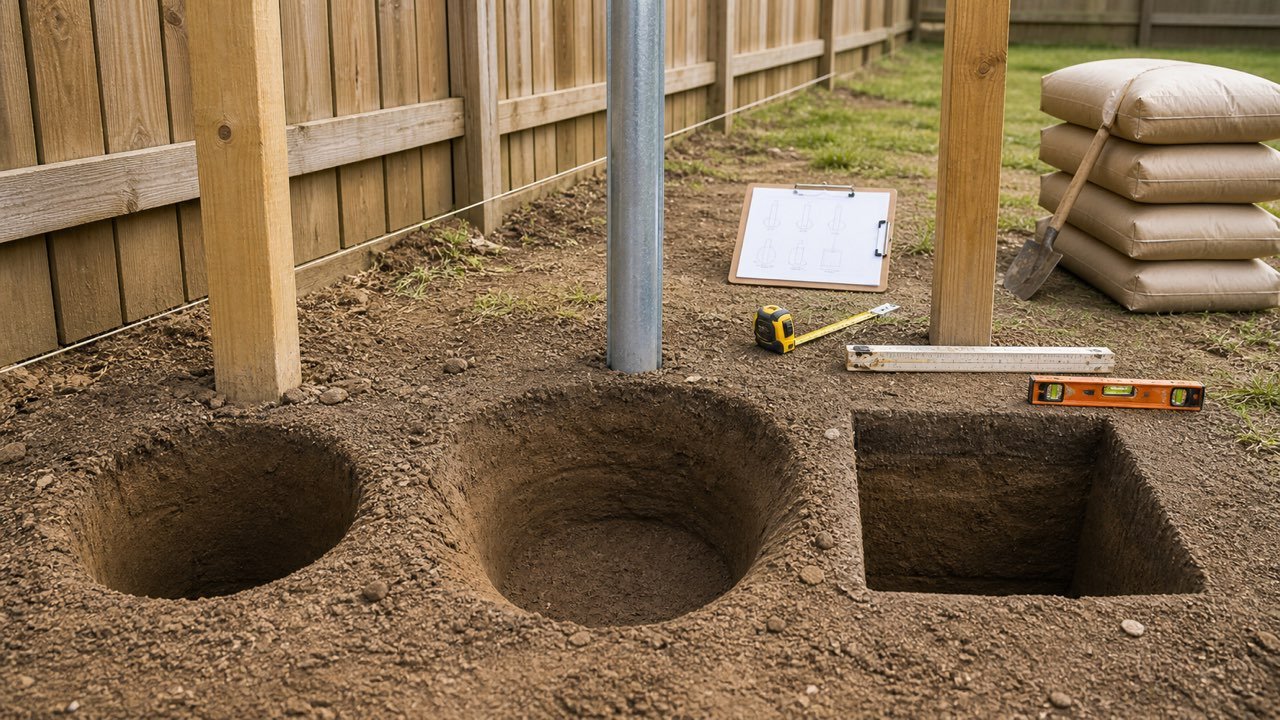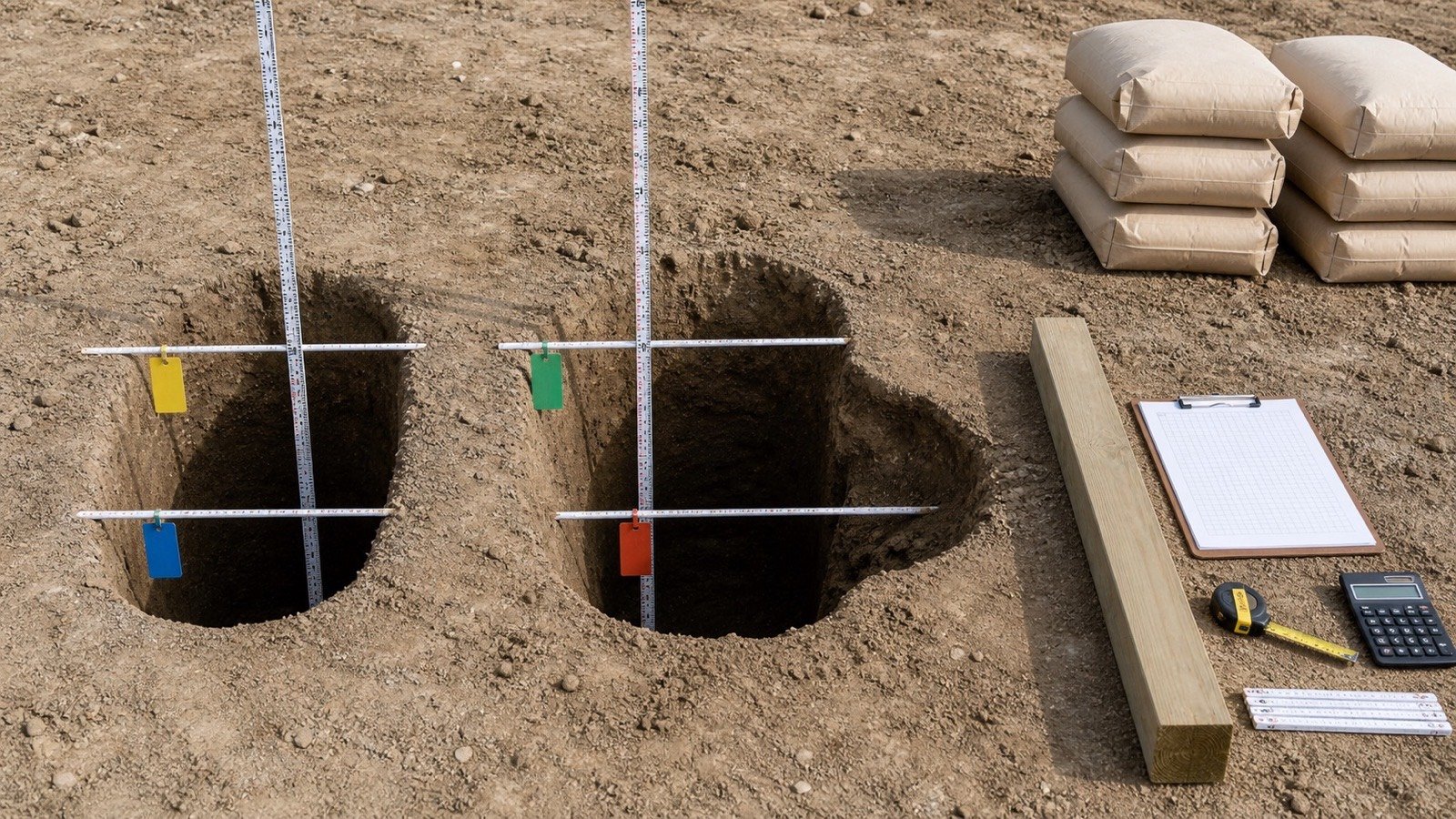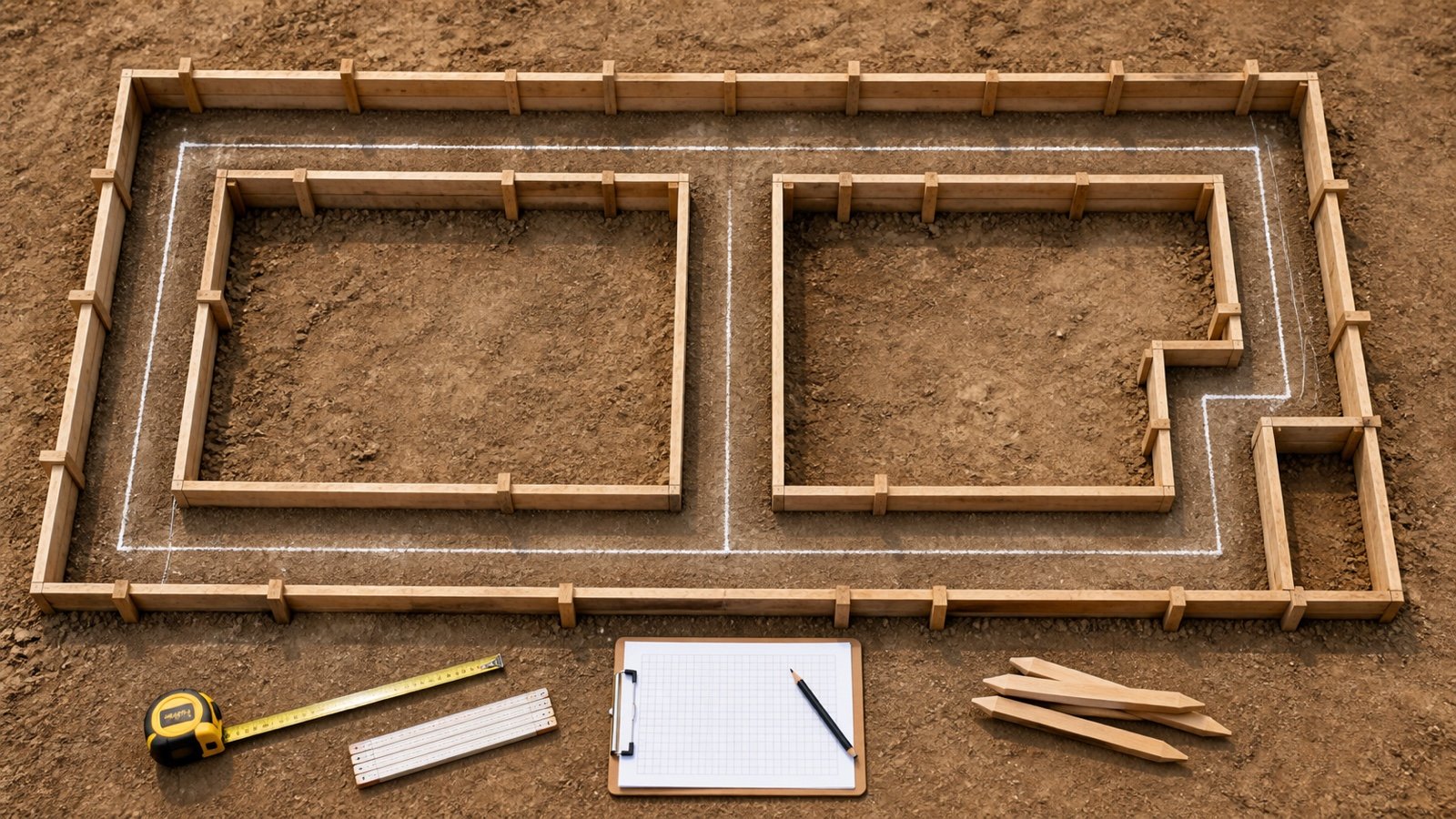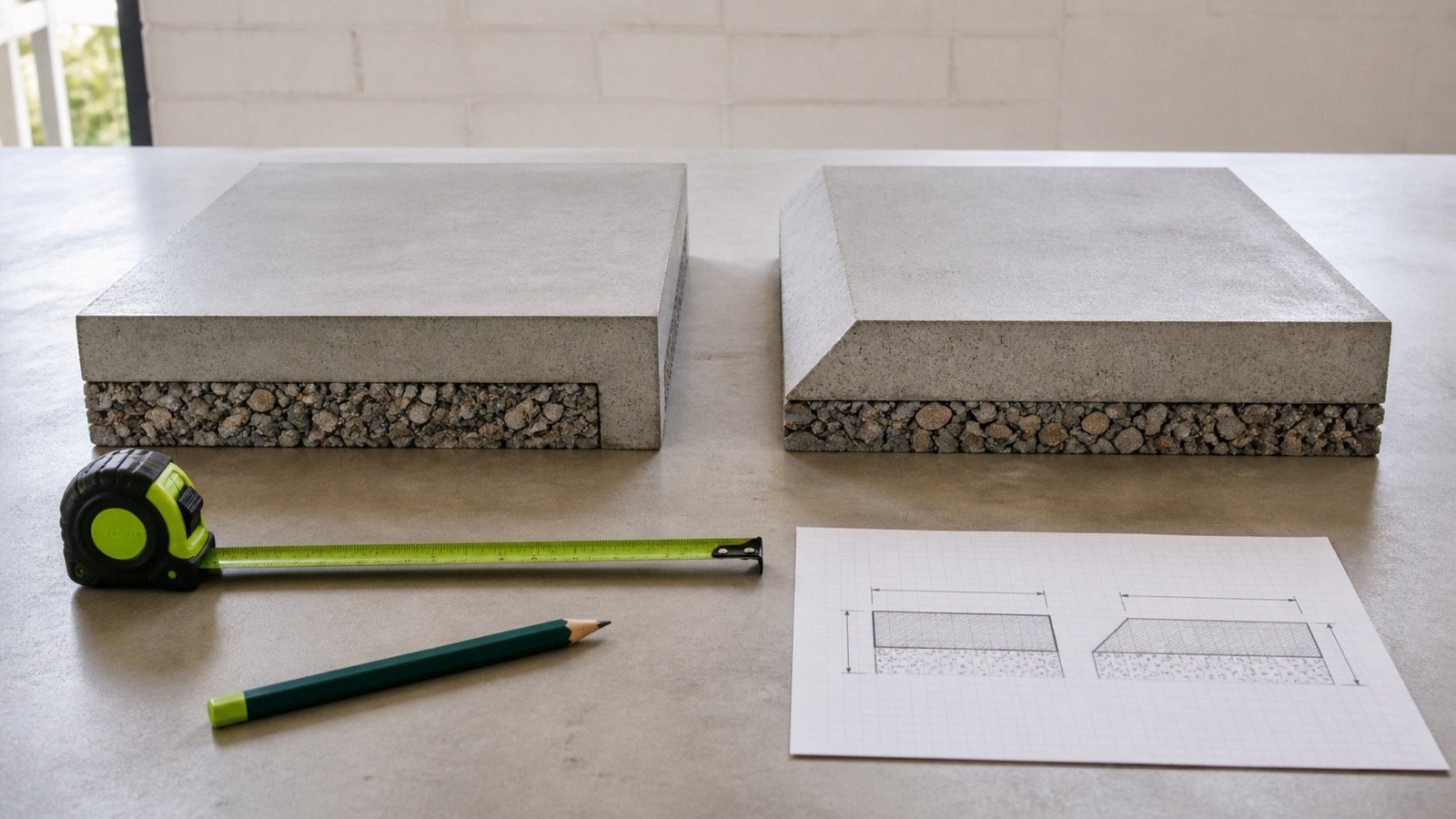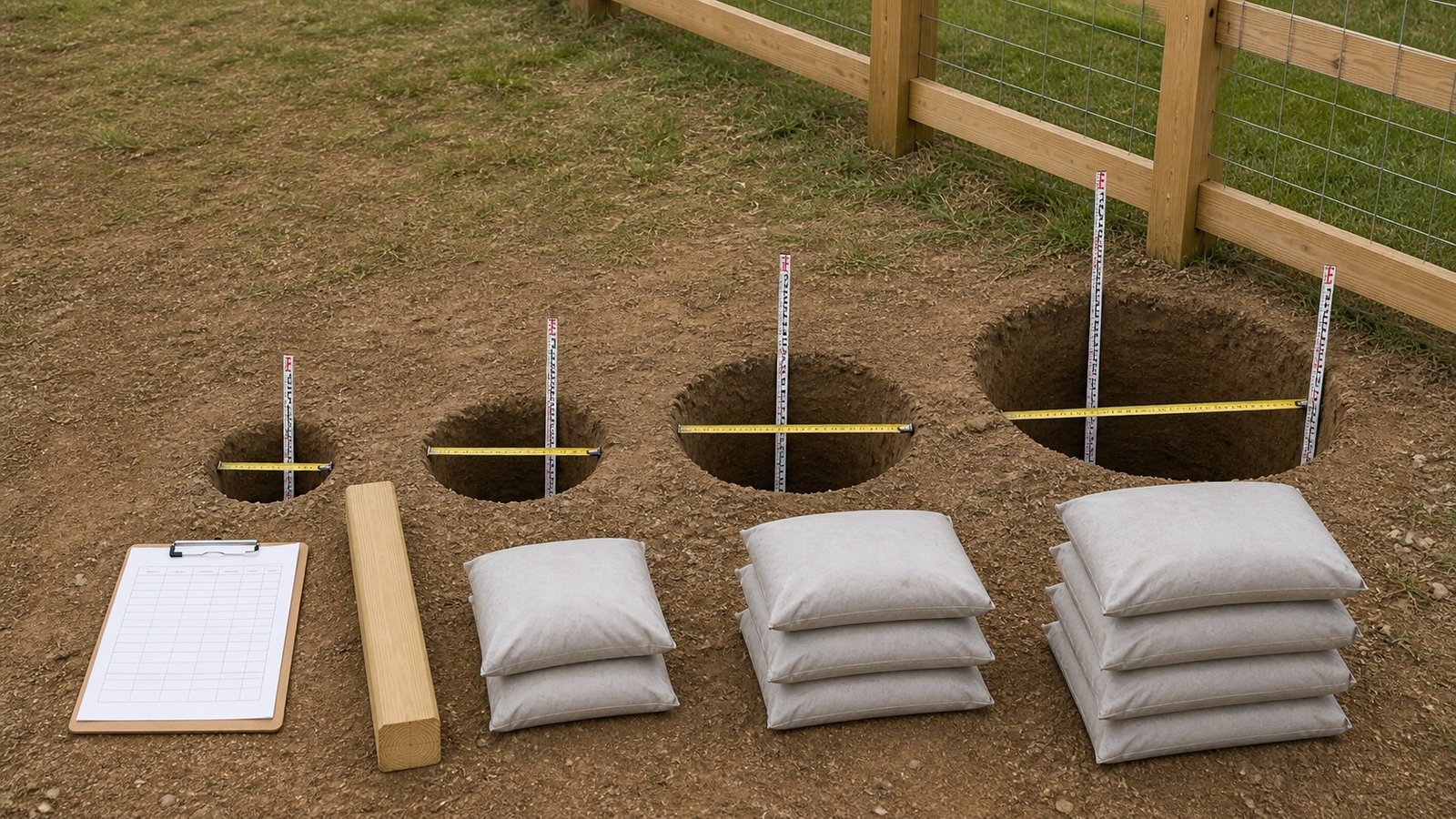
A post-hole bag chart works only when its geometry and package yield match the work. Hole diameter and depth set the gross volume. The measured post section reduces the concrete space, and the selected product's current mixed yield converts that net volume into packages.
The tables below use fixed, visible inputs so you can check the arithmetic. Use the Concrete Post Hole Calculator for your measured diameter, depth, post profile, hole count, allowance, and package yield.
How many concrete bags does one post hole need?
A straight round hole in these reference ranges needs about 1 to 7 packages per hole, depending on diameter, depth, post displacement, and whether the named product yields 0.45 ft³ or 0.60 ft³ per package. The exact quotient should be calculated before the final whole-package ceiling.
A general statement such as “2 bags per post” omits the controlling dimensions. An 8 in × 24 in fixture in the imperial table gives 1 whole 0.60 ft³ package, while a 14 in × 36 in fixture gives 5 packages on the same yield basis.
The chart calculates quantity from entered geometry. It does not select hole diameter, depth, post size, concrete product, drainage detail, or structural design.
What assumptions control these post-hole charts?
| Chart input | Imperial reference | Metric reference |
|---|---|---|
| Hole shape | Straight round cylinder | Straight round cylinder |
| Post section | Measured 3.5 in × 3.5 in square | Measured 90 mm × 90 mm square |
| Post overlap | Equals the stated concrete fill depth | Equals the stated concrete fill depth |
| Allowance | 0% | 0% |
| Smaller package-yield example | 0.45 ft³ | 12.7 L |
| Larger package-yield example | 0.60 ft³ | 17 L |
| Rounding | Each row ceilings one hole | Each row ceilings one hole |
QUIKRETE Concrete Mix No. 1101 and Sakrete High-Strength Concrete Mix currently publish approximate 0.45 ft³ and 0.60 ft³ yields for named 60 lb and 80 lb packages. Their rounded metric displays are 12.7 L and 17 L. These product examples support the yield columns only.
Imperial concrete bags per post hole chart
This table subtracts a measured 3.5 in × 3.5 in square post through the full stated concrete depth. Net volume stays unrounded for the package division.
| Hole diameter | Concrete depth | Gross hole | Net concrete | Whole packages at 0.45 ft³ | Whole packages at 0.60 ft³ |
|---|---|---|---|---|---|
| 8 in | 24 in | 0.698132 ft³ | 0.527993 ft³ | 2 | 1 |
| 8 in | 30 in | 0.872665 ft³ | 0.659991 ft³ | 2 | 2 |
| 8 in | 36 in | 1.047198 ft³ | 0.791989 ft³ | 2 | 2 |
| 10 in | 24 in | 1.090831 ft³ | 0.920692 ft³ | 3 | 2 |
| 10 in | 30 in | 1.363538 ft³ | 1.150865 ft³ | 3 | 2 |
| 10 in | 36 in | 1.636246 ft³ | 1.381038 ft³ | 4 | 3 |
| 12 in | 24 in | 1.570796 ft³ | 1.400657 ft³ | 4 | 3 |
| 12 in | 30 in | 1.963495 ft³ | 1.750822 ft³ | 4 | 3 |
| 12 in | 36 in | 2.356194 ft³ | 2.100986 ft³ | 5 | 4 |
| 14 in | 24 in | 2.138028 ft³ | 1.967889 ft³ | 5 | 4 |
| 14 in | 30 in | 2.672535 ft³ | 2.459862 ft³ | 6 | 5 |
| 14 in | 36 in | 3.207043 ft³ | 2.951834 ft³ | 7 | 5 |
Each whole-package column is a single-hole ceiling. Multiple compatible holes should use the total unrounded net volume before one final ceiling.
Metric concrete bags per post hole chart
The metric table subtracts a measured 90 mm × 90 mm square post through the full concrete depth. The two yield columns use the manufacturer displays of 12.7 L and 17 L per named package.
| Hole diameter | Concrete depth | Gross hole | Net concrete | Whole packages at 12.7 L | Whole packages at 17 L |
|---|---|---|---|---|---|
| 200 mm | 600 mm | 18.850 L | 13.990 L | 2 | 1 |
| 200 mm | 750 mm | 23.562 L | 17.487 L | 2 | 2 |
| 200 mm | 900 mm | 28.274 L | 20.984 L | 2 | 2 |
| 250 mm | 600 mm | 29.452 L | 24.592 L | 2 | 2 |
| 250 mm | 750 mm | 36.816 L | 30.741 L | 3 | 2 |
| 250 mm | 900 mm | 44.179 L | 36.889 L | 3 | 3 |
| 300 mm | 600 mm | 42.412 L | 37.552 L | 3 | 3 |
| 300 mm | 750 mm | 53.014 L | 46.939 L | 4 | 3 |
| 300 mm | 900 mm | 63.617 L | 56.327 L | 5 | 4 |
Use one unit basis throughout a calculation. Manufacturer metric displays can be rounded from cubic-foot values, so preserve the exact yield statement you use instead of switching bases partway through the takeoff.
How do you use the chart for several identical holes?
Multiply the unrounded net volume in the matching row by the number of compatible holes. Divide that total by the current product yield, then round the group quotient upward once.
Group net volume = net concrete per hole × identical hole count
Group whole packages = ceiling(group net volume × allowance factor ÷ current mixed yield)
Twelve 10 in × 24 in holes from the imperial chart contain 0.920692 ft³ of net concrete each:
- Group volume: 0.920692 × 12 = 11.048303 ft³.
- Exact quotient at 0.60 ft³ per package: 11.048303 ÷ 0.60 = 18.413838.
- Group ceiling: 19 whole packages.
- Early single-hole ceilings: 2 × 12 = 24 packages.
Compatible group rounding saves 5 packages in this fixture. It applies when one product, yield, allowance basis, and controlled placement plan can serve the complete group. Use the Concrete Bag Rounding guide when holes belong to different days, products, or work stages.
How does the measured post size change the chart?
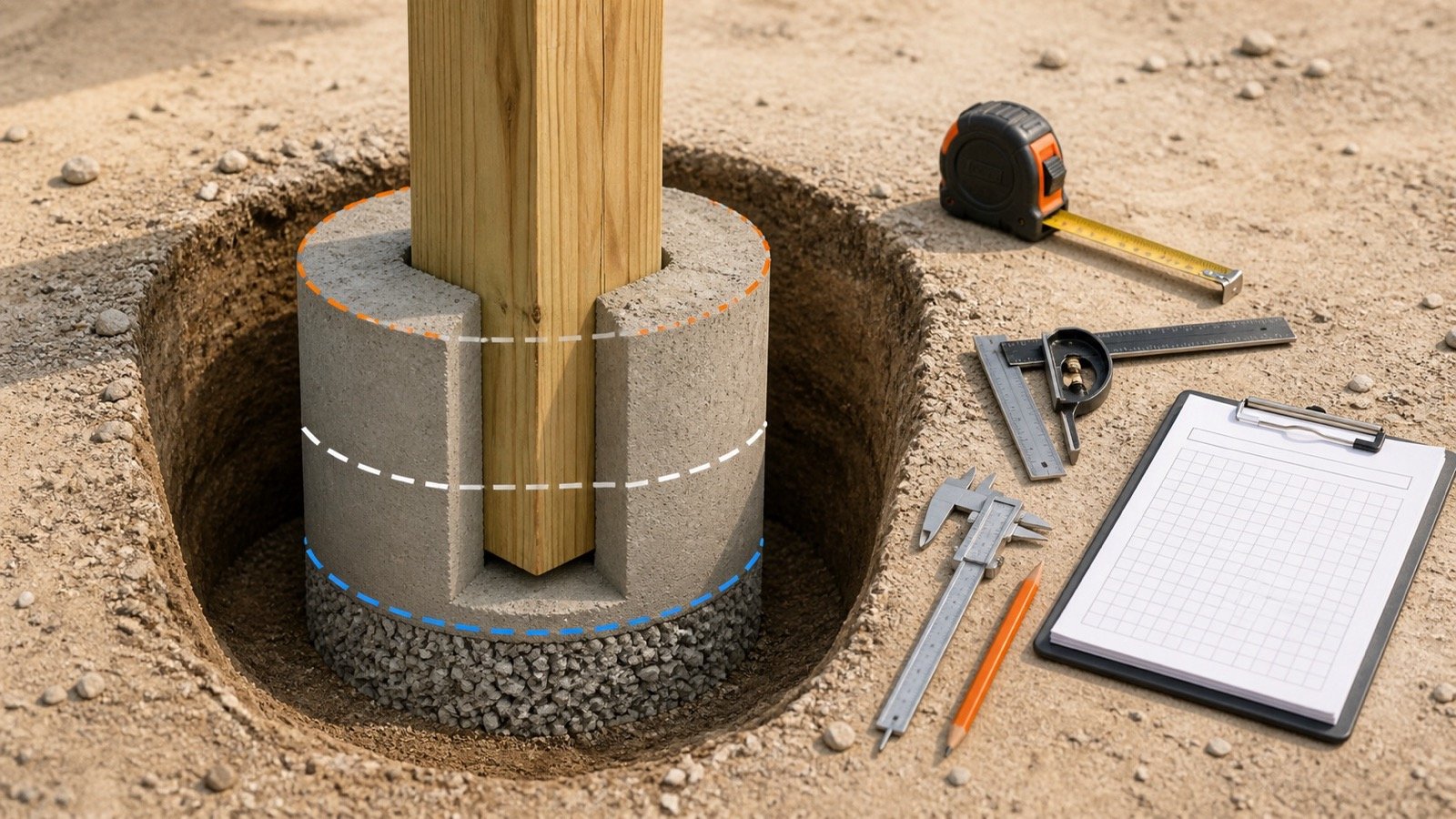
A larger post inside the same concrete zone occupies more volume. Measure the installed section and its exact overlap with the concrete.
For one 12 in diameter hole with 36 in of concrete, the gross volume is 2.356194 ft³:
| Post condition | Displacement | Net concrete | Whole packages at 0.60 ft³ |
|---|---|---|---|
| No post deduction | 0 ft³ | 2.356194 ft³ | 4 |
| Measured 3.5 in × 3.5 in post through 36 in | 0.255208 ft³ | 2.100986 ft³ | 4 |
| Measured 5.5 in × 5.5 in post through 36 in | 0.630208 ft³ | 1.725986 ft³ | 3 |
The smaller net volume does not approve a larger post or smaller concrete annulus. Foundation design, concrete cover, constructability, durability, post treatment, and load resistance remain project decisions.
What if the post stops above the concrete bottom?
Subtract the post only through its physical overlap with the concrete. Concrete below the post has no post deduction.
Suppose a hole contains 30 in of concrete and the post overlaps 26 in. Calculate the full gross cylinder, then subtract the post cross-section multiplied by 26 in. Extending the deduction through 30 in understates concrete.
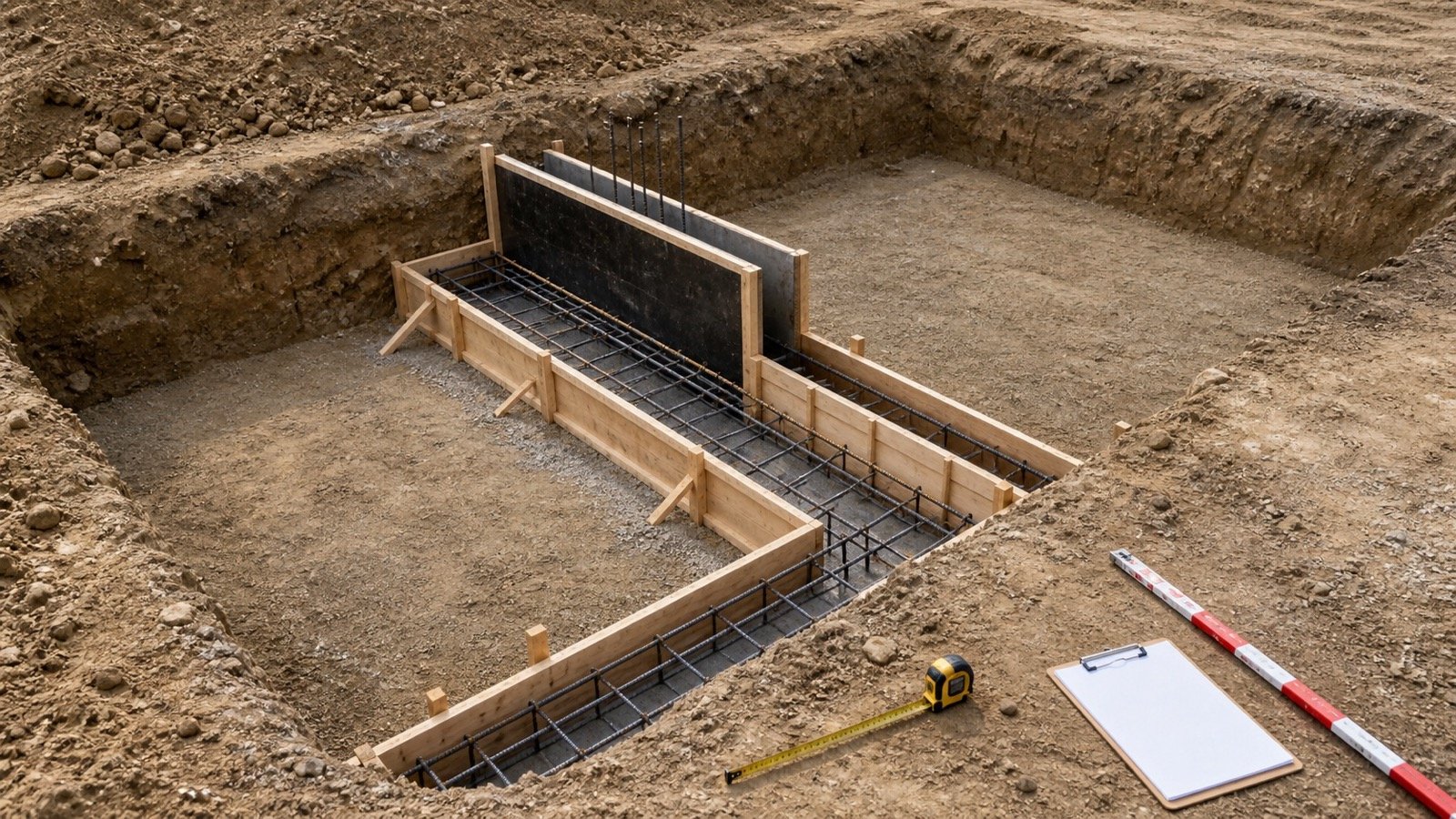
The Concrete Post Hole Volume guide shows separate base, concrete, post, collar, and unfilled zones. Use that measurement workflow when the vertical limits differ.
Does gravel reduce the chart quantity?
A separate non-concrete base reduces concrete depth only when the approved detail places that base inside the measured hole below the concrete. Record its compacted thickness and top elevation separately.
Do not subtract a gravel depth from the chart because another project or online example used it. Product instructions, drainage conditions, soil, frost, post material, permits, and design can change the required section.
Can this chart be used for tapered or irregular holes?
The tables cover straight cylinders. A tapered round hole uses a circular-frustum formula, and a stepped or irregular hole needs separate measured solids.
A widened bottom, local collapse, rock pocket, leaning bore, above-grade collar, or changed diameter can move the result outside a straight-hole row. Enter the measured top and bottom diameters in the post-hole calculator when a frustum represents the accepted geometry.
Why can the same hole produce different bag counts?
Mixed yield belongs to the exact product and package. QUIKRETE and Sakrete publish named standard-mix examples at 0.45 ft³ for 60 lb and 0.60 ft³ for 80 lb. Other products can use different formulations, densities, package masses, markets, or yields.
Use the Concrete Bag Yield Chart to record the product, package, market, yield, revision, and retrieval date. Package weight alone cannot supply a mixed-volume conversion.
When does a post-hole chart give the wrong answer?
| Mismatch | Effect | Correction |
|---|---|---|
| Actual hole diameter differs | Volume changes with diameter squared | Measure the accepted concrete boundary |
| Concrete depth differs from excavation depth | The wrong vertical zone enters the cylinder | Record concrete bottom and top levels |
| Post size or overlap differs | Displacement is wrong | Use the installed section and physical overlap |
| Taper or overbreak exists | A straight cylinder misses volume | Use valid measured sections |
| Product yield differs | The divisor and whole-package count change | Copy current mixed yield from the exact product |
| Several holes round separately | Early ceilings can add packages | Combine compatible unrounded volumes |
| Automatic allowance is added | Measured and planning quantity become mixed | Use 0% until a project basis supports another value |
What should you record before buying concrete?
- Hole group, count, shape, dimensions, concrete limits, and measurement date.
- Drawing, permit, product instruction, or approved field record behind the geometry.
- Post profile, measured dimensions, and length inside concrete.
- Gross, displacement, net, group, and planning volumes.
- Allowance, reason, and source.
- Exact product, package, market, mixed yield, and data-sheet revision.
- Exact quotient, whole-package ceiling, supplier increment, stock, and delivery plan.
- Separate gate, corner, end, repair, or changed holes.
Return to the Concrete Planning hub for packaged concrete, ready-mix, reinforcement, block, and joint workflows.
What safety and scope limits apply?
Locate expected underground utilities before excavation. OSHA 29 CFR 1926.651 sets this requirement for covered United States construction work and requires safe location steps as work approaches an installation.
Wet portland cement can cause caustic burns and dermatitis. Follow the current safety data sheet and applicable controls for skin, eyes, dust, lifting, mixing equipment, water, and washing facilities.
This chart does not design a post foundation, assess soil or frost, choose a post connection, select reinforcement, approve excavation, or certify completed work. Use current project documents, permits, product data, site conditions, local requirements, and qualified professionals.
Sources and source scope
- NIST Handbook 133 (2026), Appendix E: cubic-inch, cubic-foot, cubic-yard, litre, and cubic-metre relationships.
- QUIKRETE Concrete Mix No. 1101 SPEC-DATA and Sakrete High-Strength Concrete Mix: named-product package-yield examples.
- QUIKRETE, Setting Posts without Mixing: one manufacturer-specific workflow showing distinct fill zones.
- OSHA 29 CFR 1926.651 and OSHA concrete-products hazard guidance: the stated United States workplace safety context.
Source scope: NIST supports unit relationships. Manufacturer records support their named products and stated workflows. OSHA supports the cited United States workplace boundary. The chart dimensions are arithmetic fixtures. None of these sources sets a universal post-hole diameter, depth, post size, allowance, product, yield, frost depth, soil capacity, connection, or structural design.