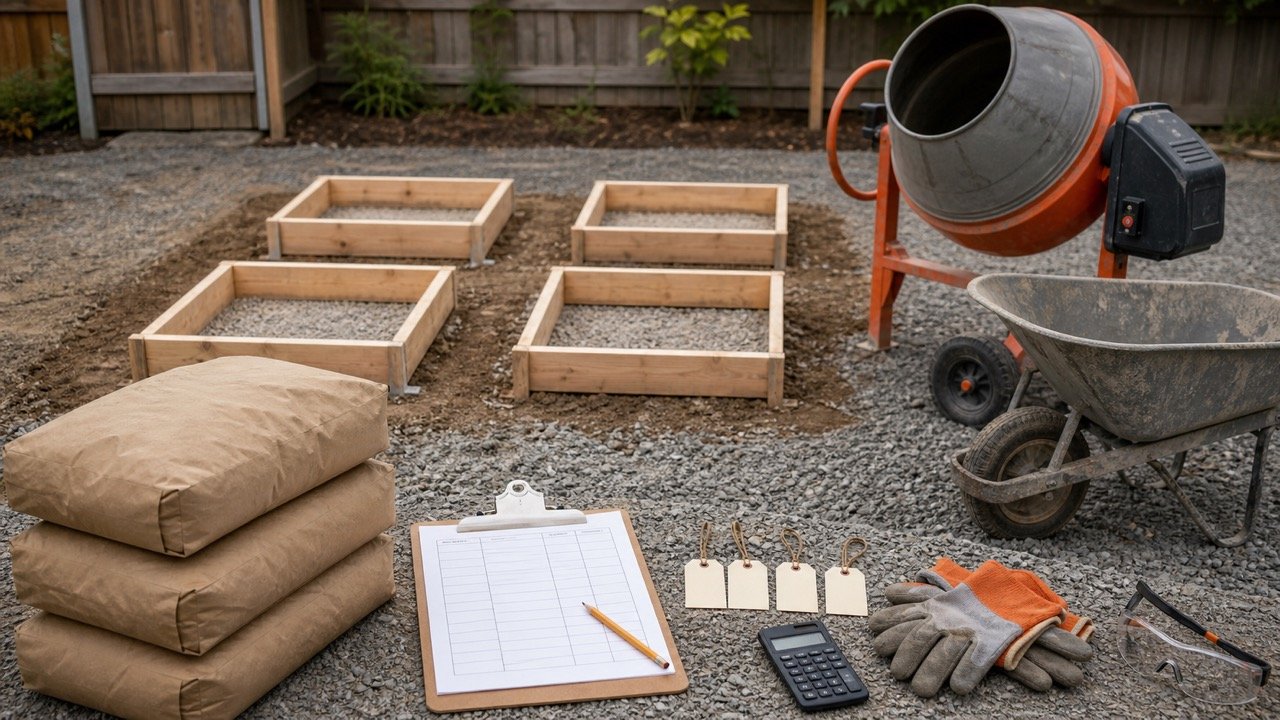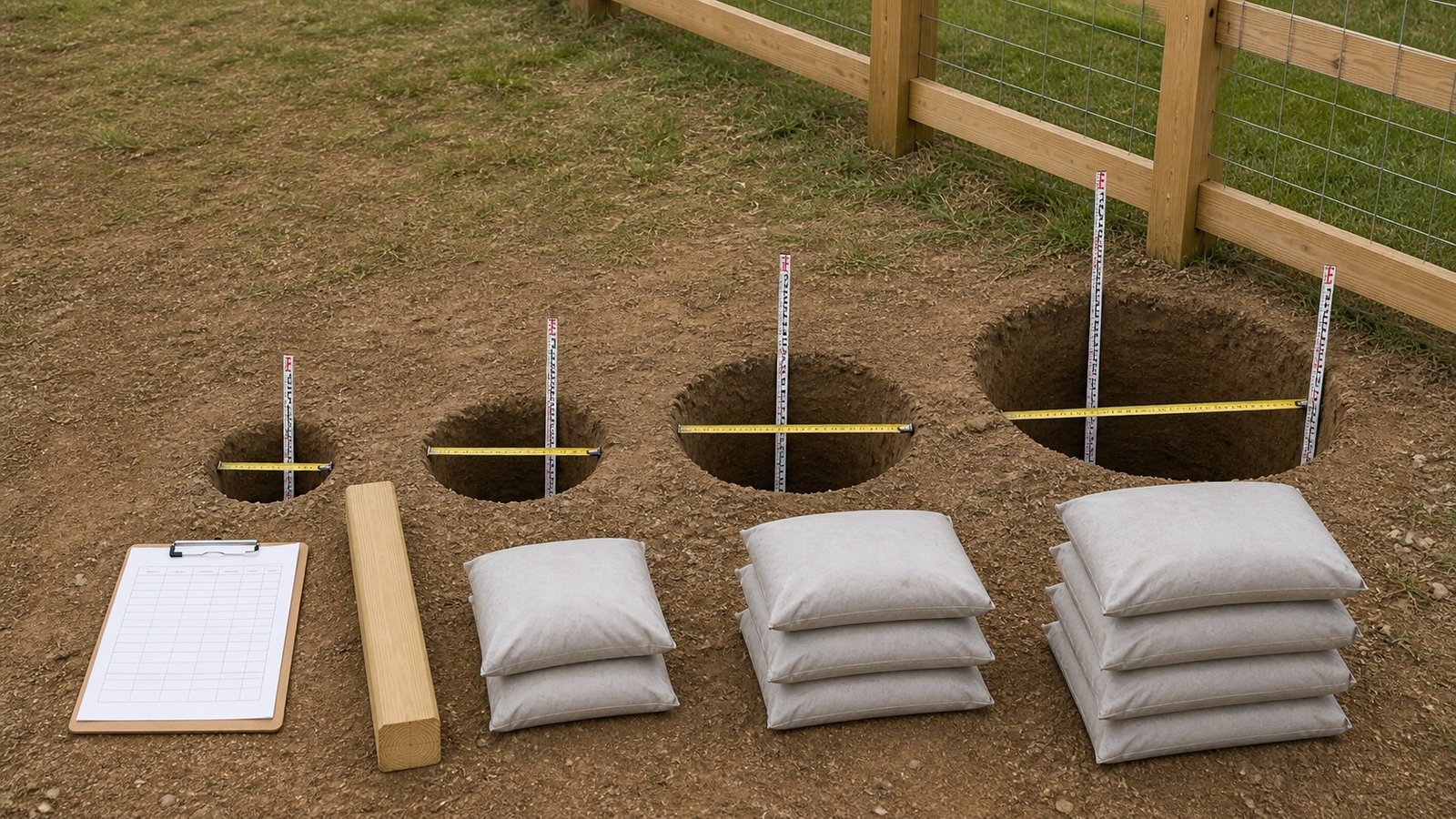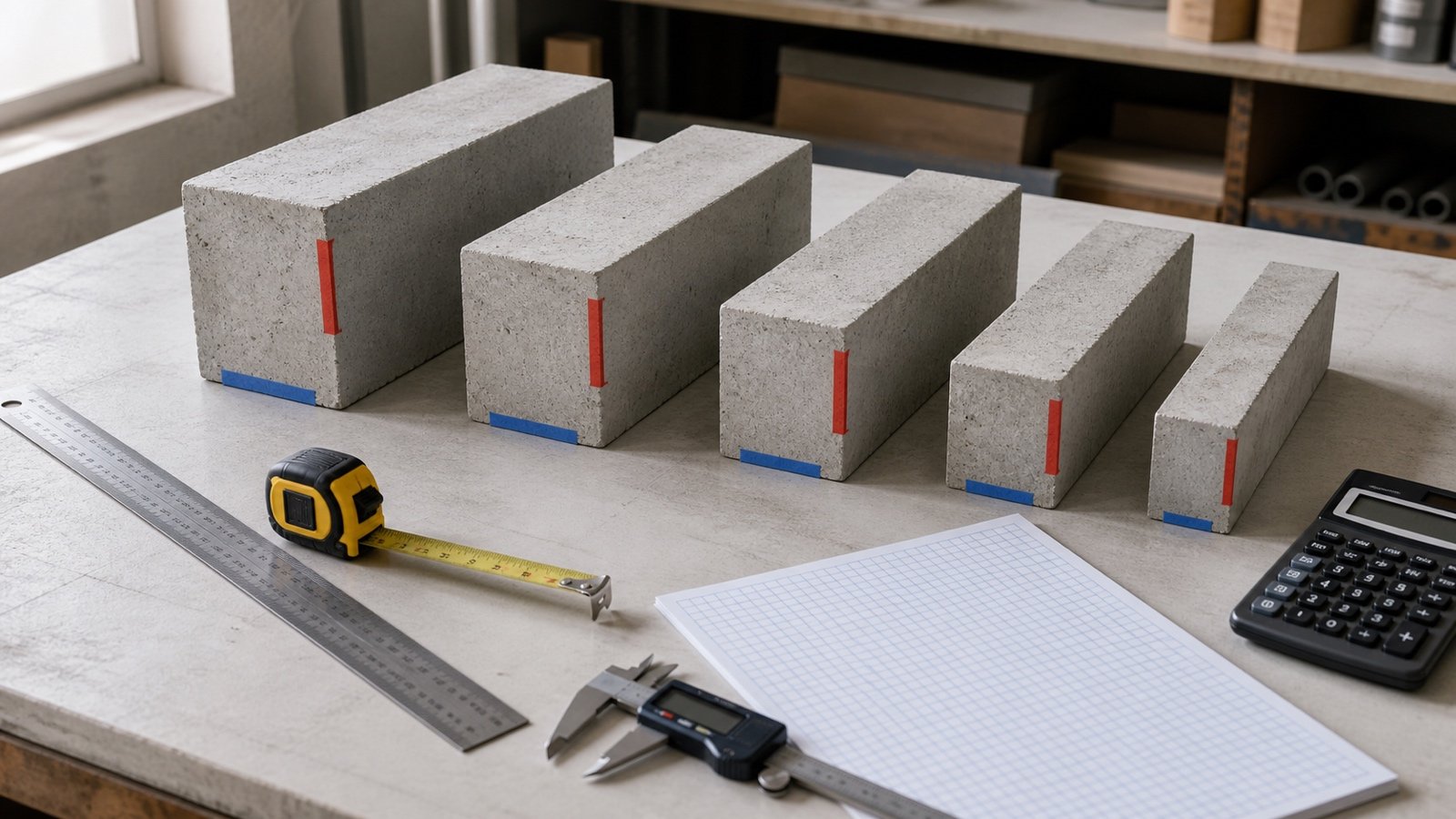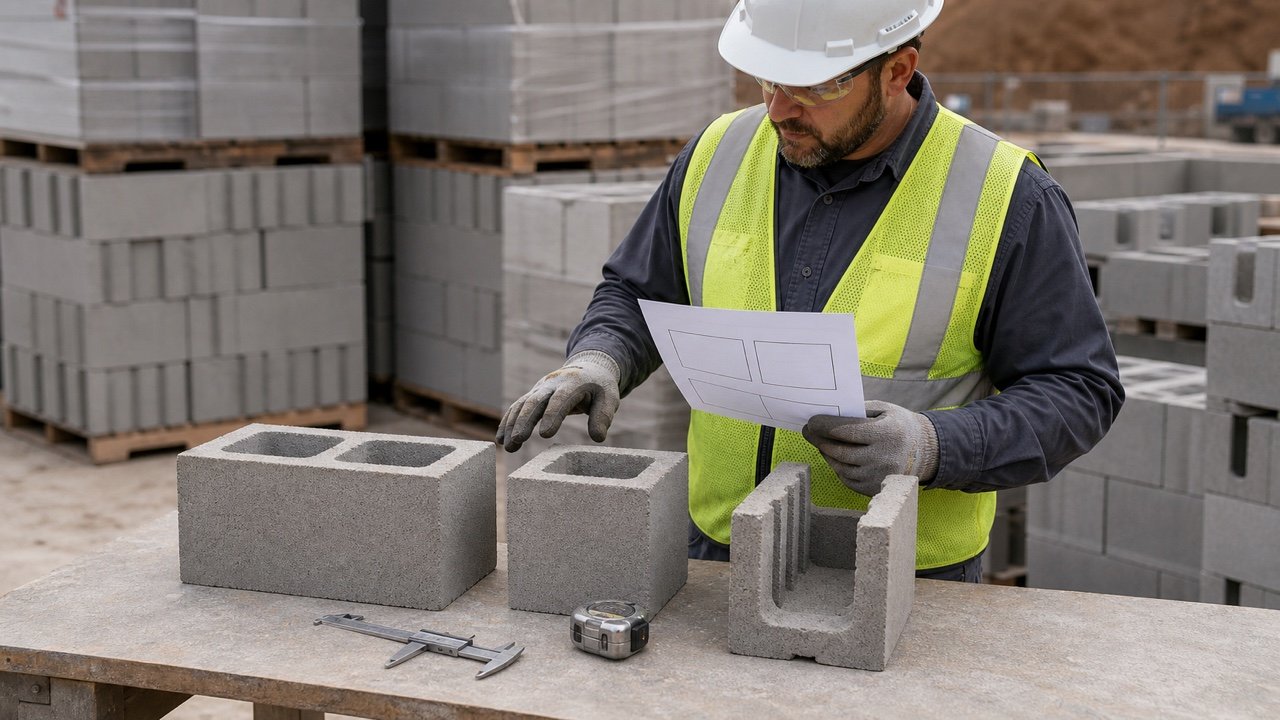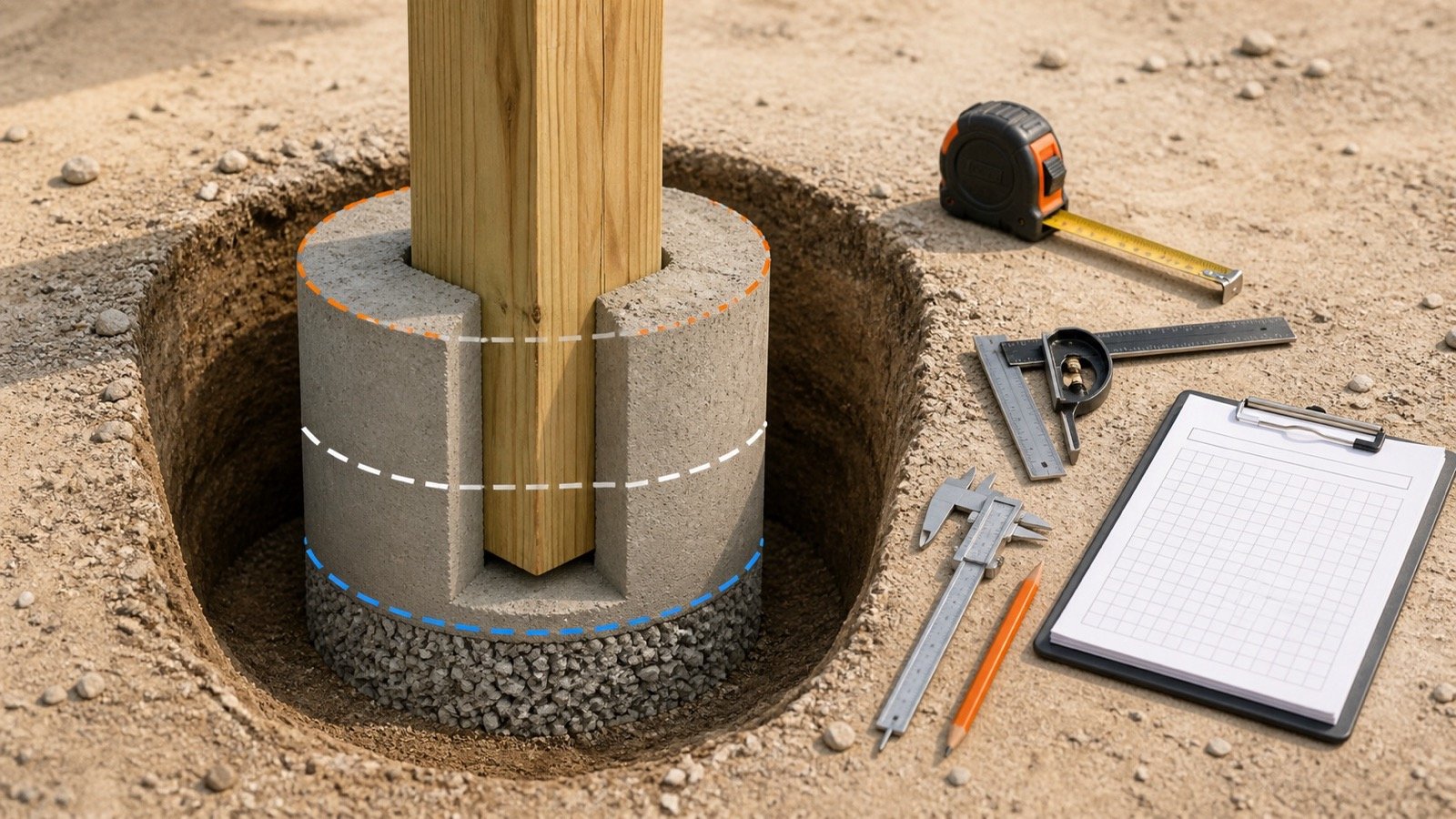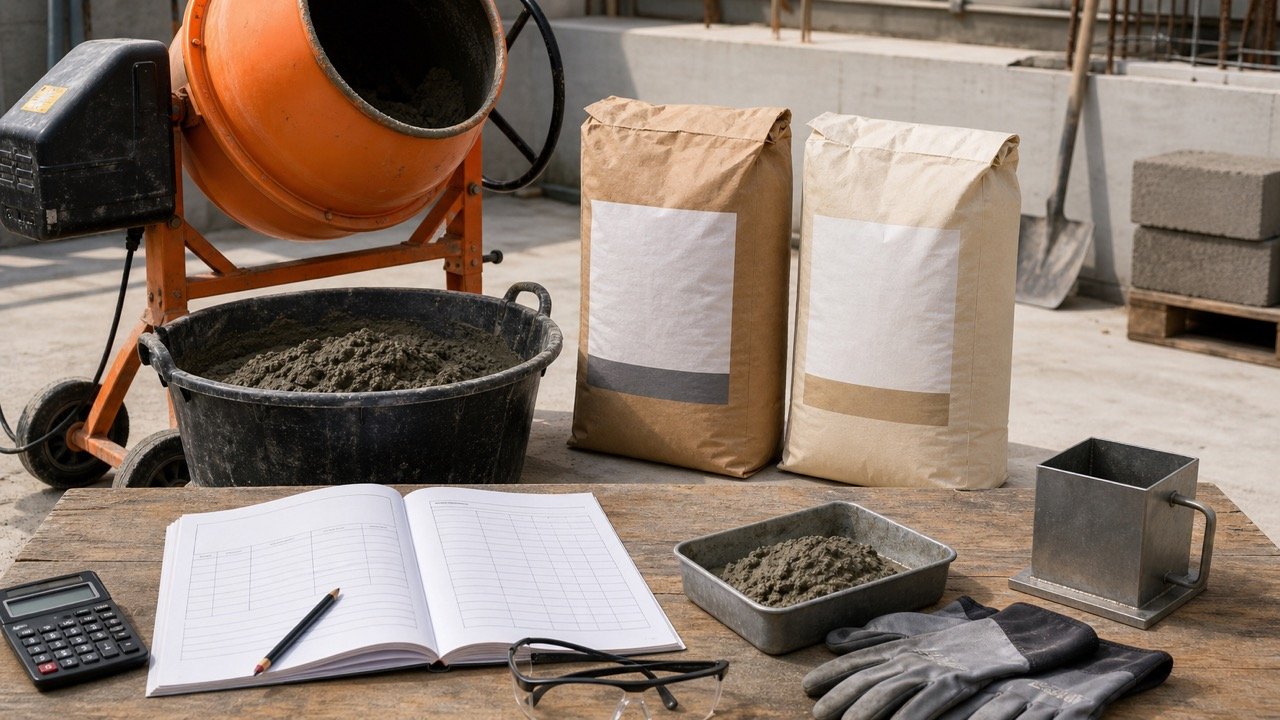
A concrete bag's dry weight does not tell you its mixed volume by itself. Product formulation matters, and current manufacturer sheets show large yield differences between some bags with the same nominal weight.
Use this dated chart to identify a product-specific yield, then verify it against the current package and technical data before calculating a purchase.
How much concrete does one bag make?
A named standard concrete mix may yield about 0.30 ft³ from 40 lb, 0.45 ft³ from 60 lb or 0.60 ft³ from 80 lb. Those familiar values are product examples, not universal weight-to-volume conversions.
On the sheets checked 2026-08-01, an 80 lb QUIKRETE Concrete Mix No. 1101 bag lists approximately 0.60 ft³, while an 80 lb Sakrete Maximizer bag lists 1.0 ft³.
Enter the verified current value in the Concrete Bags Calculator. The calculator accepts mixed yield directly so a specialty product is not forced into a standard-weight preset.
What does this concrete bag yield chart show?
The tables record approximate mixed yield for exact named products and package sizes. They also convert the stated cubic-foot yield into a whole number of bags needed to supply at least 1 yd³ of nominal planning capacity.
The snapshot date is 2026-08-01. Confirm the current package, item number, market, product page and technical sheet because formulations, availability, labels and documents can change.
QUIKRETE Concrete Mix No. 1101 yield chart
QUIKRETE's current No. 1101 data sheet lists five U.S. package examples. Its yields are approximate and belong to this exact product.
| Package | Approximate mixed yield | Manufacturer metric display | Exact quotient per yd³ | Whole bags for at least 1 yd³ |
|---|---|---|---|---|
| 40 lb (18.1 kg) | 0.30 ft³ | 8.5 L | 90 | 90 |
| 50 lb (22.6 kg) | 0.375 ft³ | 10.6 L | 72 | 72 |
| 60 lb (27.2 kg) | 0.45 ft³ | 12.7 L | 60 | 60 |
| 80 lb (36.2 kg) | 0.60 ft³ | 17 L | 45 | 45 |
| 90 lb (40.8 kg) | 0.675 ft³ | 19.1 L | 40 | 40 |
Do not use this row set for another QUIKRETE product without checking its own sheet. A brand name covers multiple formulations and instructions.
Sakrete concrete bag yield examples
Sakrete's named products demonstrate why package weight is not enough. The High-Strength sheet and product page list standard-product examples, while the Maximizer sheet lists much higher yield for its structural-lightweight-aggregate formulation.
| Product and market | Package | Stated mixed yield | Exact quotient per yd³ | Whole bags for at least 1 yd³ |
|---|---|---|---|---|
| High-Strength, U.S. | 40 lb | 0.30 ft³ | 90 | 90 |
| High-Strength, U.S. | 60 lb | 0.45 ft³ | 60 | 60 |
| High-Strength, U.S. | 80 lb | 0.60 ft³ | 45 | 45 |
| High-Strength, U.S. | 90 lb | 0.66 ft³ | 40.909091 | 41 |
| High-Strength, Canada | 25 kg | 0.41 ft³ | 65.853659 | 66 |
| High-Strength, Canada | 30 kg | 0.50 ft³ | 54 | 54 |
| Maximizer, U.S. | 40 lb | 0.50 ft³ | 54 | 54 |
| Maximizer, U.S. | 80 lb | 1.0 ft³ | 27 | 27 |
The table does not rank or substitute products. Strength, aggregate, density, application thickness, water, consistency, placement, finish, curing and project approval still need to match the work.
Can two bags with the same weight have different yields?
Yes. The current sheets contain both a small difference and a large product-line difference at equal nominal package mass.
| Comparison | Product A | Product B | Quantity result for 1 yd³ |
|---|---|---|---|
| 90 lb standard-product examples | QUIKRETE No. 1101: 0.675 ft³ | Sakrete High-Strength: 0.66 ft³ | 40 whole bags versus 41 |
| 80 lb named products | Standard examples: 0.60 ft³ | Sakrete Maximizer: 1.0 ft³ | 45 whole bags versus 27 |
For the 80 lb comparison, the arithmetic difference is 18 bags per nominal cubic yard. That does not make the products technically interchangeable or establish which one suits the project.
How are bags per cubic yard calculated?
One cubic yard contains exactly 27 ft³. Divide 27 by the current mixed yield, then round the final quotient upward when only whole packages can be purchased.
Exact quotient per yd³ = 27 ft³ ÷ mixed yield per package
Whole bags for at least 1 yd³ = ceiling(exact quotient per yd³)
For a 0.66 ft³ package, 27 ÷ 0.66 = 40.909091. The reference is therefore 41 whole bags, not 40.909 bags and not 40 bags.
The whole-bag result is nominal purchased mixed capacity. It is not a pallet count, site allowance, verified batch yield or accepted placed volume.
How should a bag yield be used for another project volume?
Calculate or obtain the approved planning volume in the same unit, divide once by the selected product yield and round only the final package quotient upward.
Exact package quotient = planning volume ÷ current mixed yield per package
Whole packages = ceiling(exact package quotient)
Purchased mixed capacity = whole packages × current mixed yield
Capacity above planning = purchased mixed capacity - planning volume
Combine compatible unrounded volumes before the package ceiling. Rounding every hole, pad or section separately can add a rounding increment to each one.
Worked example: 3.2 cubic feet with 60 lb bags
A hypothetical project has a checked planning volume of 3.2 ft³. The selected current product states 0.45 ft³ of approximate mixed yield per package.
- Exact quotient: 3.2 ÷ 0.45 = 7.111111 bags.
- Whole-package purchase: ceiling(7.111111) = 8 bags.
- Purchased mixed capacity: 8 × 0.45 = 3.6 ft³.
- Capacity above planning: 3.6 - 3.2 = 0.4 ft³.
The 0.4 ft³ comes from whole-package rounding. It is separate from any project allowance added before the division.
How do cubic feet convert to litres?
NIST's exact unit relationship gives 1 ft³ = 28.316846592 L. Manufacturer sheets may display rounded metric equivalents suitable for their product table.
| Stated yield | Exact arithmetic equivalent | Common rounded display |
|---|---|---|
| 0.30 ft³ | 8.495054 L | 8.5 L |
| 0.45 ft³ | 12.742581 L | 12.7 L |
| 0.60 ft³ | 16.990108 L | 17 L |
| 0.675 ft³ | 19.113871 L | 19.1 L |
| 1.0 ft³ | 28.316847 L | 28.3 L |
Do not calculate one bag count from the cubic-foot value and another from a rounded metric display, then treat a small difference as a product conflict. Use one stated yield basis consistently and preserve the source.
Where should the yield be copied from?
Use the exact current package and manufacturer technical data for the product, size and market being purchased. Save enough detail to reproduce the choice.
- Manufacturer and exact product name.
- Product number or item number where available.
- Package mass and market.
- Approximate mixed yield and unit.
- Technical-sheet title, revision or issue date, URL and retrieval date.
- Required water, consistency and mixing instructions.
- Application thickness, use, strength and other project-selection limits.
- Safety data sheet and storage or damaged-package instructions.
If the bag and web sheet disagree, stop and confirm the current information with the manufacturer. Do not choose the larger yield because it reduces the estimate.
Does the bag's dry volume matter?
Use the stated mixed yield, not the apparent size of the dry bag or the loose dry powder volume after opening. Dry material, mixing water, entrained air, consolidation and fresh concrete are different states.
The package mass is useful for handling, delivery and total dry-material records. It does not equal the volume or final mass of mixed or hardened concrete.
Can extra water increase usable yield?
Do not change water to chase more volume. Follow the current product instructions and required consistency.
The QUIKRETE No. 1101 sheet labels its yields approximate and ties mixing instructions to water and consistency. The Sakrete sheets also provide water and slump guidance and warn against overwatering. Product performance and durability can be harmed when instructions are ignored.
A quantity chart cannot approve a modified water content, additive, aggregate, mix time or placement method.
Should a standard allowance be added?
No universal percentage belongs in the chart. Uneven substrate, form tolerance, spillage, retained material, test samples and placement method can change a project, but the allowance needs its own evidence.
Record measured concrete, any supported allowance, planning volume, exact quotient and whole-package capacity separately. Do not use an automatic 5% or 10% value to hide uncertain geometry or an unverified product yield.
Does bags per yard equal bags per pallet?
No. Bags per yard is a volume quotient. Bags per pallet is a supplier packaging and logistics count that can vary by product, package, market and supplier.
Confirm current pallet quantity, split-pallet rules, damaged-bag handling, delivery, vehicle limits and unloading separately. Do not derive a pallet count from mixed yield.
Can the highest-yield product be selected from this chart?
The chart cannot select a concrete mix. A larger yield per bag may come from a different formulation, aggregate system, density, water demand, consistency or application scope.
Use drawings, specifications, code requirements, design, manufacturer instructions and qualified project decisions. Check strength, exposure, thickness, placement, finish, curing, temperature and compatibility before quantity.
Myth versus reality
| Myth | Reality |
|---|---|
| Every 80 lb concrete bag yields 0.60 ft³ | Current named examples include both 0.60 ft³ standard mixes and a 1.0 ft³ high-yield product. |
| Bag mass can replace mixed yield | Mass and mixed volume are different quantities. |
| 40.91 bags is an order quantity | A whole-package purchase needs 41 unless the supplier provides another valid unit. |
| Whole-bag capacity is the allowance | Rounding occurs after any separately justified planning allowance. |
| Bags per yard gives pallet quantity | Pallet packaging is a separate current supplier record. |
| The product with fewer bags is automatically suitable | Yield does not replace product selection, design or application requirements. |
Common concrete yield-chart mistakes
- Calling weight-only values universal.
- Using a standard-mix row for a high-yield, fast-setting, repair, topping, mortar or grout product.
- Ignoring product name, item number, market or sheet revision.
- Rounding 27 ÷ yield downward.
- Adding a universal waste factor inside the chart.
- Mixing cubic feet and litres from different rounded bases.
- Using dry bag dimensions as mixed volume.
- Adding water to increase apparent yield.
- Counting each small pour as a whole bag before combining compatible unrounded volumes.
- Treating approximate purchased capacity as verified placed yield.
- Choosing a product from yield alone.
What should the yield record contain?
- Project, pour ID, drawing or sketch revision and approved planning volume.
- Manufacturer, exact product, item number, package and market.
- Current mixed yield, unit, technical sheet and retrieval date.
- Required consistency, water and mixing instructions.
- Exact package quotient and final whole-package ceiling.
- Purchased mixed capacity and capacity above planning.
- Allowance and reason kept separate from package rounding.
- Supplier stock, pallet or selling unit, receipt and damaged-bag record.
- Product-selection approval, safety data and placement records required by the project.
Return to the Concrete Planning hub for the package calculator and related concrete quantity workflows.
Sources and source scope
- QUIKRETE Concrete Mix No. 1101 data sheet: named-product package sizes, approximate yields and mixing context.
- Sakrete High-Strength Concrete Mix TDS and product page: named-product U.S. and Canadian package examples and product scope.
- Sakrete Maximizer Concrete Mix TDS: named high-yield product, structural-lightweight-aggregate description and package yields.
- NIST Guide to the SI, Appendix B.8: exact volume-unit conversion.
- OSHA, Concrete and Concrete Products: Controlling Hazards: wet-portland-cement hazard context.
Source scope: manufacturer sources support only their named product data at the retrieval date. NIST supports unit conversion. OSHA supports its U.S. workplace hazard context. None of these sources selects the product, geometry, allowance, pallet quantity, price, placement method or ready-mix crossover for a specific project.