The measurement article gives you a net stone volume, a pipe length, a fabric area, and a cap volume. The order sheet turns those numbers into what the supplier actually sells: cubic yards or tons, rounded to the selling increment, plus a delivery sequence and a spoil haul plan.
What does one order sheet list?
Each material gets its own row: the measured net quantity, the allowance, the supplier's selling unit, and the final rounded order. The starting quantities come from the french drain measurement guide: measure first, then order.
| Material | Measured net quantity | Selling unit | Order math |
|---|---|---|---|
| Drainage stone | Net envelope volume after pipe displacement | Cubic yards or tons | Add handling allowance, convert units, round up to increment |
| Perforated pipe | Run length | Foot or metre sticks | Add cutting allowance, buy whole sticks |
| Geotextile fabric | Wrap area with overlap | Roll width and length | Order the roll size that covers the area with the least waste |
| Topsoil cap | Cap volume above the envelope | Cubic yards or tons | Add handling allowance, round up to increment |
How do you turn a net volume into a supplier order?
Multiply the net volume by 1 plus the handling allowance, then round up to the supplier's selling increment. The allowance covers spillage, uneven trench walls, and placement losses. Name what the allowance covers on the record, because a bare 10% cannot be checked or revised later.
Order volume = net volume × (1 + allowance % ÷ 100)
Use the measurement guide's 60 ft run as the worked case: net stone is 54.1722 ft³, which is 2.0064 yd³. A stated 10% handling allowance is a worked fixture, not a recommended standard.
- Order volume: 2.0064 × 1.10 = 2.2070 yd³.
- Round up to the selling increment: a supplier that sells in 0.5 yd³ steps gets a 2.5 yd³ order.
The topsoil cap works the same way: 30 ft³ is 1.1111 yd³; with the same 10% fixture the order volume is 1.2222 yd³, rounded up to 1.5 yd³ on the 0.5 yd³ increment. Use the Drainage Gravel Calculator to check the net volume before you add the allowance.
How do you convert cubic yards to tons?
Multiply the order volume by the supplier's loose bulk density for the delivered stone. That density must come from the supplier's product record or weighbridge ticket for the actual material: Caterpillar's density tables list bulk densities by material but warn that moisture, grain size, and compaction change them, so no universal tons-per-yard figure is safe to reuse.
Order weight = order volume × supplier bulk density
With a labelled example-only density of 1.45 tons/yd³, the fixture order of 2.2070 yd³ weighs 3.2002 tons. The 1.45 figure is an arithmetic example, not a recommended density. Record the density the supplier states, the date, and the moisture condition beside the tonnage. When the same yard sells another lot next month, confirm the figure again rather than carrying it over.
Aggregate is ordered by the gross envelope space it fills, not by the solid rock volume. Voids between the stones are part of the envelope, and the pipe already had its displacement subtracted during measurement.
How many trips does the spoil need?
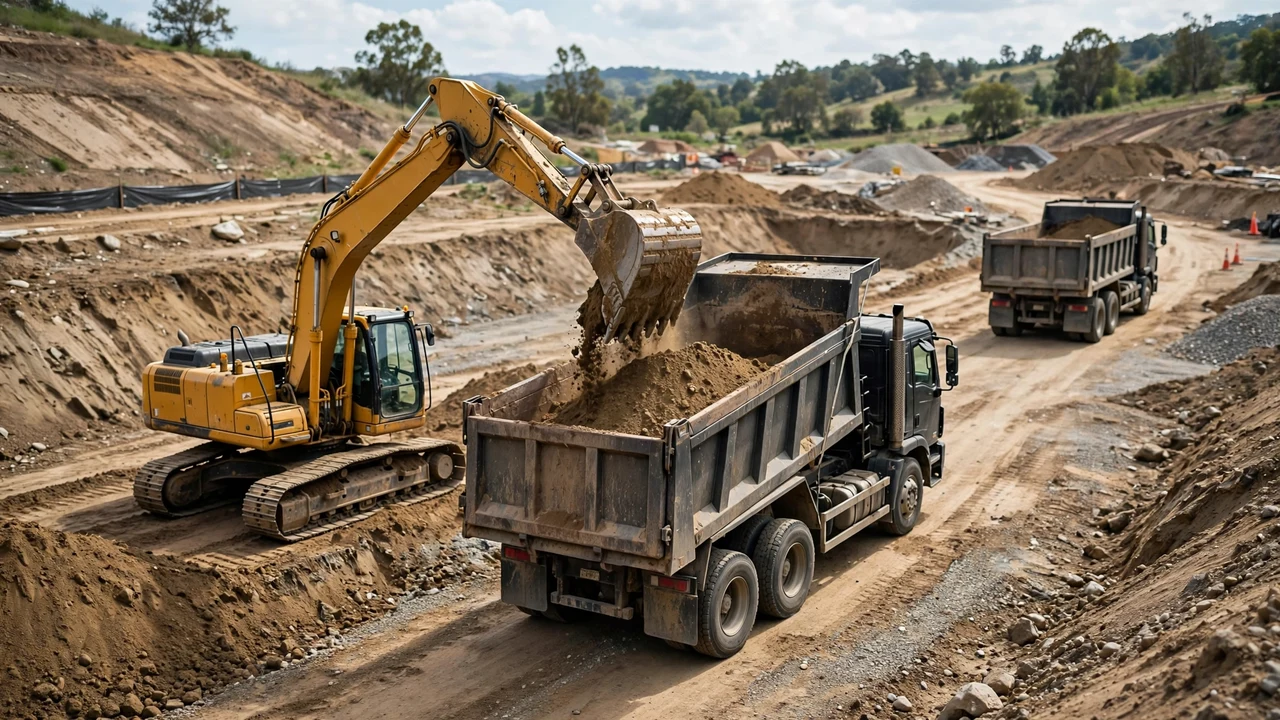
Excavated spoil swells. Convert the bank spoil volume to a loose haul volume with a stated swell record, then divide by the truck's usable loose-volume capacity and round any positive remainder up to a whole trip. The bank vs loose volume guide explains why bank and loose quantities must stay separate.
Loose spoil volume = bank volume × (1 + swell % ÷ 100)
Trips = round up (loose spoil volume ÷ usable truck volume)
The 60 ft run excavates 90 ft³, which is 3.3333 yd³ bank. With a labelled 30% swell fixture, the loose spoil is 3.3333 × 1.30 = 4.3333 yd³. A truck with 2 yd³ of usable loose-volume capacity needs ceil(4.3333 ÷ 2) = 3 trips, with a partial third load.
Check the payload separately. Body volume sets the space; material mass, moisture, legal payload, axle limits, and route restrictions can set a smaller usable load. Get the vehicle and route limits from the responsible hauler and the applicable authority, and use a loose bulk density that represents the same spoil state and moisture condition when a mass check is needed. The trench spoil balance guide shows how to separate spoil you reuse from spoil you export.
When should each delivery arrive?
Schedule materials in the order the work consumes them. Pipe and fabric arrive first so the crew can verify pipe stick lengths and fabric roll widths against the excavated trench before any stone is placed. The stone is delivered last, just before placement.
Keeping washed stone off the site until placement day protects the drain. Stone stockpiled on bare soil picks up soil fines that migrate into the envelope voids, and every double-handling move breaks down angular faces and adds spillage. If stone must sit on site, pile it on tarps or poly sheeting, keep plant and foot traffic off the pile, and cover it during rain. Topsoil for the cap arrives last, after the envelope is placed and the fabric is closed.
Do not order the stone before the excavation is measured. Trench width and depth change the envelope volume faster than any allowance covers, and stone ordered against design dimensions can arrive short or surplus against the trench actually dug.
What should you tell the supplier before dispatch?
Give the yard one complete instruction so the load matches the plan on arrival:
- The material specification exactly as the guide chose it: angular washed stone at the specified size, not rounded rock and not crusher dust fines.
- The final order quantity with its unit, plus the selling increment you rounded to.
- The bulk density you used for any tons conversion, so the weighbridge ticket can be checked against it.
- The drop point, marked on the ground, within reach of the trench but off the excavation line.
- Site access limits: gate width, overhead lines, soft ground, turning space, and the maximum truck size the site takes.
- The delivery date and arrival window, sequenced after excavation and before placement.
- Whether a small-load or split-load fee applies, and the minimum chargeable load.
Check the delivery ticket against the order on arrival: material, quantity, and lot. A wrong stone size or a short load is cheapest to catch while the truck is still on site. Split a large order across two deliveries only when storage space or access forces it; each split load can carry its own fee, which can exceed the cost of the extra allowance you would otherwise order.
What mistakes cause a second delivery?
- Ordering against design dimensions instead of the measured trench.
- Subtracting the pipe displacement but forgetting the handling allowance.
- Adding the allowance but skipping the round-up to the selling increment.
- Converting yards to tons with a generic density instead of the supplier's record.
- Reducing the stone order by the void percentage.
- Ordering stone weeks early and contaminating the stockpile on bare soil.
- Planning spoil export on bank volume with no swell, then finding one more truckload.
- Booking the hauler on body volume alone without a payload weight check.
- Telling the supplier the material as a nickname instead of the specified size and type.
- Skipping the ticket check on arrival and discovering the wrong stone after the truck leaves.
Safety and professional scope
Haulage and delivery do not change the excavation safety rules. For U.S. work, OSHA identifies cave-ins as the main trench hazard, and 29 CFR 1926.651 covers underground installations, access and egress, hazardous atmospheres, water accumulation, adjacent structures, loose material, and competent-person inspections. Keep spoil, stone piles, vehicles, and equipment away from the trench edge under the governing safety plan; OSHA's standard uses a 2 ft minimum distance for excavated material in 1926.651(j)(2).
Contact 811 a few business days before digging in the United States and wait for utility marks before breaking ground. Mark the stone drop point and the truck path before dispatch so drivers never improvise near the open trench. Other countries use their own workplace and utility rules.
Sources and scope
- NIST Handbook 44, 2026 Appendix C: cubic-foot, cubic-yard, and metric relationships.
- Caterpillar, Material Density Tables to Help Estimate Earthwork Volumes: published bank and loose bulk densities by material, with the warning that moisture, grain size, and compaction change the values and exact figures need testing.
- OSHA Trenching and Excavation and 29 CFR 1926.651: U.S. occupational excavation-safety context.
- 811 Before You Dig: the free U.S. before-you-dig service.
Scope: the formulas convert measured net quantities into supplier order quantities and haul plans. The governing drawings, survey and testing methods, geotechnical information, supplier records and tickets, hauler vehicle limits, safety plan, applicable law, and responsible qualified people control the accepted allowance, density, swell, and final project quantity.
Review responsibility: Saleem Sial owns the published calculation, source, and editorial checks. Waseem Sial, External Reviewer and Engineer, remains listed for ongoing external review; no completed external-review date is claimed.
Next, check the material choices that the order sheet depends on, or return to the Earthwork & Drainage Calculators hub.
Use the French Drain System Calculator to run the full system record for one trench section.