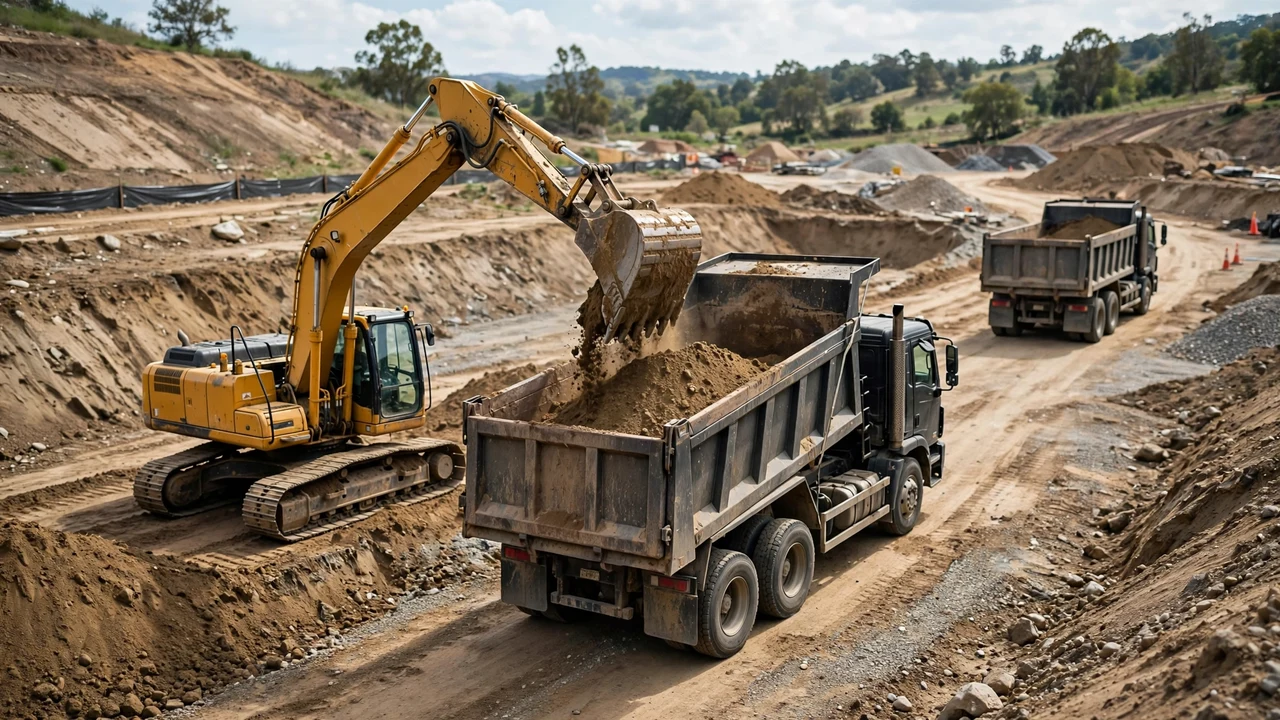
A delivery of crushed stone arrives as one conical pile, and the site needs to confirm the pile matches the delivery ticket. This example works that pile from tape measurements to a checked loose volume, then reconciles the result with the ticket.
What does this worked example cover?
One delivered stockpile of 20 mm crushed stone sitting on a level compacted pad. The example covers the starting measurements, the cone calculation, a slope check, an independent cubic-yard cross-check, a ticket reconciliation, and the final quantity record.
All dimensions, ticket figures, and results are stated example fixtures verified by independent calculation. They demonstrate the arithmetic and describe no real pile.
What are the starting measurements?
Measure the base diameter with a tape held across the base through the estimated center. Three readings: 10.1 m, 9.9 m, and 10.0 m. The mean is 10.0 m, so the radius is 5.0 m.
Measure the vertical height with a sighting rod from the documented pad beside the pile. Three readings: 3.0 m, 3.1 m, and 2.9 m. The mean is 3.0 m.
Record the readings before averaging so the source observations stay available. Confirm the shape before choosing the formula: a near-circular base, one central peak, a uniform face slope, and a visible toe all around the pad. The cone model fits this pile. For a pile that does not fit a cone, use the stockpile volume formulas page.
How do you calculate the cone volume?
Use the cone formula for a conical stockpile: volume equals π times radius squared times vertical height, divided by 3.
Cone volume = π × radius² × vertical height ÷ 3
| Stage | Calculation | Result |
|---|---|---|
| Radius | 10.0 ÷ 2 | 5.0 m |
| Radius squared | 5.0² | 25.0 m² |
| Multiply by height | 25.0 × 3.0 | 75.0 |
| Divide by 3, multiply by π | 75.0 ÷ 3 × π | 78.54 m³ loose |
Result: 78.54 m³ loose. Label the state as loose: the material was disturbed in delivery and piling, which is a different state from bank volume in an excavation.
How do you check the slope and the base?
Derive the face slope from the measured dimensions and compare it with the slope the pile actually shows. Face slope = arctan(height ÷ radius) = arctan(3.0 ÷ 5.0) ≈ 31°. The faces of this pile look uniform at about that slope, so the height reading is consistent with the shape.
If the derived slope disagrees with the visible face, recheck the height reading first. A height taken from a soft spot or an estimated peak moves the slope and the volume together.
The height must be measured from the same documented pad the pile sits on. A correct cone formula still produces a weak quantity when the height starts from an assumed level that does not match the ground beneath the pile.
How does the same pile check in cubic yards?
Convert the metric result: 78.54 m³ × 1.30795062 = 102.73 yd³ loose.
Check the same pile independently from converted inputs. Radius: 5.0 m = 16.4042 ft. Height: 3.0 m = 9.8425 ft.
Volume = π × 16.4042² × 9.8425 ÷ 3 = 2,773.60 ft³ = 102.73 yd³
Two routes give 102.73 yd³ to the displayed precision. When the routes disagree, the input conversions or the arithmetic carry the error, not the pile.
How do you reconcile the pile with the delivery ticket?
The delivery docket states 120 t of 20 mm crushed stone with a stated loose bulk density of 1.50 t/m³. Convert the ticket to the same state as the measurement.
Ticket-implied loose volume = 120 ÷ 1.50 = 80.0 m³
Measured: 78.54 m³ loose. The pile is 1.46 m³, or 1.8%, under the ticket-implied volume.
That 1.8% can hold the tape and rod uncertainty, the toe interpretation, a pad that is not perfectly level, spillage, partial or rejected loads, or a density that does not match the ticket basis. ASTM C29 measures bulk density on a dry basis in loose or compacted condition, and a stockpile’s actual compaction and moisture may differ from the test. Treat the ticket density as stated, not verified.
120 t is a mass. It becomes 80.0 m³ only through the stated 1.50 t/m³ density. A ticket without a stated density basis cannot be converted to a checkable volume.
The project record decides whether a 1.8% difference is acceptable. This example sets no universal tolerance.
What does the quantity record look like?
Keep every quantity in its state with its source. A short record prevents the field measurement, the ticket mass, and the converted volume from becoming one unexplained total.
| Record | State | How obtained |
|---|---|---|
| Base diameter | Field dimension | Tape, 3 readings, mean 10.0 m |
| Height | Field dimension | Sighting rod, 3 readings, mean 3.0 m |
| Pile volume | Loose | Cone formula, 78.54 m³ (102.73 yd³) |
| Ticket quantity | Mass | Delivery docket, 120 t |
| Ticket-implied volume | Loose, converted | 120 ÷ 1.50 t/m³ = 80.0 m³ |
| Difference | Check | 1.46 m³ (1.8%) under ticket-implied, under review |
Where does this number go next?
Send the checked loose volume to the task that matches its state. Turn it into a haulage plan with the stockpile haulage planning guide, compare bank and loose states with the bank vs loose volume guide, or review the common failure points in stockpile volume mistakes. Measure the next pile with the field procedure in how to measure a stockpile.
Safety and professional scope
Volume arithmetic does not select the measurement method for payment quantities, protective systems, equipment, or haul limits. Payment quantities follow the contract measurement provision, and the project specification controls accepted survey practice.
Keep clear of stockpile toes except when loading, and examine piles for instability before approaching them. Take measurements from safe positions through the approved quantity-control method. Quantity planning does not replace drawings, specifications, or a qualified professional.
Sources and scope
- Clear Roads, Guide for Stockpile Sizing Spreadsheet: conical and elongated-pile models; height derived from diameter through the angle of repose.
- Ohio Department of Commerce, BUSTR Technical Guidance Manual 2022, section 4.3.1: conical stockpile formula V = πr²h/3.
- ASTM International, C29/C29M-23: aggregate bulk density measured on a dry basis in loose or compacted condition; stockpile or hauling-unit compaction may not match the test, and moisture affects the comparison.
- NIST Handbook 44, 2026 Appendix C: cubic-foot, cubic-yard, litre, and cubic-metre relationships.
- MSHA, Dump Point and Stockpile Safety: stay clear of stockpile toes except when loading; examine piles for instability.
Scope: the dimensions, ticket figures, densities, and results in this article are stated fixtures verified by independent calculation; they demonstrate the arithmetic and describe no real pile. Survey-grade volumes, payment acceptance, and material-specific angle-of-repose values are outside this page. Contract measurement provisions, safety rules, and acceptance requirements remain project-specific.
Review responsibility: Saleem Sial owns the published calculation, source, and editorial checks. Waseem Sial, External Reviewer and Engineer, remains listed for ongoing external review; no completed external-review date is claimed.
Next, use the Stockpile Volume Calculator to work out the pile volume, then use the stockpile volume formulas page when the pile is not a cone, or return to the Earthwork & Drainage Calculators hub.