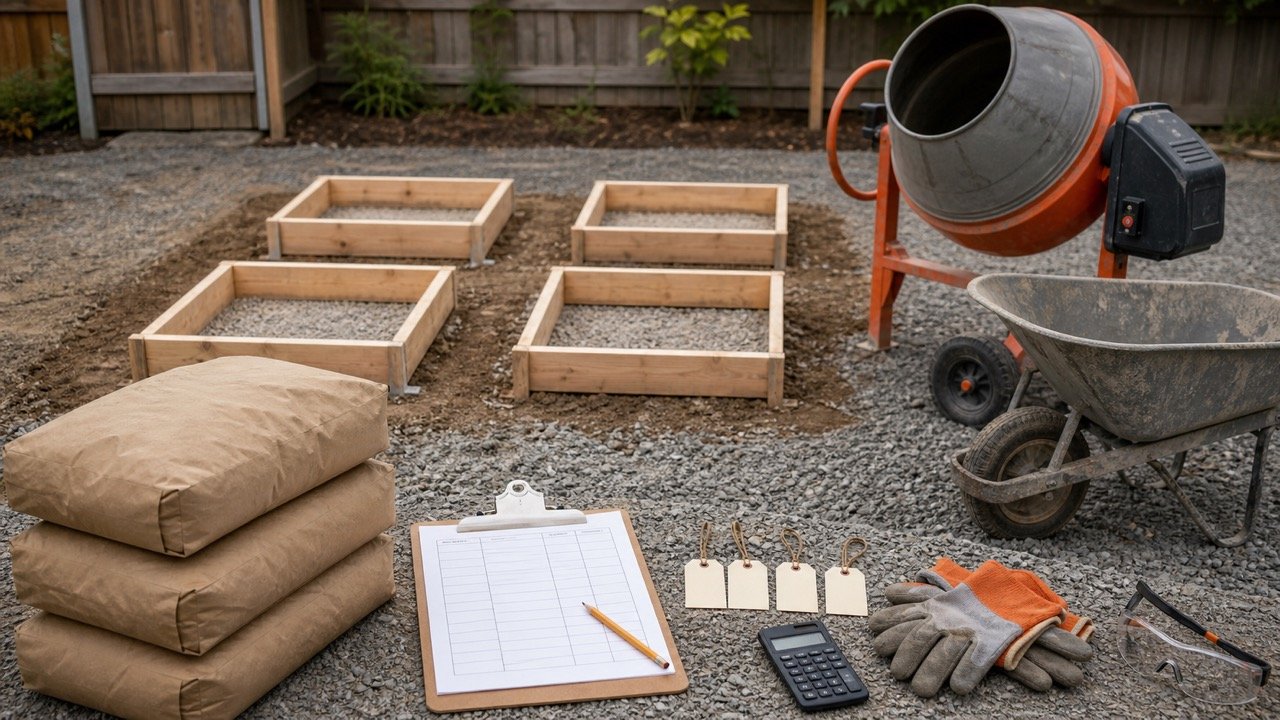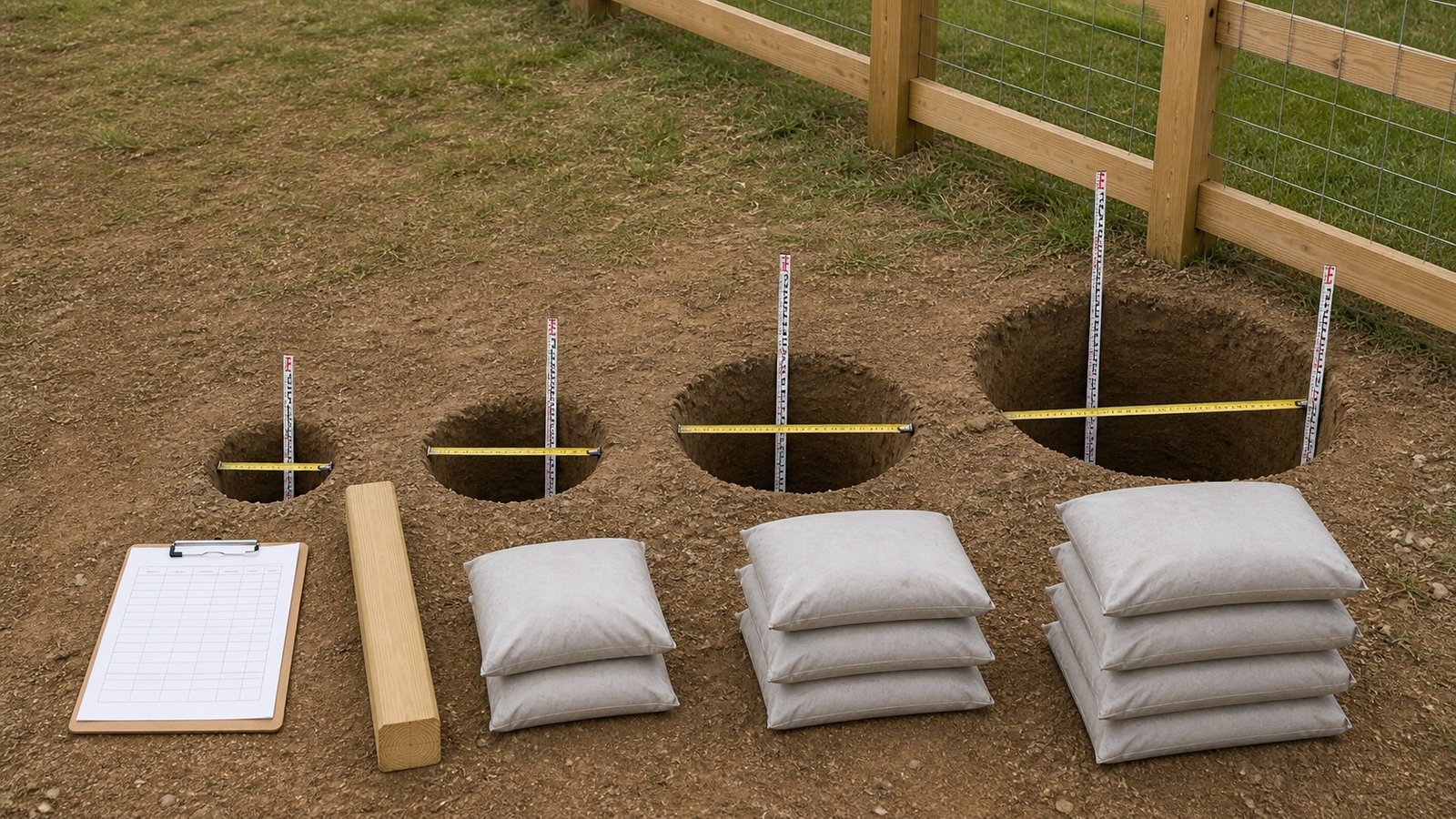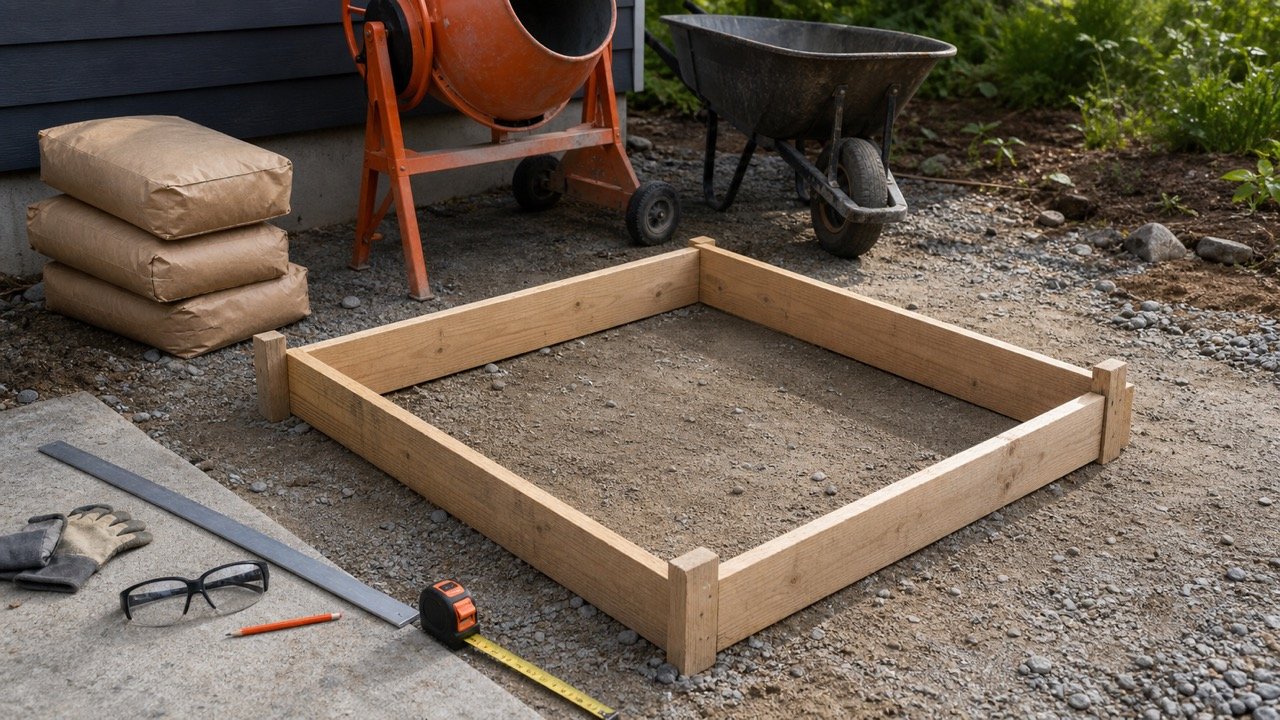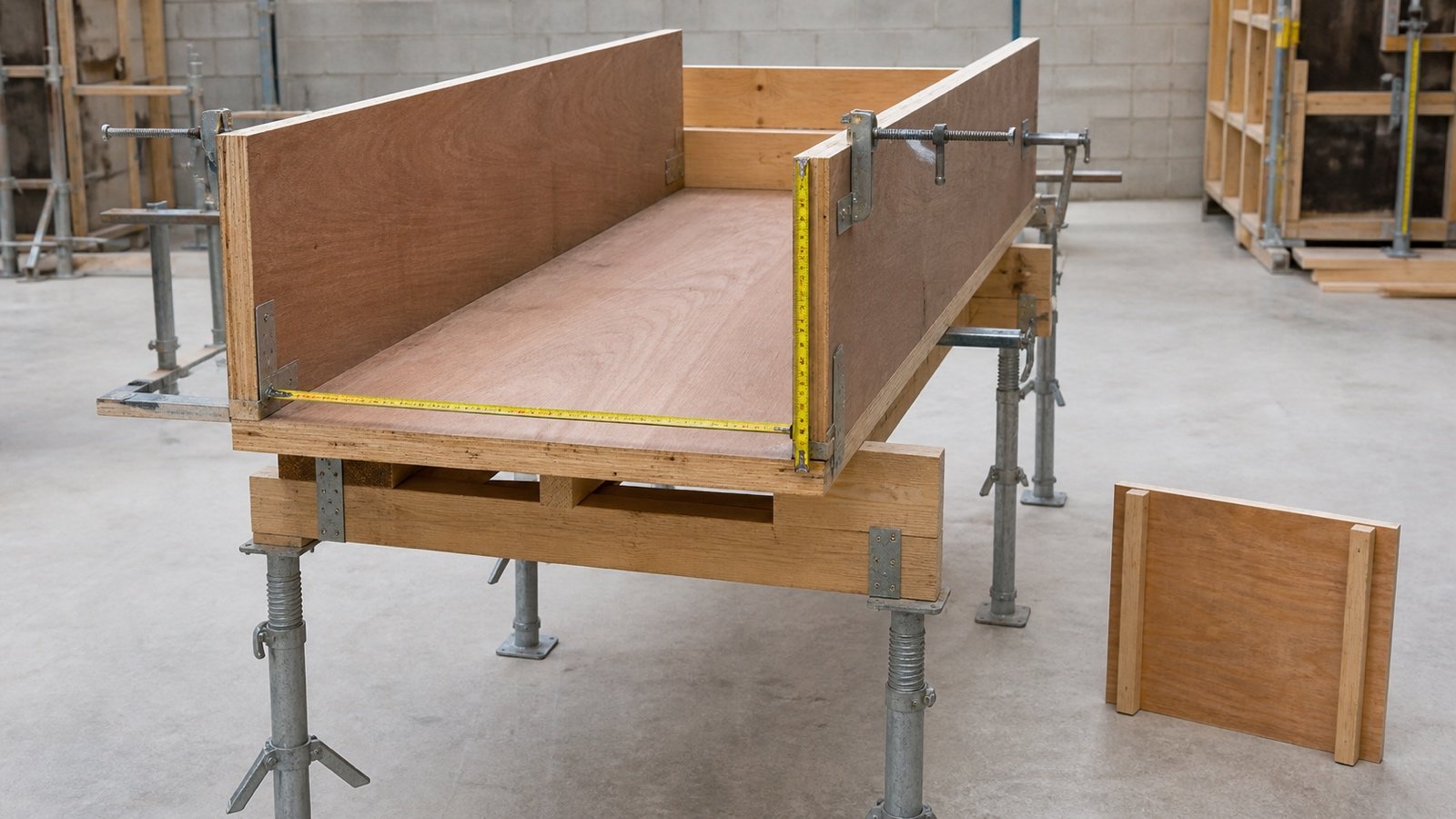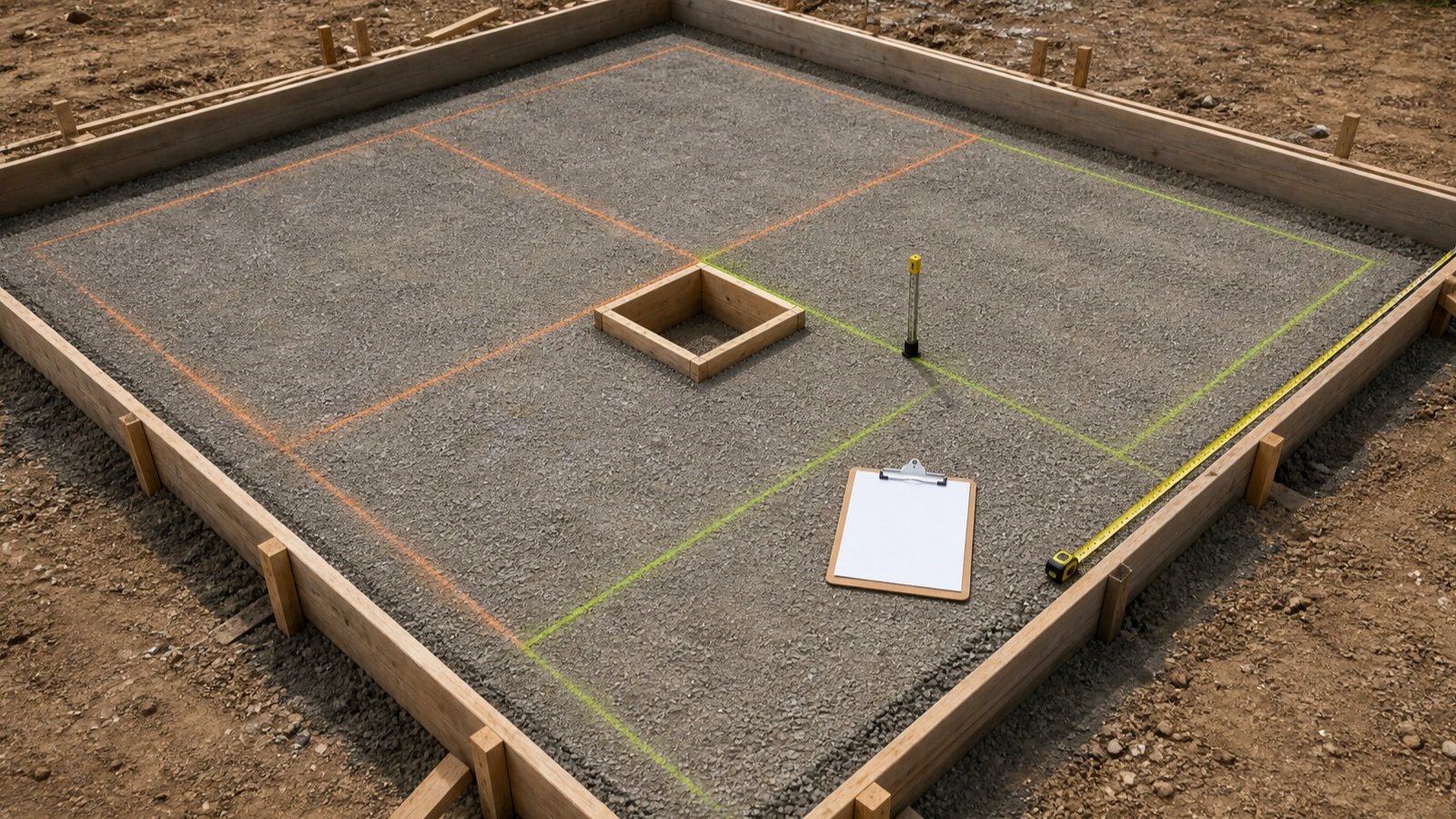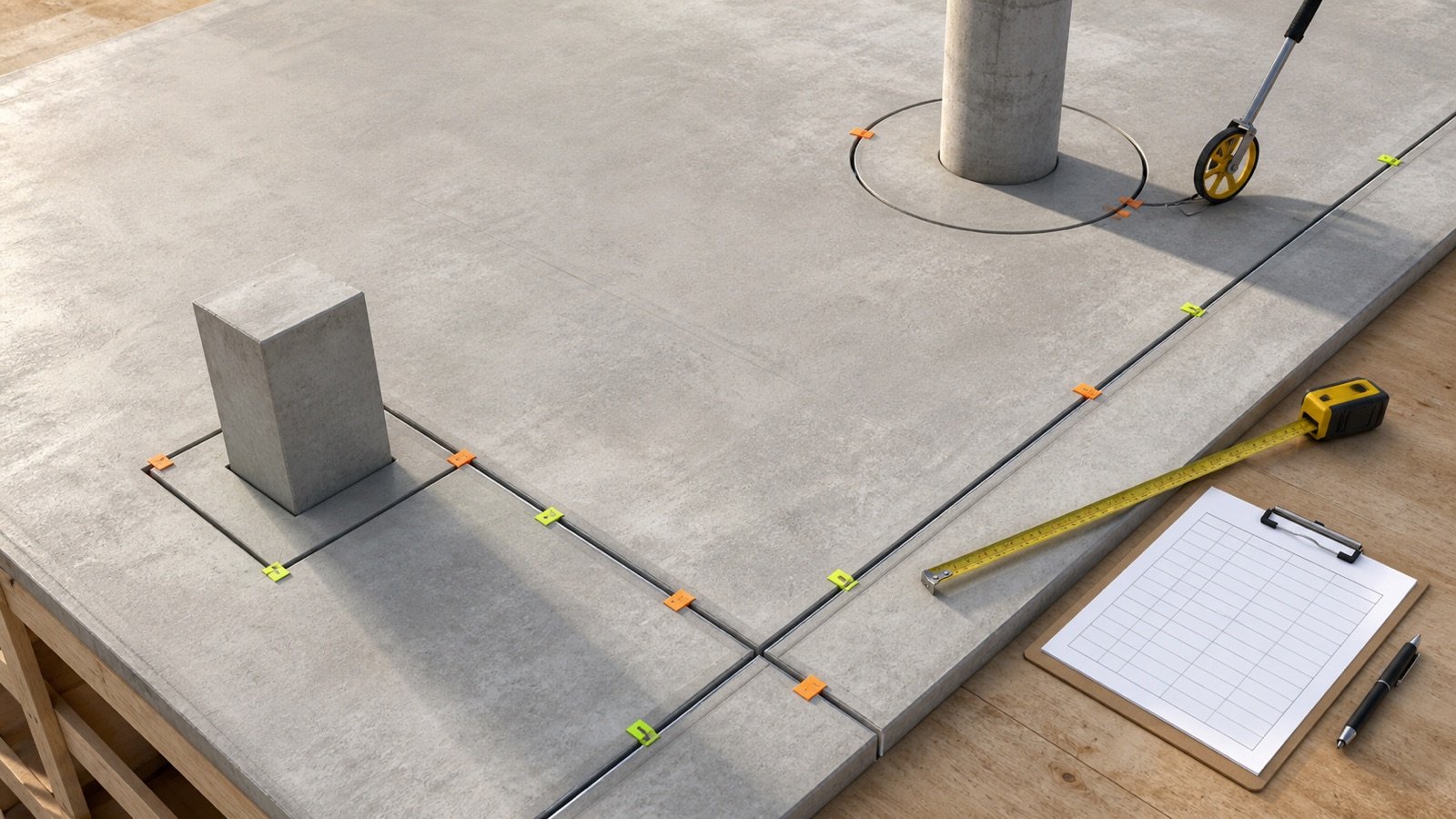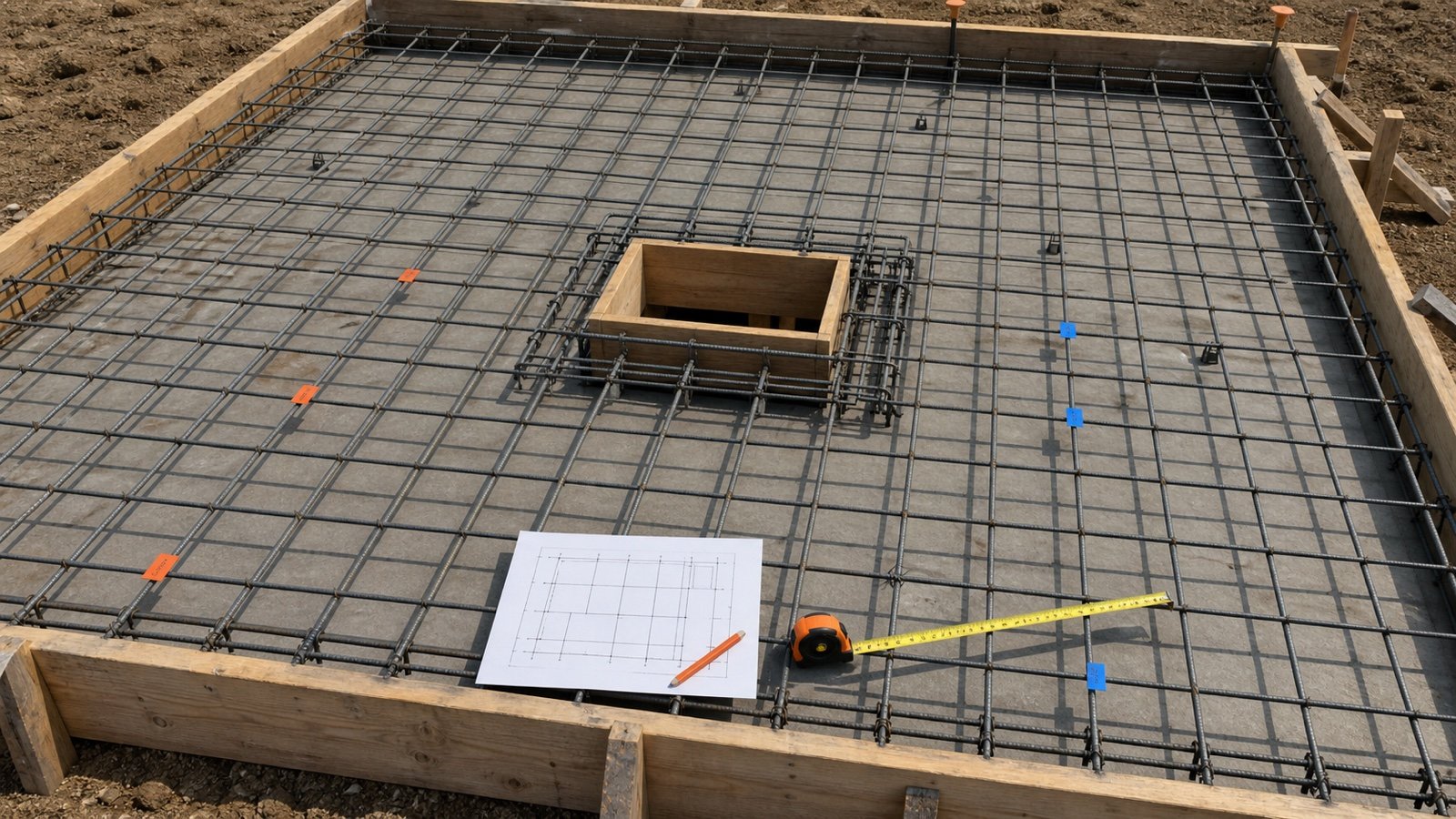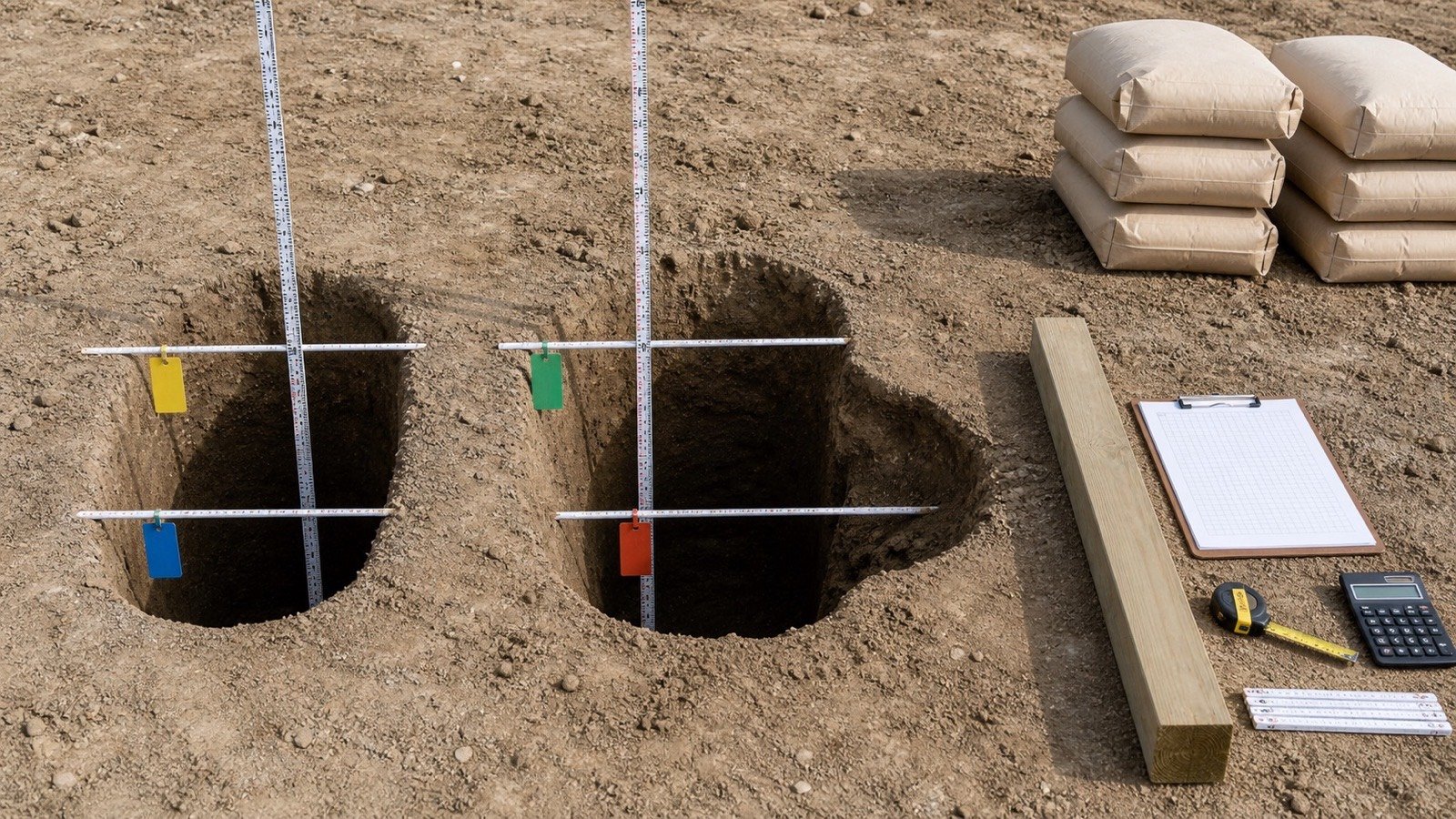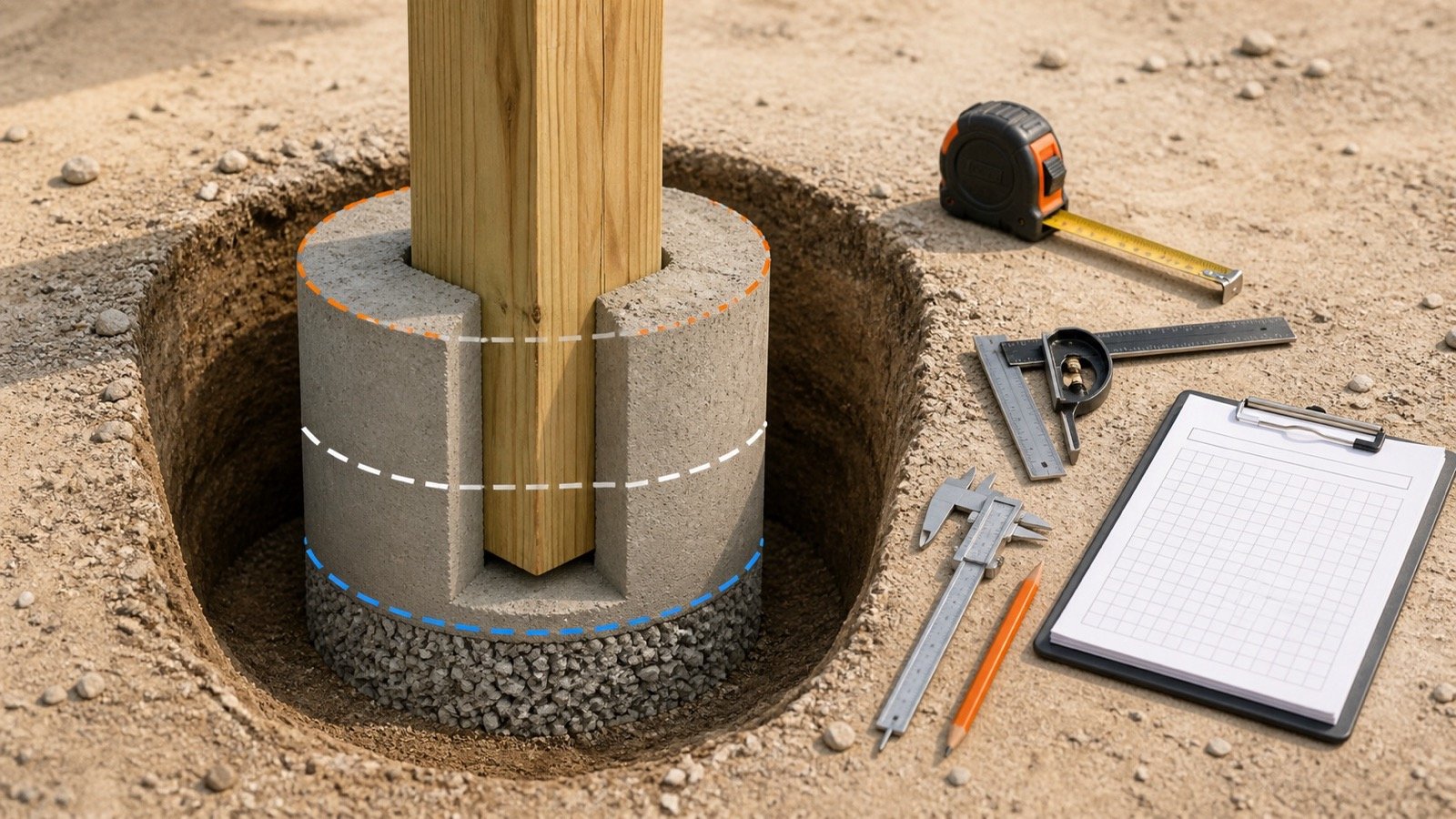
A post, sleeve or embedded fitting occupies part of a concrete-filled hole. The net concrete quantity depends on the object's external profile and the vertical depth where that object and concrete share the same space.
Record the concrete zone and the embedded object as separate solids. Subtract only their overlap, then multiply the unrounded net result across identical holes.
How do you calculate net concrete after post displacement?
Calculate the gross concrete-filled boundary. Find the external cross-sectional area of each solid object inside that boundary, multiply by its shared depth with the concrete, and subtract the verified occupied volumes once.
Object displacement = external cross-sectional area × overlap depth
Net concrete = gross concrete volume − verified displacement
A round post uses π × (diameter ÷ 2)² for its area. A square or rectangular post uses length × width. Use compatible units throughout the calculation.
What is the overlap depth?
Overlap depth is the vertical distance where the object lies inside the concrete zone. It can differ from total hole depth, concrete fill depth and total buried post depth.
Overlap depth = max(0, min(concrete top, object top) − max(concrete bottom, object bottom))
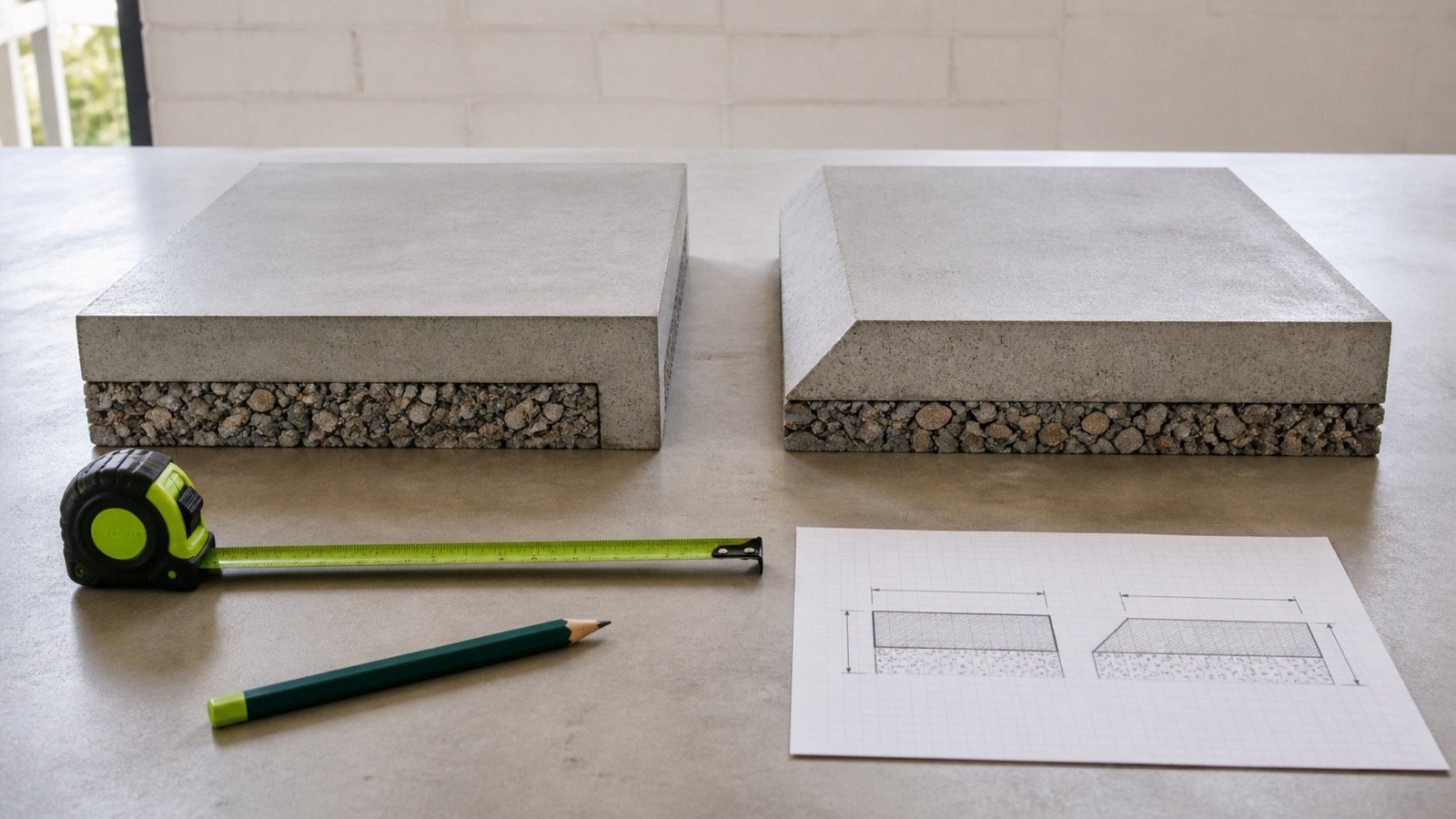
Use elevations from one datum, or draw the vertical zones and measure their shared portion. A post that stops 3 in above the concrete bottom has 3 in of concrete below it. That lower layer remains part of the net concrete.
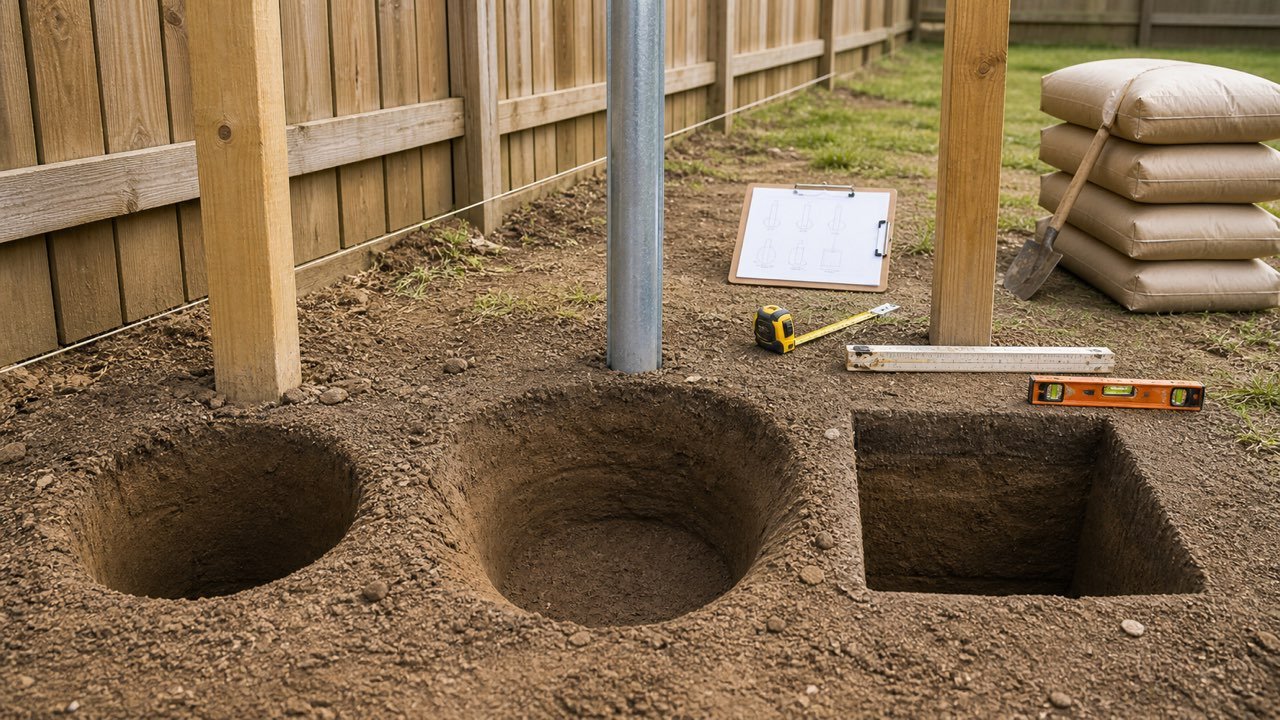
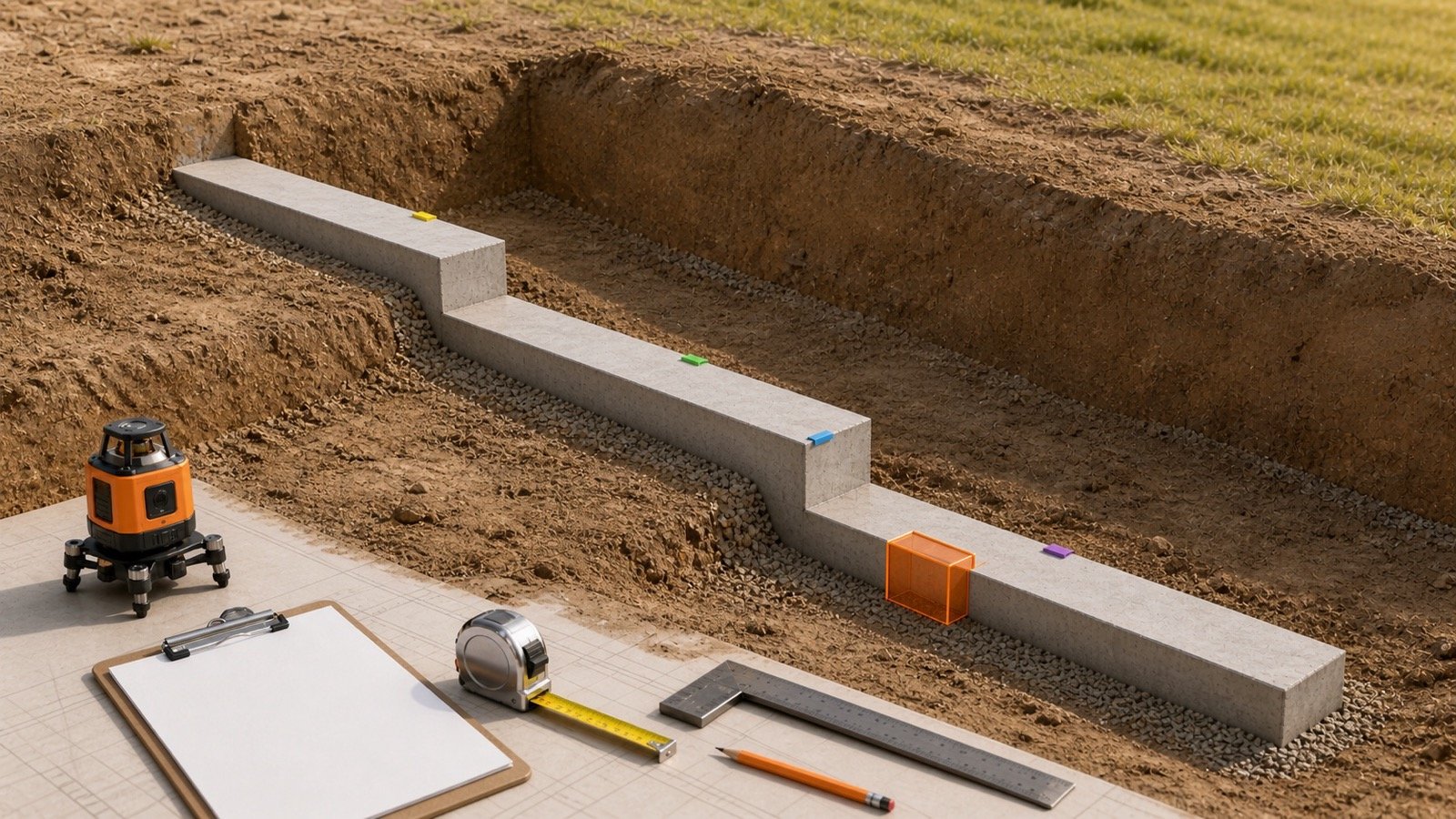
QUIKRETE's named setting-post workflow places gravel at the hole bottom, then installs the post and fills concrete to a level below grade. It shows why excavation, gravel, post and concrete depths need separate records. The product and project instructions control the actual zones.
Which dimensions belong in the displacement record?
| Field | Record | Quantity use |
|---|---|---|
| Concrete boundary | Shape, diameter or length and width, bottom elevation and top elevation | Gross volume |
| Object profile | Actual external diameter, or actual length and width | Occupied area |
| Object elevations | Bottom and top within or near the concrete zone | Shared depth |
| Fill state | Solid, sealed hollow, open hollow, or intentionally concrete-filled | External-envelope or wall-only deduction |
| Quantity | Count of identical hole and object combinations | Group total before rounding |
| Source | Drawing, detail, measured field record and revision | Traceability |
Nominal post names can differ from the installed section. Measure or obtain the accepted actual dimensions. A coating, sleeve, wrap or irregular profile may change the external boundary that excludes concrete.
Worked imperial example: square posts in round holes
Ten approved round concrete zones are 12 in in diameter and 30 in deep. Each actual timber post measures 3.5 in × 3.5 in and overlaps 27 in of the concrete depth.
- Gross per hole: π × 6² × 30 ÷ 1,728 = 1.963495 ft³.
- Post displacement: 3.5 × 3.5 × 27 ÷ 1,728 = 0.191406 ft³.
- Net per hole: 1.963495 − 0.191406 = 1.772089 ft³.
- Net for 10 holes: 1.772089 × 10 = 17.720892 ft³.
- Cubic-yard equivalent: 17.720892 ÷ 27 = 0.656329 yd³.
The post stops 3 in above the concrete-zone bottom in this fixture. Subtracting the post through the full 30 in would understate the 10-hole concrete quantity by 0.212674 ft³.
How can displacement change the bag count?
Apply the selected product's current mixed yield after the compatible net volumes are added. Round the final quotient up once.
The 10 gross holes in the imperial fixture contain 19.634954 ft³. At the current QUIKRETE Concrete Mix No. 1101 example yield of approximately 0.60 ft³ per 80 lb bag, the gross quotient is 32.724923, which rounds to 33 bags.
The net concrete is 17.720892 ft³. Its quotient is 29.534819, which rounds to 30 bags. The 3-bag difference comes from verified post displacement. No allowance is used in this comparison, and the named-product yield does not apply to another mix without a current product record.
Worked metric example: round posts with a shorter overlap
Eight approved round concrete zones are 300 mm in diameter and 750 mm deep. Each measured round post is 89 mm in diameter and overlaps 650 mm of the concrete.
- Gross per hole: π × 0.15² × 0.75 = 0.053014 m³.
- Post displacement: π × 0.0445² × 0.65 = 0.004044 m³.
- Net per hole: 0.053014 − 0.004044 = 0.048971 m³.
- Net for 8 holes: 0.048971 × 8 = 0.391765 m³.
- Litre equivalent: 0.391765 × 1,000 = 391.765 L.
The result keeps full precision until the group total. NIST Handbook 44 Appendix C supports the volume conversions. It does not set the post or hole geometry.
When is the displacement zero?
Displacement is 0 when the object occupies no part of the concrete volume being measured. Confirm that condition from the approved detail.
- A post mounted on a base plate above the concrete has no post displacement.
- A bracket above the concrete contributes no displacement; embedded anchors or hardware may occupy a separate verified volume.
- A post located in another material zone has no overlap with the concrete zone.
- An empty pier or hole with no embedded object uses the full gross concrete volume.
Do not enter a zero deduction merely because an object's volume seems small. Calculate enough to establish whether it can change the reported quantity, package ceiling or supplier handoff.
How do hollow posts and sleeves change the deduction?
The accepted fill state controls the geometry. A sealed hollow post or sleeve that keeps concrete outside displaces its full external envelope through the overlap depth.
If the approved placement fills both the space around a hollow section and its internal void, calculate the 2 regions separately. One method subtracts the external envelope from the gross hole, then adds the verified internal concrete volume. The net deduction is the section's material wall volume through the shared depth.
| Condition | Quantity treatment |
|---|---|
| Solid post | Subtract external profile × shared depth |
| Sealed hollow section | Subtract full external envelope × shared depth |
| Hollow section intentionally filled with concrete | Subtract external envelope, then add verified internal fill |
| Open sleeve with unknown concrete entry | Hold the quantity until the accepted fill boundary is known |
| Changing or tapered section | Divide into valid non-overlapping solids |
Hardware holes, drainage openings and grout zones can change whether the internal void fills. Drawings, product instructions and the accepted placement method provide that answer.
How do collars and several vertical zones affect displacement?
Calculate each non-overlapping concrete zone with its own boundary and shared object depth. A below-grade cylinder and an above-grade collar can have different diameters, shapes and post overlap.
Example: a post passes through a 24 in below-grade concrete zone and a 4 in collar. Record 24 in of displacement against the hole and 4 in against the collar. If the post stops at grade, the collar has 0 post displacement.
Gravel, soil backfill, air space and concrete are different zones. The Concrete Post Hole Volume guide explains straight, tapered and changed hole sections.
How should a rectangular post be checked inside a round hole?
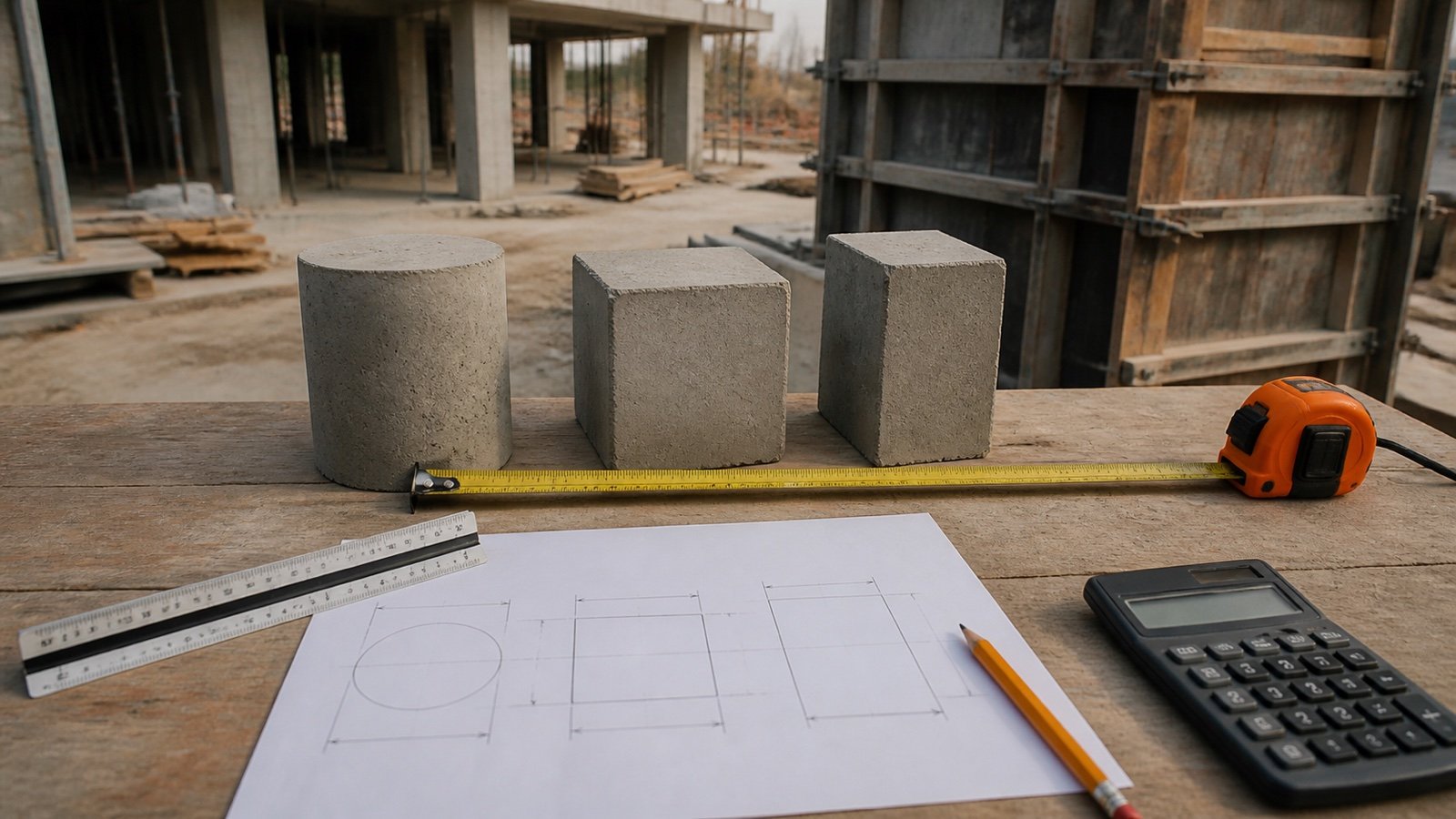
Use the rectangular post's diagonal for a basic geometric fit check. For a post with sides `a` and `b`, the diagonal is √(a² + b²). It must be smaller than the narrowest verified hole diameter for the entered geometry to fit.
A 100 mm × 100 mm post has a 141.421 mm diagonal. Its full-depth area occupies 20.3718% of a 250 mm round hole. A 100 mm round post through that same full-depth hole occupies 16%.
These percentages compare geometry. They do not approve concrete clearance, aggregate flow, consolidation, cover, constructability or structural performance.
Should small anchors and hardware be deducted?
Calculate their verified occupied volume when the takeoff standard or project record requires it. Keep the item visible even when the result does not change the purchasing increment.
A group of anchor rods may occupy far less volume than a large timber post or sleeve. The package count can remain unchanged after the deduction. That outcome is a rounding result, not proof that the hardware has no design or placement effect.
Do not estimate an unknown cage, bracket, sleeve or embed. Obtain the approved geometry or keep the displacement unresolved.
How should changed holes and objects be grouped?
Use one calculator run for holes that share the same concrete geometry, object profile, overlap depth, allowance basis and package yield. Split a group when any input changes.
The Post Hole Concrete Worksheet records line, corner, end, gate and changed-hole groups. Use Oversized Post Hole Concrete when a measured hole boundary differs from the approved base geometry.
Keep full precision across compatible groups. Rounding each hole to a whole bag can add several packages that the combined volume does not require.
Should displacement replace a planning allowance?
Displacement and allowance answer different questions. Displacement removes a measured occupied solid. An allowance is a separate planning adjustment supported by project evidence.
Start allowance at 0%. Record gross, displacement and net volume before applying any documented percentage. A percentage cannot define an unknown overlap, collapsed side, open sleeve, wrong unit or unverified product yield.
Common post-displacement mistakes
- Subtracting the post through the total hole depth instead of its concrete overlap.
- Using nominal post size without confirming the actual external profile.
- Deducting a base-mounted post that sits above the concrete.
- Treating a hollow section as solid when concrete intentionally fills its interior.
- Assuming an open sleeve will stay empty or fill completely.
- Subtracting the same object from a hole and collar twice.
- Using face width instead of the diagonal to check a rectangular post in a round hole.
- Combining different holes, posts or overlap depths in one group.
- Rounding each hole before multiplying the compatible quantity.
- Using displacement as an automatic waste allowance.
- Treating net volume as approval of the foundation detail.
What safety and design limits apply?
Locate expected underground installations before excavation. OSHA 29 CFR 1926.651 states this requirement for covered U.S. construction work and addresses safe location steps as excavation approaches an installation.
Wet portland cement, dry mix, lifting, water, equipment and excavation conditions require applicable product and workplace controls. Follow the current safety data sheet, project procedures and local requirements.
This quantity method does not size a foundation, assess soil, frost, wind or structural loads, choose a post connection, set concrete cover, approve a hollow-section fill, design excavation or certify completed work.
What should the calculation record contain?
- Hole group, count, location, drawing or detail revision and measurement date.
- Gross concrete shape, dimensions, bottom and top elevations.
- Object identity, actual external profile, fill state, bottom and top elevations.
- Overlap depth, displacement per object and any internal concrete fill.
- Gross, displacement and net volume per hole and per group.
- Allowance, reason, product, current mixed yield and package quotient.
- Field changes, unresolved fill boundaries, preparer and checker.
Enter straight round, tapered round or rectangular hole groups in the Concrete Post Hole Calculator. It subtracts a verified round or rectangular post profile and keeps measured volume, planning volume and whole packages separate.
Use the Concrete Bags per Post Hole Chart for quick diameter-and-depth rows. Return to the Concrete Planning hub for packaged concrete and ready-mix workflows.
Sources and scope
- NIST Handbook 44, 2026, Appendix C: exact volume-unit relationships used in the fixtures.
- QUIKRETE, Setting Posts without Mixing: one named manufacturer workflow with separate gravel, post and concrete zones.
- QUIKRETE Concrete Mix No. 1101 SPEC-DATA: named product package sizes and approximate mixed yield.
- OSHA 29 CFR 1926.651: cited U.S. excavation requirements within its scope.
Source scope: NIST supports unit relationships. QUIKRETE supports only its named products and stated workflow. OSHA supports the stated U.S. workplace boundary. These sources do not choose the hole, post, overlap, sleeve fill, allowance, foundation design, product or supplier order.
Review note: Saleem Sial owns the research and editorial record. Formula fixtures, source checks, build validation and rendered QA form the internal publication gate. Waseem Sial, External Reviewer and Engineer, is listed for ongoing external review; no completed review date is claimed.