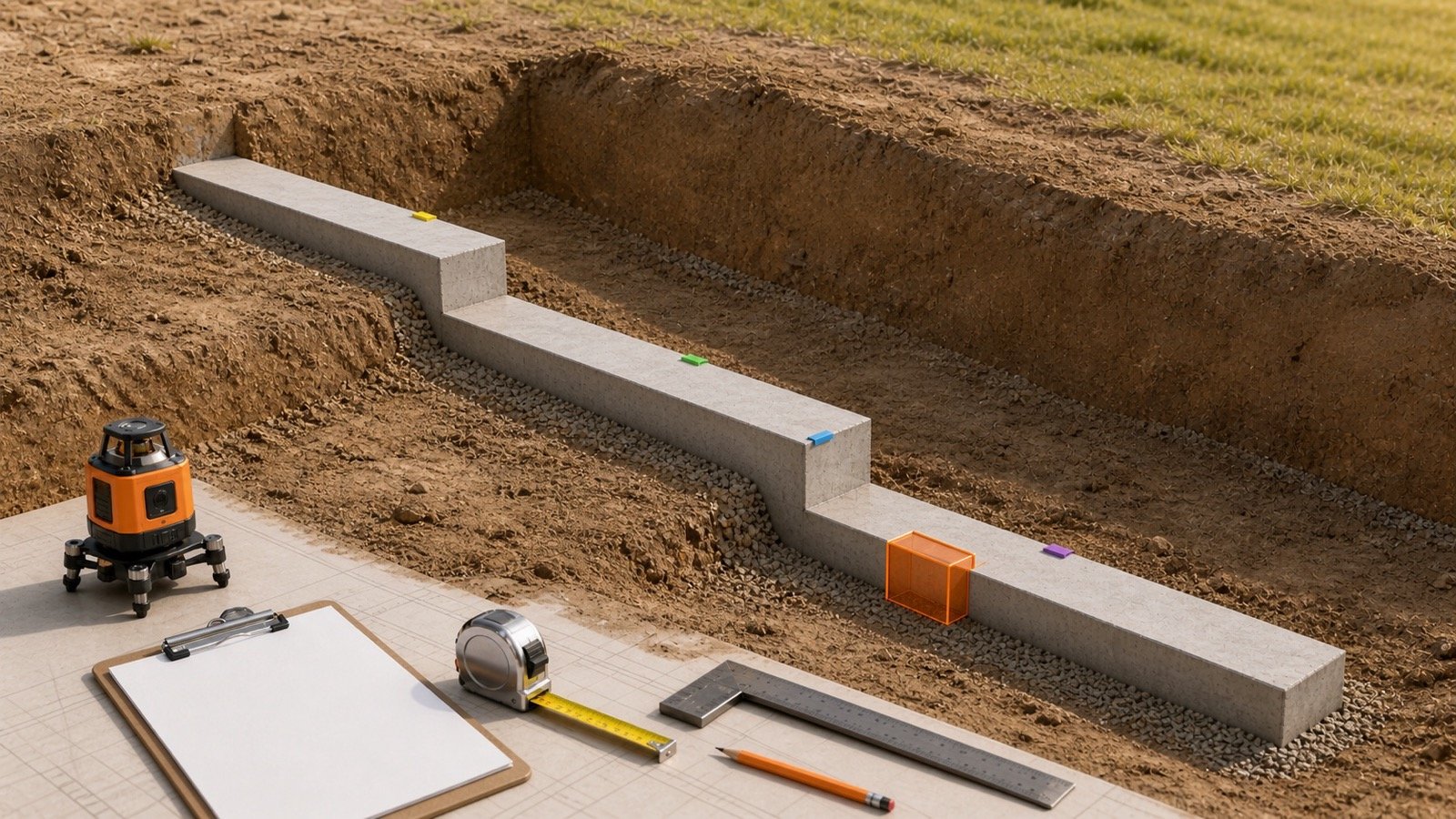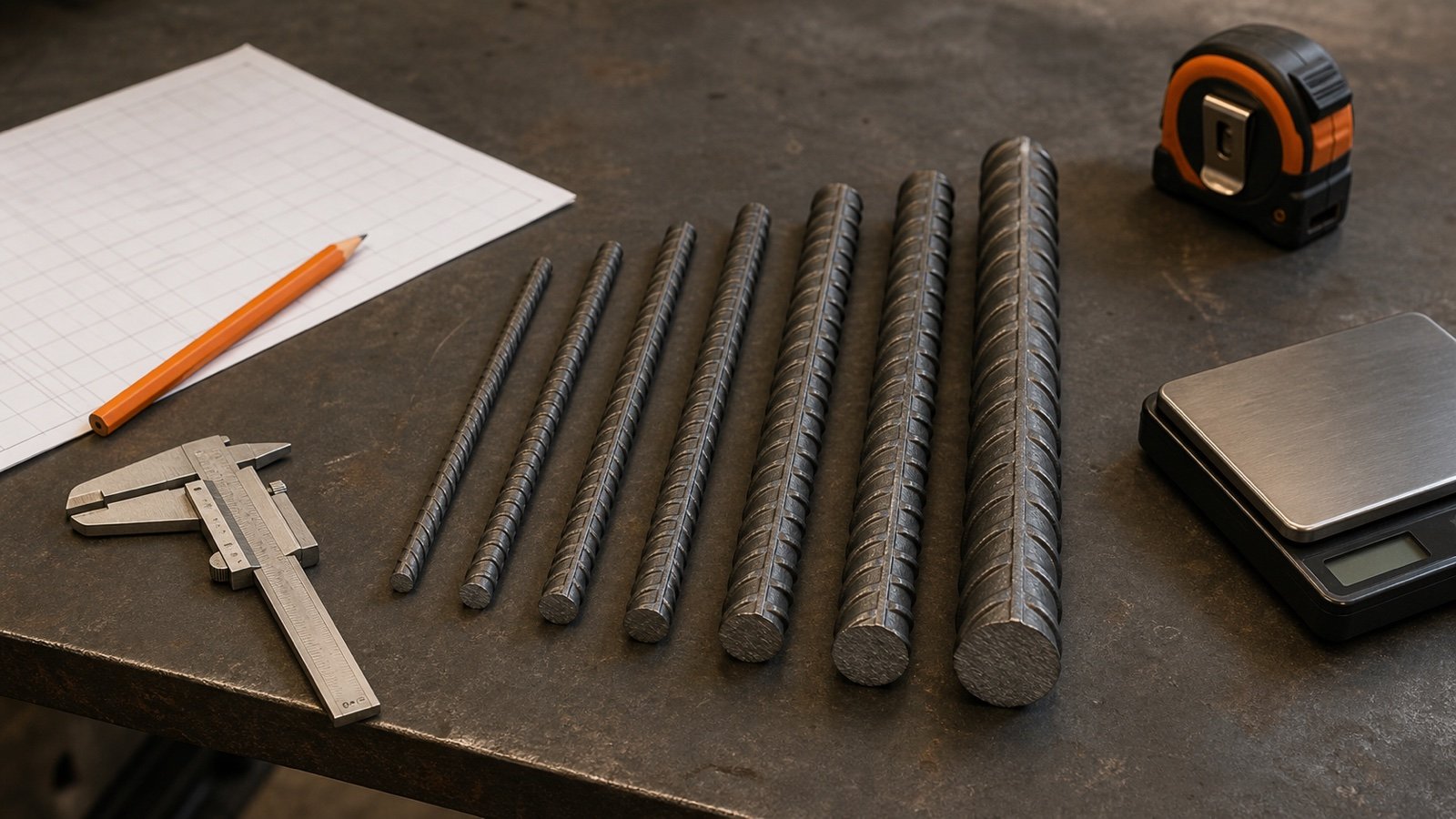
A rebar size chart is useful when a drawing gives a bar designation but the takeoff needs diameter, cross-sectional area or mass per unit length. Read the exact row first, then keep the source and material specification with the quantity record.
The table below covers the standard U.S. designations #3 through #18. It supports quantity checks and does not select reinforcement for a slab, footing, wall, beam or column.
What are the dimensions and unit weights of #3 to #18 rebar?
U.S. #3 rebar has a nominal diameter of 0.375 in and a nominal weight of 0.376 lb/ft. At the other end of this chart, #18 has a nominal diameter of 2.257 in and weighs 13.600 lb/ft.
Caltrans publishes the inch-pound diameter, area and weight values below for ASTM standard bars in its September 2025 bridge-detailing reference. Montana DOT publishes the paired metric designations and kg/m values. Confirm the applicable material standard and supplier record before using a row for purchasing or compliance.
| U.S. bar | Soft metric | Nominal diameter | Nominal area | Nominal weight |
|---|---|---|---|---|
| #3 | #10 | 0.375 in 9.5 mm | 0.11 in² 71 mm² | 0.376 lb/ft 0.560 kg/m |
| #4 | #13 | 0.500 in 12.7 mm | 0.20 in² 129 mm² | 0.668 lb/ft 0.994 kg/m |
| #5 | #16 | 0.625 in 15.9 mm | 0.31 in² 199 mm² | 1.043 lb/ft 1.552 kg/m |
| #6 | #19 | 0.750 in 19.1 mm | 0.44 in² 284 mm² | 1.502 lb/ft 2.235 kg/m |
| #7 | #22 | 0.875 in 22.2 mm | 0.60 in² 387 mm² | 2.044 lb/ft 3.042 kg/m |
| #8 | #25 | 1.000 in 25.4 mm | 0.79 in² 510 mm² | 2.670 lb/ft 3.973 kg/m |
| #9 | #29 | 1.128 in 28.7 mm | 1.00 in² 645 mm² | 3.400 lb/ft 5.060 kg/m |
| #10 | #32 | 1.270 in 32.3 mm | 1.27 in² 819 mm² | 4.303 lb/ft 6.404 kg/m |
| #11 | #36 | 1.410 in 35.8 mm | 1.56 in² 1,006 mm² | 5.313 lb/ft 7.907 kg/m |
| #14 | #43 | 1.693 in 43.0 mm | 2.25 in² 1,452 mm² | 7.650 lb/ft 11.38 kg/m |
| #18 | #57 | 2.257 in 57.3 mm | 4.00 in² 2,581 mm² | 13.600 lb/ft 20.24 kg/m |
Enter the exact product or supplier unit mass in the Rebar Calculator when it is available. The calculator does not infer bar size, grade, coating or unit mass from a name.
Does the rebar number always equal the diameter in eighths of an inch?
The shortcut is exact for the published nominal diameters from #3 through #8. Dividing those bar numbers by 8 gives 0.375 in through 1.000 in.
Do not extend that arithmetic as an exact diameter rule for the larger standard bars. The published diameter for #9 is 1.128 in, not 1.125 in. #10 is 1.270 in, #11 is 1.410 in, #14 is 1.693 in and #18 is 2.257 in. Use the table value whenever the property enters a calculation or record.
| Bar | Number ÷ 8 | Published nominal diameter | Difference |
|---|---|---|---|
| #8 | 1.000 in | 1.000 in | 0.000 in |
| #9 | 1.125 in | 1.128 in | 0.003 in |
| #10 | 1.250 in | 1.270 in | 0.020 in |
| #11 | 1.375 in | 1.410 in | 0.035 in |
| #14 | 1.750 in | 1.693 in | −0.057 in |
| #18 | 2.250 in | 2.257 in | 0.007 in |
Why can the outside width be greater than the nominal diameter?
The nominal diameter describes an equivalent round cross-section used for standard bar properties. Deformed rebar has ribs that project beyond that nominal circle, so a caliper across the deformations can show a larger outside envelope.
Caltrans lists both nominal and deformation diameters in its ASTM A706 Grade 60 bridge-detailing table. For example, it shows #5 at 0.625 in nominal diameter and 0.69 in deformation diameter. Its note tells users to use deformation diameter when calculating clearances within that Caltrans detailing scope.
| Bar | Nominal diameter | Caltrans deformation diameter | Difference |
|---|---|---|---|
| #3 | 0.375 in | 0.44 in | 0.065 in |
| #5 | 0.625 in | 0.69 in | 0.065 in |
| #8 | 1.000 in | 1.13 in | 0.130 in |
| #11 | 1.410 in | 1.63 in | 0.220 in |
| #18 | 2.257 in | 2.50 in | 0.243 in |
Do not transfer that agency note into another project without checking the governing standard and detailing rules. Cover, clear spacing, bend geometry, couplers and congestion can use different defined dimensions.
How do you calculate rebar weight from length?
Multiply the total length for one bar designation by its matching nominal unit weight. Keep feet with lb/ft or metres with kg/m.
Nominal rebar weight = total bar length × nominal unit weight
For 250 ft of #5 rebar, the chart rate is 1.043 lb/ft:
250 ft × 1.043 lb/ft = 260.75 lb
For 120 m of the corresponding #16 soft-metric-designated bar, the chart rate is 1.552 kg/m:
120 m × 1.552 kg/m = 186.24 kg
A piece-count example follows the same order. Forty #4 pieces at 20 ft each total 800 ft. At 0.668 lb/ft, the nominal weight is 534.4 lb.
Why can a converted unit weight differ in the last digit?
Published tables round their displayed values. Converting an already rounded lb/ft value can land slightly above or below the published kg/m figure.
NIST defines 1 lb as 0.45359237 kg and 1 ft as 0.3048 m. Converting #4's displayed 0.668 lb/ft gives about 0.9941 kg/m, which rounds to the published 0.994 kg/m. Preserve the unit system and precision required by the controlling record rather than mixing rounded values mid-calculation.
What does a soft-metric rebar designation mean?
The paired number is a metric designation for the listed U.S. standard bar. In the cross-checked agency tables, #4 pairs with #13, #5 with #16 and #8 with #25. The pairing lets drawings and records identify the corresponding nominal bar across unit conventions.
Do not assume every bar sold under a rounded millimetre description is the same product as the soft-metric entry. ASTM A615/A615M-26 states that inch-pound and SI orders are separate standard systems and that combining their values can cause nonconformance. The purchase order, mill certificate and project specification should identify the actual system and bar.
Which unit mass should you use in the Rebar Calculator?
Use the unit mass stated for the exact designation and applicable product record. A current mill certificate, supplier data or project bar list takes priority when it identifies the supplied material and the project accepts that basis.
- Read the bar mark and designation from the current structural or placing documents.
- Confirm the governing material standard, grade and coating.
- Find the unit mass in the accepted product, supplier or project record.
- Use lb/ft in the calculator's imperial mode or kg/m in metric mode.
- Store the source, revision and rate beside the result.
The Rebar Calculator multiplies the entered rate by installed or planning length. It keeps the grid calculation separate from the property source.
What should a rebar property record contain?
A short source record lets another reviewer reproduce the mass calculation and detect a row copied from the wrong designation.
| Field | Example | Reason |
|---|---|---|
| Bar mark and location | B12, slab lower mat | Connects the rate to a drawing quantity |
| Designation | #5 / #16 | Identifies the chart or product row |
| Material and grade | As specified on S-501 | Prevents a size table from replacing the material requirement |
| Coating or finish | Uncoated, epoxy-coated or another specified system | Separates product and handling records |
| Unit-mass source | Supplier data, revision and date | Makes the entered lb/ft or kg/m traceable |
| Calculation unit | 1.043 lb/ft | Prevents feet and metres from being mixed |
| Included quantity state | Installed length, lap-added cut length or whole stock | Shows what the resulting mass represents |
Can this chart be used for #20 [64] or non-U.S. bars?
This table stops at #18 because the public Caltrans, Montana DOT and Wisconsin DOT references used for cross-checking publish #3 through #18 together. ASTM A615/A615M-26 includes No. 20 [64] and warns that some design codes or specifications may not recognize it; use can require authority approval and special detailing.
For #20 [64], hard-metric bars, welded wire reinforcement, stainless steel, glass-fibre-reinforced polymer, rail steel, axle steel or another reinforcing product, use the applicable current standard and exact manufacturer or supplier data. Do not extend this table by proportion or substitute a nearby designation.
Which decisions remain outside a rebar size chart?
The chart cannot select bar size, grade, spacing, cover, number of layers, lap length, development length, hooks, bends, couplers, welding, supports, chairs, stock length or allowance. It also cannot approve a substitution or show whether a bar fits through a congested detail.
Structural drawings, calculations, specifications, placing drawings, approved submittals, bar lists and responsible professionals govern those decisions. Use the Concrete Planning hub to keep concrete-volume and reinforcement-quantity tasks connected without merging their assumptions.
Common rebar chart mistakes
- Applying the bar-number-over-eight shortcut as an exact rule above #8.
- Reading the outside deformation envelope as nominal diameter.
- Using nominal diameter alone for a clearance or congestion check.
- Treating a soft-metric designation as proof of a separate hard-metric product.
- Mixing rounded lb/ft and kg/m values in one calculation.
- Using a #4 rate for #5 because the bar marks look similar on a crowded plan.
- Multiplying stock length when the quantity represents installed length, or the reverse.
- Adding chairs, tie wire, couplers or supports to the bar weight without a separate quantity basis.
- Using this chart to choose reinforcement or approve a substitution.
Sources and source scope
- ASTM A615/A615M-26 public page: current carbon-steel reinforcing-bar scope, standard table location, grade range, separate unit systems and the No. 20 [64] caution.
- Caltrans Bridge Design Details 13.1, September 2025: #3–#18 nominal diameter, deformation diameter, nominal area and lb/ft values within its ASTM A706 Grade 60 bridge-detailing scope.
- Montana DOT MT 414-23: #3–#18 U.S. and metric designations, nominal diameter, lb/ft and kg/m reference values.
- Wisconsin DOT Bridge Construction handout: U.S. and soft-metric designation mapping with nominal diameter, area and weight values.
- NIST Guide to the SI, Appendix B: exact unit conversions used to check the relationship between lb/ft and kg/m.
Source scope: The agency tables support the stated reference properties in their published scope. ASTM describes the current A615/A615M-26 specification but its full standard table is not reproduced here. The project specification, current drawings and accepted supplier records control the actual reinforcing product and work.
Review note: Saleem Sial owns the research and editorial record. Source checks, independent calculation fixtures, editorial review, build validation, link crawl, schema review and rendered QA form the internal publication gate. Waseem Sial, External Reviewer and Engineer, is listed for ongoing external review; no completed review date is claimed.