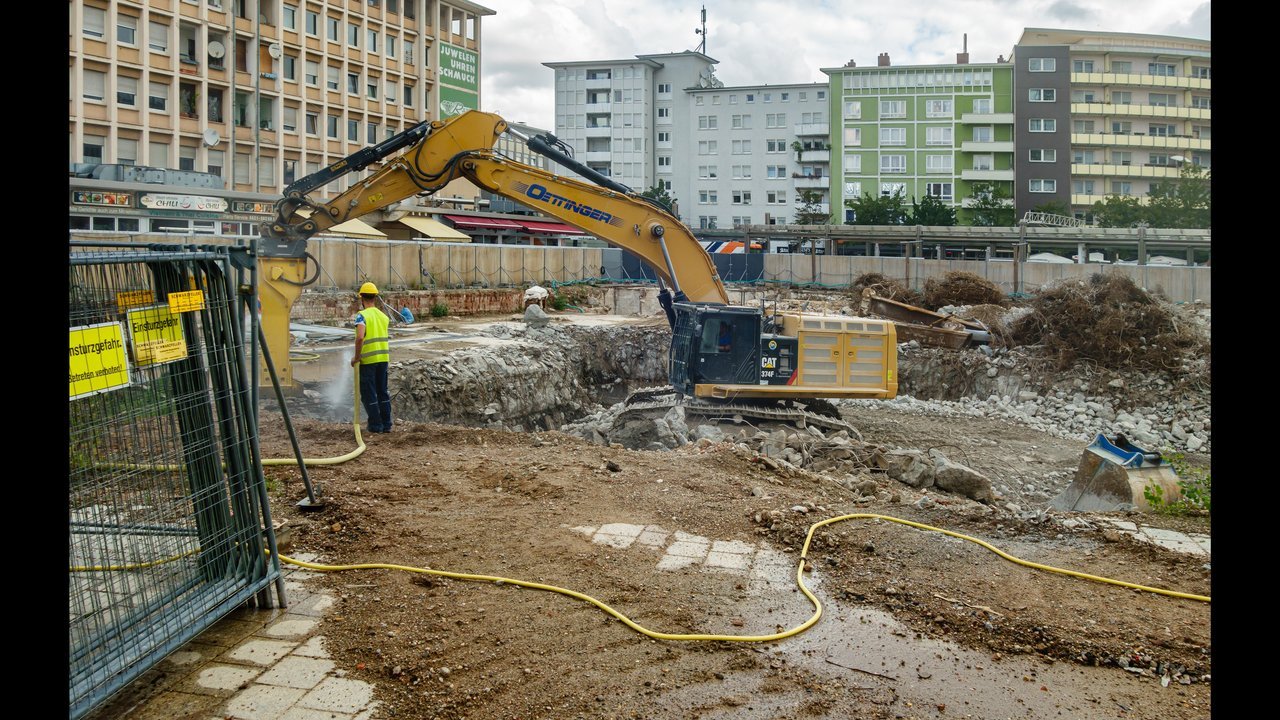
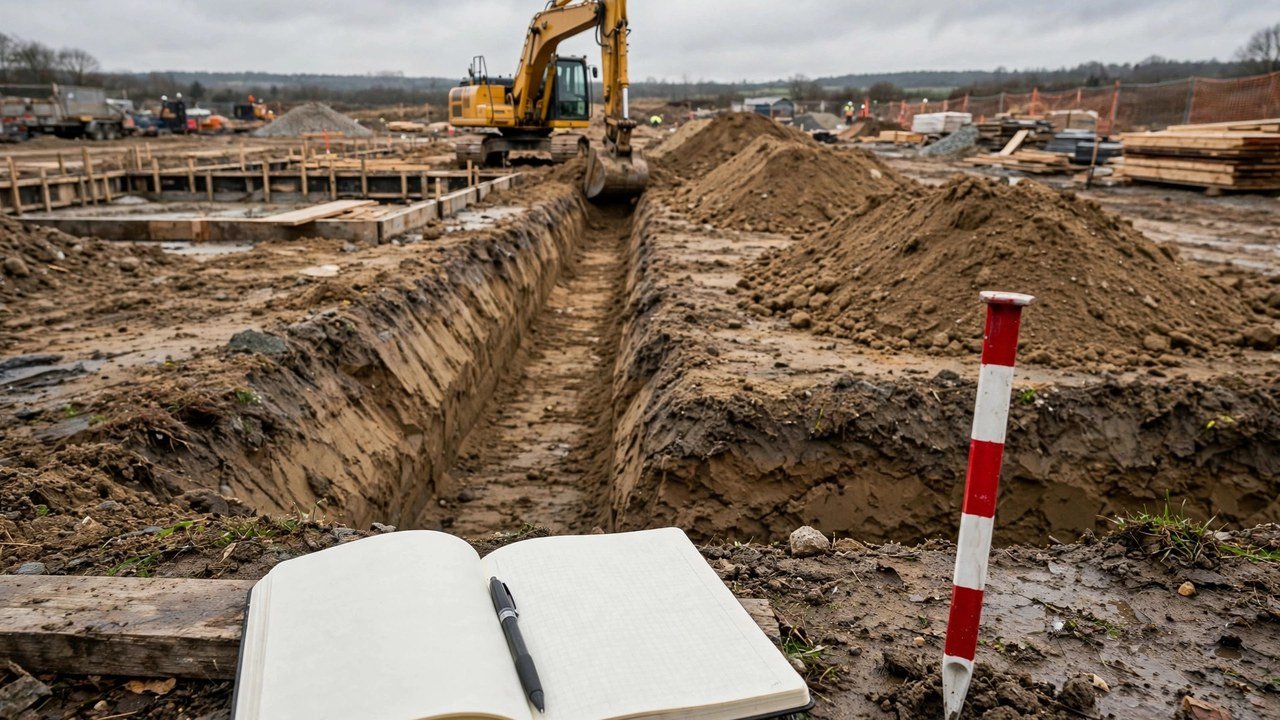
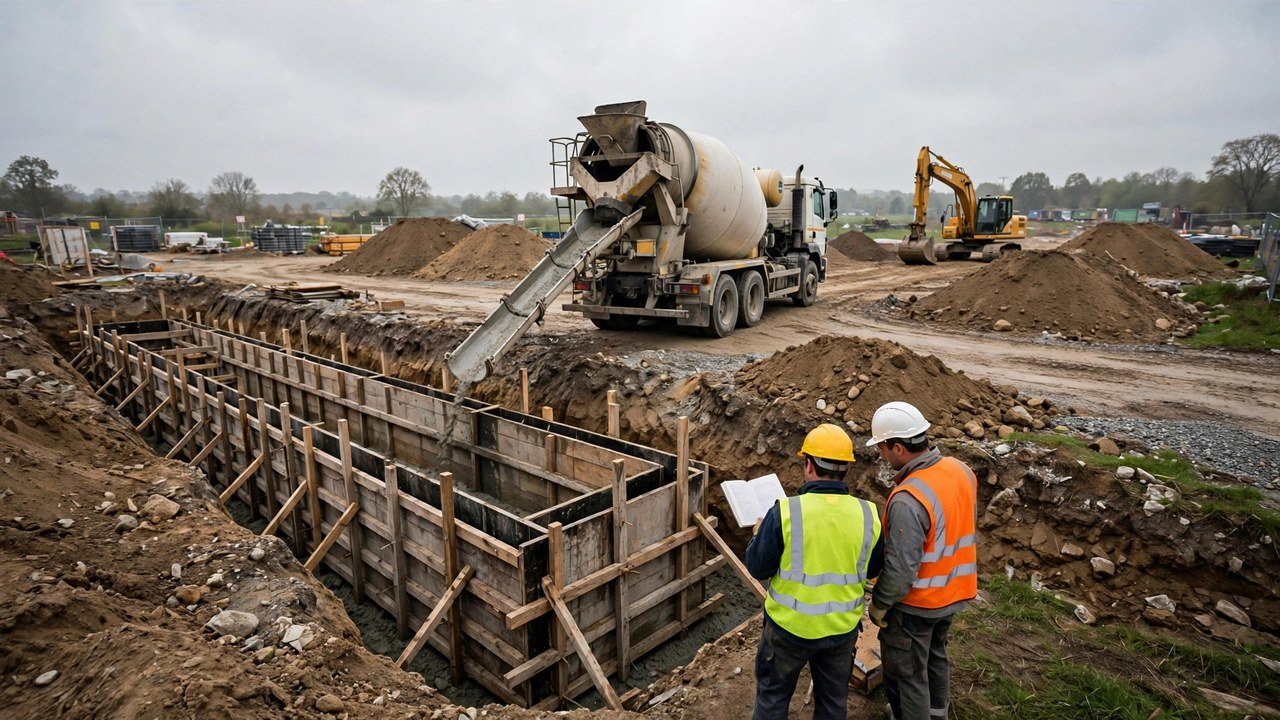
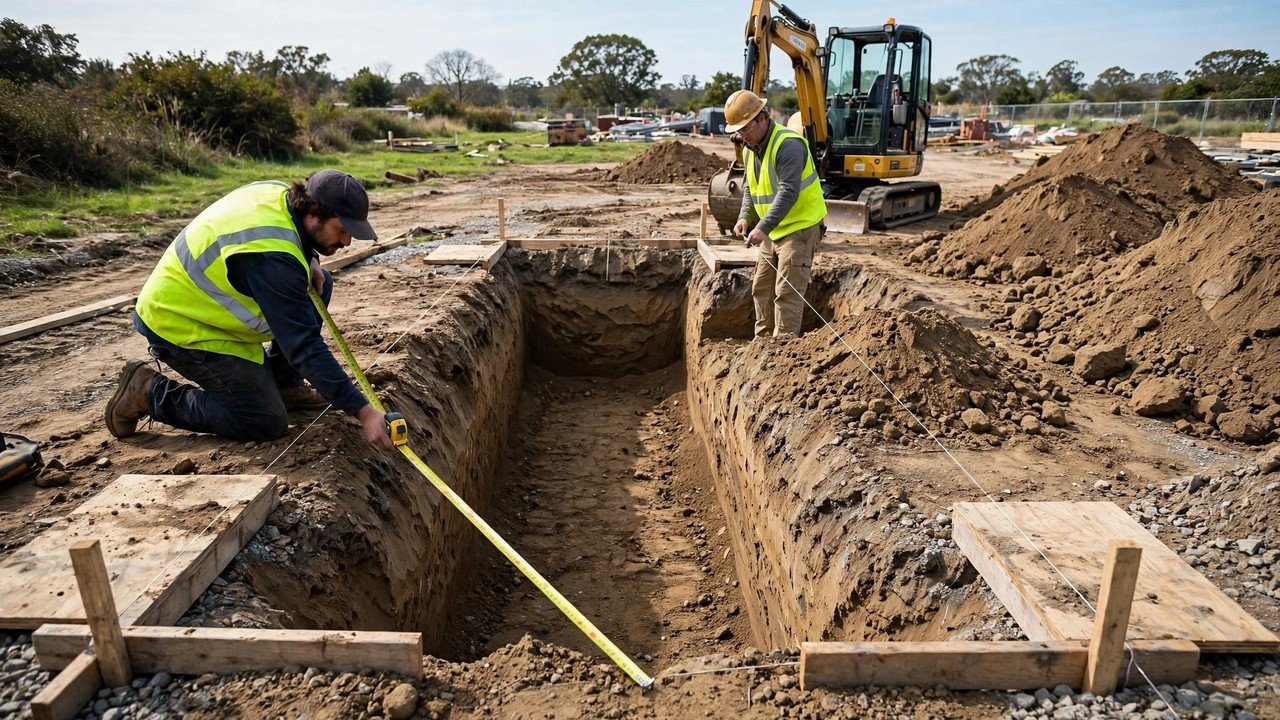
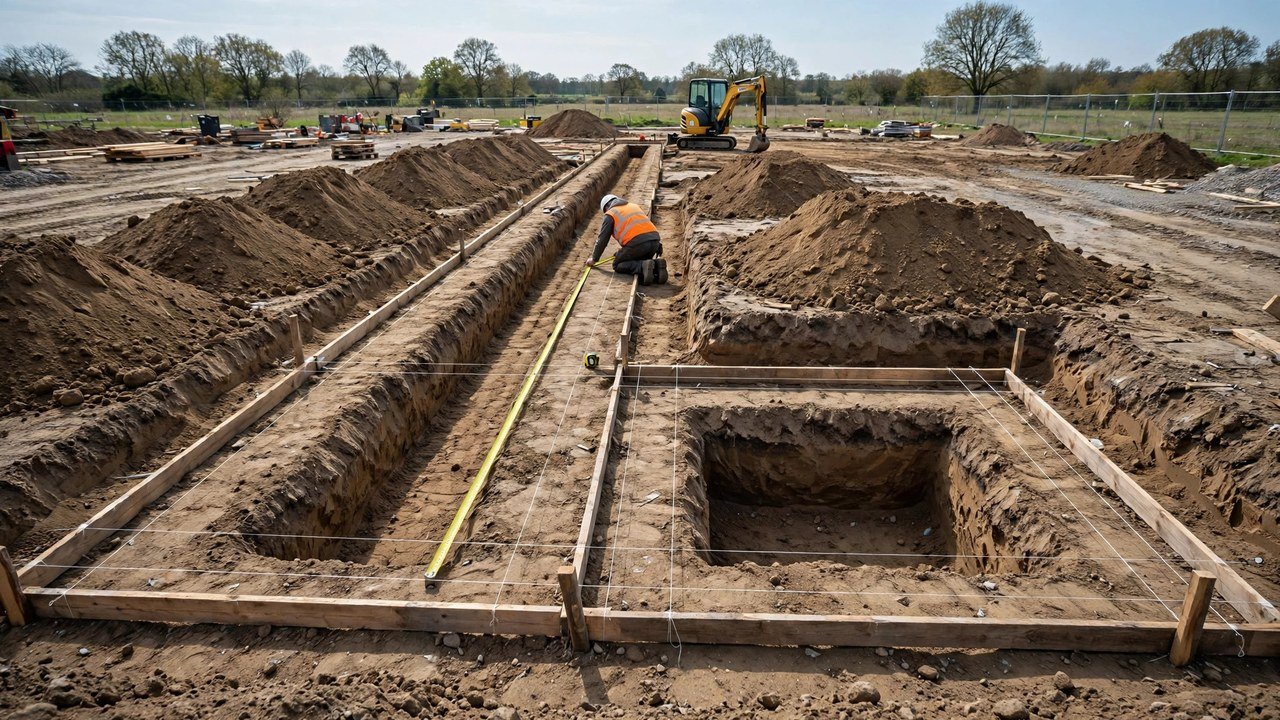
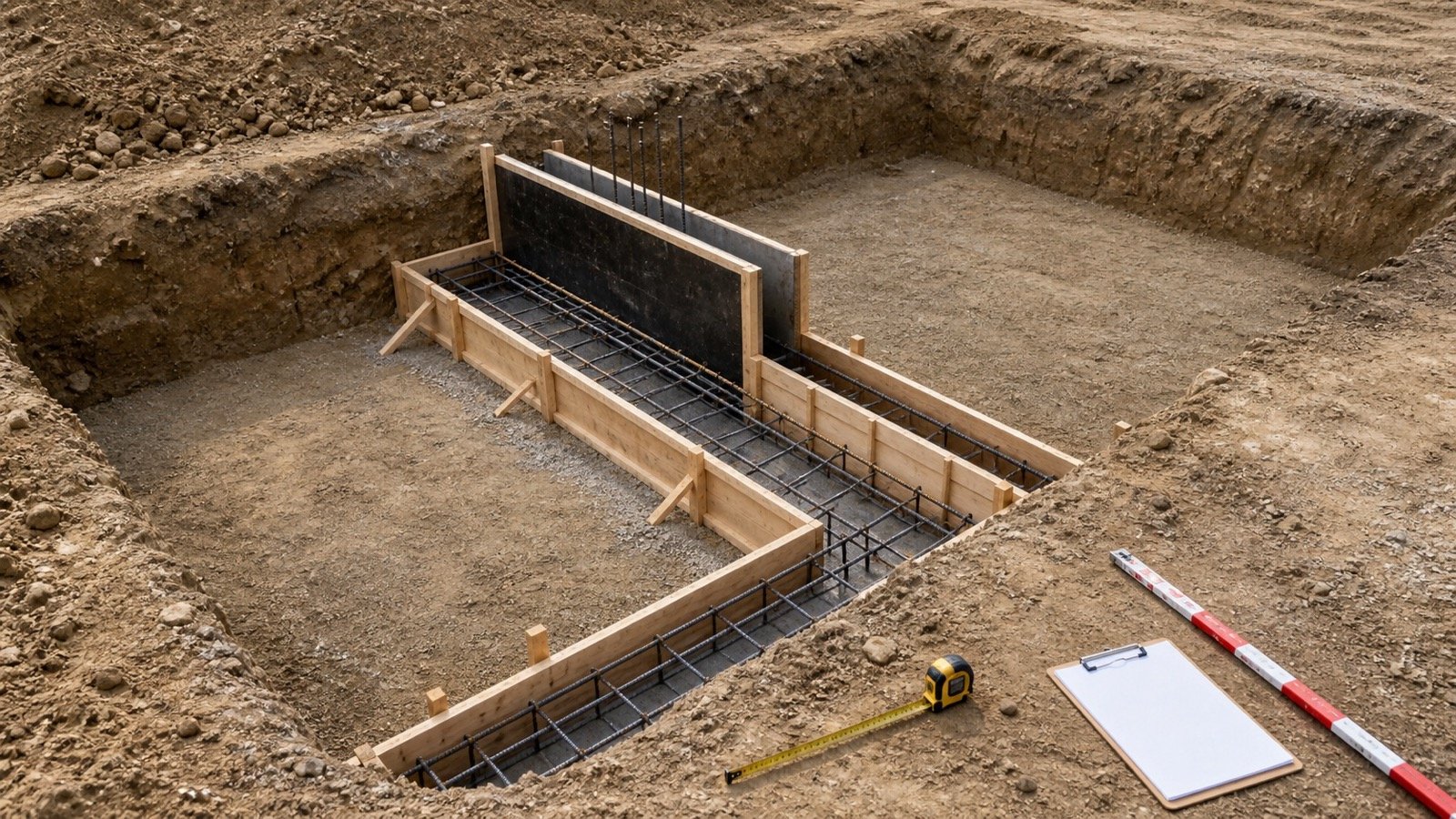
A footing excavation is a geometric pit: plan area multiplied by excavation depth. Footings are almost always repeated, so the calculator totals identical pits from the pit count you enter. The footing excavation measurement guide shows how to record each pit's dimensions before digging starts.
How much soil do your footings require to excavate?
Enter the pit shape, plan dimensions, and excavation depth for one footing, then set how many identical excavations the project needs. The calculator returns the bank volume per pit and the total bank volume in cubic yards and cubic feet, or cubic metres and litres.
Swell and truck loads appear as separate planning stages after the measured result. The calculator starts the swell factor at 0%, so the first result remains a checkable geometric volume rather than a result changed by an assumed percentage.
Record bank volume first, loose spoil volume second, and truck loads last. Each stage has a different source and can change for a different reason.
| Result | Calculation | What you must confirm |
|---|---|---|
| Excavated volume per pit | Pit plan area × excavation depth | Shape, dimensions, depth, and units |
| Total excavated volume | Per-pit volume × identical-pit count | Pit count and that the pits are identical |
| Loose spoil volume | Total bank volume × (1 + entered swell ÷ 100) | Reason and evidence for the swell value |
| Estimated truck loads | Loose spoil volume ÷ entered truck body volume, rounded up | Truck body volume from the hauler and loading method |
When should you use this footing excavation volume calculator?
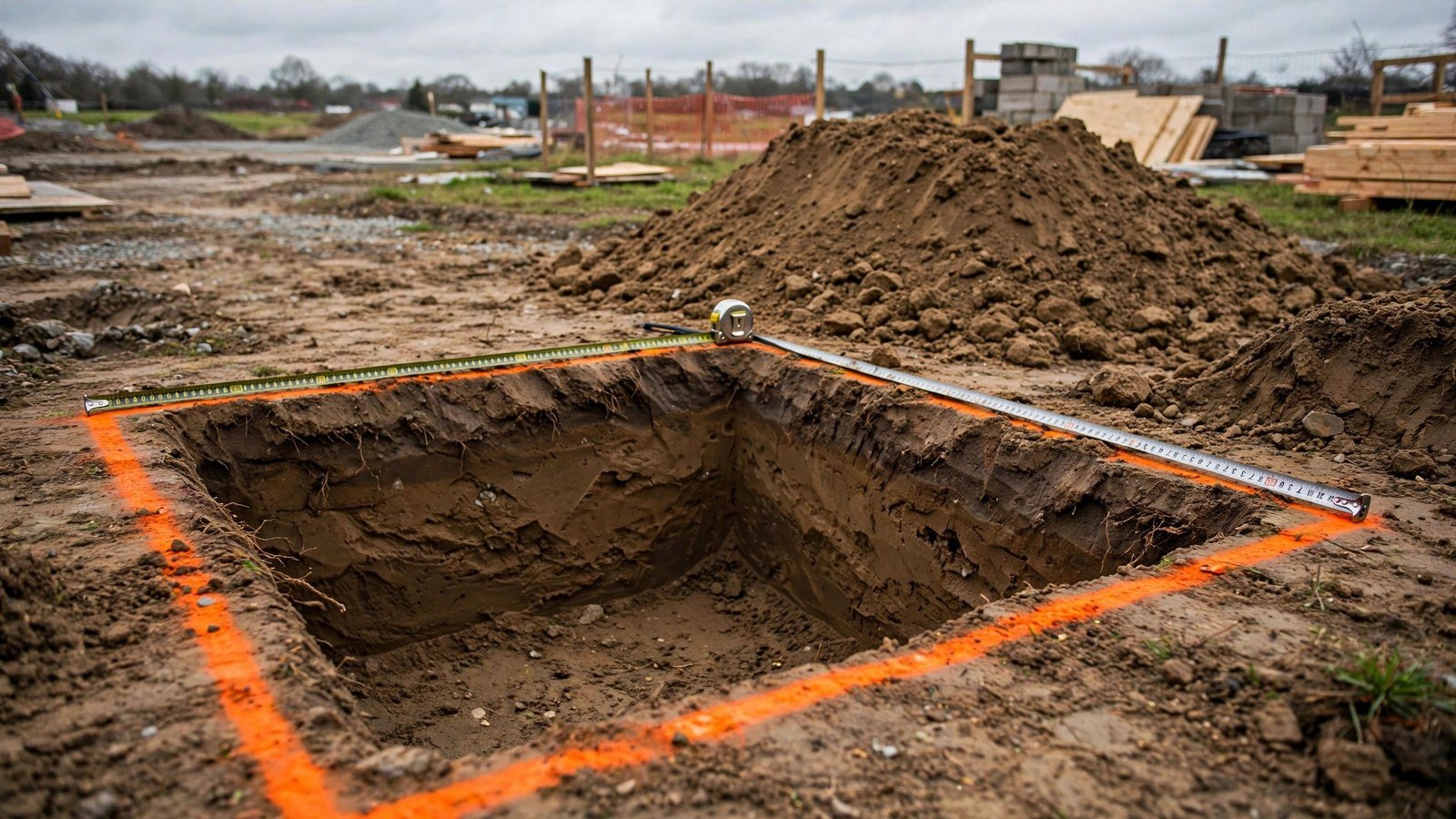
Use it for footing excavations that can be represented as vertical-sided pits: rectangular pad pits, round pier pits, and strip-footing runs entered by known area. Run the calculator separately when the pit shape, dimensions, or depth changes.
| Project condition | Calculator method | Record to keep |
|---|---|---|
| Square or rectangular pad footings | Pad mode: enter length, width, and excavation depth | Pit identifier, dimensions, and depth source |
| Round pier footings | Round mode: enter the full pit diameter and depth | Diameter measured through the centre of the pit |
| Strip footing runs | Known-area mode: enter run length × width as area, then depth | Run limits, corner and junction treatment |
| Area already known | Use known-area mode and enter depth | Drawing, survey, or separate area calculation |
| Pits of different sizes or depths | Calculate each size group separately and add unrounded totals | Schedule of pit groups and quantities |
| Irregular or stepped pits | Divide the pit into simple shapes or use a project-specific takeoff | Sketch and section identifiers |
| Sloped or benched sides | Outside this calculator: sidewall slope changes the geometry | Slope angle or bench dimensions and the project source |
Which measurements do you need?
You need the pit plan dimensions and the excavation depth for one footing, plus the count of identical pits. Measure in the units printed beside the fields and record where each dimension came from.
Pit length and width
Measure the plan limits of a rectangular or square pit. The excavated pit is usually wider than the footing itself because workers need working clearance around the forms; measure the pit you will actually dig, not the footing it contains.
Diameter
Measure a round pit's full width through its centre. A radius is half the diameter, so entering a radius in the diameter field reduces the calculated area to one quarter of the intended circle.
Known area
Use known-area mode when a drawing, survey, or separate shape calculation already gives the plan area, for example a strip-footing run. Confirm whether that area includes corners or junctions before entering it.
Excavation depth
Enter the depth from the working surface to the pit bottom. This is an excavation quantity, not a structural dimension: the designed concrete thickness does not control it. Include over-dig below the footing base only when the project record states it.
Identical pit count
Enter how many excavations share the same shape and dimensions. One footing plan can contain several pit sizes; schedule each size group as a separate calculation and add the unrounded totals.
What formulas does the calculator use?
The calculator finds the per-pit plan area, converts excavation depth to the base length unit, multiplies to get the bank volume, and multiplies by the identical-pit count. It retains full JavaScript precision during the calculation and displays up to 3 decimal places.
Pad pit area = length × width
Round pier pit area = π × (diameter ÷ 2)²
Excavated volume per pit = pit plan area × excavation depth
Total excavated volume = per-pit volume × identical-pit count
Loose spoil volume = total bank volume × (1 + swell % ÷ 100)
Estimated truck loads = loose spoil volume ÷ truck body volume, rounded up
| Displayed conversion | Relationship | Calculator use |
|---|---|---|
| Cubic feet to cubic yards | 27 ft³ = 1 yd³ | Imperial excavated and spoil volume |
| Cubic metres to litres | 1 m³ = 1,000 L | Metric equivalent volume |
| Cubic yards to cubic metres | 1 yd³ = 0.764554857984 m³ | Checking a unit conversion |
| Cubic metres to cubic yards | 1 m³ = 1.307950619... yd³ | Checking a unit conversion |
NIST Handbook 44 Appendix C supplies the cited volume relationships. Unit switching converts populated dimensions and the truck body volume, clears the displayed result, and requires a fresh calculation in the selected units.
Worked imperial example
Six identical pad footings need pits 4 ft long, 4 ft wide, and 3 ft deep. The project record supports 20% swell, and the hauler quotes a 10 yd³ body.
- Plan area: 4 × 4 = 16 ft².
- Per-pit volume: 16 × 3 = 48 ft³.
- Total bank volume: 48 × 6 = 288 ft³.
- Total in cubic yards: 288 ÷ 27 = 10.6667 yd³.
- Loose spoil volume: 10.6667 × 1.20 = 12.8 yd³.
- Loads: 12.8 ÷ 10 = 1.28, rounded up to 2 loads.
Measured result: 48 ft³ per pit and 10.667 yd³ total bank volume. The swell and loads are separate planning stages from user-entered values.
Worked metric example
Four identical round pier footings need pits 0.9 m in diameter and 1.5 m deep.
- Plan area: π × (0.9 ÷ 2)² = 0.6362 m².
- Per-pit volume: 0.6362 × 1.5 = 0.9543 m³.
- Total bank volume: 0.9543 × 4 = 3.817 m³.
- Equivalent volume: 3.817 × 1,000 = 3,817 L.
Measured result: 0.954 m³ per pit and 3.817 m³ total bank volume. With no swell entered, the loose spoil volume equals the bank volume. A 3 m³ truck body gives 2 loads.
How does swelling change the spoil volume?
Excavated soil occupies more volume than the same soil in the ground. The calculator multiplies the total bank volume by the entered swell percentage and keeps the result as a separate loose spoil volume.
The correct swell value depends on the soil type, moisture, and how the soil is handled. The page publishes no universal swell percentage; enter the value that the project record, geotechnical information, or the hauler supports. The bank vs loose volume guide explains the material states in more detail.
Keep the bank volume visible beside the loose result. Reviewers can then see whether a changed total came from measured geometry or from a changed assumption.
How do truck loads work?
Enter the hauling truck's body volume in the calculator's primary volume unit (m³ or yd³). The calculator divides the loose spoil volume by the truck body volume and rounds up, because a partial load still needs a truck.
The load count is a planning estimate, not a hauling contract. Truck body volume, heaped vs struck loading, material weight, vehicle payload, axle limits, and access conditions can change what a truck actually carries. Confirm the practical count with the hauler before booking.
What excavation safety limits apply?
US OSHA rules require a cave-in protective system for excavations 5 ft or deeper, unless a competent person determines there is no cave-in potential. Excavated soil must stay at least 2 ft from excavation edges. These are safety requirements, not quantity inputs, and the calculator does not design or approve any excavation support.
The page does not model sloped or benched sides. Where soil conditions or depth require sloping, the pit geometry differs from the vertical-sided calculation and needs a project-specific takeoff. The footing excavation safety guide covers the safety basics for this work.
Common footing excavation mistakes
- Entering inches in a feet field or centimetres in a metres field.
- Entering a radius in the diameter field.
- Measuring the footing size instead of the excavated pit.
- Counting all pits as one size when dimensions change across the plan.
- Applying swell before preserving the measured bank volume.
- Using a swell value from an unrelated soil type or project.
- Calculating truck loads from the hauler's struck volume while loading heaped.
- Rounding every pit before adding the total.
- Treating excavation volume as the concrete order quantity.
- Using a vertical-sided calculation for sloped or benched excavation sides.
Questions about footing excavation volume
Can this calculator size a footing?
It calculates excavation quantity from dimensions you enter. Footing size is a structural design decision that depends on loads, soil bearing capacity, frost depth, and local code. The calculator makes no design recommendation.
Is excavation volume the same as concrete volume?
Rarely. The excavated pit is usually larger than the footing it contains, and backfill occupies part of the pit after the footing is cast. Calculate the two quantities separately.
Does the calculator include working clearance?
Only the clearance you measure into the pit dimensions. Measure the pit you will actually dig, including room for forms and workers, rather than entering the footing size and hoping the pit matches.
What should you do with overbreak?
Measure the real excavated pit after digging. Collapsed sidewalls, loose pockets, and uneven bottoms add volume that a clean-geometry calculation cannot predict.
Can the swell field estimate compaction for backfill?
It applies one user-entered percentage to bank volume. Backfill settlement and recompaction need separate documented assumptions matched to the soil and compaction method.
Does the calculator estimate excavation cost?
It calculates quantity. Cost needs a current quote for the equipment, labour, haul distance, disposal fees, soil conditions, and access constraints of the project.
How should strip-footing runs be measured?
Use known-area mode for a strip footing run. Enter the run length multiplied by the trench width as the area, then the excavation depth. The strip footing length guide shows how to handle corners and junctions without double counting.
Measure after the working surface is cut to grade. Excavation depth is the distance from that surface to the pit bottom, not the designed concrete thickness; over-dig below the footing base belongs in the depth when the project record includes it.
Why can excavation and footing-concrete volumes differ?
Excavation measures the soil removed; concrete volume measures the concrete placed. Working clearance, over-dig, formwork thickness, and backfill keep the two numbers different. The footing excavation vs concrete volume guide compares the two quantities, and the Concrete Footing Calculator handles the concrete side of the same project.
Sources and scope
- OSHA 29 CFR 1926 Subpart P — Excavations: protective-system requirement for excavations 5 ft or deeper, 2 ft spoil setback, atmospheric testing scope; accessed 9 October 2026.
- NIST Handbook 44 (2026), Appendix C: cubic-foot, cubic-yard, litre, and cubic-metre relationships; accessed 9 October 2026.
- NIST Guide to the SI, Appendix B: metric and US customary conversion relationships; accessed 9 October 2026.
Source scope: OSHA supports the stated safety requirements for US construction; it does not design protective systems or classify soil for a specific project. NIST supports the stated conversions. The pit geometry, count, swell value, and truck body volume come from the user's project record. Structural sizing, soil classification, excavation safety planning, permits, and local code compliance belong to qualified people and the project documents.
Review note: Calculation logic and independent automated fixtures passed internal review. Saleem Sial is the research and editorial owner. Waseem Sial's external review remains ongoing. The published page is indexable.