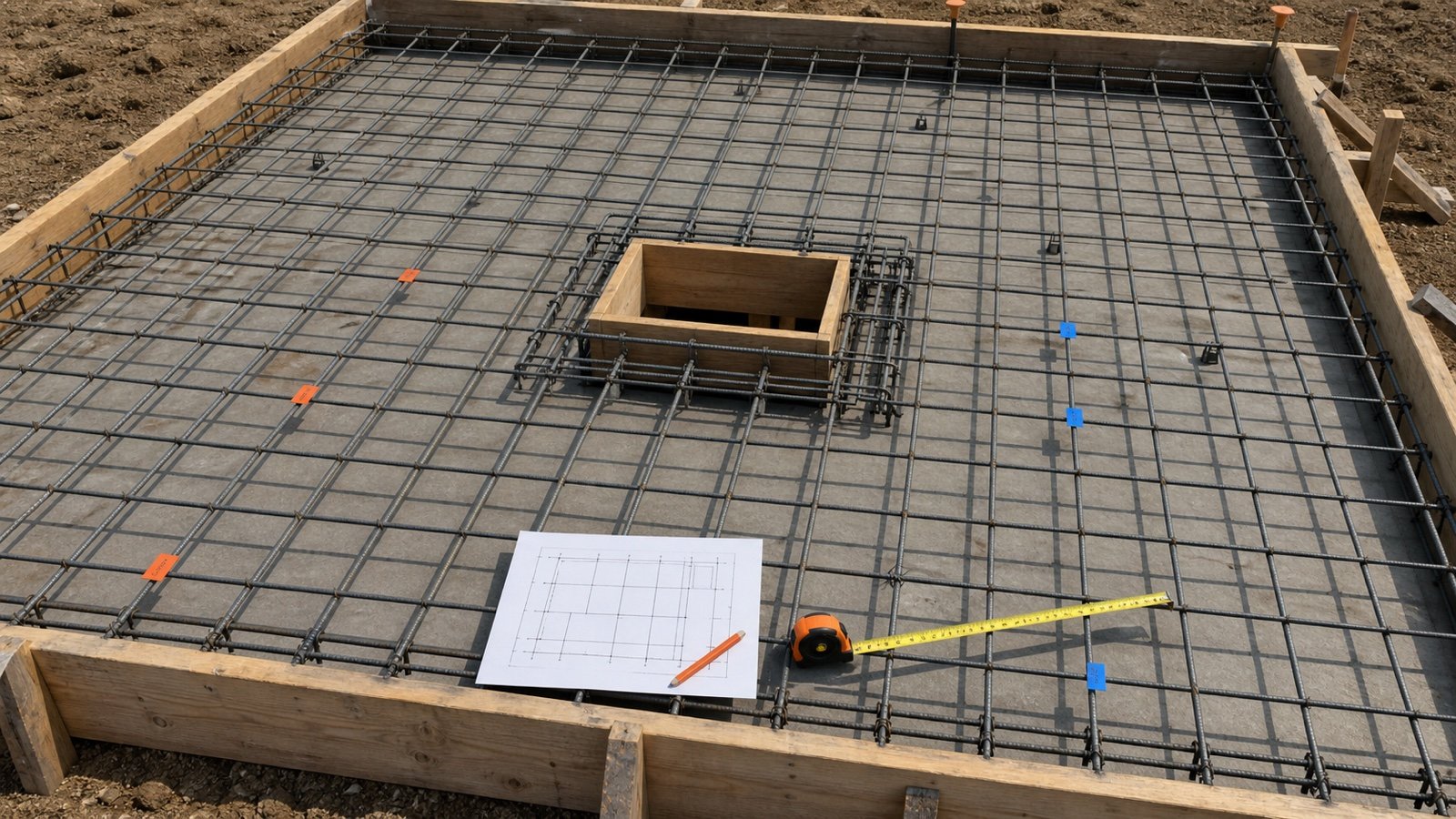
A ready-mix sequence links the producer, delivery loads, site acceptance and placement crew. A fixed truck interval can fail when testing, positioning, pump changes, access or the actual placement rate differs from the assumption.
Build the sequence from load-specific volumes and a verified net placement rate. Add the required hold points and name the person who calls dispatch when the plan changes.
How should ready-mix truck arrivals be spaced?
Set arrival spacing jointly with the producer and placement team. Use confirmed load volumes, the verified net placement rate, acceptance time, positioning, site queue capacity, travel variability and the approved response to delays.
A published 15-minute or 30-minute example describes a particular workflow. It does not prove that your crew, pump, chute, testing plan, site or producer can use the same interval.
Confirm the order with the Ready-Mix Cubic-Yard Ordering guide, then prepare the load split with the Ready-Mix Truck-Load Planning guide.
Which stages belong in the delivery sequence?
Give every load a planned path from producer release to departure. Keep hold points visible so the next movement does not rely on an assumption.
| Stage | Required record | Handoff |
|---|---|---|
| Producer release | Load ID, mix code, ticket reference and planned quantity | Producer to driver and site coordinator |
| Arrival | Time, access condition and queue position | Driver to traffic or logistics lead |
| Acceptance | Ticket, designation, required checks and disposition | Quality lead to placement lead |
| Positioning | Approved discharge point, pump or chute setup | Spotter to driver and equipment lead |
| Discharge | Start, pauses, end, destination and exception | Driver or pump lead to placement crew |
| Placement | Zone, progress, observed rate and remaining quantity | Placement lead to coordinator |
| Departure | Washout or cleanup route and site-clear time | Coordinator to driver |
| Next-load release | Current status and approved instruction | Coordinator to producer dispatch |
How do you estimate placement duration for one load?
Divide the load volume by a verified net placement rate for the planned crew, method, zone and conditions. The result is an arithmetic duration check, not an automatic arrival interval.
Placement duration in minutes = load volume ÷ verified net placement rate × 60
A hypothetical 8 yd³ load at a verified net rate of 6 yd³/hour gives:
- 8 ÷ 6 = 1.333333 hours.
- 1.333333 × 60 = 80 minutes.
The 80-minute result covers only the stated net placement basis. The agreed sequence may also include acceptance, testing, positioning, switching and controlled overlap. Producer cycle and travel remain separate.
What counts as a verified net placement rate?
Use a rate supported for the current placement method and site plan. Gross equipment capacity does not show how quickly accepted concrete will reach the approved forms.
| Input | Useful evidence | Common error |
|---|---|---|
| Crew and method | Approved method statement, trial, prior comparable records or qualified plan | Using a generic crew rate |
| Pump, chute or conveyor | Site configuration and verified net output under planned conditions | Using maximum equipment rating |
| Zone | Access, reinforcement congestion, movement and finishing sequence | Applying one rate to every zone |
| Acceptance and testing | Project inspection and test plan | Hiding hold time inside placement rate |
| Transitions | Repositioning, hose move, form change or lift transition plan | Assuming continuous discharge |
Record the source, date, conditions and approver beside the rate. Recalculate when the method or conditions change.
Why can the final load need different timing?
A smaller final load has a shorter arithmetic placement duration when the verified rate stays the same. Repeating the full-load interval can create unnecessary idle time.
| Load | Volume | Verified net rate | Arithmetic duration |
|---|---|---|---|
| Full load | 8 yd³ | 6 yd³/hour | 80 minutes |
| Final load | 2.4 yd³ | 6 yd³/hour | 24 minutes |
The producer must approve any dispatch change. Commercial partial-load terms, plant availability, travel and the approved placement sequence can still control the final arrival.
How do you compare the planned and observed placement rate?
Measure accepted volume placed over a documented interval. Compare the observed rate with the plan and use the project's approved trigger to decide the next action.
Observed rate = accepted placed volume ÷ elapsed placement hours
A crew places 3 yd³ in 45 minutes. The observed rate is 3 ÷ 0.75 = 4 yd³/hour. Against a 6 yd³/hour plan, the difference is 2 yd³/hour, or 33.333% below plan.
This page does not choose an acceptable variance. Record the current trigger from the project and producer plan.
When should the coordinator call or hold dispatch?
Write the trigger, decision owner, communication route and safe state before the first load arrives. The coordinator should not invent a response during a disruption.
| Observed condition | Record immediately | Possible approved action |
|---|---|---|
| Placement rate below trigger | Volume, interval, cause and current load state | Call dispatch, revise release or hold the next load |
| Pump or equipment stoppage | Failure time, concrete state and recovery estimate | Stop release, activate backup or resequence |
| Load rejected or held | Load ID, reason, authority and disposition | Hold following load or revise sequence |
| Access blocked | Location, hazard and queue status | Use approved alternate route or stop arrivals |
| Weather or site condition change | Time, measured condition and affected zone | Apply project weather plan or suspend |
| Quantity change | Placed, remaining and approved revision | Start the quantity-revision workflow |
“Possible approved action” is a planning category. The named responsible person chooses the action under the current plan.
How much queue space does the site need?
Base the queue on the approved traffic and access plan. Check whether trucks can enter, wait, position, discharge, wash out and leave without blocking each other or exposing workers and the public.
- Confirm ground support, slope, width, height, turning and overhead restrictions.
- Mark the approved waiting and discharge positions.
- Separate pedestrian, equipment and public routes.
- Assign spotters and communication methods.
- Keep emergency and departure paths clear.
- Confirm whether the site can hold an arriving truck while another discharges.
NRMCA CIP 31 advises purchasers to confirm truck access and consider other conveying or placement methods when access is limited. Site-specific traffic controls govern the work.
What should the planned-versus-actual timeline show?
| Field | Planned | Actual |
|---|---|---|
| Producer release | Window and authority | Time and load ID |
| Arrival | Window and queue position | Time and access exception |
| Acceptance complete | Checks and duration | Time and disposition |
| Discharge | Start, duration and destination | Start, pauses, end and zone |
| Observed placement | Rate and progress point | Accepted volume, interval and rate |
| Departure | Route and target time | Time and exception |
| Next-load instruction | Trigger and decision owner | Call time, instruction and recipient |
Preserve the original plan. Record revisions as new decisions with time, owner and reason.
Common delivery-sequence mistakes
- Copying a universal truck interval.
- Using pump rating as net placement rate.
- Giving every load the same duration.
- Leaving testing and positioning outside the timeline.
- Scheduling more trucks than the site can queue safely.
- Failing to name one coordinator for producer communication.
- Waiting for a stoppage before defining the call trigger.
- Combining different mix codes or zones in one record.
- Overwriting planned times with actual times.
- Treating a calculated interval as producer confirmation.
Use the Ready-Mix Concrete Calculator for order and optional load arithmetic. Return to the Concrete Planning hub for the complete workflow.
Safety and scope limits
This page does not approve mixture, placement, joint, pump, form, access, traffic, weather, testing or emergency procedures. Follow current specifications, permits, producer instructions, safety plans and qualified professional direction.
Fresh concrete can injure skin and eyes. Use the current safety data sheet and applicable controls for PPE, traffic, equipment, communication, washout and emergency response.
Sources and source scope
- NRMCA CIP 31, Ordering Ready Mixed Concrete: scheduling, placement-rate communication, readiness, stoppage notice and access context.
- NRMCA and ASCC Checklist for Ordering and Scheduling Ready Mixed Concrete: order, spacing, rate, access, placement and contact fields.
- ACI CCS-1(10) preview: slab-placement access, positioning, testing and discharge-sequence examples.
- OSHA, Concrete and Concrete Products: Controlling Hazards: fresh-cement hazard context.
Source scope: the sources support the coordination fields and hazards described above. They do not set one arrival interval, net placement rate, queue size, hold trigger, discharge deadline or approved response for every project.