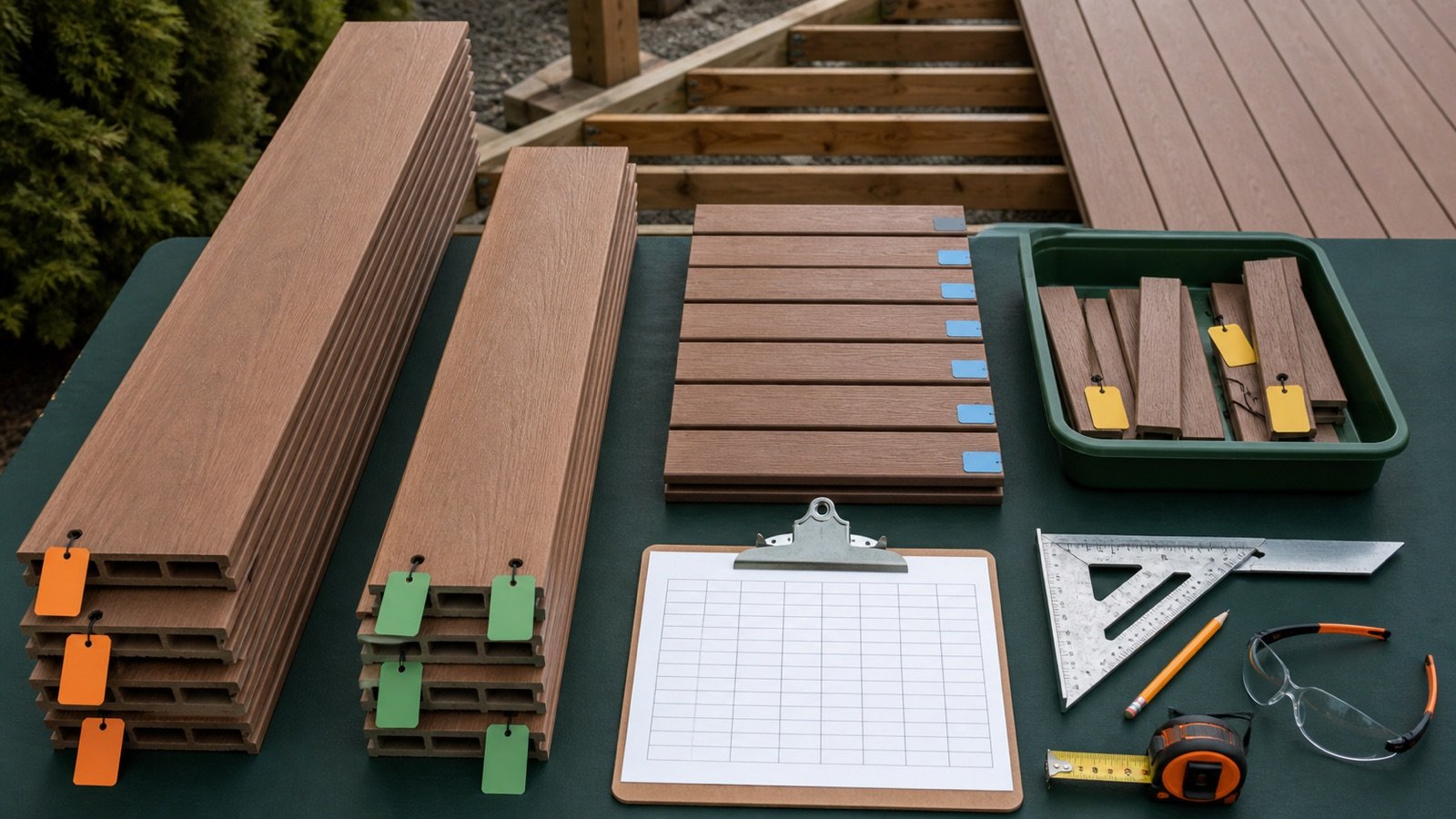
An extra-decking percentage changes a checked base quantity into whole purchasable boards. The percentage needs a stated job: cover a verified cut-plan loss, provide installation contingency, or account for another approved cause.
Known stock-length offcuts, shipment rejections and boards retained for future repair belong on separate ledger lines. Combining them as unexplained waste can hide duplicate material or an unresolved supplier issue.
How much extra decking should you buy?
Start with an accepted whole-board base from the measured fields and stock-length plan. Add only the extra boards supported by the selected product instructions, approved layout, cut study, receiving process and spare-stock decision.
Published manufacturer guidance does not supply one universal rate. Trex gives a 5% editorial example for waste or mistakes. TimberTech gives 10% to 15% for mishaps, waste and offcuts, and 30% for diagonal or herringbone layouts. Each recommendation has its own product and page scope.
A record containing only “10%” cannot show whether it covers known row cutoffs, pattern cuts, rejected boards, installation mistakes or retained spares.
Why do decking allowance recommendations differ?
Board direction, pattern, perimeter details, stock lengths and product instructions change the cut schedule. A manufacturer's planning example can test a project quantity, but it cannot replace that project's layout and procurement record.
| Named source | Published planning guidance | How to use it |
|---|---|---|
| Trex quantity article | 5% extra for waste or mistakes | Scenario check for that editorial example; verify the selected product and layout |
| TimberTech quantity article | 10% to 15% for mishaps, waste and offcuts | Test the range against the actual field and cut study |
| TimberTech quantity article | 30% for diagonal or herringbone layouts | Flag the need for pattern-specific geometry; do not apply it automatically to every angled field |
| TimberTech Composite installation guide | Roughly 10% scrap factor | Follow the named guide only when it covers the selected system and current revision |
The recommendations disagree because their scope and assumptions differ. Record the source title, revision or retrieval date, product, pattern and reason when a published value informs the order.
What should the decking allowance ledger keep separate?
Use separate fields for quantities created at different calculation stages. This makes the final release reproducible and prevents a supplier issue from disappearing inside installation waste.
| Ledger field | What it records | Control |
|---|---|---|
| Accepted base boards | Whole stock boards from the approved fields and stock-length method | Freeze the measurement and calculation revision |
| Known cut-plan additions | Boards required by borders, pattern cuts or piece lengths beyond the accepted base method | Attach the piece and cut schedule |
| Installation contingency | Approved provision for identified execution risks not already counted | Name the risk, basis and approver |
| Rejected material | Boards excluded by the receiving or inspection record | Record supplier disposition separately |
| Whole-board rounding | The discrete board created when a percentage result is not a whole number | Show the exact result before rounding up |
| Retained spare boards | Full boards intentionally kept for a later repair | Set a count, owner and storage location |
| Post-installation leftover | Usable material measured after work is complete | Reconcile it after installation, not before |
The same physical board cannot satisfy 2 ledger fields at once. A whole board added as installation contingency becomes leftover only if it remains after installation.
What does the calculator base already include?
The Deck Board Calculator counts each straight row against one entered stock length. Its no-pooling base rounds the stock pieces needed for every row before it applies an allowance.
That conservative base can already contain known stock-length cutoffs. Applying another generic cuts percentage without checking those offcuts can count the same length loss twice.
| Calculator result | Meaning | Allowance treatment |
|---|---|---|
| No-pooling base | Each row receives enough whole stock pieces independently | Accepted starting point unless a checked cut plan replaces it |
| Pooled lower bound | All installed length is divided by stock length as if pieces were freely reusable | Efficiency check only until joint and placement rules are proved |
| Length above installed amount | Stock length above the installed row length | Inspect the causes; do not label all of it avoidable waste |
| Allowance boards | Whole boards added after multiplying the no-pooling base | Use one documented percentage once |
How does the whole-board allowance formula work?
Multiply the accepted base by 1 plus the approved decimal allowance, then round up to a whole board. Subtract the base to show the number of extra boards created by the percentage.
Order boards = ceiling(base boards × (1 + allowance ÷ 100))
Extra boards = order boards − base boards
If retained spare boards are approved separately, add their count after the installation order. Do this only when the entered percentage does not already include those spares.
| Accepted base | 0% | 5% | 10% | 15% |
|---|---|---|---|---|
| 20 boards | 20 | 21 | 22 | 23 |
| 21 boards | 21 | 23 | 24 | 25 |
For a 21-board base, 5% gives 22.05 boards and rounds to 23. The extra quantity is 2 boards, or 9.52% of the base after whole-board rounding. Show both the entered rate and the resulting count.
Worked example: 20 rows cut from 16 ft stock
A straight field has 20 rows. Each row needs one uninterrupted 12 ft piece, and the confirmed stock length is 16 ft.
- Installed length: 20 × 12 ft = 240 ft.
- No-pooling base: 20 rows × 1 stock board per row = 20 boards.
- Known cutoff from each base board: 16 − 12 = 4 ft.
- Total known cutoff length: 20 × 4 ft = 80 ft.
- Pooled lower bound: ceiling(240 ÷ 16) = 15 boards.
The 15-board lower bound cannot supply 20 separate 12 ft pieces. Reaching it would require joints and a placement schedule that the simple length division does not prove.
The 20-board base already contains the 4 ft cutoff from every row. Adding another percentage solely because each row is cut from 16 ft stock counts that known stock-length effect again. Review whether a cutoff can serve an approved border, blocking-free nonstructural detail or another field only through the applicable product, joint, support and layout rules.
How should a diagonal, herringbone or picture-frame layout be handled?
Split changed geometry from the straight field and prepare a pattern-specific piece schedule. Angled edges, direction changes and perimeter boards alter cut lengths even when the surface area stays the same.
TimberTech's published 30% diagonal or herringbone guidance is a useful warning that pattern geometry can materially change the order. It does not prove that every diagonal field needs exactly 30% or that 30% will cover an unmeasured pattern.
- Remove picture-frame and divider boards from the clear field calculation.
- Record the direction and length of every border segment.
- Lay out diagonal or patterned rows against the accepted boundaries.
- Identify mirrored, directional or profile-specific pieces where the product uses them.
- Test each offcut against its next permitted location.
- Compare the finished cut schedule with the manufacturer's scenario range.
Use the deck-board measurement guide to divide the deck into clear fields and separate borders before calculating.
When can a deck-board offcut be reused?
Reuse an offcut only when its length, profile, condition and destination meet the selected system's requirements. A total-linear-foot result cannot perform those checks.
| Check | Accept only when | Record if rejected |
|---|---|---|
| Usable length | The piece covers the planned location after required end treatment and gaps | Too short for the scheduled piece |
| Edge and end profile | The required grooved, square or finished edges remain usable | Required profile was removed or damaged |
| Joint and support | Each end, joint location and stagger follow the current approved details | Unsupported or prohibited joint position |
| Appearance and direction | Color, grain, orientation and pattern suit the accepted field | Wrong face, direction or appearance zone |
| Condition | The piece passes the project's inspection criteria | Split, scratch, contamination, deformation or other rejection reason |
| Traceability | The piece remains identified with its product and possible destination | Mixed or unidentified stock |
Do not shorten an offcut's recorded length to a rounded convenient value. Keep the measured usable length and the exact destination piece requirement.
How should damaged or rejected boards be counted?
Inspect the delivery under the selected product and project process. Record rejected boards separately from planned cuts, then record the supplier's written disposition.
- Product code, color, profile, length, lot or bundle identifier.
- Delivered count and inspection date.
- Rejected count and specific condition.
- Photographs or other evidence when appropriate.
- Quarantined storage location.
- Supplier response: replacement, credit, return, accepted use or unresolved.
- Effect on installation schedule and final purchase release.
No universal defect rate or replacement right applies here. Seller terms, product warranty, inspection timing and the documented condition control the commercial response. Do not charge every rejected board to project waste before that response is known.
How should spare deck boards be planned?
Set retained spares as a board count with an owner and storage plan. Keep them outside the installation allowance unless the approved percentage explicitly includes them.
Trex's quantity article notes the option of holding extra boards for replacement or expansion. The project still has to decide how many to retain and whether the exact product can be stored as required.
- Match manufacturer, product line, color, profile, dimensions and production record when available.
- Prefer full usable boards when a likely future repair needs full-length material.
- Identify any retained offcut by its measured usable length.
- Record who owns the stock and where it will remain accessible.
- Follow current product storage instructions.
- Do not promise that future material will match color, weathering or availability.
Deckorators' current Vista instructions tell users to store the named boards flat, protected and acclimated under its stated conditions. Apply the current instructions for the product actually purchased.
Worked release: cuts, rejection and one retained spare
A checked field has an accepted 20-board no-pooling base. A separate picture-frame cut schedule requires 2 additional boards. The owner approves 1 full retained spare.
- Accepted field base: 20 boards.
- Verified picture-frame addition: 2 boards.
- Installation release before spare: 22 boards.
- Retained spare: 1 board.
- Planned purchase release: 23 boards.
If 2 delivered boards are rejected, place them on the receiving ledger and obtain the supplier disposition. Do not silently change the planned 23-board release to 25 unless the purchasing record shows that 2 replacement boards must be bought separately.
This cause-ledger result can be compared with a percentage. Applying 15% to the 20-board base also returns 23 boards, but the matching total does not make the methods equivalent. The cause ledger explains the 2 pattern boards and 1 retained spare.
Which allowance mistakes change the order?
- Copying 5%, 10% or 15% without the source scope and project reason.
- Applying a cuts percentage after the base already rounds every row to a stock board.
- Ordering from the pooled linear lower bound without a permitted joint and cut plan.
- Using a straight-field allowance for diagonal, herringbone or picture-frame work.
- Assuming every offcut can move to another row.
- Combining planned cuts, installation contingency, rejected boards and retained spares as one waste number.
- Adding retained spares after the entered percentage already includes them.
- Hiding whole-board rounding by reporting only the percentage.
- Charging rejected delivery material to the project before supplier disposition is recorded.
- Assuming surplus can be returned without written seller terms.
- Using a surface quantity to approve framing, span, joint support or fastening.
What should the supplier release contain?
The release should let another checker reproduce both the base and every added board. Current stock, package, delivery and return terms need a dated supplier record.
- Project, deck zone, drawing and measurement revision.
- Manufacturer, product line, color, profile, actual face width and stock length.
- Accepted fields, rows, installed length and no-pooling base.
- Cut schedule for borders, direction changes, stairs and irregular pieces.
- Selected allowance percentage, exact unrounded result, whole-board result, reason and approver.
- Separate retained-spare count, owner and storage location.
- Supplier branch, selling increment, available lengths and quote date.
- Delivery, inspection, replacement, credit and return terms.
- Unresolved assumptions and the date they must be closed.
Use the deck-board sizes and coverage guide to verify face width, gap and stock-length records before the release.
Structural, installation and safety limits
This guide plans surface-board quantities. It does not design or inspect joists, blocking, beams, ledgers, posts, footings, guards, stairs, connections or lateral resistance. It does not approve board span, overhang, fasteners, joints, end support or an existing deck.
The American Wood Council's DCA6 document has a stated 2015 IRC scope and places approval with the authority having jurisdiction. Confirm the current code, local amendments, permits, accepted drawings and project specifications for the actual location.
Deck work can involve falls, unstable framing, heavy boards, sharp edges, saws and dust. Follow the selected product instructions, tool manuals, workplace controls and approved project safety plan. Stop when the supporting structure, access or existing deck condition is uncertain.
Return to the Decking planning hub for the calculator and current guides. The calculation methodology explains unit and rounding checks, and the corrections route accepts a documented source or arithmetic issue.
Sources and source scope
- Trex's deck-board quantity article supports its 5% editorial example and the option to retain extra boards. It does not set a universal allowance.
- TimberTech's quantity article supports its 10% to 15% guidance and higher diagonal or herringbone scenario. It does not replace a project cut plan.
- TimberTech's Composite Decking Installation Guide supports the named guide's roughly 10% scrap factor, rounding sequence and product-specific installation scope.
- Deckorators Vista instructions support product-specific storage, acclimation, handling, safety and structural limits. They do not supply an allowance percentage.
- American Wood Council DCA6 supports the structural and jurisdiction boundary for its stated scope. It does not approve a current local project.