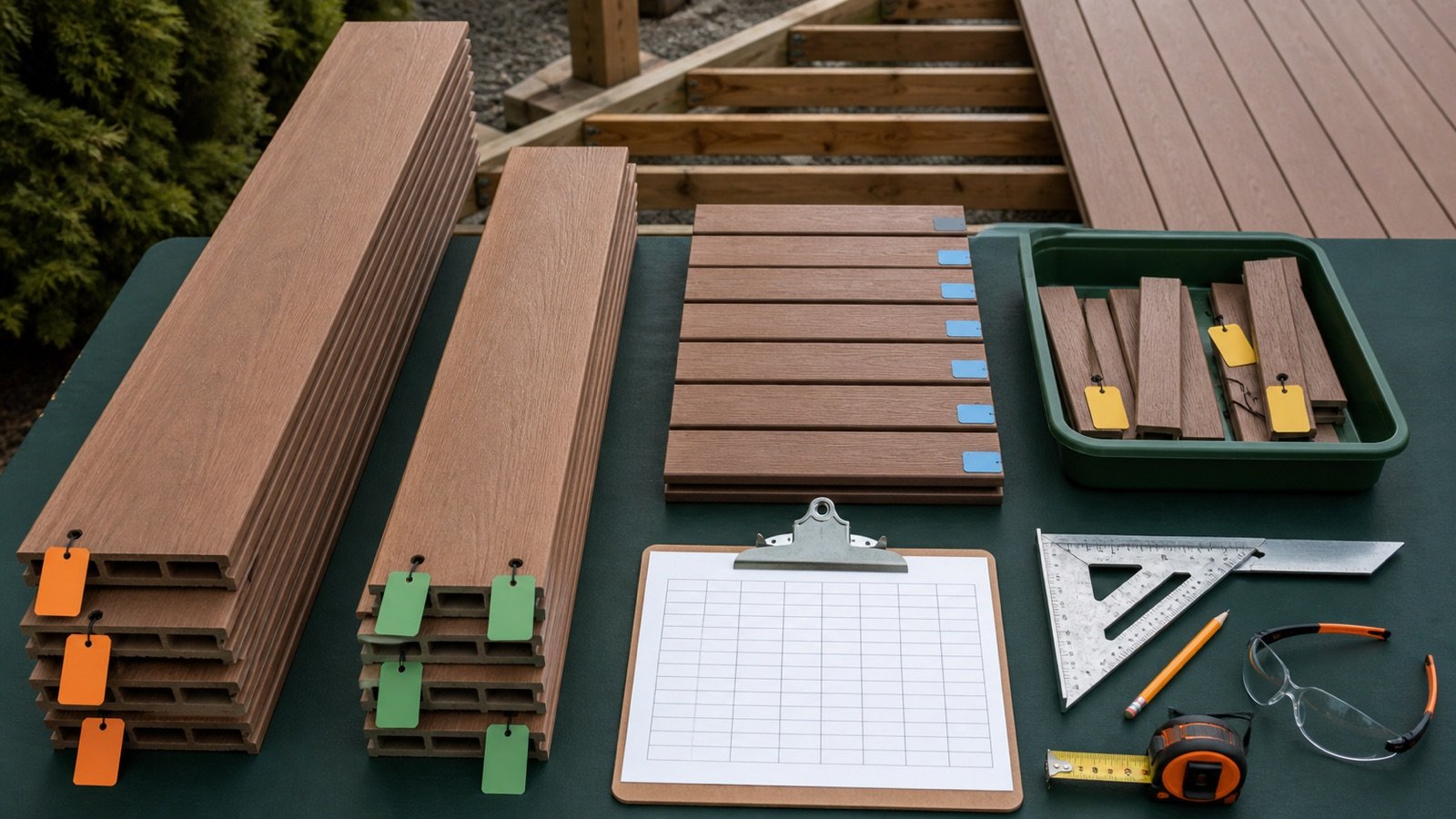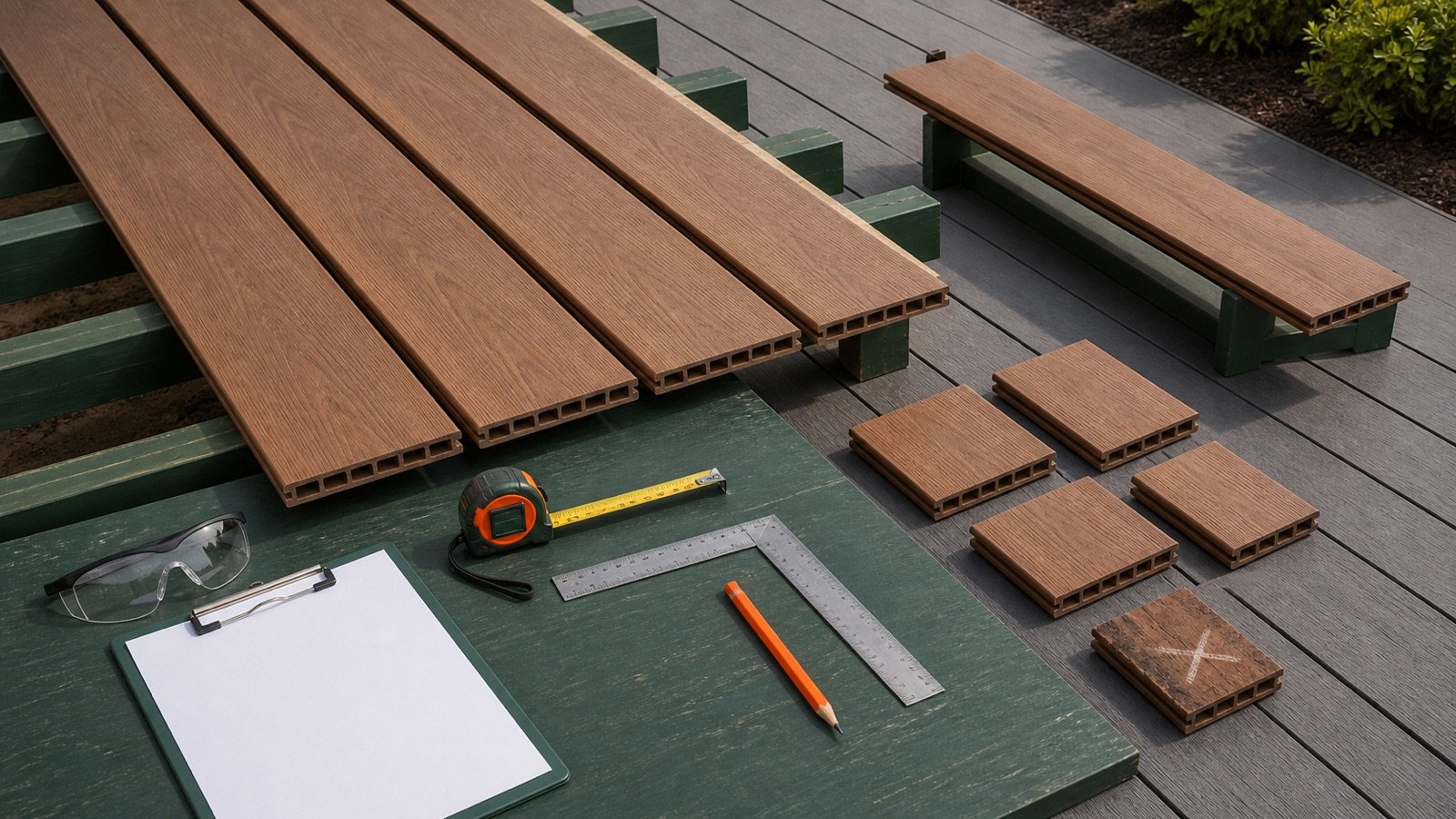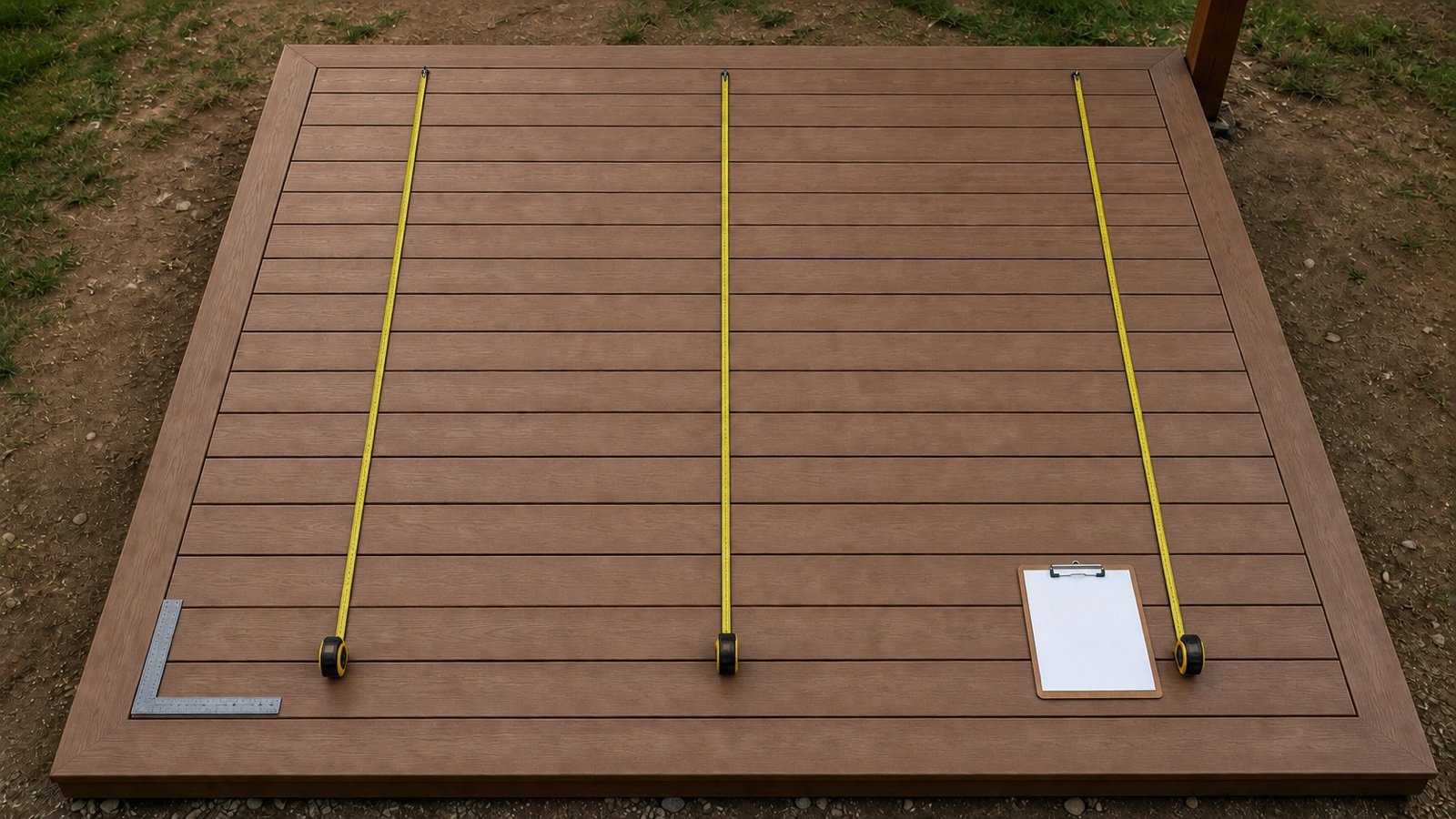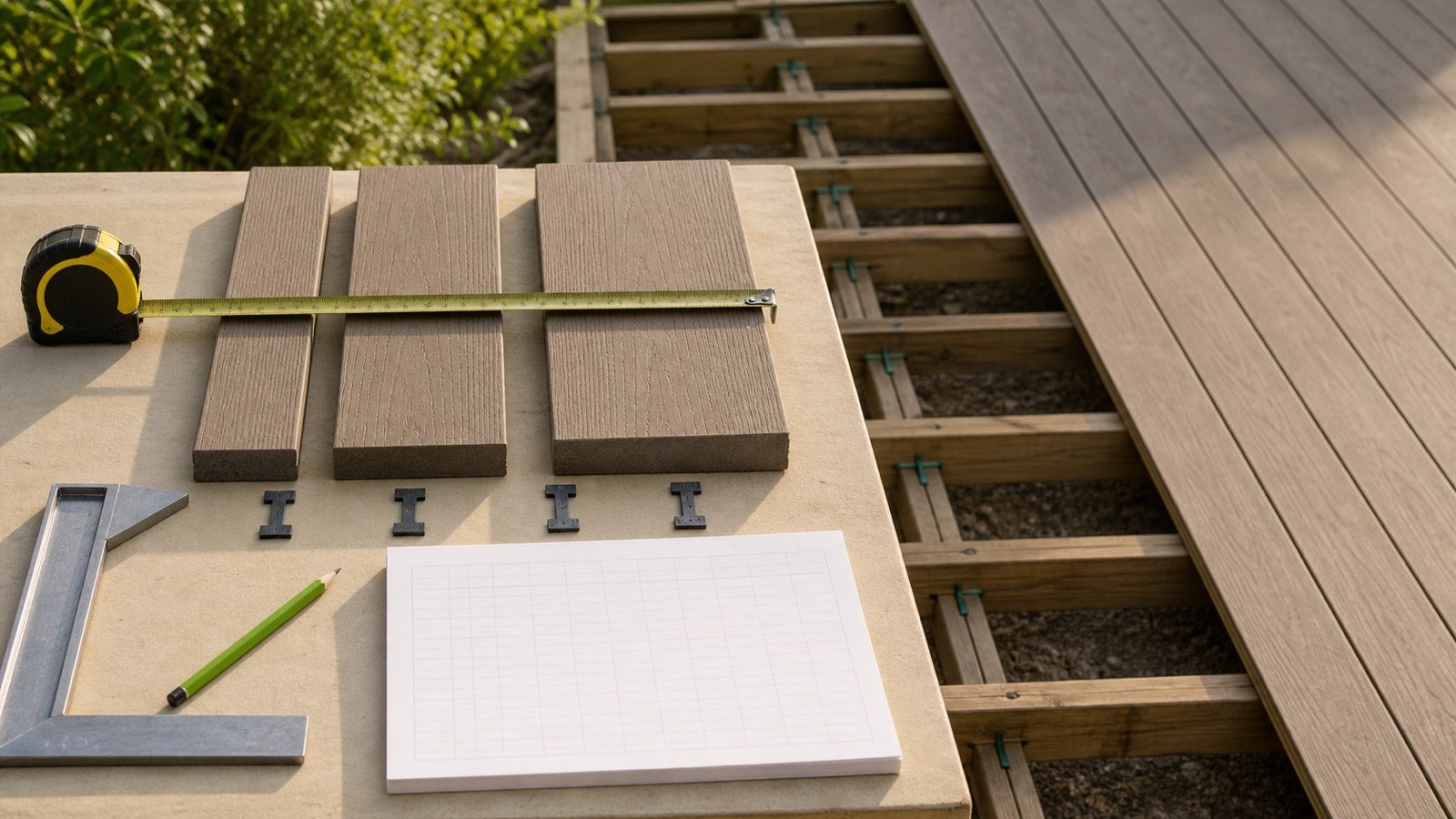
Deck-board names, measured faces and installed coverage answer different questions. A nominal label helps identify lumber or a profile, while the actual face width and approved side gap control the number of rows across a deck field.
Copy the selected product's dimensions and available lengths before calculating. Keep borders, fascia, stairs and changed-width patterns on separate schedules.
Which deck board size should you use for quantity planning?
Use the actual face width and stock length from the current product record or a checked sample. Copy the side gap from the installation instructions for the exact board, fastening system and site conditions.
Enter those values in the Deck Board Calculator after the clear field has been measured. The calculator counts exact straight rows and tests one available stock length. It does not supply a default board or gap.
Manufacturer, product line, profile, actual face width, thickness, edge type, stock length and installation-guide revision belong on the same ledger row.
Which deck-board widths appear in current product records?
Current manufacturer pages show several face widths within named product ranges. These examples help check a product record; they do not create standard dimensions for every wood, composite or PVC board.
| Named source | Profile example | Actual face width | Other stated details |
|---|---|---|---|
| TimberTech multiwidth decking | Narrow, square shoulder | 3.5 in | Availability depends on the stated collection |
| TimberTech multiwidth decking | Standard, square shoulder or grooved | 5.5 in | Use the selected collection and fastener record |
| TimberTech multiwidth decking | Wide, square shoulder | 7.25 in | Not listed as a grooved multiwidth example on that page |
| Trex Transcend | 1 in grooved edge | 5.5 in | .94 in thick; 12, 16 and 20 ft lengths listed |
| Trex Transcend | 1 in square edge | 5.5 in | .94 in thick; 16 and 20 ft lengths listed |
| Trex Transcend Tropicals | 2 x 4 square edge | 3.4 in | 1.3 in thick; 16 ft listed |
A 3.4 in product face is not interchangeable with a 3.5 in preset. At 40 rows, the face-width difference reaches 4 in before gaps are added.
What is the difference between nominal size and actual face width?
The nominal name identifies a trade size or profile. The actual face width is the measured or published surface width that contributes to field coverage. Product thickness, edge shape and length remain separate fields.
Do not infer an actual size from the nominal label when the selected product record supplies a dimension. Composite and PVC lines can use branded profile names or several widths that do not follow one softwood-lumber table.
| Record | Purpose | Quantity use |
|---|---|---|
| Nominal or marketed size | Product identification | Cross-check only |
| Actual face width | Surface occupied by one board face | Row and face-area calculations |
| Side gap | Space between adjacent installed rows | Coverage pitch and exact row calculation |
| Thickness and profile | Product and fastening identity | Assembly verification, not surface arithmetic |
| Stock length | Purchasable piece length | Cut and whole-board schedule |
How do you calculate one board's face area?
Convert the actual face width and board length to one unit, then multiply them. Face area excludes the gap beside the board.
Board face area = actual face width × board length
A 5.5 in face equals 5.5 ÷ 12 = 0.458333... ft. Keep that value through the multiplication.
| Board length | Calculation | Face area |
|---|---|---|
| 12 ft | 5.5 ÷ 12 × 12 | 5.5 ft² |
| 16 ft | 5.5 ÷ 12 × 16 | 7.333333... ft² |
| 20 ft | 5.5 ÷ 12 × 20 | 9.166666... ft² |
Rounding 5.5 ÷ 12 to 0.45 before multiplication returns 5.4, 7.2 and 9.0 ft². Each result is 1.82% below the exact face area. Round the reported result, not the conversion used inside the calculation.
How does the gap change deck-board coverage?
Add the approved internal gap to the actual face width to obtain the repeating coverage pitch. Use the pitch for a linear-foot cross-check across a large straight field.
Coverage pitch = actual face width + approved internal gap
Approximate linear ft per ft² = 12 ÷ coverage pitch in inches
| Source example | Stated planning gap | Pitch | Large-field cross-check |
|---|---|---|---|
| TimberTech Advanced PVC with Cortex project guide | 1/8 in | 5.625 in | 2.133333... linear ft/ft² |
| TimberTech Composite with CONCEALoc straight guide | 3/16 in | 5.6875 in | 2.109890... linear ft/ft² |
The 2 rows describe different named systems. Choose the value from the current instructions for the selected product and fastening method. Do not average them or apply either value to another board.
Why does area coverage differ from an exact row count?
A field with n rows has n - 1 internal gaps. The final board does not have another internal gap after it, so an area or repeating-pitch shortcut cannot prove the whole-row boundary.
Whole rows = ceiling((clear field width + gap) ÷ (face width + gap))
Covered width = rows × face width + (rows - 1) × gap
With a 5.5 in face and 3/16 in gap, 21 rows cover exactly 119.25 in:
21 × 5.5 + 20 × 0.1875 = 119.25 in
A 119.26 in clear field crosses that full-row boundary. The formula returns 22 rows before an approved balanced-edge, ripped-board, overhang or spacing adjustment is applied. TimberTech's Cortex project guide also notes that ripping may be required for full coverage.
Worked example: a 12 ft run across a 10 ft field
The selected straight-system example has a 5.5 in face, a 3/16 in internal gap and a 12 ft clear run. The field width across rows is 10 ft, or 120 in.
- Coverage pitch: 5.5 + 0.1875 = 5.6875 in.
- Exact row ratio: (120 + 0.1875) ÷ 5.6875 = 21.131868...
- Whole rows: 22.
- Covered width: 22 × 5.5 + 21 × 0.1875 = 124.9375 in.
- Installed board length: 22 × 12 = 264 linear ft.
- Board-face area: 264 × 5.5 ÷ 12 = 121 ft².
The large-field area cross-check returns 120 ft² × 2.109890... = 253.1868 linear ft. It is 10.8132 linear ft below the exact 22-row result because the 10 ft boundary requires another full row.
The 4.9375 in coverage above the clear width flags the edge layout. It does not instruct you to rip one board by that amount. Check the approved starting edge, final edge, border, overhang, fastening and minimum-width details.
How should narrow, standard and wide boards be compared?
Compare product rows by actual face width, edge profile, approved gap and available length. A wider face can reduce row count, while its profile or fastening options may change the layout and stock schedule.
TimberTech's named multiwidth page lists 3.5, 5.5 and 7.25 in faces. It identifies the standard width as square-shouldered or grooved and the narrow and wide examples as square-shouldered. That profile difference can prevent one hidden-fastener assumption from applying to all 3 widths.
For a mixed-width pattern, write the exact sequence. Add every face and each internal gap in that sequence, then repeat only the portion that the accepted design repeats. An average board width can hide where a partial pattern ends at the field edge.
Can you mix inch and metric product dimensions?
Choose one declared unit set for each fixture. Manufacturer pages may display rounded metric equivalents beside imperial product dimensions, so mixing one value from each column can create a false precision error.
NIST defines 1 in as exactly 25.4 mm. Therefore, 5.5 in equals 139.7 mm exactly. A product page may display 140 mm as the corresponding marketed dimension. Trex also displays 12 ft beside 365 cm, while the exact conversion is 365.76 cm.
| Displayed pair | Exact conversion | Worksheet treatment |
|---|---|---|
| 5.5 in / 140 mm | 5.5 in = 139.7 mm | Keep one source column through the calculation |
| 12 ft / 365 cm | 12 ft = 365.76 cm | Do not combine 140 mm with 12 ft and label it exact metric area |
| 16 ft / 487 cm | 16 ft = 487.68 cm | Use the supplier's purchasable product identity, then measure or confirm as required |
Rounded equivalents can identify a product. They should not be mixed into an exact conversion fixture unless the manufacturer declares which values control.
What belongs in a deck-board product record?
The record should let another checker reproduce the calculator inputs and confirm that the ordered piece matches the approved installation system.
- Manufacturer, product line, collection, color and product code.
- Material type, profile, edge type, thickness and actual face width.
- Declared imperial and metric dimensions as separate source fields.
- Approved side gap, butt-joint gap and the conditions that change them.
- Fastening system and current installation-guide title or revision.
- Available stock lengths, supplier branch, quote date and selling increment.
- Field, border, divider, fascia, stair or trim purpose.
- Measured sample check, checker, date and unresolved variation.
Keep local stock and price out of a permanent coverage chart unless a dated supplier record supports them. A manufacturer product page does not prove that every listed length is available at the reader's branch.
Which size and coverage mistakes change the order?
- Using the nominal label as the actual face width.
- Applying a 5.5 in preset to a 5.25, 5.4 or 5.6875 in product face.
- Copying a gap from another board or fastener system.
- Counting a gap after the final row.
- Rounding 5.5 in to 0.45 ft before calculating face area.
- Mixing rounded metric and imperial dimensions in one fixture.
- Dividing field area by board face area and calling the result a cut plan.
- Combining field boards, picture frames, fascia and stairs in one coverage rate.
- Assuming every listed manufacturer length is locally stocked.
- Using a surface-coverage result to approve board span or framing.
Structural, installation and safety limits
This guide calculates surface quantities. It does not select or approve a board, fastening system, span, overhang, joist spacing, blocking, beam, ledger, post, footing, guard, stair or connection.
The American Wood Council's DCA6 document has a stated 2015 IRC scope and requires approved construction and materials within that scope. Confirm the current code, local amendments, permits, accepted drawings and authority-having-jurisdiction requirements for the project location.
Check the substructure before measuring or working on an existing deck. Control falls and access, and follow current product instructions, tool manuals and the project safety plan when handling, cutting or fastening decking.
Use the deck-board measurement guide to create clear rectangular fields. Return to the Decking planning hub for the current cluster. The calculation methodology explains unit and rounding checks, and the corrections route accepts a source or arithmetic issue.
Sources and source scope
- TimberTech Advanced PVC with Cortex guide supports one 5.5 in face and 1/8 in spacing example, width-plus-spacing arithmetic and the possible need for ripped edge boards.
- TimberTech Composite with CONCEALoc guide supports one straight-system example using grooved 5.5 in boards and 3/16 in spacing.
- TimberTech multiwidth decking supports the named 3.5, 5.5 and 7.25 in width examples and stated edge-profile availability.
- Trex Transcend product page supports actual dimensions and listed lengths for the named profiles retrieved on August 11, 2026.
- TimberTech quantity guide supports manufacturer quantity context and its instruction to use the chosen line's installation guide.
- American Wood Council DCA6 supports the structural and jurisdiction boundary for its stated scope.
- NIST Handbook 44 (2026), Appendix C supports the exact unit relationships used in the conversion audit.
Source scope: manufacturer dimensions and gaps apply to their named products and instructions. The geometry formulas are independently reproducible. No source here proves current local stock, price, structural suitability or approval for another project.
Review note: Saleem Sial owns the research and editorial record. Source checks, independent fixtures, build validation, link crawl, schema review and rendered QA form the internal publication gate. Waseem Sial, External Reviewer and Engineer, is listed for ongoing external review; no completed review date is claimed.