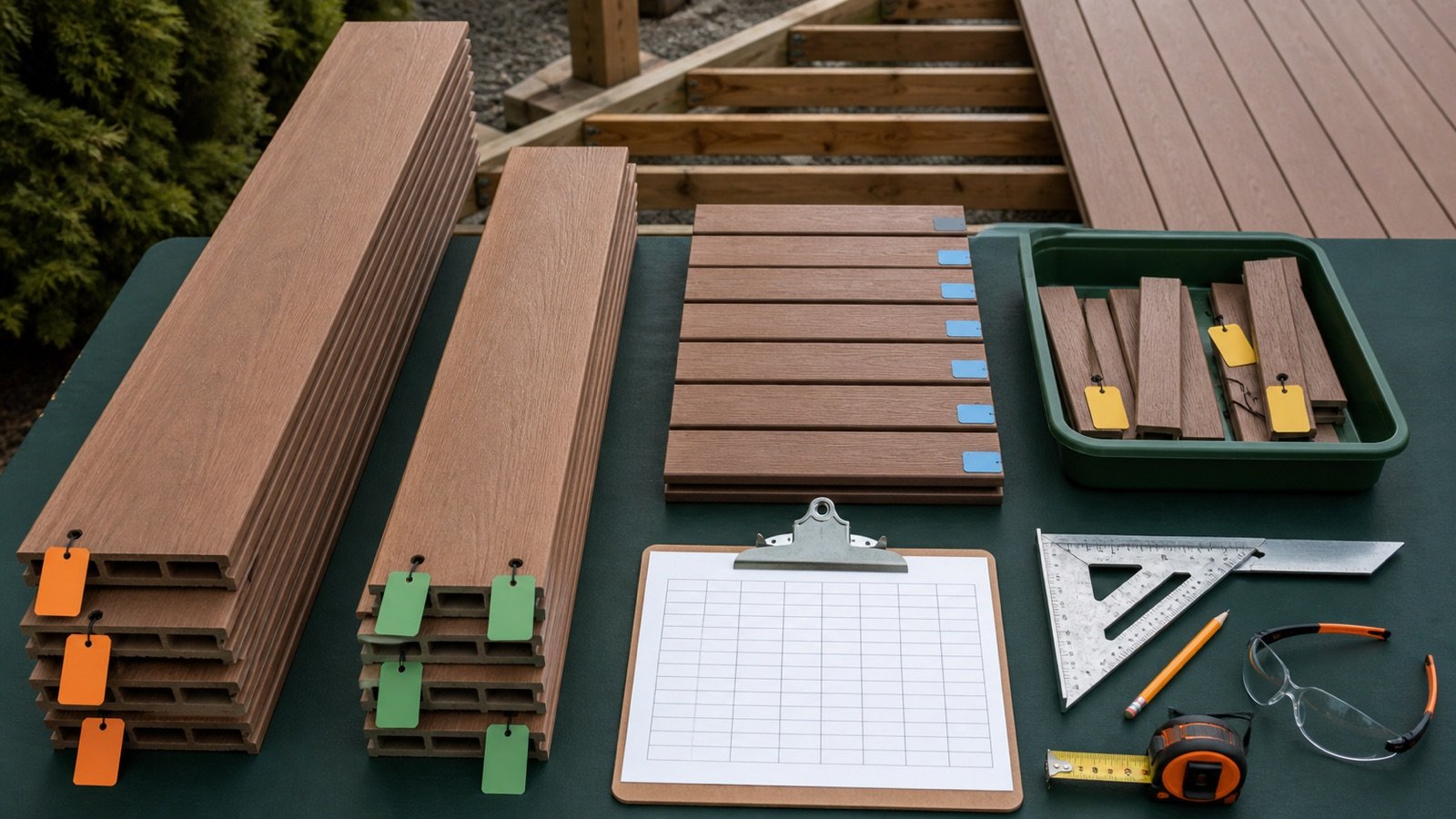
A deck-board count becomes a cut list when every required piece has a destination, finished length and product identity. The list then assigns those pieces to purchasable stock boards and records the material removed by end trimming and saw cuts.
Joint location, bearing, fastening and product gaps remain attached to each piece. A length-packing result can show that pieces fit on one stock board; the selected installation instructions and approved details decide whether those pieces can be used in the planned deck positions.
How do you make a deck-board cut list?
Freeze the accepted deck zones and row count, identify every field, border and divider piece, then group only pieces with compatible product and end conditions. Assign the pieces to confirmed stock lengths and check each assignment after trim and cut losses.
Give each finished piece and stock board a unique ID. That link lets the estimator, purchaser and installer trace a changed dimension without rebuilding the whole schedule from memory.
A purchase length belongs in the stock column. A row, border or breaker-board segment belongs in the finished-piece column. Keeping both columns prevents a 16 ft order board from becoming a false 16 ft installed piece.
Download the deck-board cut-list worksheet
Which records must be approved first?
The cut list needs stable geometry and a selected product record. Complete the deck-board measurement guide and verify the product inputs with the deck-board sizes and coverage guide before assigning stock.
- Accepted drawing or field-measurement revision.
- Deck zones, board direction, clear field widths and clear run lengths.
- Picture-frame, divider, fascia, stair and opening boundaries.
- Manufacturer, product line, color, profile, actual face width and current instructions.
- Approved side gaps, end gaps, edge treatments and installation conditions.
- Joint locations, support and fastening detail references.
- Supplier-confirmed stock lengths and selling increments.
- End inspection, trimming and cut-loss method.
Run the Deck Board Calculator for each compatible straight rectangular field. Its row count and no-pooling stock result provide a check; the cut list supplies the piece locations and cross-row reuse decisions that the calculator leaves open.
What belongs on each finished-piece line?
One line can represent several identical pieces when their product, profile, finished length, end condition and destination rule match. Split the line when any of those fields changes.
| Field | Example format | Reason |
|---|---|---|
| Piece ID | D01-F01-R07 | Links the cut piece to deck 1, field 1, row 7 |
| Purpose | Field row, picture frame, divider or stair | Keeps incompatible geometry out of one quantity |
| Product identity | Product code, color and profile | Prevents substitutions between visually or mechanically different boards |
| Finished length | 94.75 in | Sets the required placed piece after approved gaps |
| Quantity | 8 identical pieces | Allows repeat packing without losing the destination group |
| End condition | Factory end, field-cut end or prepared end | Identifies inspection and trimming requirements |
| Joint or support reference | Detail D-4 at grid B3 | Ties a splice to its accepted bearing and fastening detail |
Use the project's actual ID convention. The example ID is a record format, not a required construction notation.
How should stock-board IDs work?
Assign an ID to each planned stock board or repeatable stock-board pattern. Record its product, source length, usable length after required inspection, assigned finished pieces and planned remnant.
| Stock record | Entry |
|---|---|
| Stock-board ID | SB-16-001 |
| Supplier length | 192 in |
| Recorded usable length | Value after the selected end-check method |
| Assigned pieces | D01-F01-R01 and D01-F01-R02 |
| Trim and cut losses | Separate measured or specified entries |
| Planned remnant | Length plus keep, assign, quarantine or discard status |
A stock-board pattern can be multiplied only when the input boards and assigned pieces have the same verified conditions. Record warped, damaged or out-of-tolerance stock separately through the receiving process.
How do you check whether pieces fit on one stock board?
Subtract the finished piece lengths, required trim loss and planned saw-cut losses from the recorded usable stock length. The assignment passes the length check when the unrounded remnant is zero or greater.
Planned remnant = usable stock length − sum of finished piece lengths − trim loss − cut loss
Define cut loss from the actual planned saw passes and cutting method. Blade width, end preparation and whether a stock end can remain on a finished piece can change the total. The worksheet therefore has fields for entered trim and cut losses rather than a universal kerf.
A nonnegative remnant proves length fit. Product compatibility, appearance, joint position, support, gaps and fastening need separate acceptance.
Worked boundary: 1/8 in changes the assignment
A checked stock board has 120 in of usable length. The plan assigns one 92 in piece, one 27.75 in piece and 0.125 in of cut loss between them.
- Finished pieces: 92 + 27.75 = 119.75 in.
- Add cut loss: 119.75 + 0.125 = 119.875 in.
- Planned remnant: 120 − 119.875 = 0.125 in.
The length check fits before any further end trim. Replace the 27.75 in piece with a 28 in piece and the result changes:
120 − 92 − 28 − 0.125 = −0.125 in
The second assignment is 1/8 in short. Subtract any required end trimming before accepting the first assignment, because another 1/4 in trim would also make it fail.
How do different stock lengths change the cut list?
Test each supplier-confirmed length against the finished-piece groups. The lowest board count can still purchase more total length than a mixed stock release.
Example: the schedule requires 8 pieces at 141 in and 8 pieces at 94.75 in. The confirmed example stock lengths are 144 and 192 in.
- Assign each 141 in piece to one 144 in board: 8 stock boards, each with 3 in before further trim losses.
- Fit two 94.75 in pieces on one 192 in board with one 0.125 in separator loss: 192 − 94.75 − 94.75 − 0.125 = 2.375 in.
- Eight 94.75 in pieces use 4 of the 192 in boards.
- Mixed release: 8 × 144 + 4 × 192 = 1,920 in across 12 stock boards.
Using 192 in stock for all pieces also needs 12 boards because a 141 in piece cannot share a board with a 94.75 in piece. That release purchases 12 × 192 = 2,304 in. The mixed schedule purchases 384 in, or 32 ft, less stock before trim and rejection effects.
Compare price, local inventory, color or lot continuity, delivery, handling and seller increments before releasing the mix. A shorter mathematical total does not prove that both lengths are available or commercially preferable.
How should breaker boards and picture frames enter the list?
Give borders and breaker boards their own piece groups. Their width, direction, end gaps and support can change the field-piece lengths on each side.
Trex's named Enhance project guide cuts field boards to precise lengths around a breaker board and directs the reader to the current Trex guide for the temperature-dependent gap. It also keeps the field-board ends on their own support rather than sharing the breaker-board support in that detail.
Use that source only for the named Trex project and system. For another product, copy the applicable gap and support requirements from its current instructions and accepted drawings.
| Record | Cut-list action |
|---|---|
| Breaker-board position | Fix its accepted centerline or clear opening from the drawing |
| Breaker-board pieces | List their product, profile, length and support detail separately |
| Left field | Measure or calculate finished pieces to the accepted end-gap boundary |
| Right field | Create another piece group with its own finished lengths |
| Field-board ends | Reference the product-specific bearing and fastening detail |
| Reconciliation | Compare all field, border and breaker pieces with the calculator zones |
How should butt joints be recorded?
Mark every planned butt joint with a joint ID, location and accepted detail reference. Record the 2 meeting piece IDs and any product-specific end gap, bearing, blocking or fastener requirement.
Current manufacturer examples differ. TimberTech's CONCEALoc project guide describes a double-joist or sister-block arrangement that gives each end bearing and clip attachment. Deckorators' current StealthLock instructions require a double joist, separate clips for each board end and the deck-board manufacturer's end-gap rule for that named fastener system.
Those examples show why a generic cut optimizer cannot approve a splice. Use the instructions for the exact board and fastener system, along with the accepted structural and local details.
- Joint ID and drawing location.
- Left and right piece IDs.
- Finished length of each piece.
- Required end condition and gap source.
- Bearing, blocking or joist detail reference.
- Fastener system and attachment reference.
- Checker, date and unresolved condition.
When can an offcut return to the schedule?
Measure the usable remnant after the cut. Give retained material an offcut ID and preserve its product, profile, condition and source stock-board ID.
| Offcut check | Required record |
|---|---|
| Usable length | Measured length after damage and end preparation are excluded |
| Profile | Remaining grooved, square or finished edges |
| Condition | Inspection result for split, chip, scratch, deformation or contamination |
| Destination | Compatible piece ID or approved remnant storage |
| Joint and support | Accepted detail for the destination piece |
| Status | Assigned, available, quarantined or discarded |
Do not count a planned remnant as reused until the cut is complete and the piece passes inspection. The decking allowance guide keeps planned cuts, rejected material and retained spares on separate quantity lines.
How should revisions be controlled?
Keep the measurement revision, drawing revision, product record and cut-list revision together. A changed border position or stock length can affect many assignments even when the deck area stays unchanged.
- Freeze the prior cut list and issue a new revision.
- Identify changed piece and stock-board IDs.
- Recalculate every affected remnant at full precision.
- Return released but uncut stock to the available-stock list when its condition and product identity remain valid.
- Quarantine cut pieces that no longer have an accepted destination.
- Update the purchase release, allowance record and supplier instruction.
Record who checked the revision and when. A changed date without a documented geometry, product or source check does not show what was reviewed.
Which cut-list mistakes change the purchase quantity?
- Using stock length as the finished row length.
- Combining field rows, picture frames, divider boards, fascia and stairs in one line.
- Dropping the product profile or end condition when grouping pieces.
- Ignoring required end trimming or cut loss at a tight packing boundary.
- Rounding a remnant before testing whether the assignment fits.
- Mixing inches and millimetres in one stock assignment.
- Accepting a mathematical fit across a prohibited or unsupported joint.
- Reusing an offcut before measuring and inspecting it.
- Counting the same remnant in 2 future locations.
- Buying only from total linear feet without a piece schedule.
- Applying the allowance again after allowance boards already appear in the release.
- Assuming every manufacturer-listed length is stocked by the supplier.
What should the installer and supplier receive?
The supplier needs the exact product and stock quantities. The installer needs the finished-piece and stock-board assignments plus the approved detail references.
- Project and cut-list revision.
- Product code, color, profile and confirmed stock lengths.
- Whole stock-board quantity by length.
- Piece schedule by zone and purpose.
- Stock-board ID to finished-piece ID assignments.
- Entered trim and cut-loss basis.
- Joint IDs and accepted support or fastening references.
- Planned remnant and offcut status.
- Separate allowance and retained-spare decision.
- Supplier branch, quote date, selling increment and delivery terms.
Save the deck-board cut-list CSV with the project record. Add project-specific columns when the product, specification or supplier requires them.
Structural, installation and safety limits
This worksheet plans deck-surface pieces and stock boards. It does not design or inspect joists, blocking, beams, ledgers, posts, footings, guards, stairs, connections or lateral resistance. It does not approve board span, joint support, fasteners, overhang or an existing deck.
The American Wood Council's DCA6 document has a stated 2015 IRC scope and places approval with the authority having jurisdiction. Confirm the current code, local amendments, permits, accepted drawings and project specifications for the actual location.
Cutting and deck work can involve falls, unstable framing, long heavy boards, sharp edges, saws and dust. Follow the selected product instructions, tool manual, workplace controls and approved project safety plan. A cut list does not replace training or a safe cutting setup.
Return to the Decking planning hub for the full workflow. The calculation methodology explains unit and rounding checks, and the corrections route accepts a documented source or arithmetic issue.
Sources and source scope
- TimberTech's quantity article supports named stock-length, orientation, joint and breaker-board planning context. It does not prove local inventory or a project cut list.
- Trex's Enhance fastening project guide supports one precise breaker-board field-cut and support workflow. Its dimensions and gaps are product- and project-specific.
- TimberTech's CONCEALoc project guide supports one butt-joint bearing and clip-attachment example.
- Deckorators StealthLock instructions support the named system's double-joist, separate-clip and manufacturer-gap requirements.
- American Wood Council DCA6 supports the structural and jurisdiction boundary for its stated scope.
- NIST Handbook 44 (2026), Appendix C supports exact unit relationships. It does not supply product dimensions or cut loss.