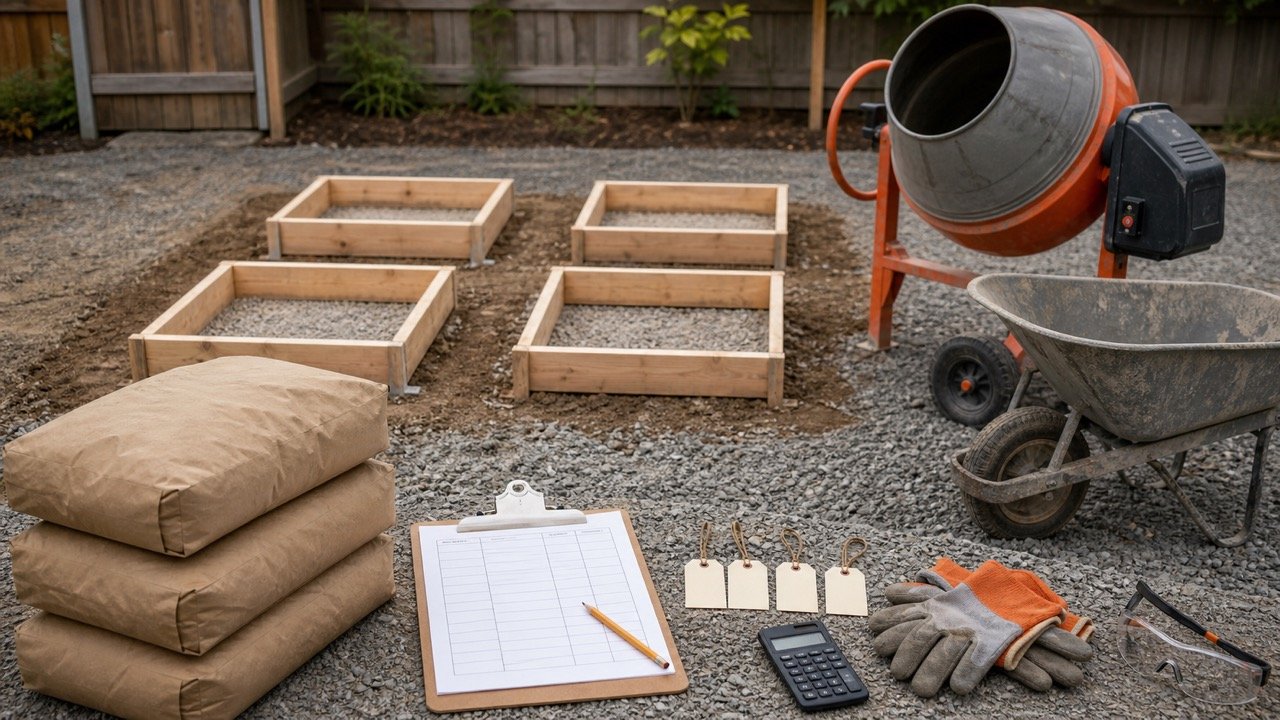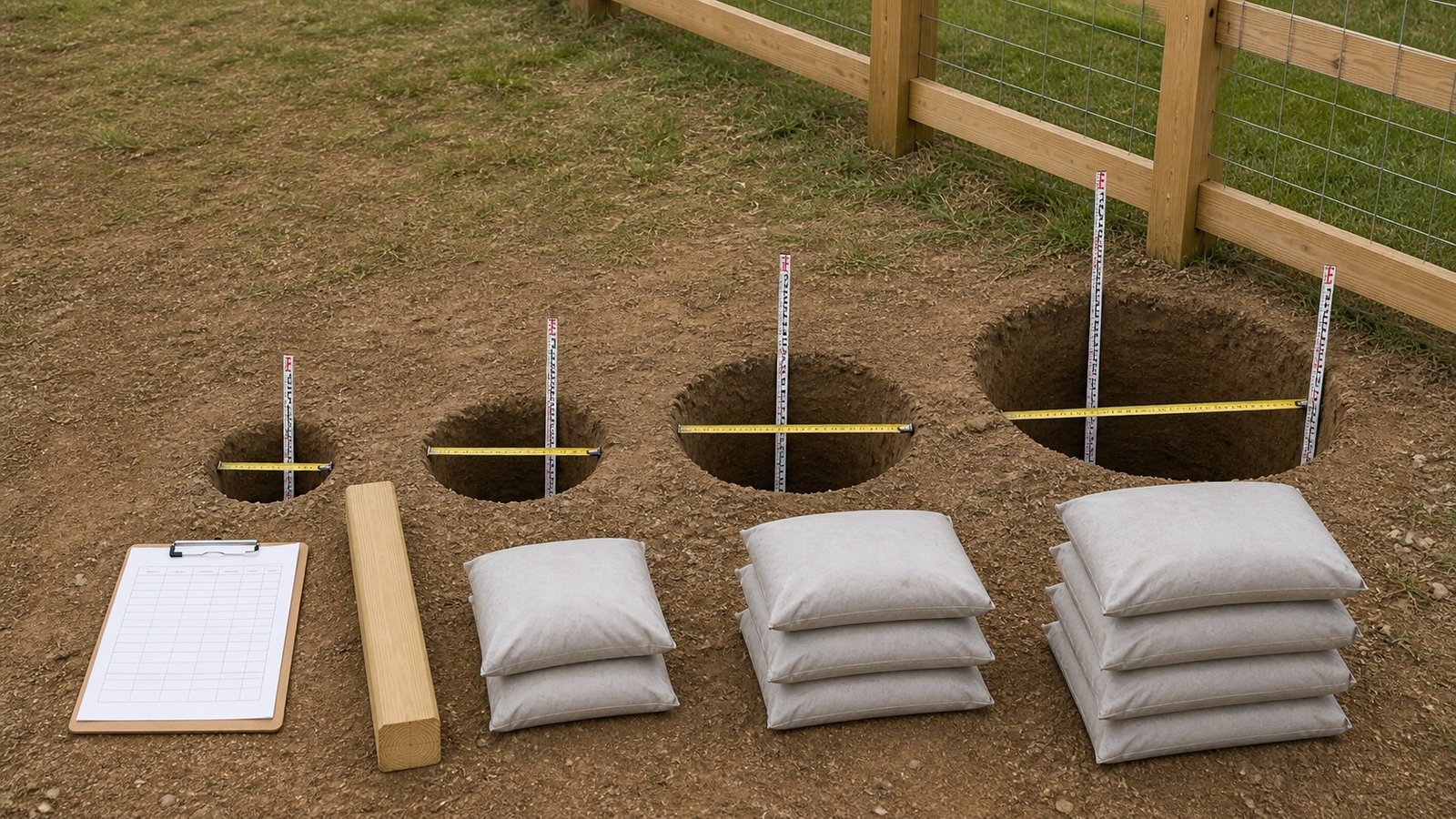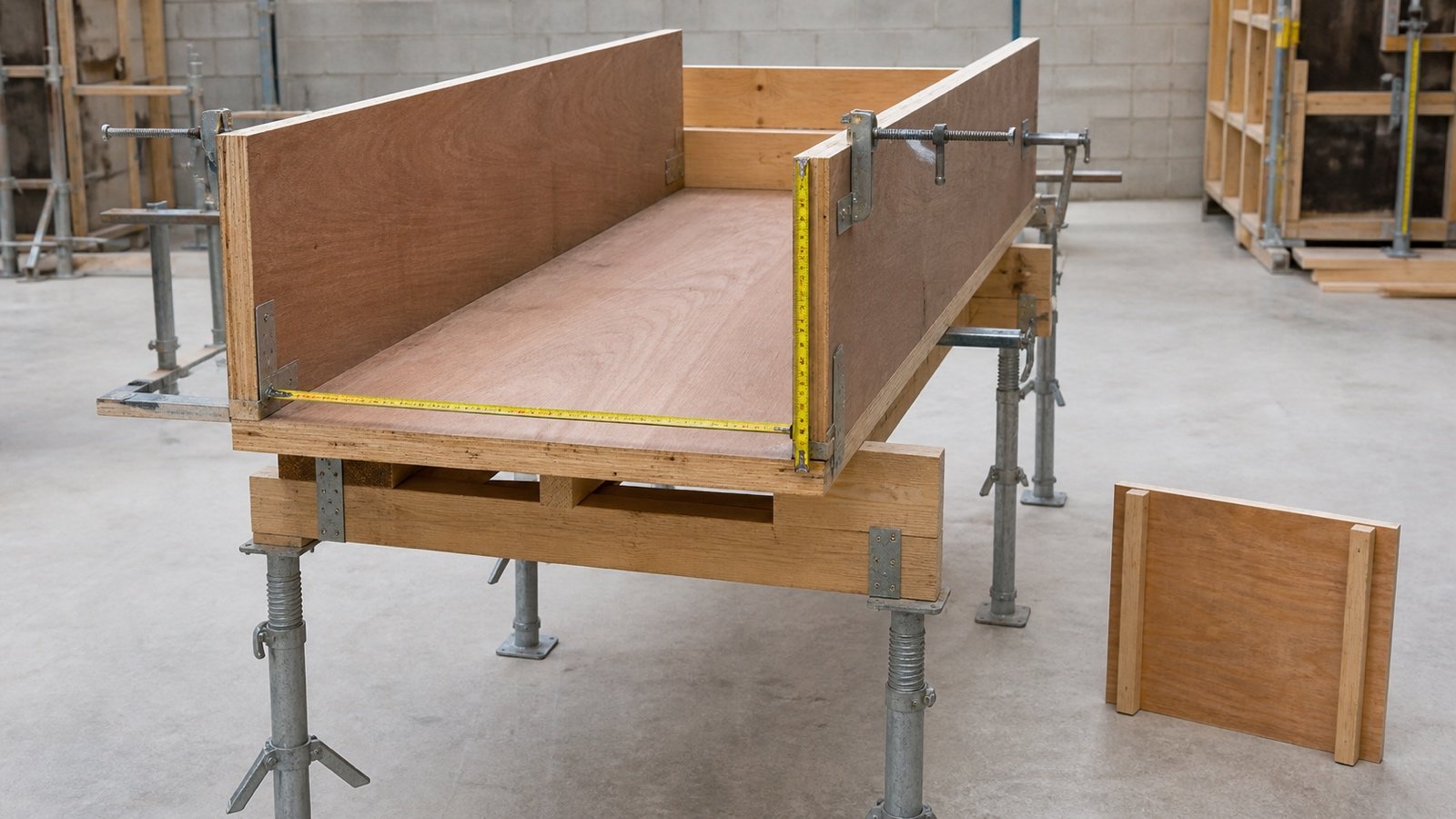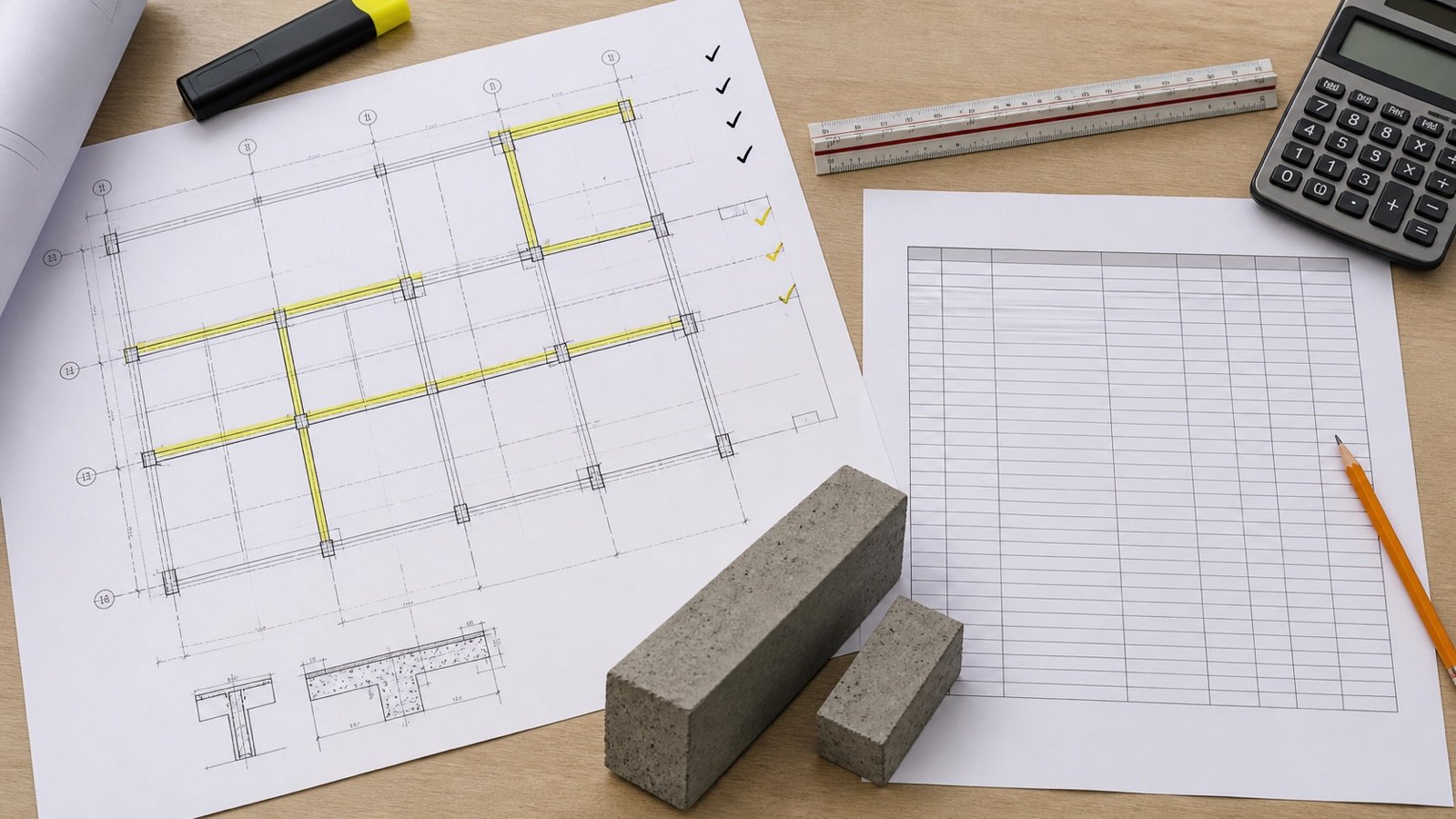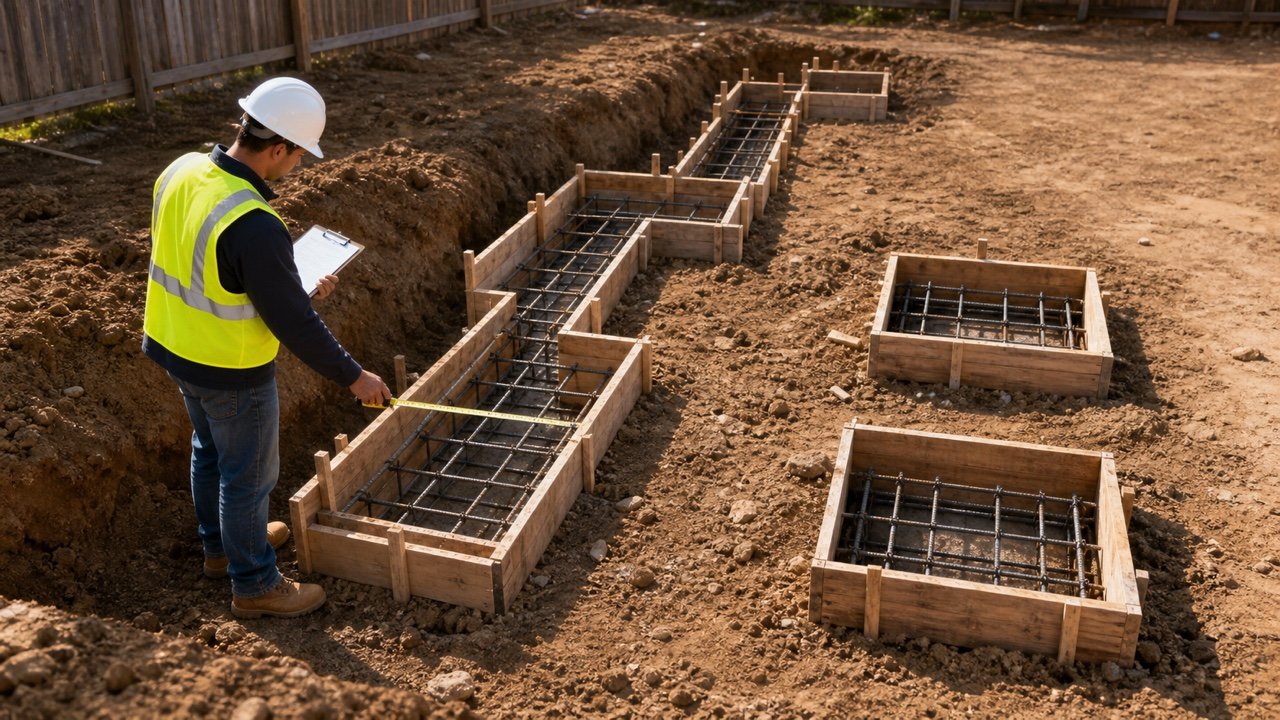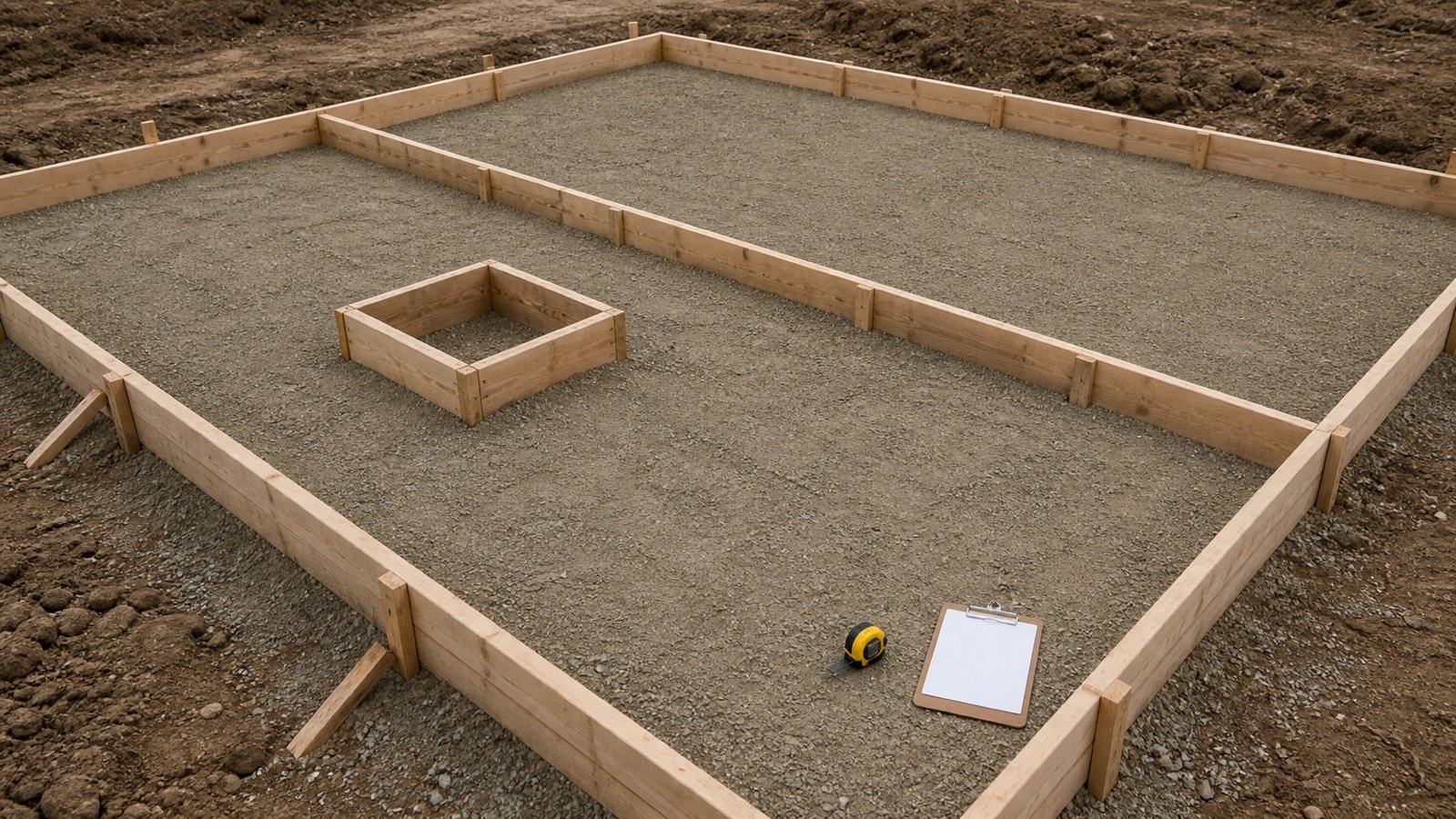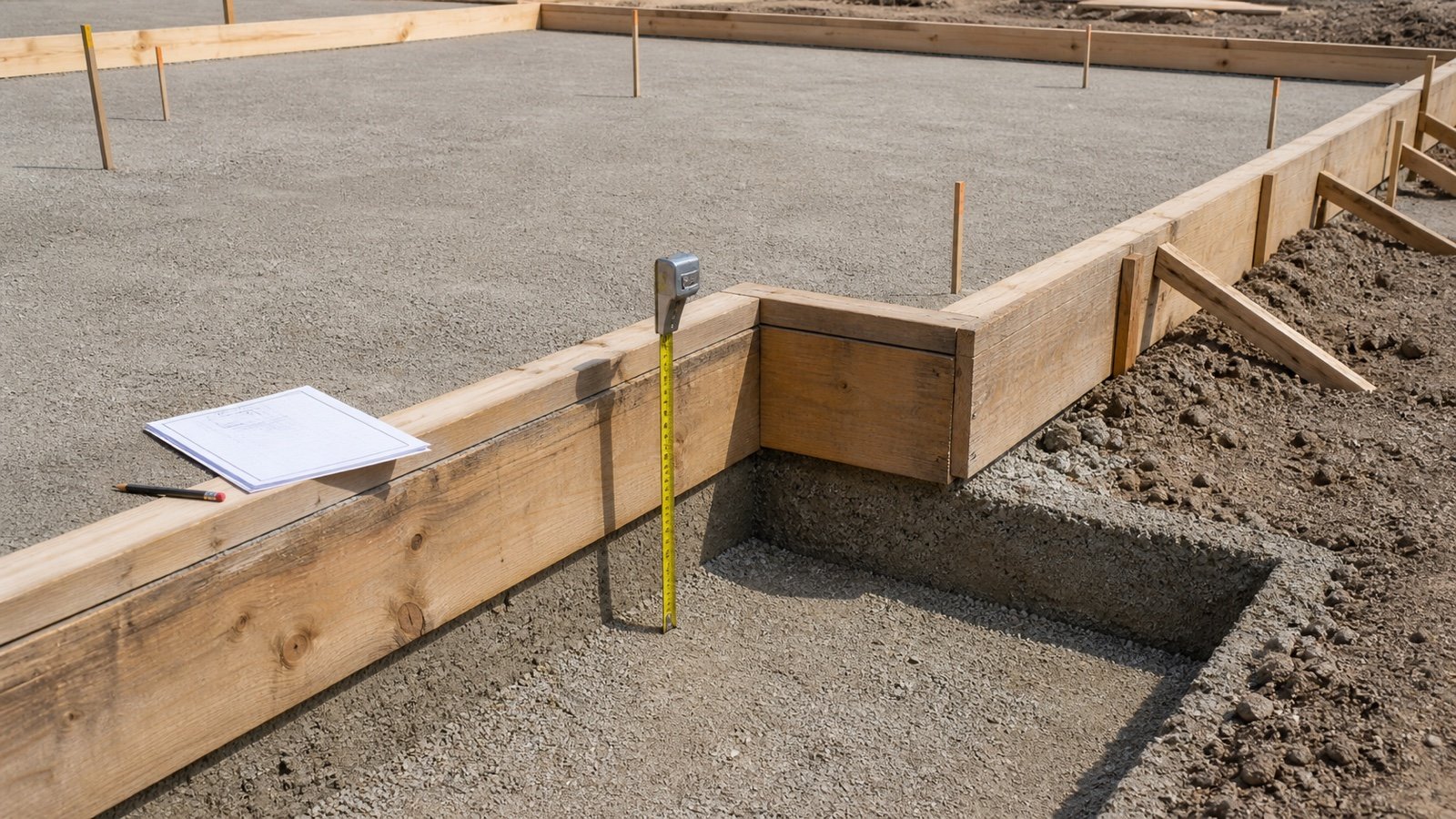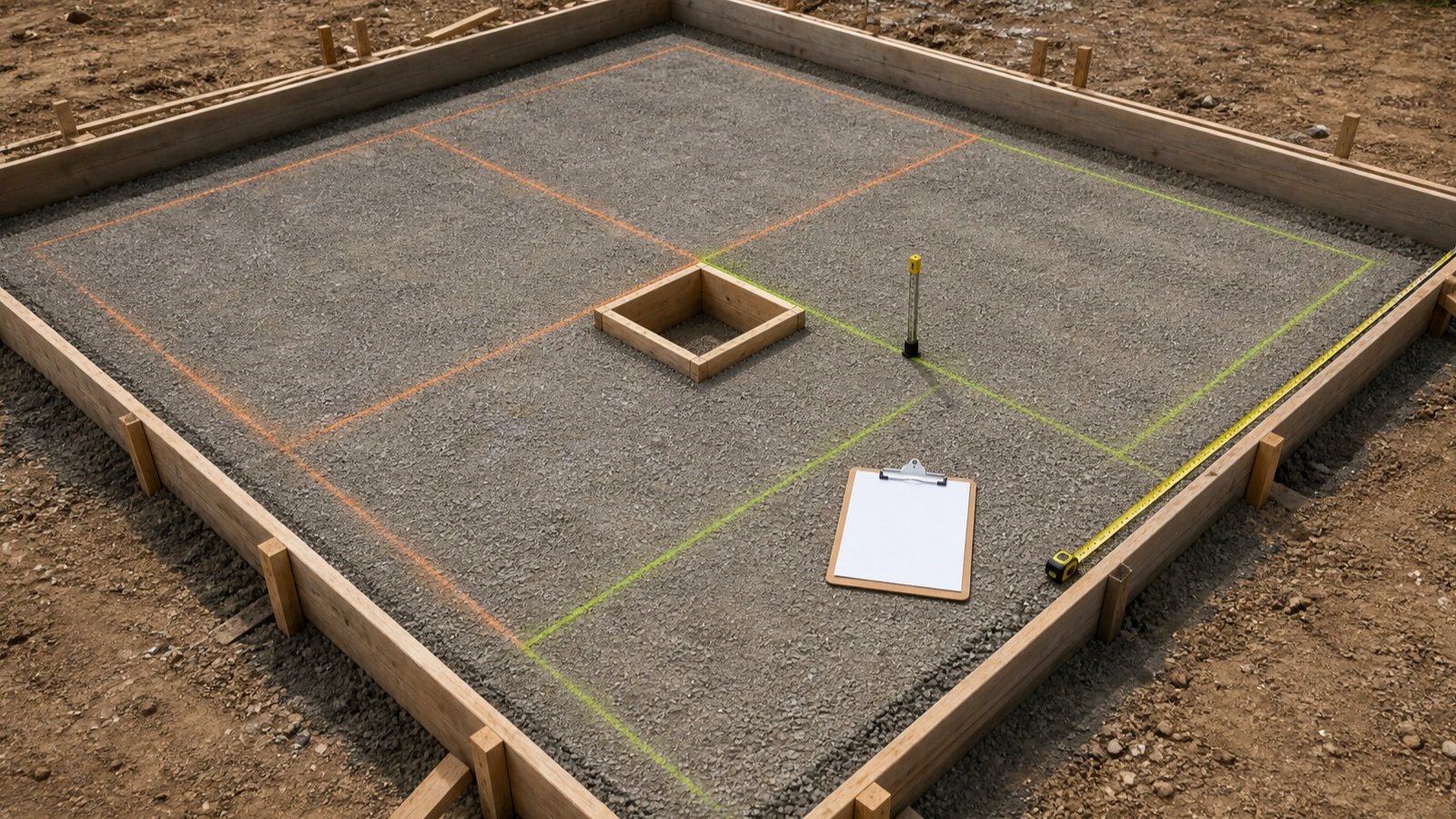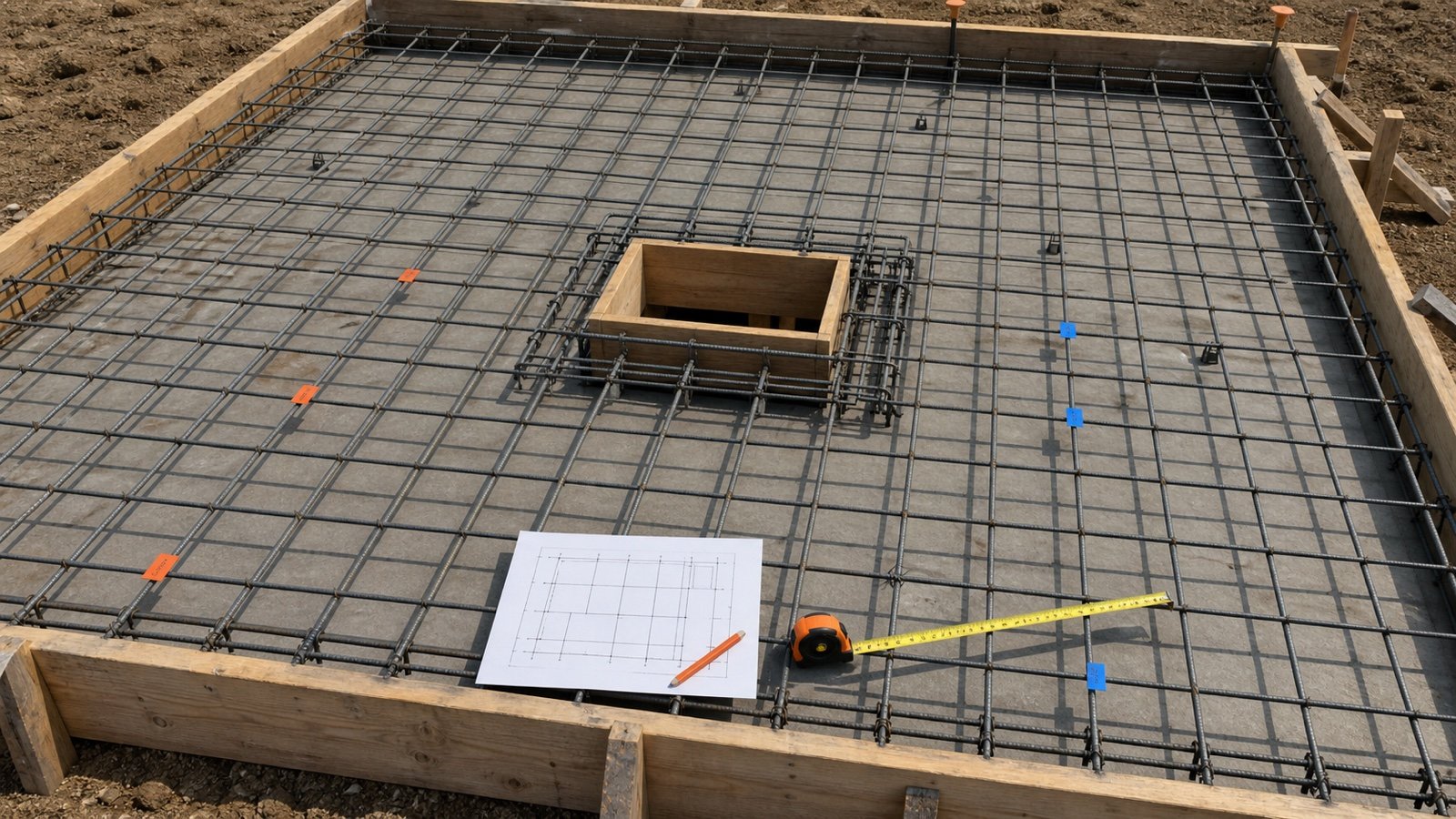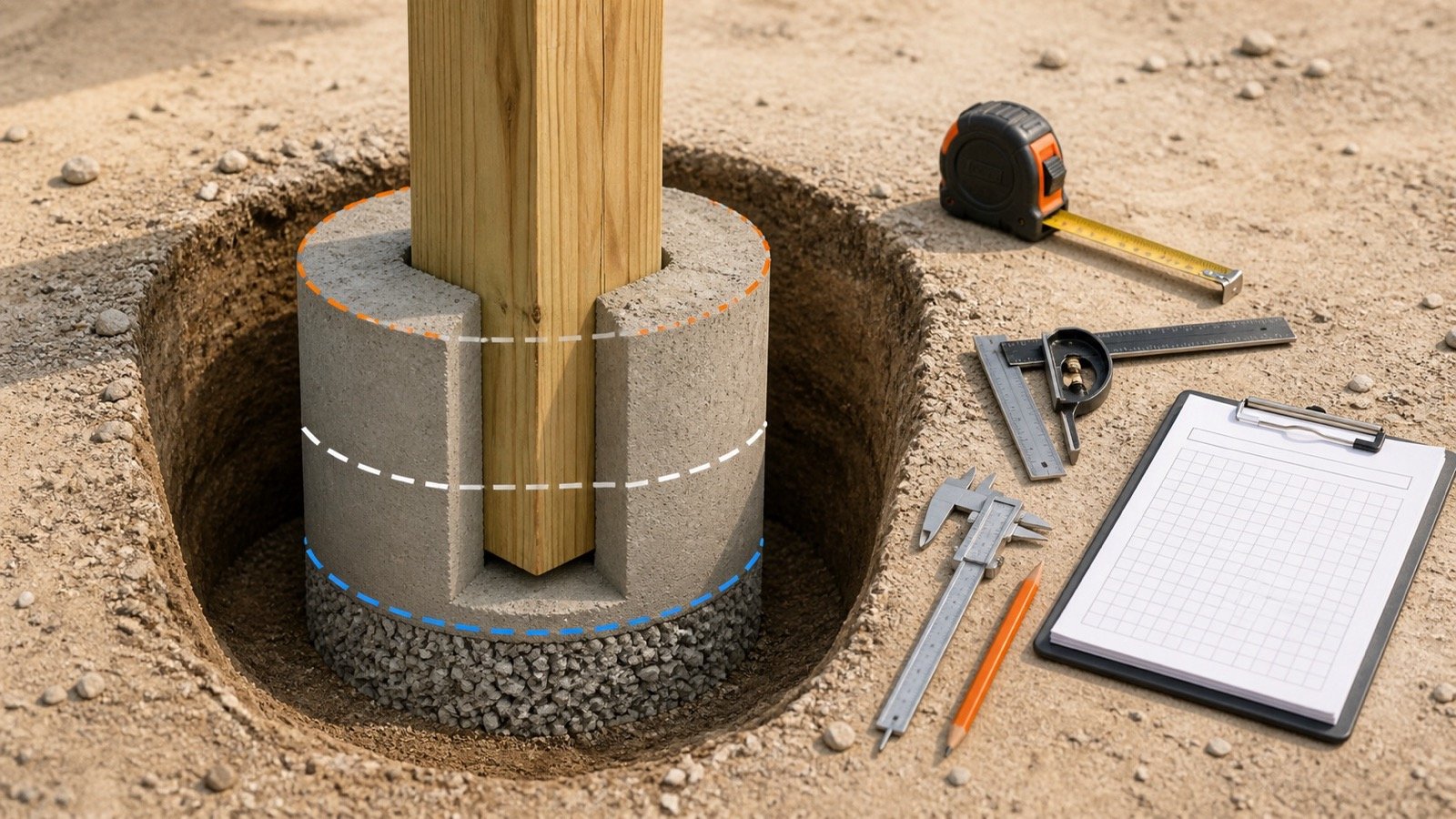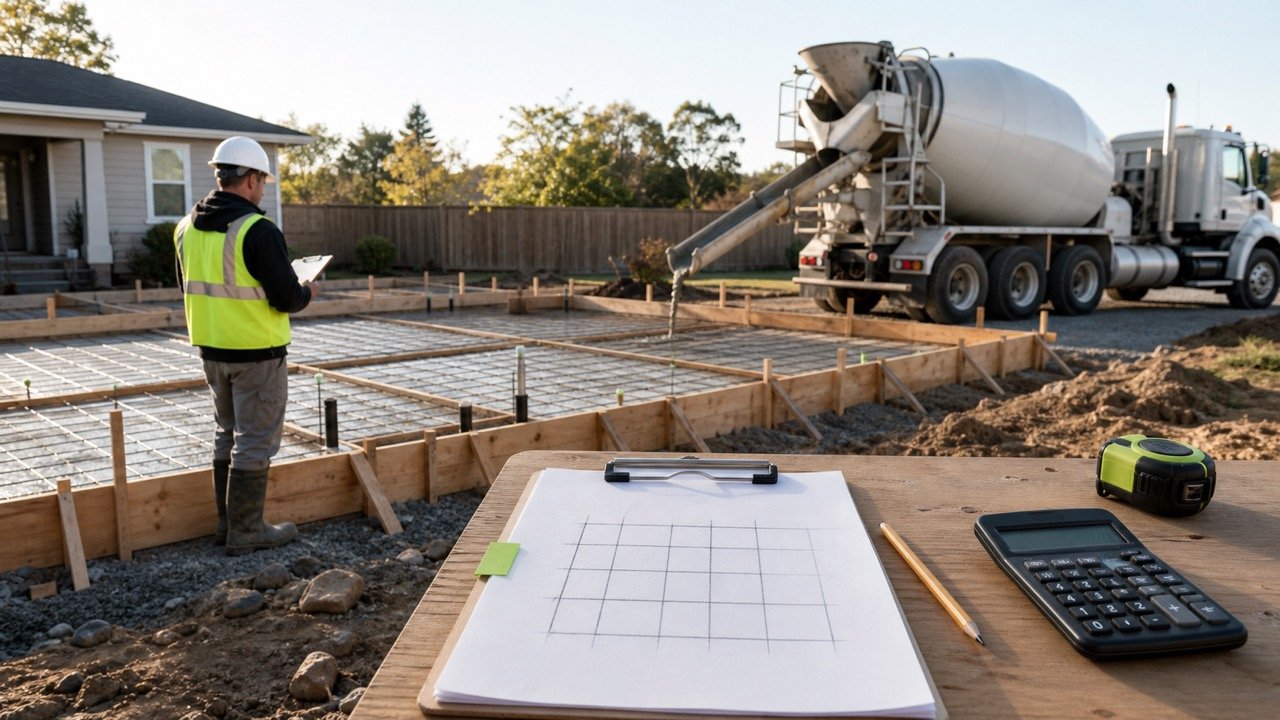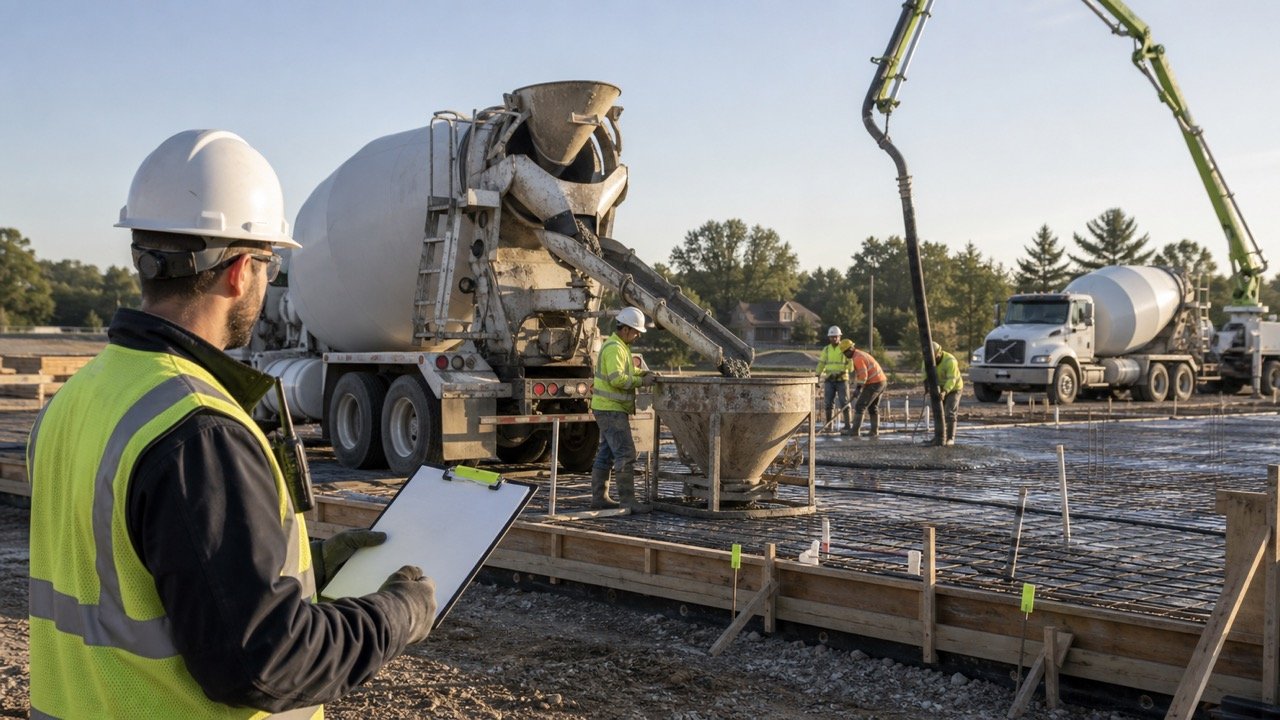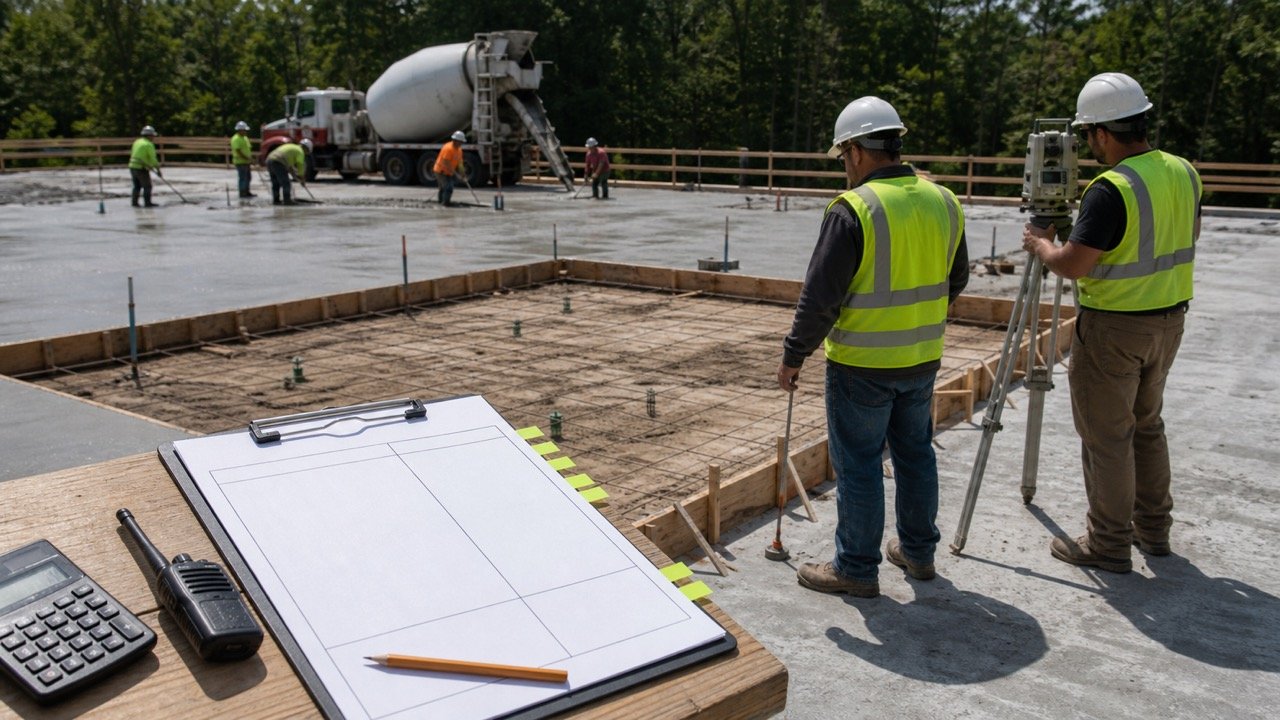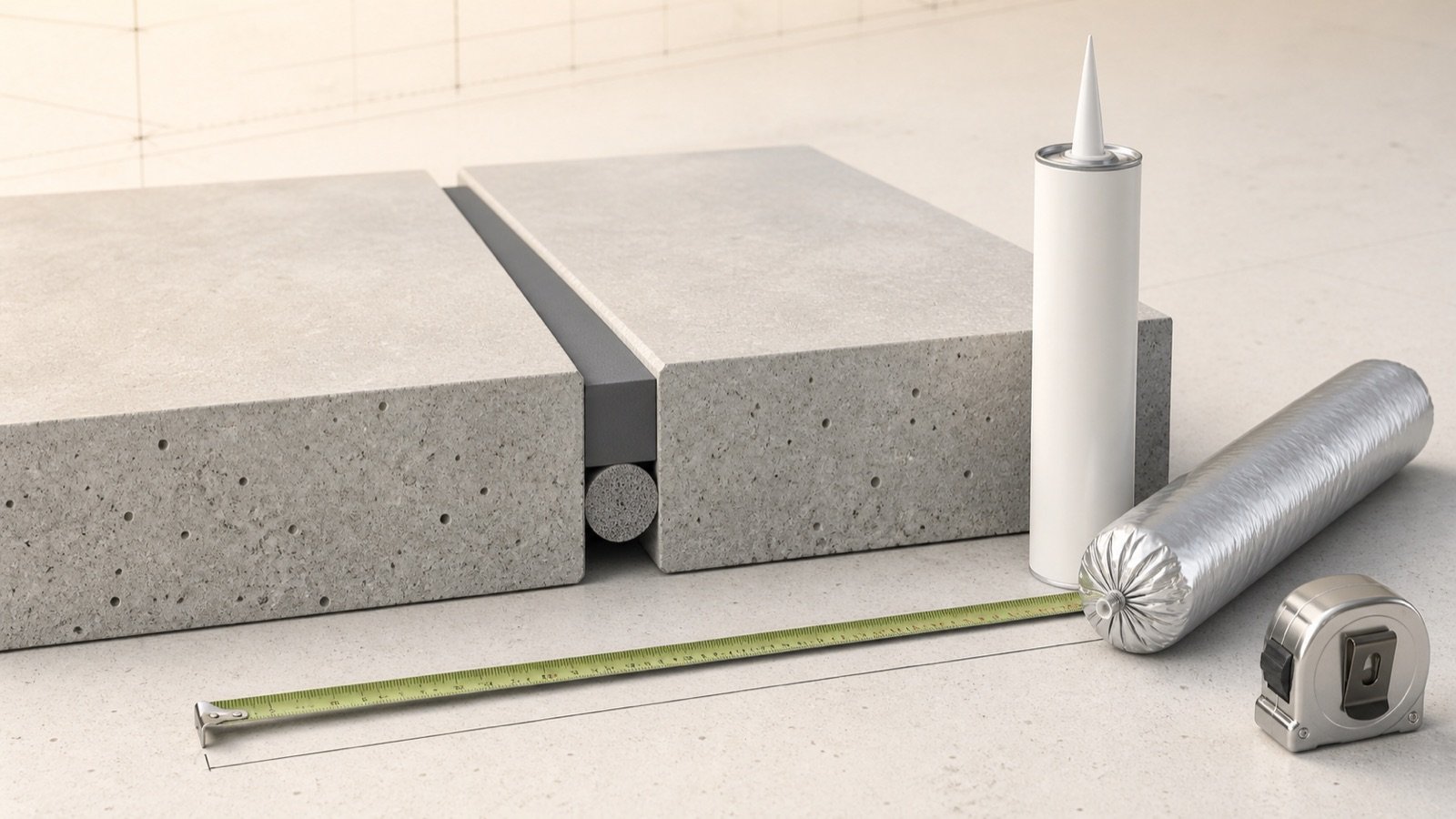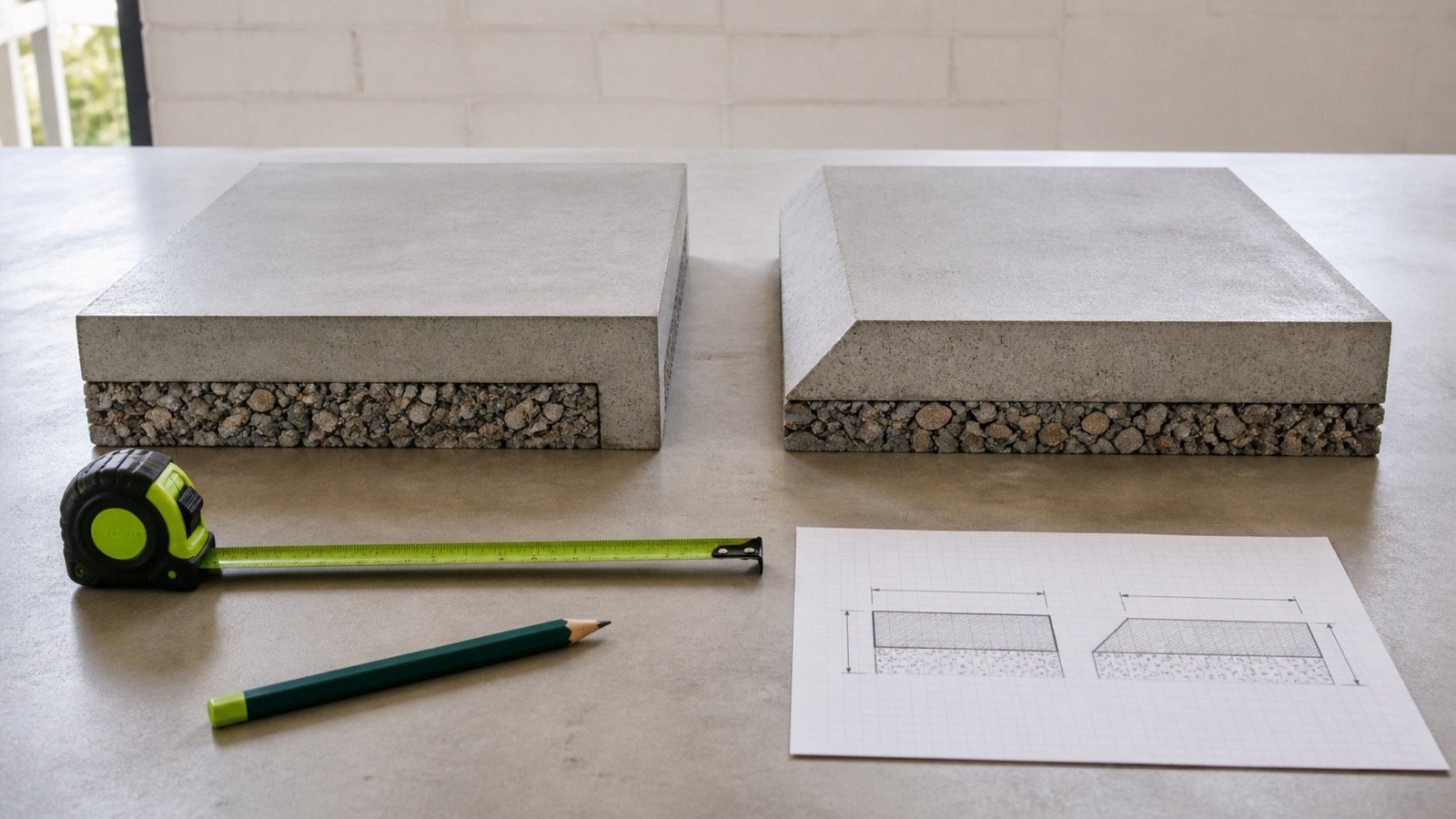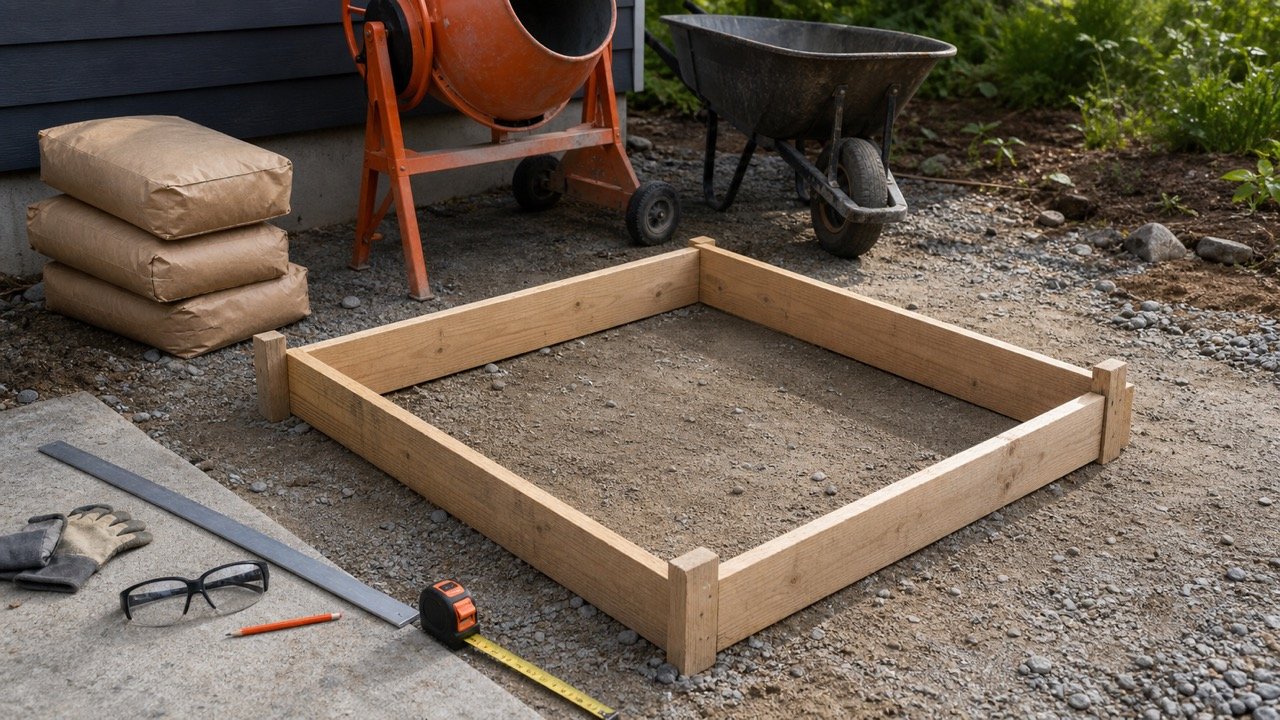
A small slab can still require more concrete bags than its footprint suggests. Thickness is the third dimension, and the final package count also depends on the exact product's mixed yield and any separately justified allowance.
The examples below show the arithmetic without prescribing a slab design. Obtain the approved dimensions, thickness, product and placement plan before ordering.
How many concrete bags does a small slab need?
Multiply the slab's inside length, inside width and approved thickness to get measured fresh volume. Divide the planning volume by the current product yield, then round the final quotient upward to whole packages.
At 0% allowance and 0.60 ft³ per named standard-product package, the exact quotient is 8.888889, so the purchase is 9 whole bags.
Use the Concrete Bags Calculator for the actual dimensions and current product. The table below is a set of checked fixtures, not a replacement for the calculator or design documents.
What formula calculates bags for a rectangular slab?
Keep measured volume, allowance, exact package quotient and whole-package rounding as separate steps.
Measured ft³ = length in ft × width in ft × thickness in in ÷ 12
Planning volume = measured volume × (1 + documented allowance ÷ 100)
Exact bags = planning volume ÷ current mixed yield per bag
Whole bags = ceiling(exact bags)
Metric geometry uses metres and millimetres:
Measured m³ = length in m × width in m × thickness in mm ÷ 1,000
Use NIST conversion relationships for units. They do not select the slab thickness, allowance, product or package yield.
Small-slab bag table at an entered 4 inch thickness
The following U.S. examples use 0% allowance and current approximate yields listed for QUIKRETE Concrete Mix No. 1101: 0.30 ft³ for 40 lb, 0.45 ft³ for 60 lb and 0.60 ft³ for 80 lb packages.
| Inside slab size | Measured volume | 40 lb at 0.30 ft³ | 60 lb at 0.45 ft³ | 80 lb at 0.60 ft³ |
|---|---|---|---|---|
| 2×2 ft | 1.333333 ft³ | 5 bags | 3 bags | 3 bags |
| 3×3 ft | 3.000000 ft³ | 10 bags | 7 bags | 5 bags |
| 4×4 ft | 5.333333 ft³ | 18 bags | 12 bags | 9 bags |
| 5×5 ft | 8.333333 ft³ | 28 bags | 19 bags | 14 bags |
Four inches is an entered example, not a universal minimum or recommendation. A slab for equipment, a structure, a vehicle, a hot tub, a walkway or another use can require different design, subgrade, reinforcement, joints, anchorage, drainage and thickness.
Worked example: 4×4 ft slab with no allowance
A hypothetical form has checked inside dimensions of 4 ft by 4 ft and a uniform approved depth of 4 in. The selected current product states approximately 0.60 ft³ of mixed yield per package.
- Convert depth: 4 in ÷ 12 = 0.333333 ft.
- Measured volume: 4 × 4 × 0.333333 = 5.333333 ft³.
- Exact package quotient: 5.333333 ÷ 0.60 = 8.888889.
- Whole packages: ceiling(8.888889) = 9.
- Purchased mixed capacity: 9 × 0.60 = 5.4 ft³.
- Capacity above measured volume: 5.4 - 5.333333 = 0.066667 ft³.
The result has little capacity above the measured geometry. It does not account for unmeasured thickening, uneven support, form movement, samples, spill or another project condition.
Can a small allowance change the whole-bag result?
Yes. A modest planning increase can cross the next package boundary. Add one only when a measured or documented project condition supports it.
| Record | 0% allowance | 5% allowance fixture |
|---|---|---|
| Measured volume | 5.333333 ft³ | 5.333333 ft³ |
| Planning volume | 5.333333 ft³ | 5.600000 ft³ |
| Exact quotient at 0.60 ft³ | 8.888889 | 9.333333 |
| Whole bags | 9 | 10 |
| Purchased capacity | 5.4 ft³ | 6.0 ft³ |
The 5% fixture needs 10 bags, not 9. Whole-package rounding occurs after the allowance is applied.
Do not adopt 5% from the example. QUIKRETE's calculator states that its approximate values do not include uneven substrate or waste, but that disclosure does not establish one percentage for every site.
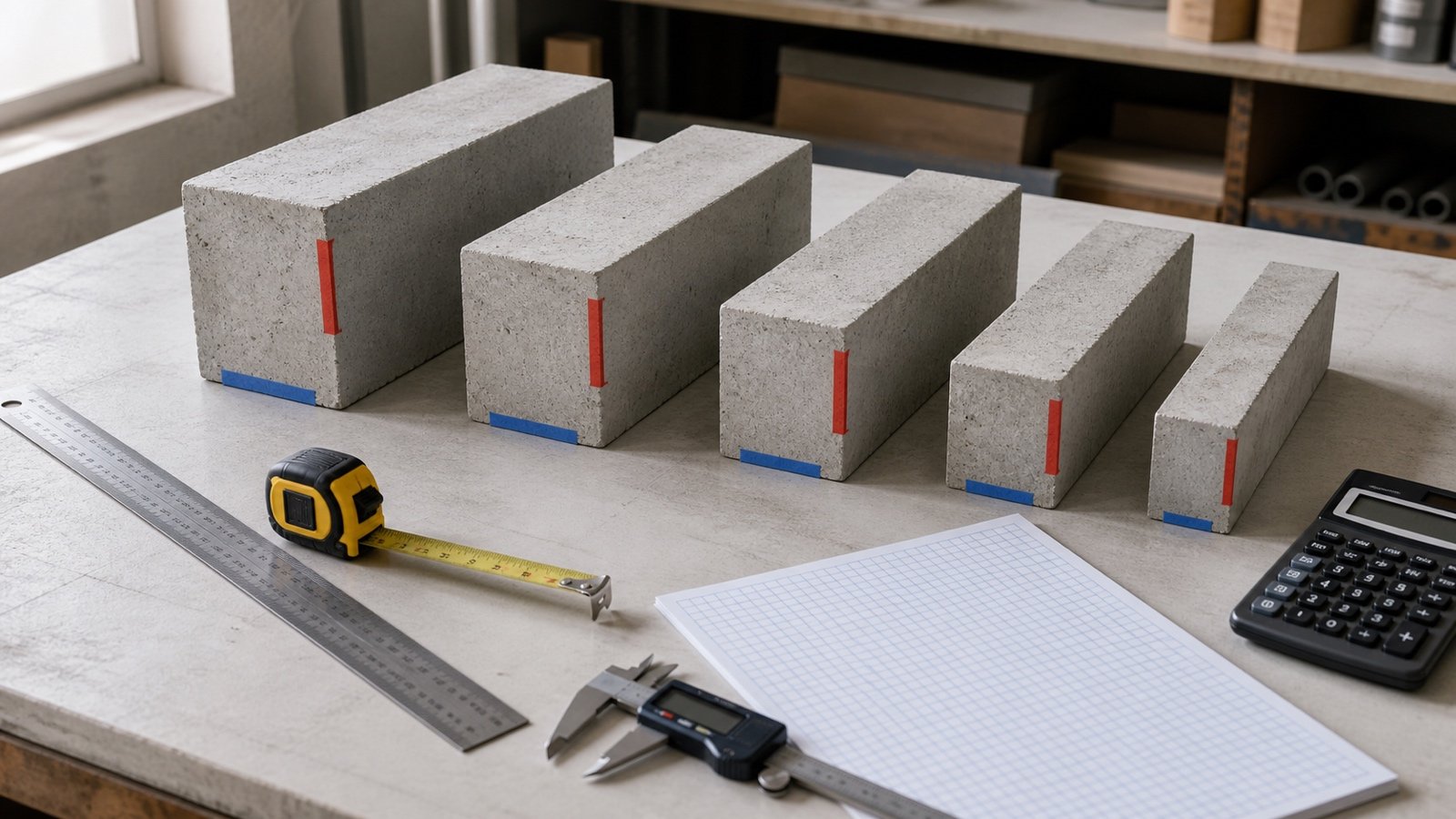
How much does slab thickness change the bag count?
Volume changes in direct proportion to a uniform thickness. The whole-package result changes in steps as each quotient crosses a package boundary.
| Entered uniform thickness | Measured volume | Exact quotient | Whole bags |
|---|---|---|---|
| 2 in | 2.666667 ft³ | 4.444444 | 5 |
| 3 in | 4.000000 ft³ | 6.666667 | 7 |
| 4 in | 5.333333 ft³ | 8.888889 | 9 |
| 5 in | 6.666667 ft³ | 11.111111 | 12 |
| 6 in | 8.000000 ft³ | 13.333333 | 14 |
This table compares arithmetic inputs only. It does not say that 2, 3, 4, 5 or 6 in is suitable for a particular slab.
Worked metric example: 1 metre square slab
A hypothetical slab is 1 m by 1 m with an approved uniform thickness of 100 mm. The selected current package states 17 L of mixed yield.
- Measured volume: 1 × 1 × 100 ÷ 1,000 = 0.1 m³.
- Convert volume: 0.1 m³ = 100 L.
- Exact package quotient: 100 ÷ 17 = 5.882353.
- Whole packages: 6.
- Purchased capacity: 6 × 17 = 102 L.
- Capacity above measured volume: 2 L.
Use the product's current metric yield. Do not infer litres from package kilograms.
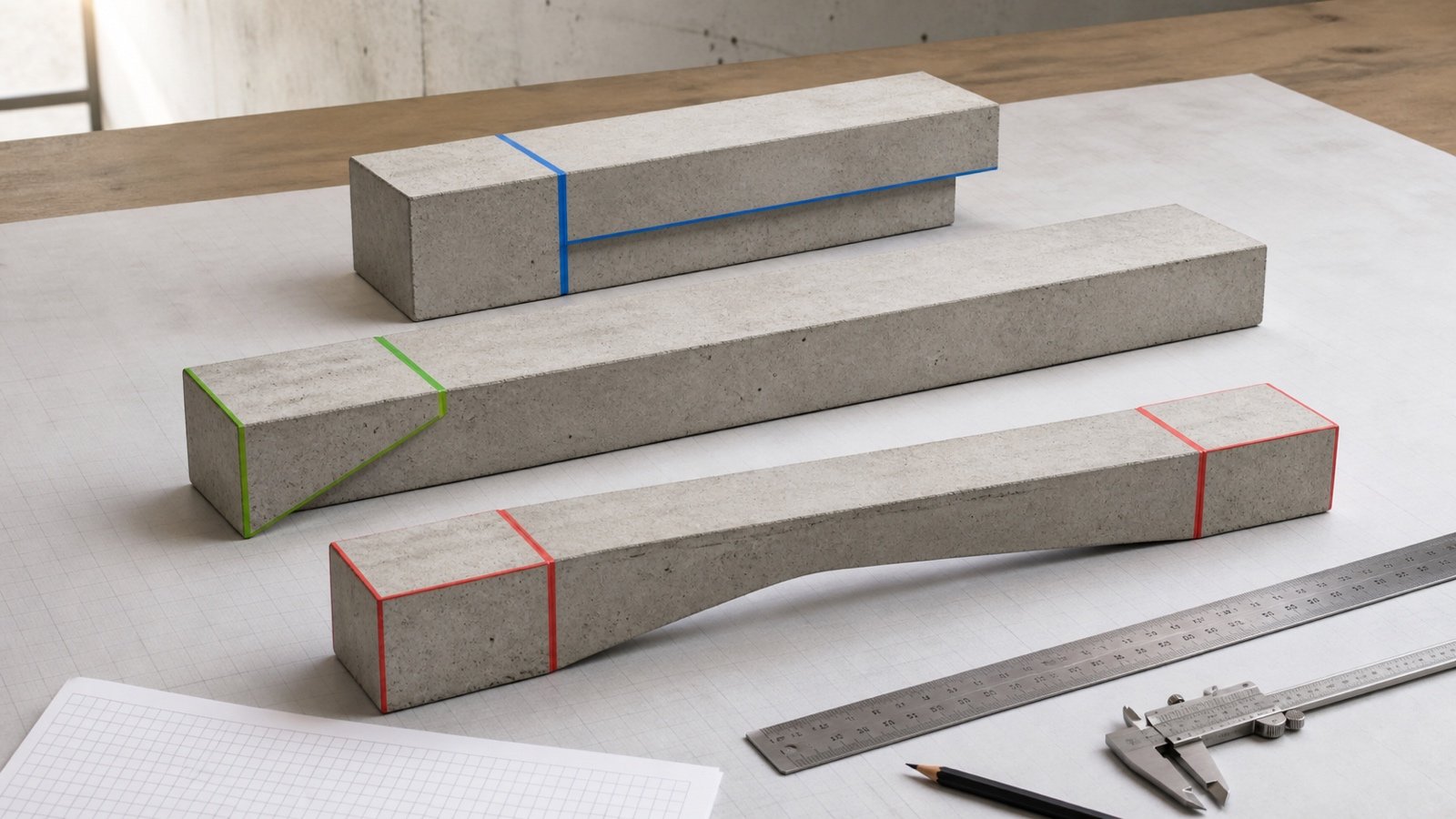
How do you calculate a thickened slab edge?
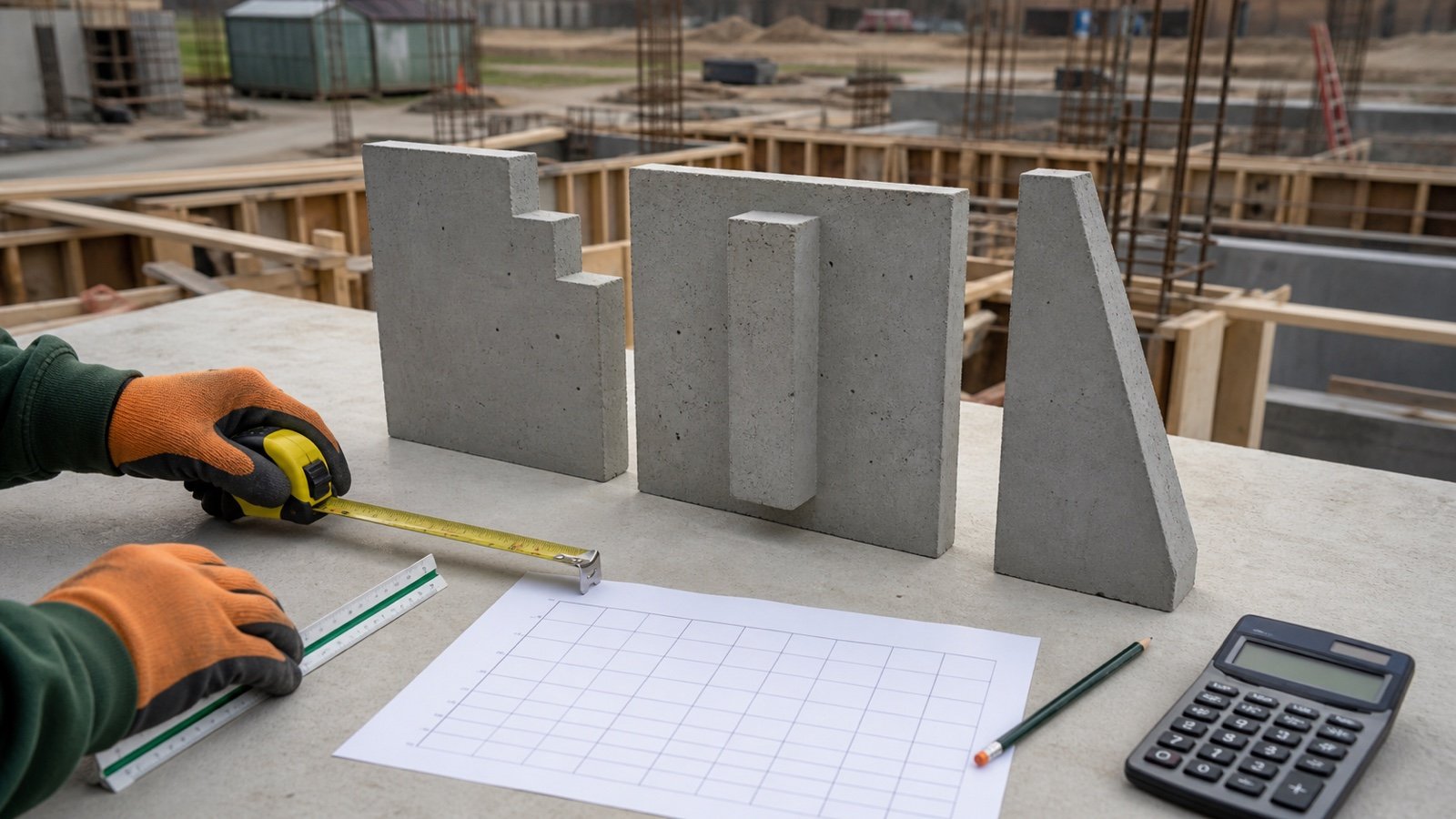
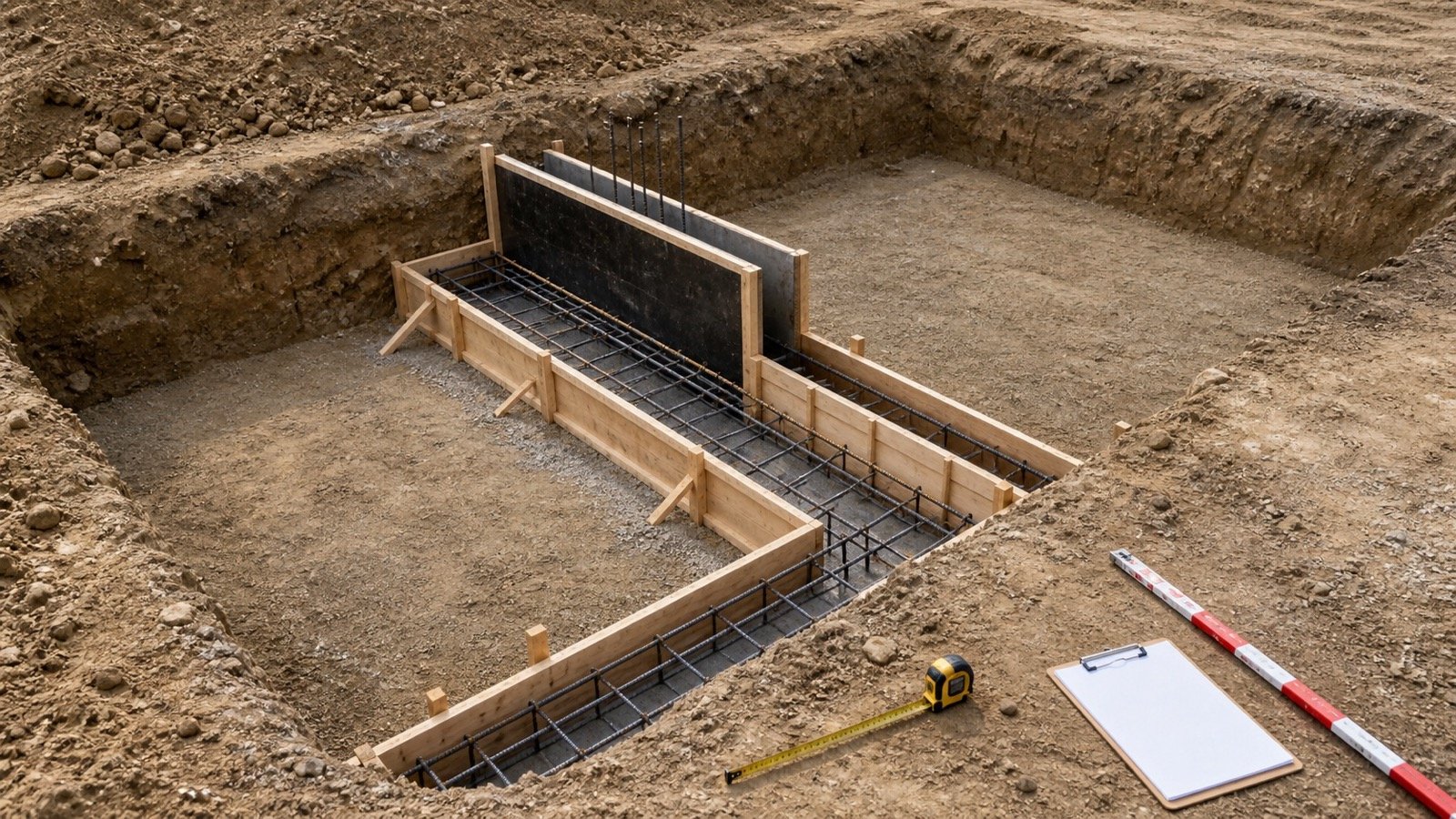
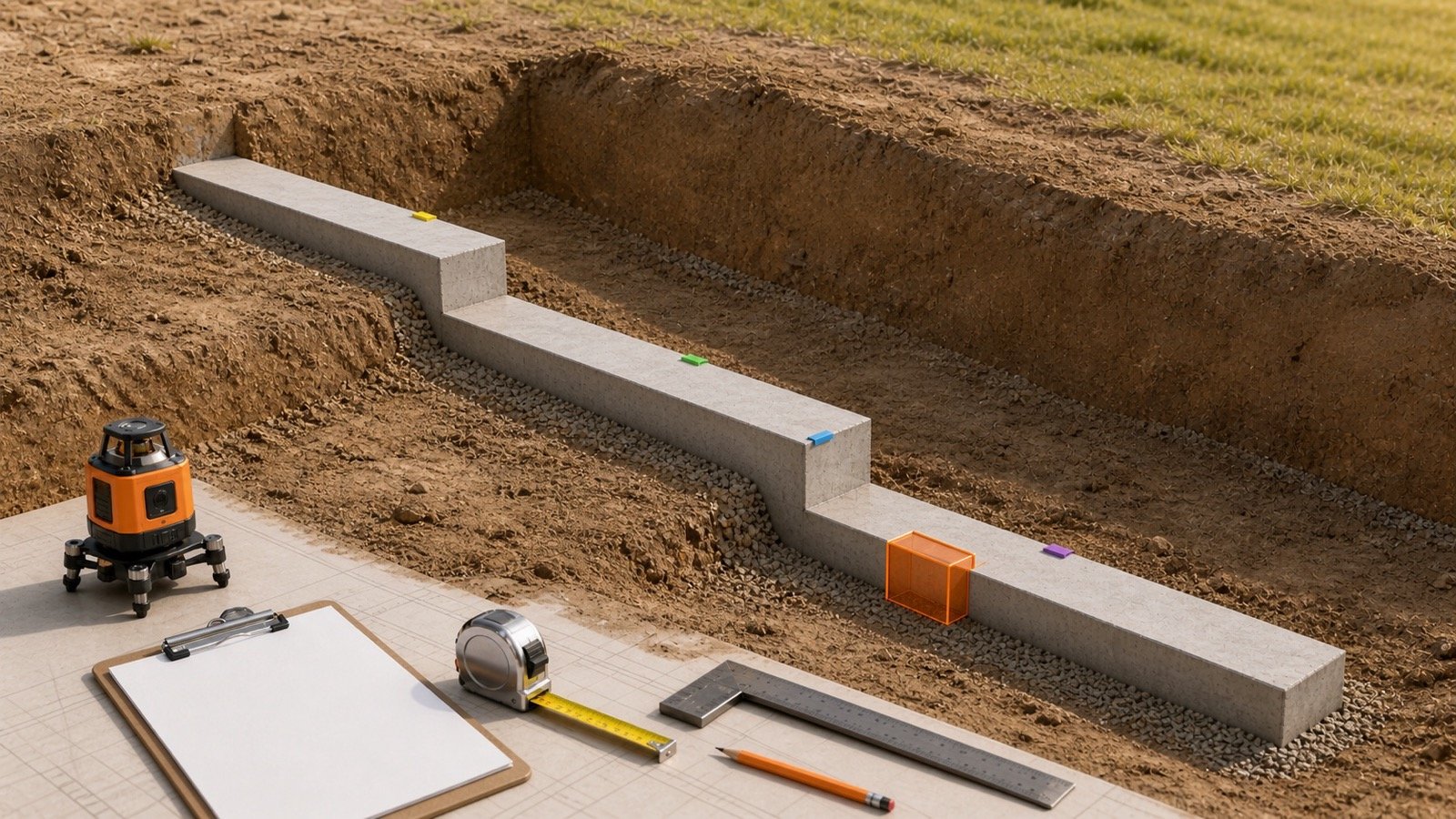
Calculate the base slab once, then add only the extra depth within the thickened zone. Applying the full deeper thickness to the entire slab overstates volume; ignoring the band understates it.
Consider a hypothetical 4×4 ft slab with a 4 in base, plus a 6 in wide perimeter band extending another 4 in below the base. These dimensions demonstrate geometry and are not a structural detail.
- Base slab: 4 × 4 × 4 ÷ 12 = 5.333333 ft³.
- Inner dimensions after two 6 in bands: 3 × 3 ft.
- Band plan area: 4 × 4 - 3 × 3 = 7 ft².
- Additional band volume: 7 × 4 ÷ 12 = 2.333333 ft³.
- Total measured volume: 5.333333 + 2.333333 = 7.666667 ft³.
- At 0.60 ft³ per bag: 7.666667 ÷ 0.60 = 12.777778, so 13 whole bags.
| Method | Measured volume | Whole bags at 0.60 ft³ | Issue |
|---|---|---|---|
| Ignore thickened band | 5.333333 ft³ | 9 | Misses the additional zone |
| Base plus extra band | 7.666667 ft³ | 13 | Matches the hypothetical two-zone geometry |
| Apply 8 in to full slab | 10.666667 ft³ | 18 | Double counts depth outside the band |
What if the slab thickness slopes or varies?
Divide the slab into valid depth zones or use a suitable surface or cross-section method. One maximum depth across the whole footprint can overstate the quantity, while one minimum can leave the form short.
For a truly planar thickness changing uniformly from one edge to the opposite edge, the average of the two end thicknesses can support the prism volume. Do not use that shortcut for irregular subgrade, isolated depressions, drainage sumps, multiple slopes or thickened details.
Which slab dimensions should be measured?
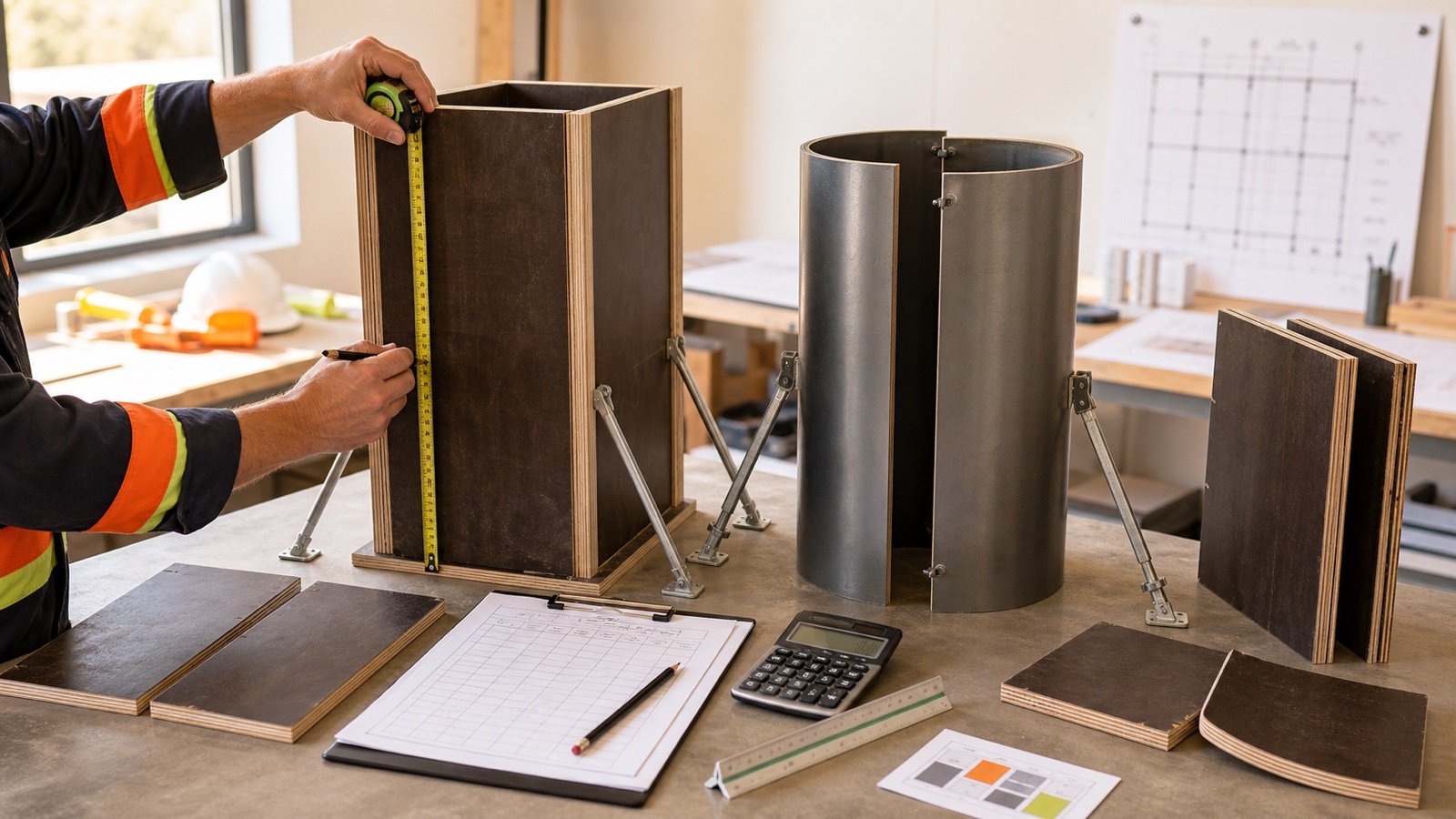
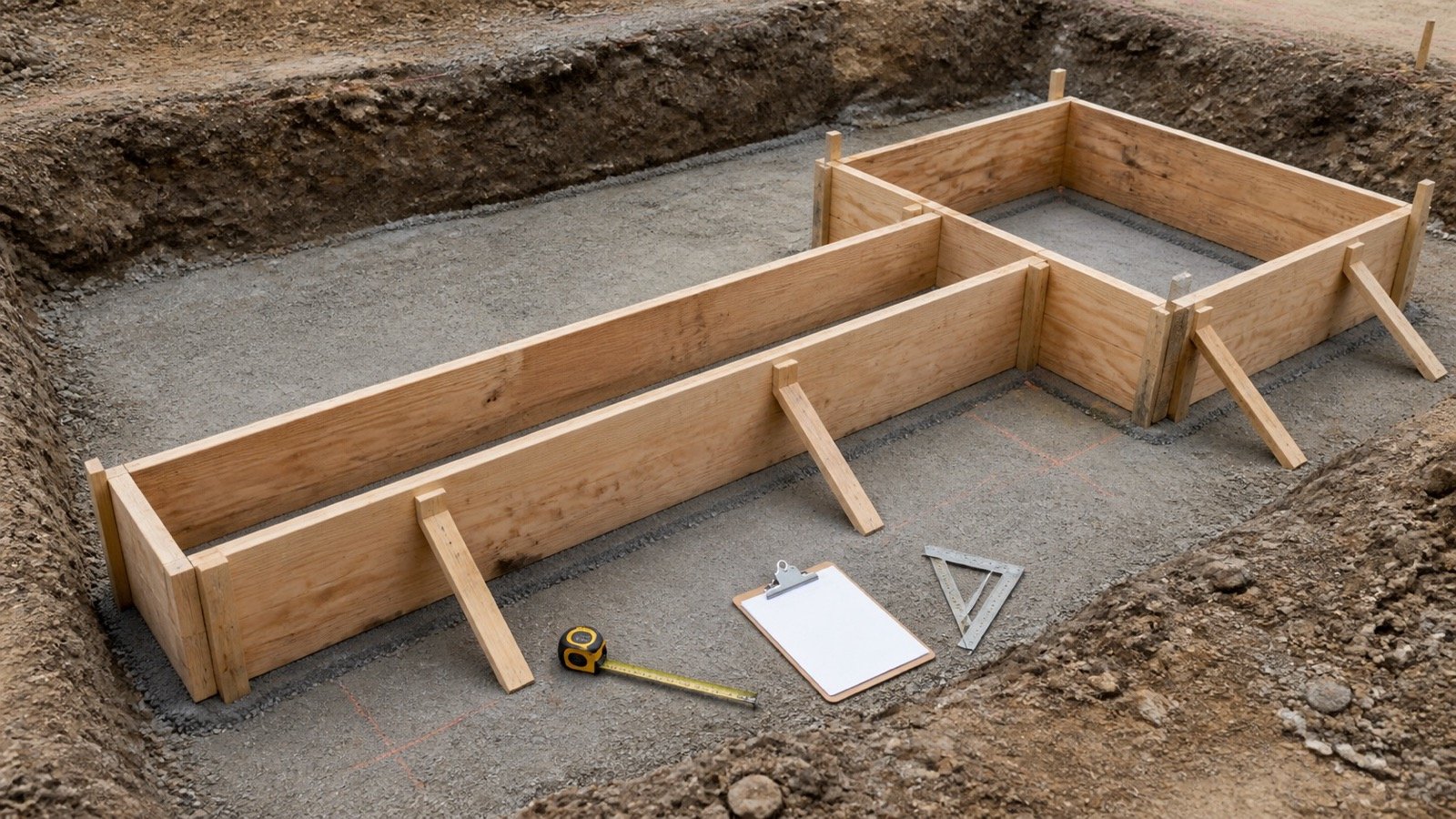
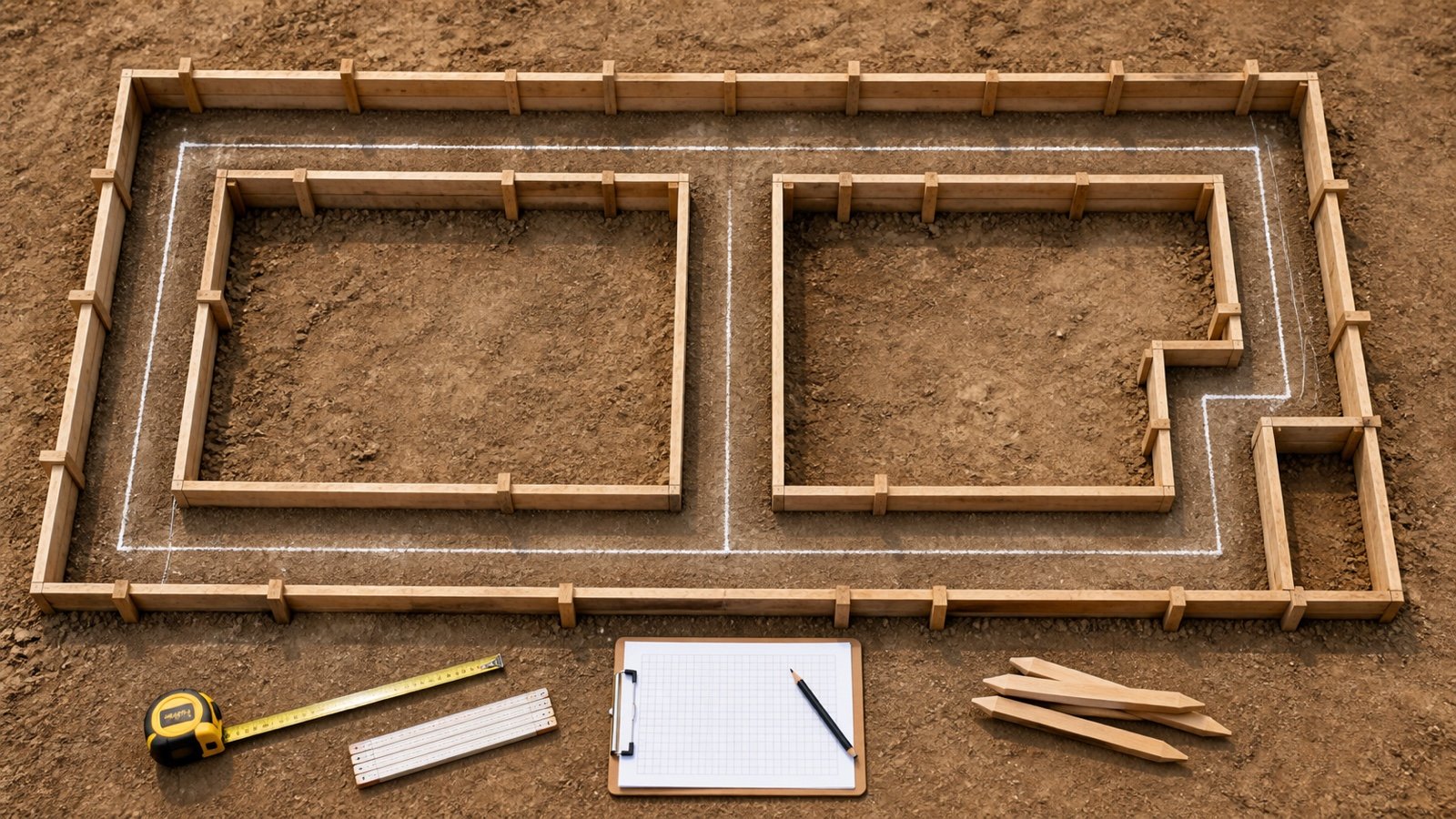
Use the concrete space inside the forms or the controlled drawing dimensions, not automatically the outside of the form boards. Record the form thickness and reference points so another person can reproduce the measurement.
- Measure inside length and width at more than one location.
- Check diagonals and squareness when they affect the work.
- Record approved thickness from a controlled datum.
- Separate recesses, openings, steps, curbs and thickened zones.
- Do not subtract reinforcement or small embedments without a supported takeoff rule.
- Recheck forms and subgrade before placement.
Which concrete bag yield belongs in the example?
Use the exact current product's approximate mixed yield. Package weight alone cannot select it.
The Concrete Bag Yield Chart documents named standard and high-yield examples. The Dry Bag vs Mixed Volume guide explains why dry mass, water, fresh yield and placed concrete are separate states.
Check product use, thickness, strength, consistency, temperature, mixing, placement, finish, curing, storage and safety instructions before using a yield row.
Should several small slabs be rounded separately?
Combine their unrounded planning volumes before one package ceiling only when the same product, yield, allowance and placement plan legitimately apply. Separate the calculations when those conditions differ.
For example, three identical 2×2×4 in slabs each measure 1.333333 ft³. Rounding each independently at 0.60 ft³ gives 3 bags each, or 9. Combining the measured volumes gives 4 ft³ ÷ 0.60 = 6.666667, or 7 whole bags. The correct treatment depends on whether the material can actually be shared across one compatible operation.
What placement checks remain after the bag count?
Whole packages do not prove that the mixer, people, water, power, access, forms, placement rate or finishing plan can complete the work correctly. Review the actual product working time and mixing instructions.
QUIKRETE No. 1101 instructs users to fill slab forms to full depth and work continuously from one end to the other in its stated method. A universal number of bags cannot decide whether hand mixing, a mixer or ready-mix delivery fits the project.
Myth versus reality
| Myth | Reality |
|---|---|
| Every small slab should be 4 in thick | The example needs an entered thickness; design and project requirements select it. |
| A 5% allowance never changes a 4×4 example | At 0.60 ft³ per bag, it changes the whole purchase from 9 to 10. |
| An 80 lb label always means 0.60 ft³ | Mixed yield is product-specific. |
| A thickened band makes the whole slab twice as deep | Add only the extra volume within the band zone. |
| Outside form dimensions equal concrete dimensions | The form boards occupy space; use the controlled inside concrete geometry. |
| Each slab must be rounded to bags separately | Compatible unrounded volumes can be combined when one placement and product basis applies. |
Common small-slab calculation mistakes
- Using a familiar thickness without design or project approval.
- Entering inches as feet or millimetres as metres.
- Measuring outside the form instead of the concrete space.
- Using package mass as mixed yield.
- Adding an automatic allowance with no stated reason.
- Rounding the bag quotient before the allowance.
- Ignoring a thickened edge or applying its full depth everywhere.
- Using one average depth for irregular subgrade.
- Rounding each compatible section before combining volume.
- Assuming bag count approves product selection or placement capacity.
What should the small-slab quantity record contain?
- Project, use, drawing or sketch revision and responsible thickness source.
- Inside form length, width, depth, units, date and measurement points.
- Base slab, bands, recesses, openings and other separate zones.
- Measured volume before allowance.
- Allowance, reason and planning volume.
- Exact product, package, current mixed yield and data-sheet revision.
- Exact quotient, whole bags, purchased capacity and capacity above planning.
- Mixer, batch, placement, form, field check and exception records.
Return to the Concrete Planning hub for packaged and ready-mix quantity workflows.
Safety and design limits
The examples do not design a slab, footing, equipment base, hot-tub base, generator pad, shed foundation, driveway, reinforcement, joint, subbase, drainage, anchor or form. Use applicable drawings, specifications, permits, codes, soil information, manufacturer instructions and qualified professionals.
OSHA states that wet portland cement can cause caustic burns and dermatitis. Follow the current product safety data sheet and applicable controls for dust, eyes, skin, lifting, equipment, electricity, excavation and washing.
Sources and source scope
- QUIKRETE Concrete Mix No. 1101 data sheet: named-product approximate yields, mixing and slab-placement context.
- QUIKRETE Concrete Calculator: manufacturer disclosure that results are approximate and exclude uneven substrate or waste.
- NIST Guide to the SI Appendix B: unit conversions.
- OSHA, Concrete and Concrete Products: Controlling Hazards: wet-portland-cement hazard context.
Source scope: the product sources support the named product examples at the retrieval date. NIST supports unit arithmetic. OSHA supports its U.S. workplace context. None selects a slab design, thickness, allowance, product, placement method, ready-mix crossover or code requirement for a specific project.