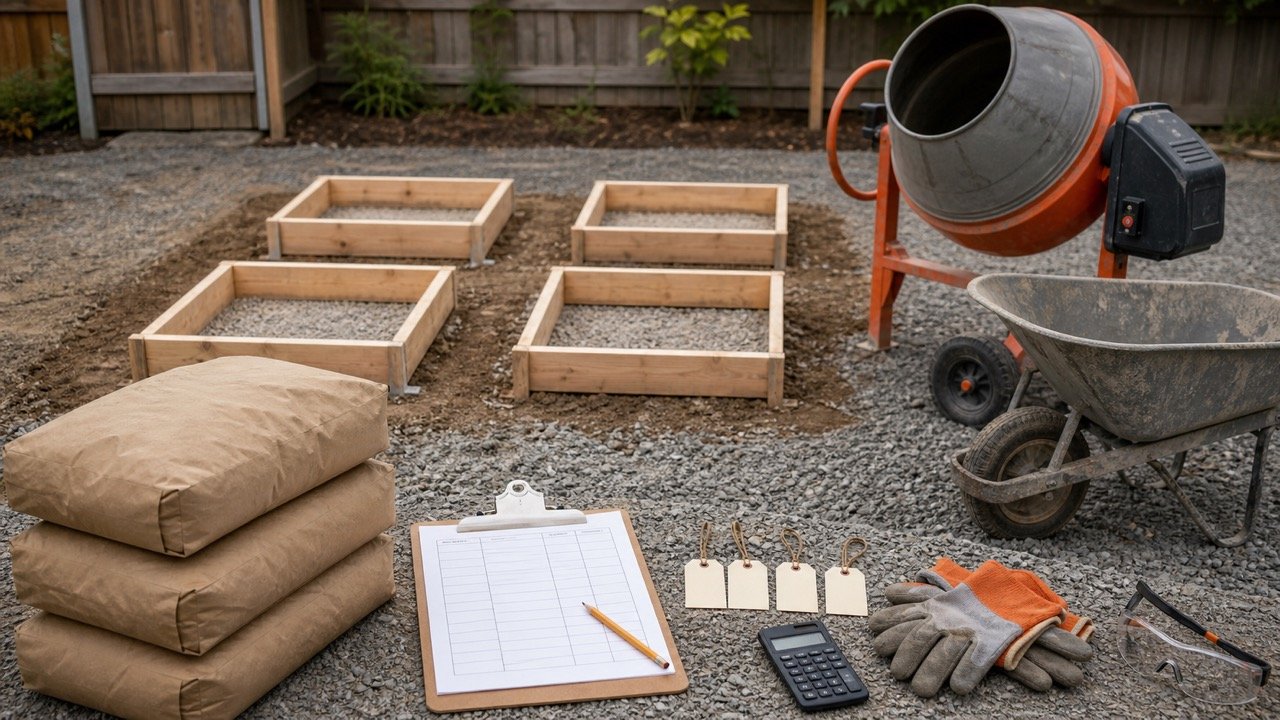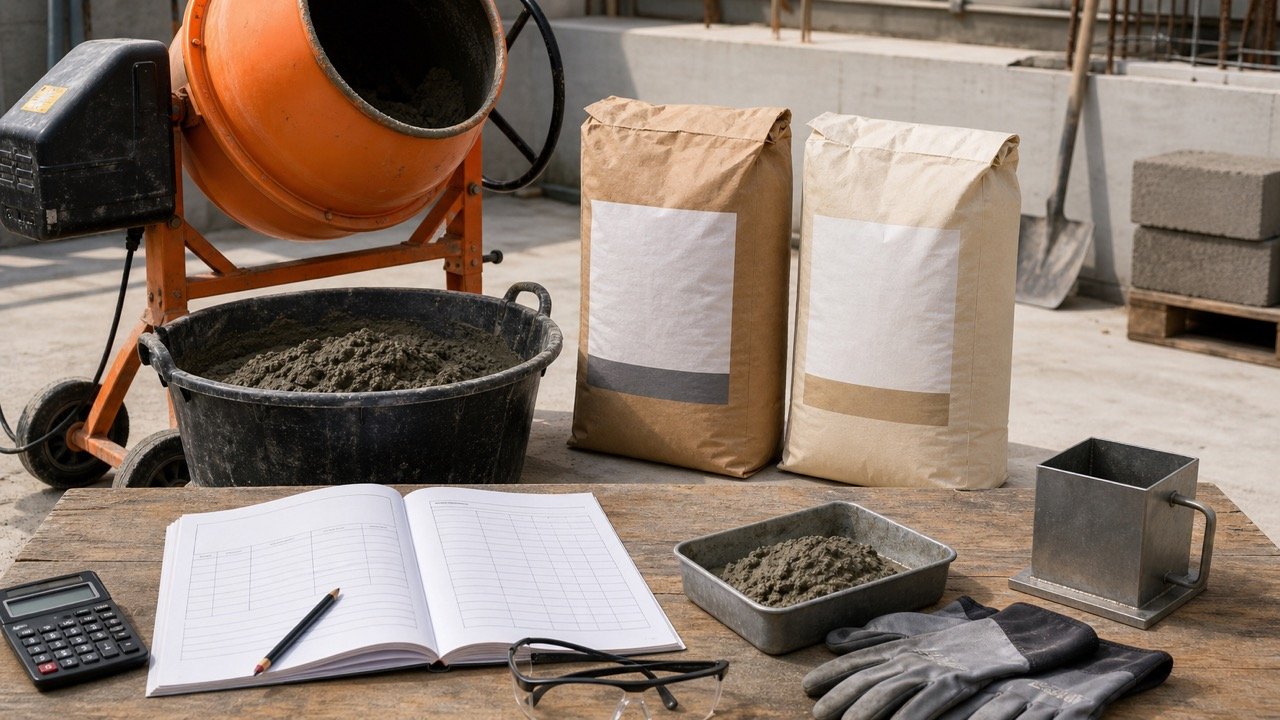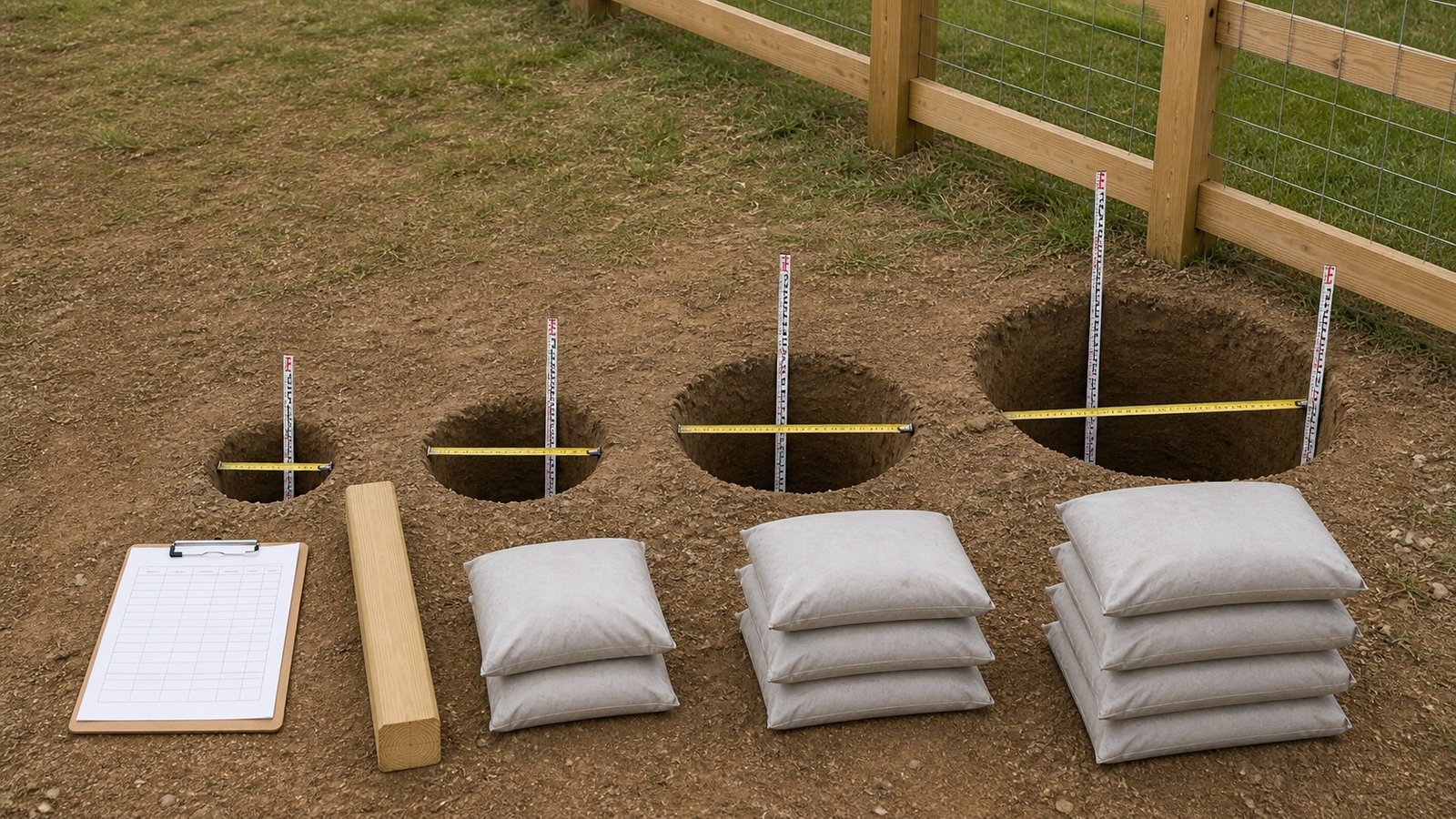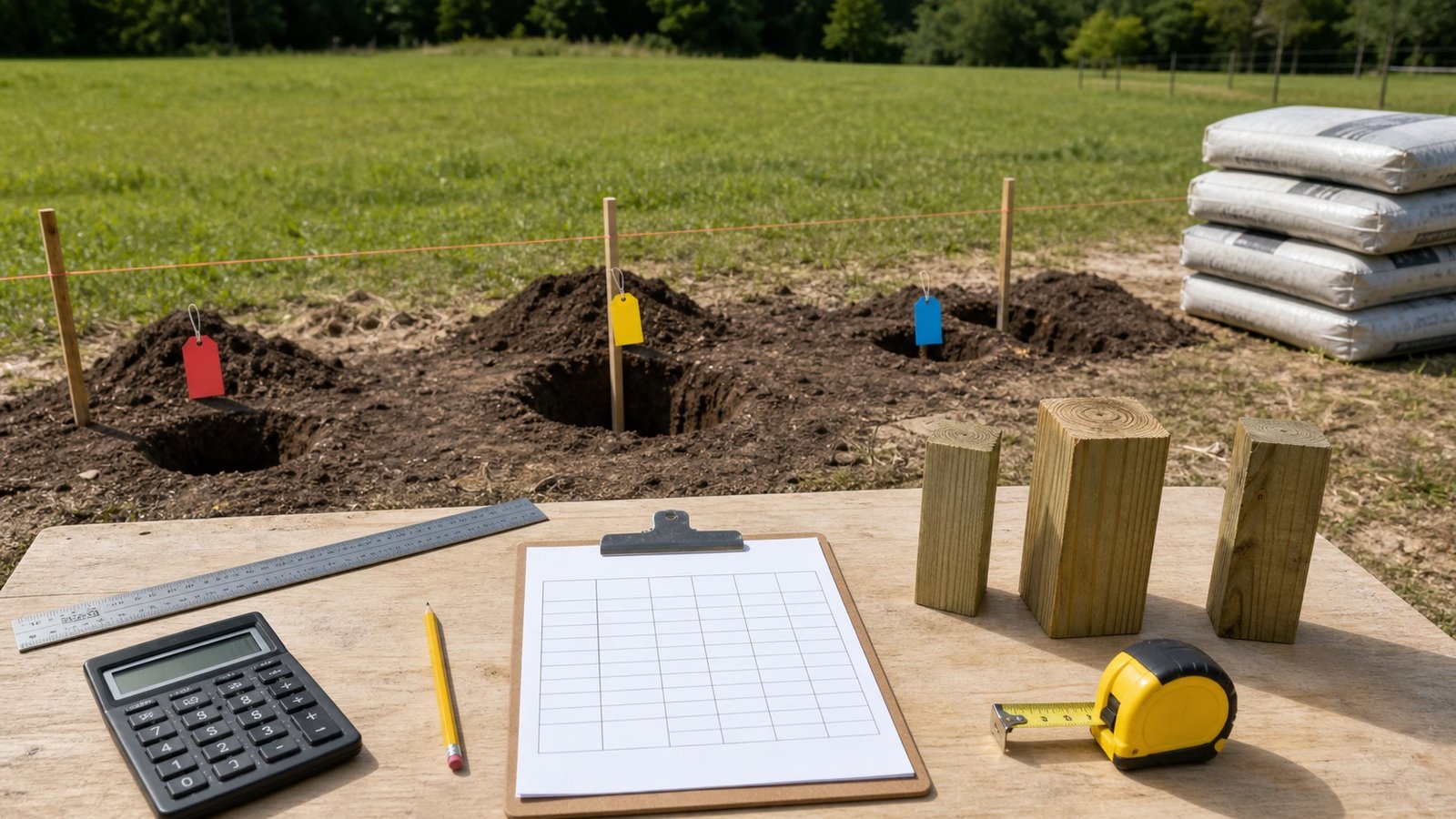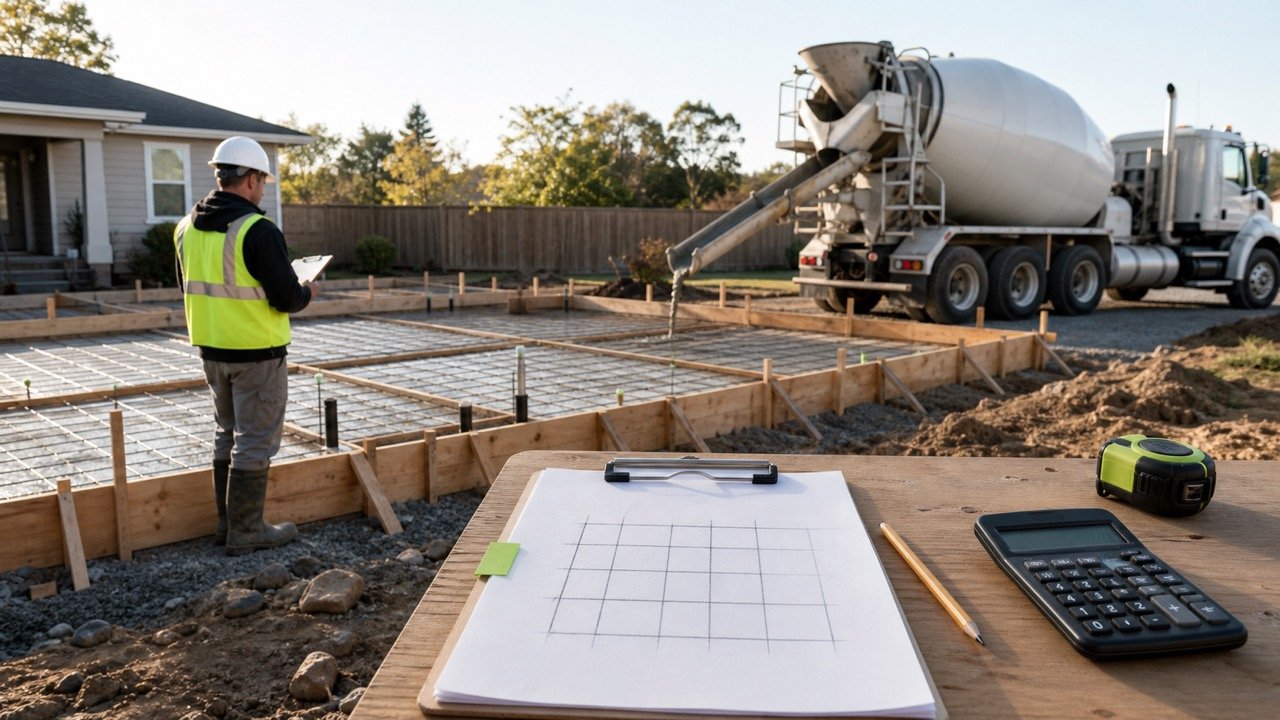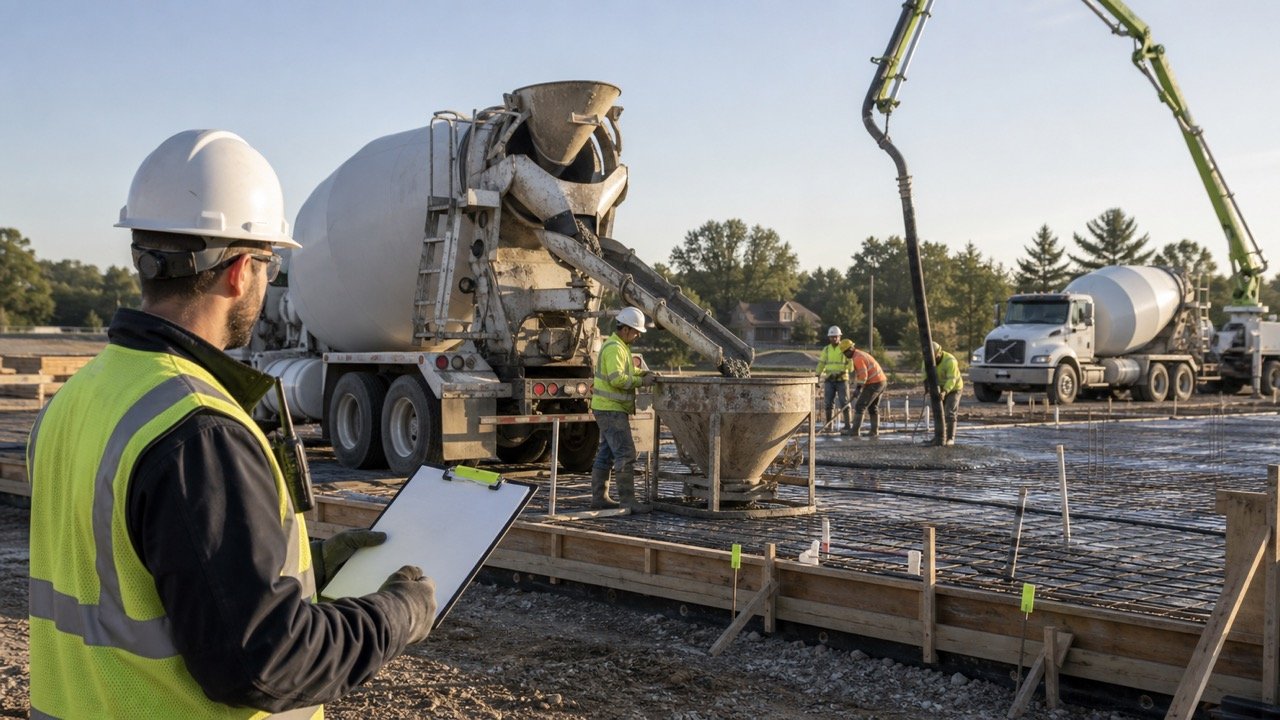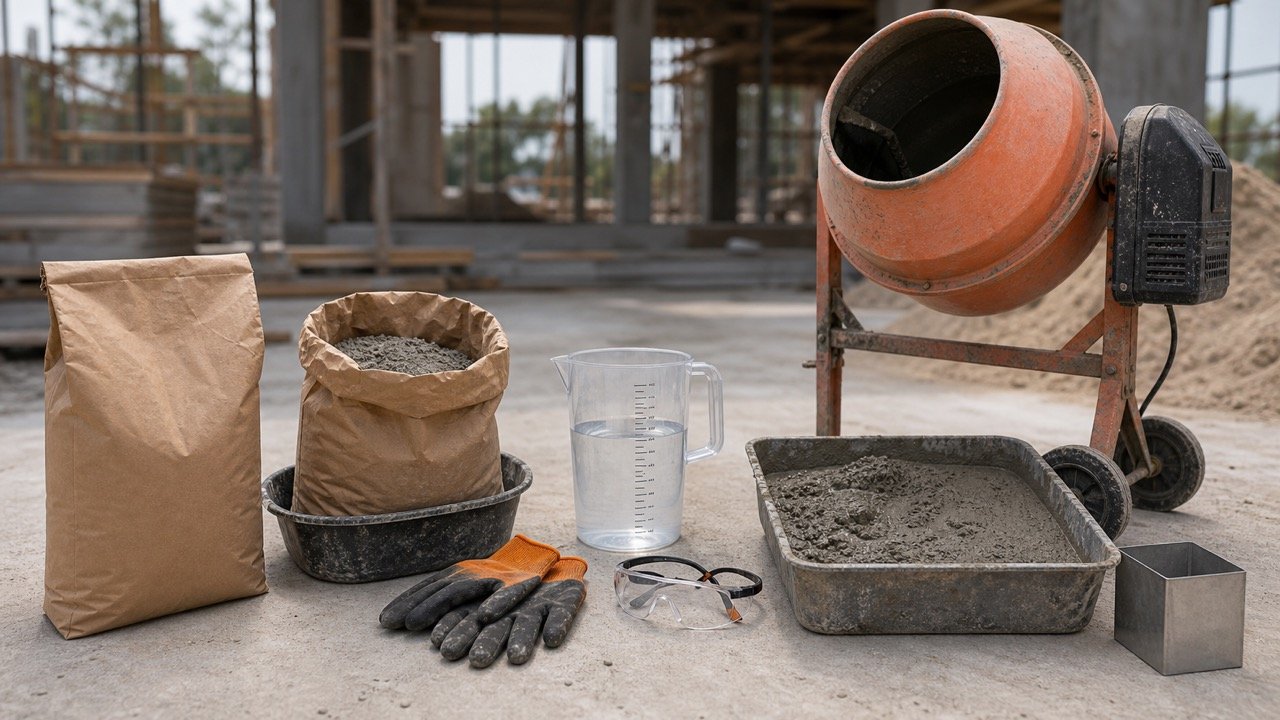
An 80 lb concrete bag contains 80 lb of dry packaged material under its label basis. After water is added, the batch has more input mass, while its useful quantity for a form is the product's approximate fresh mixed yield.
Dry mass, loose dry volume, water, fresh yield, placed volume and hardened concrete answer different questions. Keep them separate in the estimate and mixing record.
What changes between a dry concrete bag and mixed concrete?
Water and mixing change the material state, mass distribution, consistency and occupied volume. The number printed as package weight remains a dry-contents record; it does not become the fresh yield.
| State | Useful quantity | What it is used for | What it does not prove |
|---|---|---|---|
| Unopened package | Net dry mass | Purchase, lifting, storage and dry inventory | Loose or mixed volume |
| Loose dry contents | Apparent bulk volume under an unstated or measured condition | Controlled product testing when required | Fresh mixed yield from package mass alone |
| Mixing inputs | Dry contents plus measured water and approved additions | Batch control and nominal input mass | Retained fresh mass after residue or spill |
| Fresh mixed concrete | Approximate stated yield or tested fresh volume | Bag count and form quantity | Accepted placed or hardened volume |
| Placed fresh concrete | Volume after transfer, consolidation and strike-off | Placement and form record | Later hardened mass or dimensions |
| Hardened concrete | Measured later mass, dimensions and properties | Inspection or engineering record | A simple dry-bag-plus-water shortcut |
Use dry package mass for handling and inventory. Use the exact product's approximate mixed yield when converting a planned fresh concrete volume into bags.
The Concrete Bags Calculator keeps package mass optional and requires current mixed yield as the bag-count divisor.
What does an 80 lb concrete label mean?
It states the net mass basis for the dry packaged contents. It does not state that the opened material occupies 80 lb worth of a universal volume or that the mixed batch will weigh exactly 80 lb.
Package mass can support lifting, pallet, vehicle and dry inventory records only after the actual package count and applicable limits are checked. It cannot approve a manual lift, vehicle payload, mixer batch or structural load.
Is the dry material inside the bag the same volume as its yield?
No. The apparent loose volume of granular dry contents depends on product formulation, particle packing, aggregate, handling and measurement condition. Manufacturer mixed yield describes a different state after the product is mixed to the required consistency.
Do not empty a bag into a box, measure the loose powder and use that volume to fill a concrete form. Do not divide bag mass by a generic concrete density to invent a product yield.
The Concrete Bag Yield Chart shows current named-product examples, including equal-weight products with different stated mixed volumes.
What does mixed yield mean?
Mixed yield is the approximate volume of fresh concrete produced by the exact product and package under the manufacturer's stated mixing and consistency conditions. It is normally the quantity used to estimate how many bags supply a planned fresh volume.
Exact bag quotient = planning fresh volume ÷ current mixed yield per package
Whole bags = ceiling(exact bag quotient)
Preserve the product name, package, market, sheet and retrieval date. A familiar 0.60 ft³ value does not apply to every 80 lb concrete product.
Does adding water make the mixed batch heavier?
Yes, the measured water adds input mass. A nominal dry-plus-water mass can be estimated for batch planning, but the retained fresh mass can differ because material remains in the bag or mixer, spills, evaporates or is sampled.
Nominal mixing input mass = dry package net mass + measured water mass + other approved input mass
NIST defines density as mass per unit volume and describes water density as approximately 1 g/cm³. The examples below use 1 kg/L only as an explanatory approximation. They are not scale measurements.
Worked example: standard 80 lb package with a water range
QUIKRETE Concrete Mix No. 1101 lists an 80 lb package, approximately 0.60 ft³ mixed yield, about 6 U.S. liquid pt starting water and 9 pt maximum expected water. These values belong to that named product sheet.
| Record | Starting-water case | Maximum-expected-water case |
|---|---|---|
| Dry package mass | 80 lb | 80 lb |
| Water volume | 6 pt = 2.839059 L | 9 pt = 4.258588 L |
| Approximate water mass | 6.259 lb | 9.389 lb |
| Nominal dry + water input | 86.259 lb | 89.389 lb |
| Approximate stated yield | 0.60 ft³ | 0.60 ft³ |
| Arithmetic mass ÷ yield | 143.765 lb/ft³ | 148.981 lb/ft³ |
The sheet separately lists approximately 140 lb/ft³ as a typical unit weight. The arithmetic range does not disprove the sheet. It combines rounded package mass, approximate yield, an approximate water-density conversion and a permitted water range while ignoring residue and test method.
Why is dry mass plus water divided by yield not a density test?
A valid fresh-concrete density and yield check uses the applicable procedure, calibrated equipment, representative sample, consolidation, strike-off and measured mass. Rounded package information cannot reproduce that test.
FHWA training for AASHTO T 121 and ASTM C138 describes fresh concrete being placed in a known-volume calibrated measure to determine density. The record includes the measure volume, tare and filled mass. Project specifications decide when qualified testing is required.
| Item | Package arithmetic | Controlled fresh test |
|---|---|---|
| Purpose | Planning cross-check | Density, yield or acceptance under the applicable method |
| Inputs | Label mass, approximate water and stated yield | Calibrated volume, actual sample and measured masses |
| Material condition | Assumed from product instructions | Actual representative fresh concrete |
| Precision | Limited by rounded and approximate source values | Controlled by method, equipment and reporting rules |
| Result status | Not an acceptance test | Use only within the specified test and authority |
Worked example: high-yield 80 lb package
Sakrete Maximizer lists an 80 lb package, 1.0 ft³ yield and 1.5 to 2.0 U.S. gal of water. Its sheet describes a structural-lightweight-aggregate concrete mix.
| Record | Lower-water case | Upper-water case |
|---|---|---|
| Dry package mass | 80 lb | 80 lb |
| Water volume | 1.5 gal = 5.678118 L | 2.0 gal = 7.570824 L |
| Approximate water mass | 12.519 lb | 16.691 lb |
| Nominal dry + water input | 92.519 lb | 96.691 lb |
| Stated yield | 1.0 ft³ | 1.0 ft³ |
This 80 lb package has a different water range and yield from the standard example. Do not transfer its figures to another product or choose it by yield alone.
Does all mixing water disappear when concrete hardens?
No simple subtraction describes the hardened state. Water participates in cement hydration, remains in pores, moves, bleeds and evaporates under changing conditions. Concrete can also gain or lose environmental moisture.
Do not calculate permanent structural dead load, shipping mass, disposal mass or hardened density by adding package mass and mixing water, then assuming a fixed percentage disappears. Those decisions need the actual mix, geometry, condition, age, testing and engineering basis.
Can the stated mixed yield equal the placed volume exactly?
Manufacturer yield is approximate. The quantity that reaches a form can be affected by residue, spill, transfer, samples, leakage, form movement, subgrade variation, embedments and consolidation.
Record the stages instead of hiding them inside a universal waste percentage:
- Whole packages opened and accepted.
- Measured water and batch IDs.
- Approximate product capacity from package yield.
- Material held, rejected, spilled or left in equipment.
- Test samples or other authorised removals.
- Zones placed and measured under the project method.
- Unused or unopened packages and their condition.
Which value belongs in each project decision?
| Task | Use | Do not substitute |
|---|---|---|
| Buy concrete bags | Planning fresh volume ÷ current mixed yield | Dry bag volume or generic density |
| Plan dry handling | Package count × dry package mass | Fresh or hardened concrete mass |
| Batch water | Current product instruction and actual measured water | Water from another mix or bag size |
| Check fresh density or yield | Applicable calibrated test and representative fresh sample | Rounded label arithmetic |
| Accept placed volume | Drawing, forms, field measurement and specified checks | Receipt count alone |
| Determine hardened mass or load | Project-specific engineering and measured or specified properties | Dry mass plus a guessed retained-water value |
How should mixer capacity be checked?
Use the manufacturer's mixer-capacity instruction, mixer rating and safe operating procedure. Mixed yield is not the same as the free drum volume needed to combine the material.
For one named example, QUIKRETE No. 1101 says to allow at least 1 ft³ of mixer capacity for each 80 lb bag mixed at one time, although the same bag's approximate mixed yield is 0.60 ft³. This distinction prevents a 0.60 ft³ yield from being treated as adequate mixer space.
Myth versus reality
| Myth | Reality |
|---|---|
| An 80 lb bag makes 80 lb of fresh concrete | Measured water and approved additions add input mass. |
| The loose dry bag volume is the mixed yield | They are different material states and measurement conditions. |
| Every 80 lb package has the same water and yield | Named current examples differ substantially by product. |
| Dry mass + water ÷ yield is a fresh density test | It is arithmetic using approximate inputs, not a calibrated representative-sample test. |
| All mixing water evaporates | Hydration, pore water, bleeding, evaporation and exposure affect the later state. |
| Package capacity proves placed volume | Transfer, residue, samples, forms and field conditions still need records. |
Common material-state mistakes
- Entering 80 lb or 36.2 kg as the calculator's mixed yield.
- Measuring loose dry powder and calling it finished concrete.
- Using a water range from another product or package.
- Adding water to create more apparent volume.
- Combining rounded label values to publish an exact fresh density.
- Using manufacturer approximate yield as a project acceptance test.
- Assuming a standard and lightweight high-yield mix are interchangeable.
- Treating mixer drum capacity as mixed output capacity.
- Using dry handling mass as vehicle, structural or hardened load without the required checks.
- Hiding residue, samples and placement differences inside an unsupported percentage.
What should the dry-to-mixed record contain?
- Manufacturer, product, item number, package, market and sheet revision.
- Dry package mass and whole package count.
- Current approximate mixed yield and its unit.
- Required water range, actual measured water and batch ID.
- Any product-approved additions and their measured quantity.
- Nominal input mass labelled as an estimate when used.
- Packages rejected, damaged, opened, unused or returned.
- Residue, spill, samples, placed zones and exceptions.
- Fresh density or yield test identity when the project requires one.
- Separate placed and hardened records under the governing project method.
Return to the Concrete Planning hub to keep packaged-concrete quantity, ready-mix and block workflows separate.
Safety limits
OSHA states that wet portland cement can cause caustic burns and dermatitis. Dry mix can also create dust and handling hazards. Follow the current product safety data sheet, applicable workplace rules, hazard assessment and controls for skin, eyes, breathing, lifting, equipment, electricity, housekeeping and washing.
A mass or volume estimate does not approve manual handling, mixer operation, access, formwork, excavation, placement or structural work.
Sources and source scope
- QUIKRETE Concrete Mix No. 1101 data sheet: named-product package, approximate yield, water, unit-weight and mixer-capacity examples.
- Sakrete Maximizer Concrete Mix TDS: named structural-lightweight-aggregate product, package, yield and water examples.
- FHWA, Testing Fresh Concrete participant workbook: calibrated known-volume measurement context for fresh density and yield.
- NIST Density glossary and NIST Guide to the SI Appendix B: density definition, approximate water density and unit conversions.
- OSHA, Concrete and Concrete Products: Controlling Hazards: wet-portland-cement hazard context.
Source scope: the manufacturer values apply only to the named products at the retrieval date and include approximate or typical fields. NIST supports definitions and unit arithmetic. FHWA explains controlled fresh testing. OSHA supports its U.S. workplace context. None selects a product, water addition, field allowance, density, hardened load or acceptance decision for a specific project.