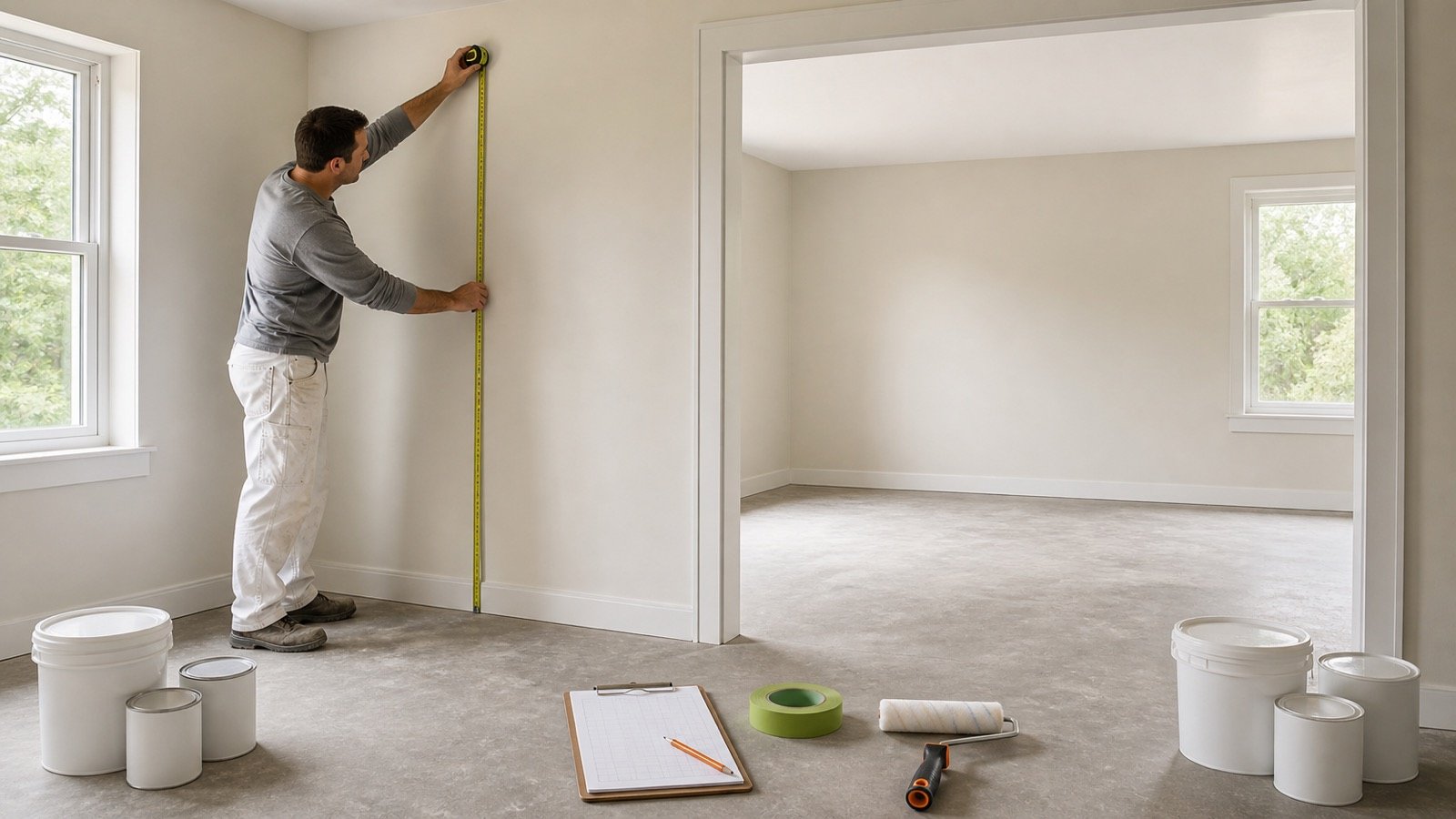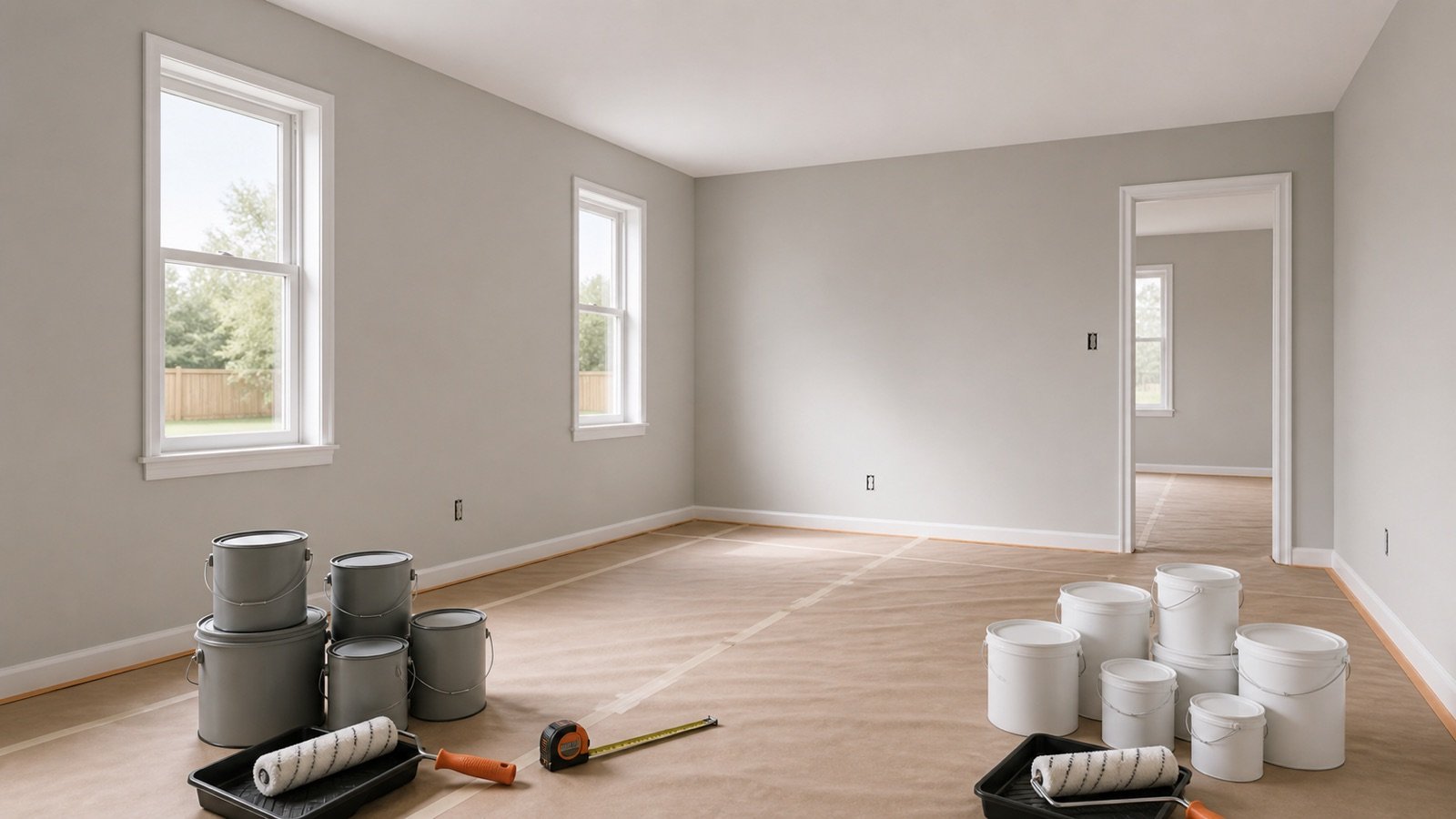
A room paint estimate needs the surface area, the number of coats and the selected product's coverage. Doors, windows, tile, cabinets and other unpainted zones can reduce wall area, while rough or porous surfaces and the application method can change how far the product goes.
Wall and ceiling paints often have different coverage records and package sizes. This calculator keeps them separate through the purchase step, then reports the combined volume only as a summary.
How much paint do you need for walls and a ceiling?
Calculate net wall area, multiply by the wall coat count and divide by the wall paint's current coverage. Round the exact volume up through the entered container size. Repeat the sequence for the ceiling when it uses a separate product.
The tool starts with blank coat, coverage and container fields. Enter values from the chosen product record and planned work instead of treating a general coverage range as the project specification.
What does the Paint Calculator return?
The result keeps geometry, coating demand and packaging on separate lines. You can trace which step changed the purchase quantity.
| Result | Calculation | Use |
|---|---|---|
| Gross wall area | Room perimeter × wall height, or checked wall area | Records the measured wall boundary |
| Opening area | Width × height × quantity for each entered group | Records doors, windows or other unpainted rectangles |
| Net wall area | Gross wall area − openings | Defines the wall surface assigned to one paint |
| Coated area | Net surface area × coats | Counts each planned pass over the surface |
| Exact paint volume | Coated area ÷ current coverage | Shows calculated demand before packaging |
| Full containers | Exact volume ÷ entered container size, rounded up | Converts demand to one selling increment |
| Container surplus | Purchased volume − exact volume | Separates package rounding from surface demand |
Separate wall and ceiling records prevent one coverage rate, coat count or container size from being applied to 2 products. The total volume line is useful for scale only. Do not combine the full-container counts across unlike products.
How does the paint quantity formula work?
Gross wall area = 2 × (room length + room width) × wall height
Opening area = sum(opening width × opening height × quantity)
Net wall area = gross wall area − opening area
Coated area = net surface area × number of coats
Exact paint volume = coated area ÷ product coverage
Full containers = ceiling(exact paint volume ÷ container size)
Rectangular-room mode calculates ceiling area as room length × room width. Checked-area mode accepts wall and ceiling totals prepared from elevations, drawings or a field schedule. Save that supporting record because a single area value cannot reveal omitted faces or overlaps.
The calculator retains full precision and displays up to 3 decimal places. It rounds up only after dividing exact volume by the entered container size. Metric mode uses metres, square metres, litres and m²/L. Imperial mode uses feet, square feet, U.S. liquid gallons and ft²/US gal.
Worked metric room example
A room is 4.8 m long, 3.6 m wide and 2.7 m high. One unpainted door measures 0.9 m × 2.1 m. Two unpainted windows each measure 1.2 m × 1 m. The wall record uses 2 coats, 10 m²/L coverage and a 5 L container.
- Room perimeter: 2 × (4.8 + 3.6) = 16.8 m.
- Gross wall area: 16.8 × 2.7 = 45.36 m².
- Opening area: (0.9 × 2.1) + (1.2 × 1 × 2) = 4.29 m².
- Net wall area: 45.36 − 4.29 = 41.07 m².
- Wall coated area: 41.07 × 2 = 82.14 m².
- Exact wall-paint volume: 82.14 ÷ 10 = 8.214 L.
- Container ratio: 8.214 ÷ 5 = 1.6428 containers.
- Purchase: 2 containers supply 10 L, leaving 1.786 L above the calculated wall demand.
The ceiling is 4.8 × 3.6 = 17.28 m². With 1 coat, 11 m²/L coverage and a 2.5 L container, exact demand is 17.28 ÷ 11 = 1.570909 L. One 2.5 L container leaves 0.929091 L above the calculated ceiling demand.
The metric fixture uses selected coverage and package values for arithmetic testing. Replace each value with the current wall or ceiling product record.
Worked imperial room example
A room is 12 ft long, 10 ft wide and 8 ft high. It has one unpainted 3 ft × 7 ft door and two unpainted 3 ft × 4 ft windows. The wall paint record uses 2 coats, 350 ft²/US gal coverage and 1 US gal containers.
- Gross wall area: 2 × (12 + 10) × 8 = 352 ft².
- Openings: (3 × 7) + (3 × 4 × 2) = 45 ft².
- Net wall area: 352 − 45 = 307 ft².
- Coated wall area: 307 × 2 = 614 ft².
- Exact wall-paint volume: 614 ÷ 350 = 1.754286 US gal.
- Purchase: 2 one-gallon containers, with 0.245714 US gal above calculated wall demand.
The 120 ft² ceiling uses a separate 1-coat record at 400 ft²/US gal. Exact demand is 0.3 US gal. One 1 US gal ceiling-paint container leaves 0.7 US gal above calculated demand.
How should a room be measured for paint?
Measure room length and width at the wall faces that define the painted perimeter. Measure wall height for the same zone. A room with different wall heights needs separate wall rectangles or a checked area schedule.
| Condition | Calculator treatment | Record to keep |
|---|---|---|
| Rectangular room with one wall height | Use room mode | Length, width, height and room ID |
| Open plan with missing wall segments | Use checked wall area | Each included wall length and height |
| Vaulted, sloped or stepped ceiling | Use checked ceiling area | Slope dimensions and area method |
| Half-height tile or wall covering | Calculate only the paint receiving band | Finish boundary and elevation |
| Several colors or sheens | Run one calculation per product zone | Color and finish schedule |
| Cabinet, trim, door or baseboard paint | Keep on a separate takeoff | Face or linear measurement method |
Measure irregular walls as rectangles and triangles when those shapes describe the surface. Curves, arches, stair walls and sloped faces need a checked sketch or drawing. Keep the area calculation beside the paint record.
Which openings should be deducted?
Deduct a door, window or other rectangle only when its face will remain unpainted with the selected wall product. Enter its measured width, height and quantity.
A painted door needs a separate face count because its product, preparation and coverage can differ from the wall paint. Painted jambs, reveals, sills and trim also need their own measurement. The opening deduction removes only the boundary entered in the calculator.
Small switches, outlets and penetrations may save little roller area and add cutting work. Use the project's takeoff rule and keep it consistent. This calculator does not apply a default opening deduction.
How should coverage and coat count be chosen?
Copy coverage from the current label or technical data sheet for the exact product. Check whether the published rate applies per coat and whether it assumes a stated surface, film thickness or application method.
Sherwin-Williams states that product requirements vary with application method and surface type or condition. Benjamin Moore labels its calculator output as a rough estimate and names application method as one factor. Those manufacturer warnings support an editable coverage field.
Record the coat count from the approved finish schedule, product instructions and surface assessment. A color change, repaired surface, porous substrate or product system can affect primer and finish-coat decisions. Enter primer as a separate calculation because its coverage, coats and container size can differ.
Why are walls and ceilings calculated separately?
A ceiling may use a different product, sheen, color, coat count, coverage rate and package. Combining the surfaces before product selection can assign the wall rate to the ceiling or round 2 products as one purchase.
Example: walls need 8.214 L from 5 L containers, and the ceiling needs 1.570909 L from 2.5 L containers. The exact total is 9.784909 L. The purchase remains 2 wall containers plus 1 ceiling container because the products cannot share the same package line.
You may combine room volumes before rounding when the same product, base, color, sheen, coverage and container size supply every included surface. Add the unrounded exact volumes, then divide once by that container size.
What does container surplus mean?
Container surplus is the purchased package volume above the calculated demand. It comes from the entered selling increment. It does not prove the amount left after painting because transfer, tools, application and site conditions affect used volume.
Keep touch-up stock as a named purchasing decision. Check storage instructions, shelf life, local disposal rules and whether the retained paint can be identified by product, color formula and batch record.
Which conditions can change the estimate?
- Surface texture, porosity, repairs, stains and existing coating condition.
- Brush, roller or spray application and the selected product instructions.
- Color change, hiding, sheen and the approved number of coats.
- Primer or sealer applied as a separate product.
- Vaulted ceilings, stair walls, niches, alcoves and partial-height finishes.
- Openings whose jambs or doors receive a different coating.
- Several rooms sharing one color and package versus separate products.
- Container availability, tint-base limits, seller terms and jobsite storage.
The calculator handles geometry and product arithmetic. A sample patch, manufacturer guidance, supplier confirmation or qualified painter may be needed where substrate and finish conditions control the result.
Which paint calculation mistakes change the order?
- Using floor area as wall area.
- Omitting wall height or a room segment.
- Deducting an opening while also counting its painted door or returns as wall area.
- Using one coverage preset for every coating.
- Forgetting that a coverage rate normally applies to one coat.
- Combining wall and ceiling paint before product selection.
- Rounding every wall or room to a container before combining compatible demand.
- Entering a 5 L package as 5 US gal after changing units.
- Treating package surplus as guaranteed touch-up stock after application.
- Using an old label, data sheet, quote or container size.
What should the paint quantity record contain?
- Project, room, elevation and drawing or field-measurement date.
- Gross wall area, every opening deduction and net wall area.
- Ceiling area and the method used for sloped or irregular surfaces.
- Manufacturer, product, base, color, sheen and tint or batch record.
- Coverage source, coat count, exact volume and container size.
- Full containers, purchased volume and container surplus by product.
- Primer, trim, doors, cabinets and other coatings on separate lines.
- Surface condition, preparation, application method, quote date and supplier confirmation.
Safety and project limits
Paint work can involve ladders, solvents, ventilation needs, spray equipment, dust and existing coatings. Read the current label, safety data sheet and technical data sheet for the selected product. Follow the controls required for the workplace, occupants, substrate and application method.
EPA states that renovation, repair or painting work in a pre-1978 U.S. home can create dangerous lead dust when lead-based paint is present. Contractors may have certification and work-practice duties under the Renovation, Repair and Painting Rule. Homeowners should review current EPA guidance before disturbing old coatings.
This calculator does not identify lead, asbestos, mold, water damage or an unsafe substrate. It does not design ventilation, select personal protective equipment, approve a ladder setup, set dry or recoat time, calculate labor or cost, or confirm local environmental and waste rules.
Return to the Paint planning hub for this calculator's category record. The calculation methodology explains formula, unit and rounding checks. Report a problem through the corrections route.
Sources and source scope
- Sherwin-Williams paint calculator guidance: square-footage context, a general coverage reference and product, application and surface limits.
- Benjamin Moore Paint Calculator: room dimensions, opening inputs, same-color area combination and rough-estimate limits.
- Behr Paint and Stain Calculator: metric and imperial inputs, separate surface lines, per-coat results and estimate disclaimer.
- NIST Handbook 44 (2026), Appendix C: foot, metre, area, litre and U.S. liquid-gallon relationships.
- EPA lead-safe renovation guidance for DIYers: U.S. pre-1978 home and lead-dust safety context.
Source scope: The paint manufacturers support the measurement inputs and the need to qualify coverage. They do not select the coverage, coats or product for this project. NIST supports unit conversion. EPA supports the U.S. lead-safety warning. These sources do not approve a coating system, preparation method, application loss, purchase allowance, price or work plan.
Review note: Saleem Sial owns the research and editorial record. Formula fixtures, source checks, build validation and rendered QA form the internal publication gate. Waseem Sial, External Reviewer and Engineer, is listed for ongoing external review; no completed review date is claimed.