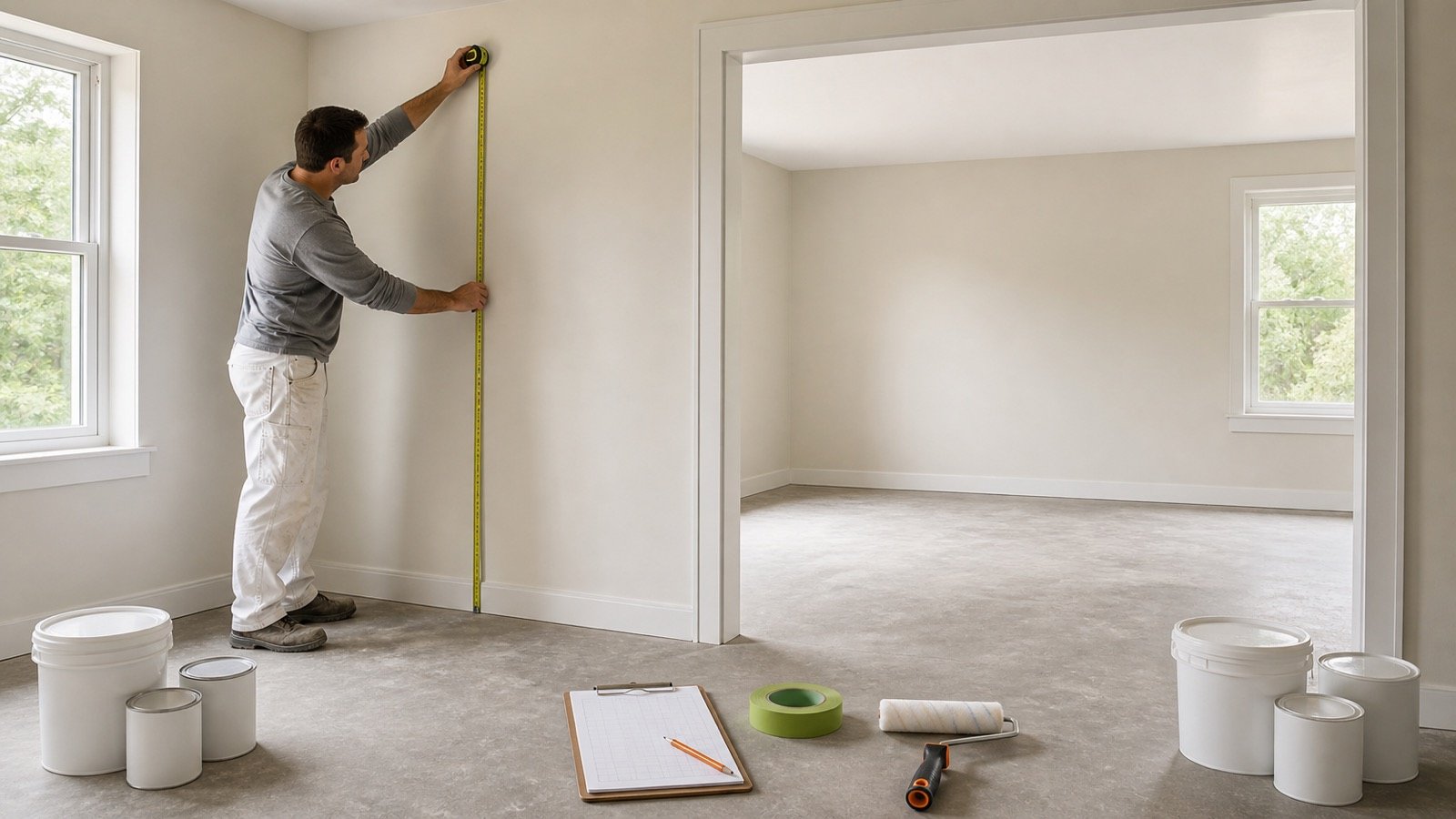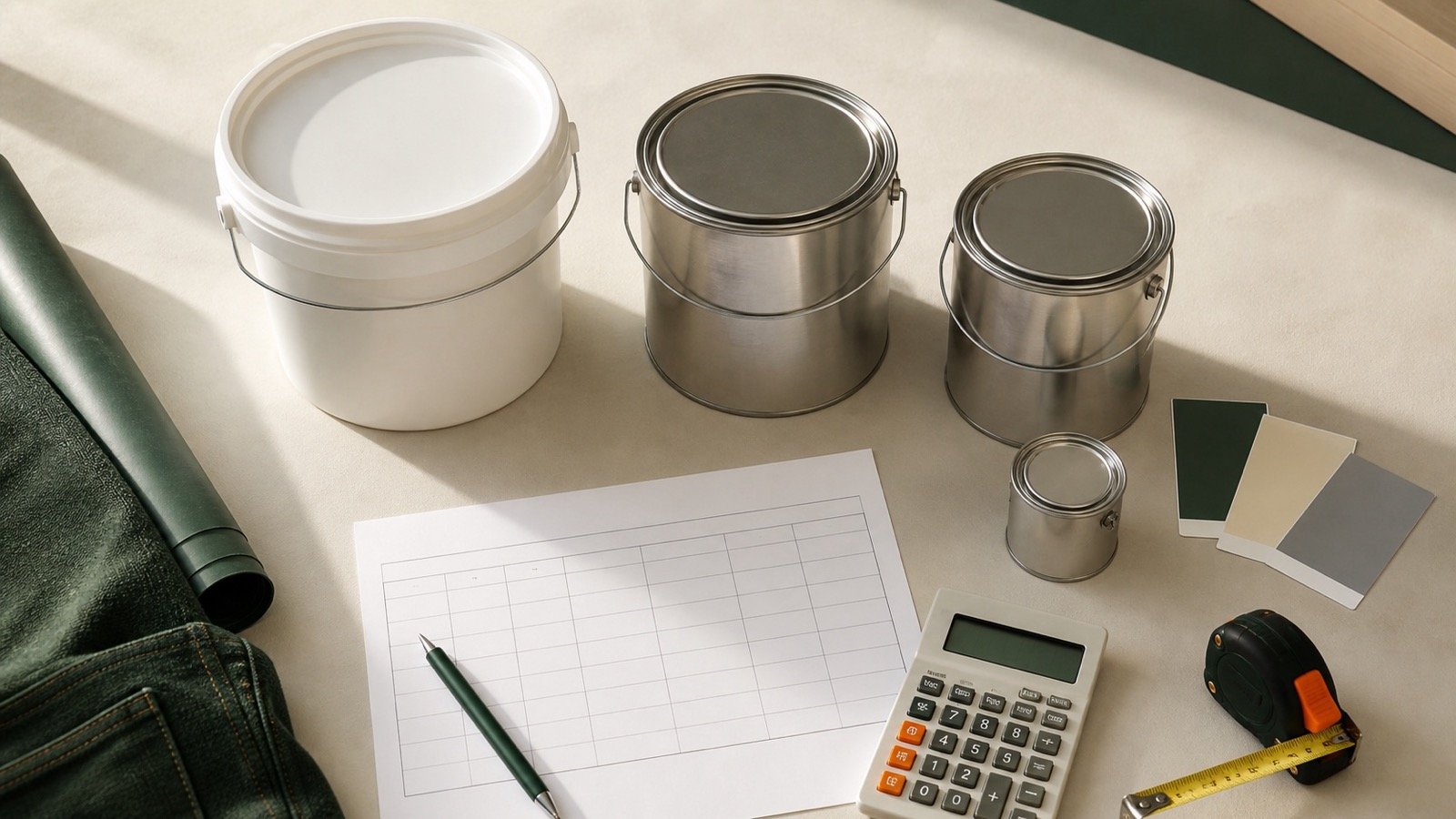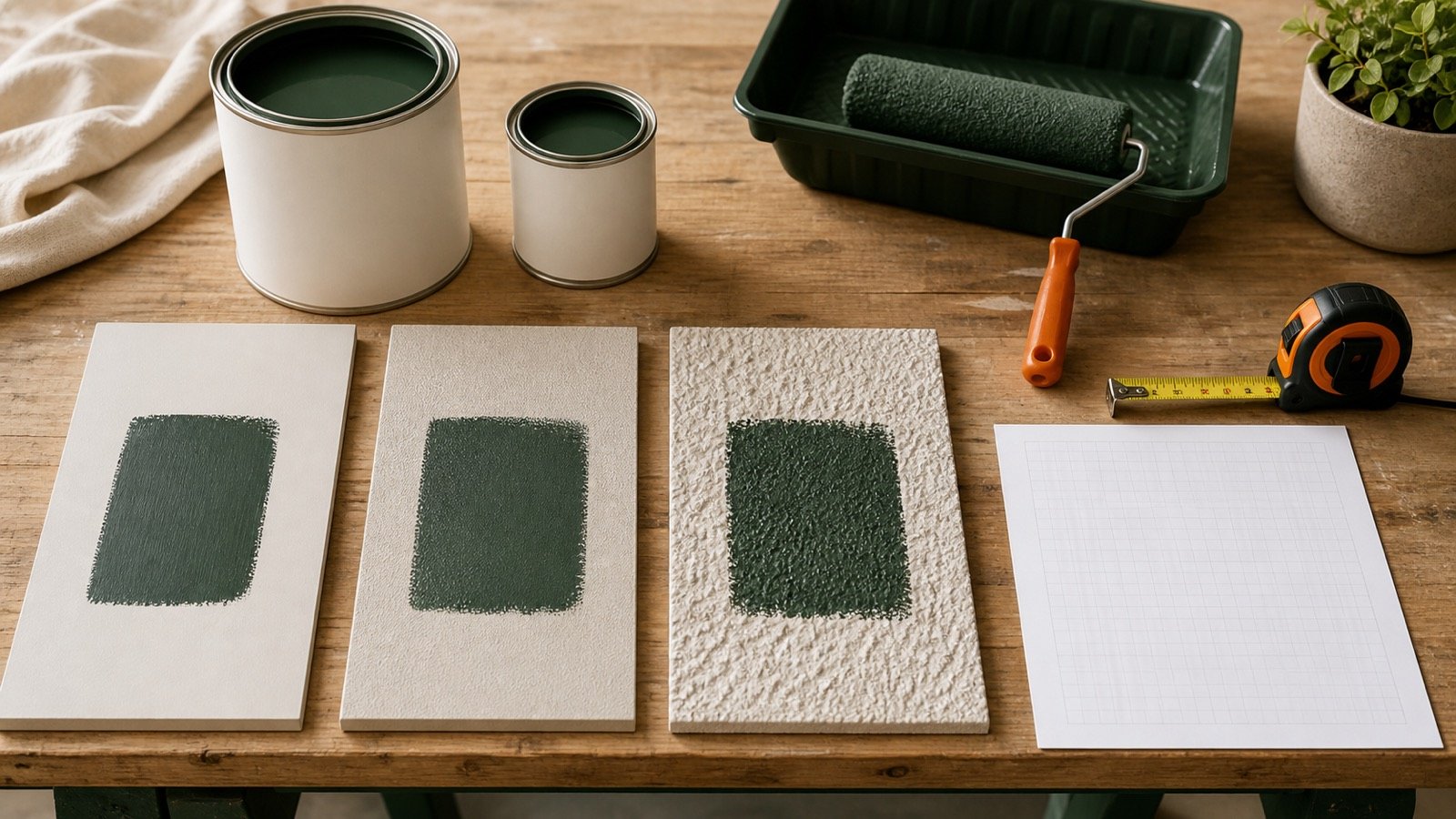
A paint order can contain primer, finish paint and several surface zones. Each product needs its own area, coat count, coverage rate and container calculation.
The selected coating system controls whether a surface receives no separate primer, spot primer or full-surface primer. Record that decision from the current product instructions, project specification and surface assessment before calculating litres or gallons.
How many primer and paint coats should you calculate?
Use the coat count approved for the exact substrate, condition and product system. Copy it from the current label or technical data sheet, then confirm any project specification or manufacturer instruction that changes it.
A universal rule such as 1 primer coat plus 2 finish coats can overstate one job and understate another. Benjamin Moore currently lists 1 or 2 recommended coats for one Fresh Start primer, and its data sheet says severe stains may require 2 primer coats. That record applies to the named product and conditions only.
Keep primer and finish paint separate even when both cover the same wall. Their rates, coat counts, package sizes, preparation rules and application windows may differ.
Which decisions must be made before calculating quantity?
Identify the receiving surface and the required coating system first. The quantity formula cannot decide whether a primer is compatible, whether spot treatment is enough or whether a stain needs a different product.
| Record | What to enter | Why it changes quantity |
|---|---|---|
| Surface zone | Room, wall, ceiling, trim or repair ID | Defines the measured area assigned to the line |
| Substrate and condition | Existing coating, bare material, porosity, repairs, stains and gloss | May change the approved preparation and coating system |
| Product identity | Manufacturer, product, base, color, sheen and code | Connects the calculation to one current record |
| Primer scope | None, measured spot area or full measured area | Sets the primer area |
| Coat count | Approved passes for that product and zone | Multiplies the coated area |
| Coverage | Current ft²/US gal or m²/L rate for the planned conditions | Sets the volume divisor |
| Container | Current available selling size | Controls package rounding |
| Source record | Label or TDS title, revision and access date | Lets another person reproduce the decision |
Do not infer primer need from a marketing phrase alone. Behr's current Premium Plus page explains that the finish product supplies color, hide and a finished surface, while a separate primer seals the surface, supports adhesion and creates a more uniform base. The same page directs users to a separate primer for named conditions. Follow the exact product's current directions.
How do you calculate primer and finish paint separately?
For each line, multiply its net receiving area by its coat count. Divide the coated area by that product's coverage rate. Round the exact volume through that product's current container size.
Primer volume = primer area × primer coats ÷ primer coverage
Finish volume = finish area × finish coats ÷ finish coverage
Full containers = ceiling(exact product volume ÷ selected container size)
Use the same area units in the numerator and coverage rate. A square-metre area needs an m²/L rate. A square-foot area needs an ft²/US gal rate when the result is U.S. gallons.
Run the Paint Calculator once for the primer record and again for the finish record. The calculator keeps exact volume, full containers and package surplus visible.
Worked example: full primer and 2 finish coats
A checked wall schedule contains 42 m². The approved worksheet uses a primer at 10 m²/L for 1 coat and a finish paint at 12 m²/L for 2 coats. Both selected products are sold in recorded 5 L containers.
| Line | Calculation | Exact volume | Purchase record |
|---|---|---|---|
| Primer | 42 × 1 ÷ 10 | 4.2 L | 1 × 5 L container; 0.8 L package surplus |
| Finish | 42 × 2 ÷ 12 | 7 L | 2 × 5 L containers; 3 L package surplus |
The exact liquid total is 11.2 L. The order remains 1 primer container and 2 finish containers because the products cannot share a package line.
The 10 m²/L and 12 m²/L rates, coat counts and 5 L sizes are checked fixture inputs. Replace them with the approved records for the actual products and work.
How does spot priming change the calculation?
Measure the repair or stain-treatment area assigned to spot primer. Keep the finish-paint area at the full receiving surface unless the approved finish schedule says otherwise.
Example: a room has 640 ft² of net finish area and 96 ft² of repairs approved for spot primer. The selected primer record uses 1 coat at 300 ft²/US gal. The finish record uses 2 coats at 400 ft²/US gal.
- Spot-primer volume: 96 × 1 ÷ 300 = 0.32 US gal.
- Finish coated area: 640 × 2 = 1,280 ft².
- Finish volume: 1,280 ÷ 400 = 3.2 US gal.
If the approved method changed to full-surface priming at the same rate, primer volume would be 640 ÷ 300 = 2.133333 US gal. The arithmetic shows why the primer boundary must be measured. It does not choose spot priming for the project.
Can primer and finish areas be combined?
Combine areas only inside a single compatible product line. The manufacturer, exact product, base, color, sheen, coverage, coat count, container and application conditions must match.
Several rooms using the same finish paint can share one exact-volume total before package rounding. Keep separate rows when a room uses another tint base, sheen, product, coat requirement or container size.
Primer and finish paint stay separate even when their numeric coverage happens to match. Product compatibility and application sequence remain outside a volume total.
How should coverage ranges be used?
A manufacturer range describes the named product within its stated conditions. It does not give permission to select the highest value for every surface.
Current official examples differ. Behr Drywall Plus lists 250–400 ft² per gallon. KILZ 2 lists 300–400 ft² per gallon depending on texture, porosity and application method. Benjamin Moore Fresh Start 046 lists 400–450 ft² per gallon and 1 or 2 recommended coats.
Record the rate supported for the planned substrate, film thickness and method. Ask the manufacturer or supplier when the current record does not resolve the condition. A sample area can test appearance and application, but it does not rewrite the product specification.
Does primer always reduce the number of finish coats?
No universal reduction can be entered safely. Primer selection can address sealing, adhesion, stains or a uniform base, while finish-coat requirements still come from the selected system and the result required on site.
Keep the planned finish coats in their own row. Change that count only after the current product instructions, specification or responsible project decision supports the change. Record who approved it and when.
What changes after patching, staining or a strong color change?
The affected areas need a surface record before quantity work. Map each repair, stain or changed substrate and identify the product system approved for it.
- Fresh compound or bare material may have different porosity from the surrounding coating.
- A stain-blocking treatment can have its own product, coat and drying instructions.
- A glossy or hard existing surface can need product-specific preparation and compatibility checks.
- A strong color change can affect the selected base, primer color and finish-coat decision.
- A severe stain may require another primer coat under the named product instructions.
Do not hide these conditions inside a general waste percentage. Create a separate zone or product line when the treatment differs.
Which mistakes change the primer and paint order?
- Applying one coverage rate to primer and finish paint.
- Using the full wall area for spot primer without measuring the spot boundary.
- Using only the repair area for finish paint when the full wall receives the finish.
- Treating 1 primer coat plus 2 finish coats as a universal rule.
- Assuming a paint-and-primer product removes every separate-primer instruction.
- Combining unlike products before container rounding.
- Using the high end of a coverage range without checking the stated conditions.
- Entering litres against an ft²/US gal rate.
- Adding a general waste percentage without a documented project reason.
- Using an old label or technical data sheet after the product changes.
What should the final coating schedule contain?
- Room, elevation or surface-zone ID and measured net area.
- Substrate, existing condition, repairs and preparation decision.
- Primer scope: none, measured spots or full surface.
- Manufacturer, product, code, base, color and sheen for every line.
- Coverage source, coat count and exact calculated volume.
- Current container size, full-container count and package surplus.
- Application method, temperature or timing limits stated by the product.
- Label or TDS revision, supplier confirmation and decision date.
The room-by-room paint guide explains the area ledger. The paint coverage guide explains rate units and conversions. Return to the Paint Quantity Planning hub for the published Paint resources.
Safety and project limits
Read the current label, technical data sheet and safety data sheet for every selected coating. Follow the product's preparation, ventilation, protective-equipment, application, drying and disposal instructions.
EPA states that renovation, repair or painting work in a pre-1978 U.S. home can create dangerous lead dust when lead-based paint is present. EPA recommends lead-safe work practices and explains that contractors can have certification duties under the Renovation, Repair and Painting Rule.
This quantity method does not test for lead, asbestos, mold or moisture. It does not select a coating system, approve compatibility, specify surface preparation, design ventilation or replace a project specification or qualified painter.
Sources and source scope
- Benjamin Moore Fresh Start 046 product record: named primer coverage, recommended coat range, product scope and base or color limitation.
- Behr Drywall Plus Primer & Sealer: named primer coverage and surface, sheen, preparation and application limits.
- KILZ 2 All-Purpose Primer: named primer coverage and texture, porosity and application conditions.
- Behr Premium Plus Interior Paint & Primer: finish and separate-primer functions and product-specific primer directions.
- EPA lead-safe renovation guidance for DIYers: U.S. pre-1978 housing and lead-dust safety scope.
Source scope: The manufacturer records support only the named products and listed conditions. EPA supports the U.S. lead-safety warning. The worked examples use declared arithmetic fixtures. These sources do not select a primer, finish paint, coat count, coverage rate, package, price or preparation method for a reader's project.
The calculation methodology explains formula, unit and rounding checks. Report a source or arithmetic issue through the corrections route.
Review note: Saleem Sial owns the research and editorial record. Source checks, independent fixtures, build validation, link crawl, schema review and rendered QA form the internal publication gate. Waseem Sial, External Reviewer and Engineer, is listed for ongoing external review; no completed review date is claimed.