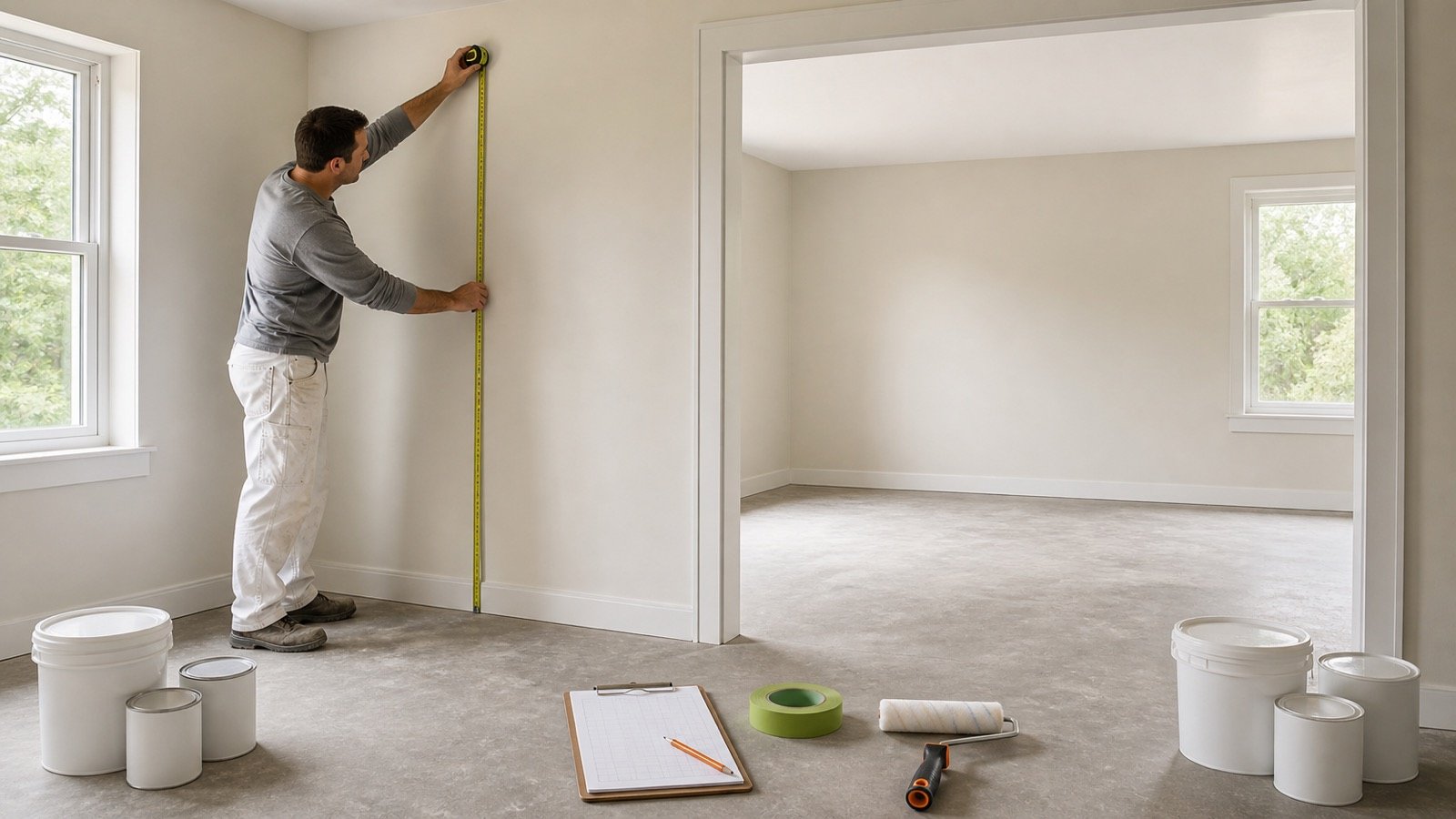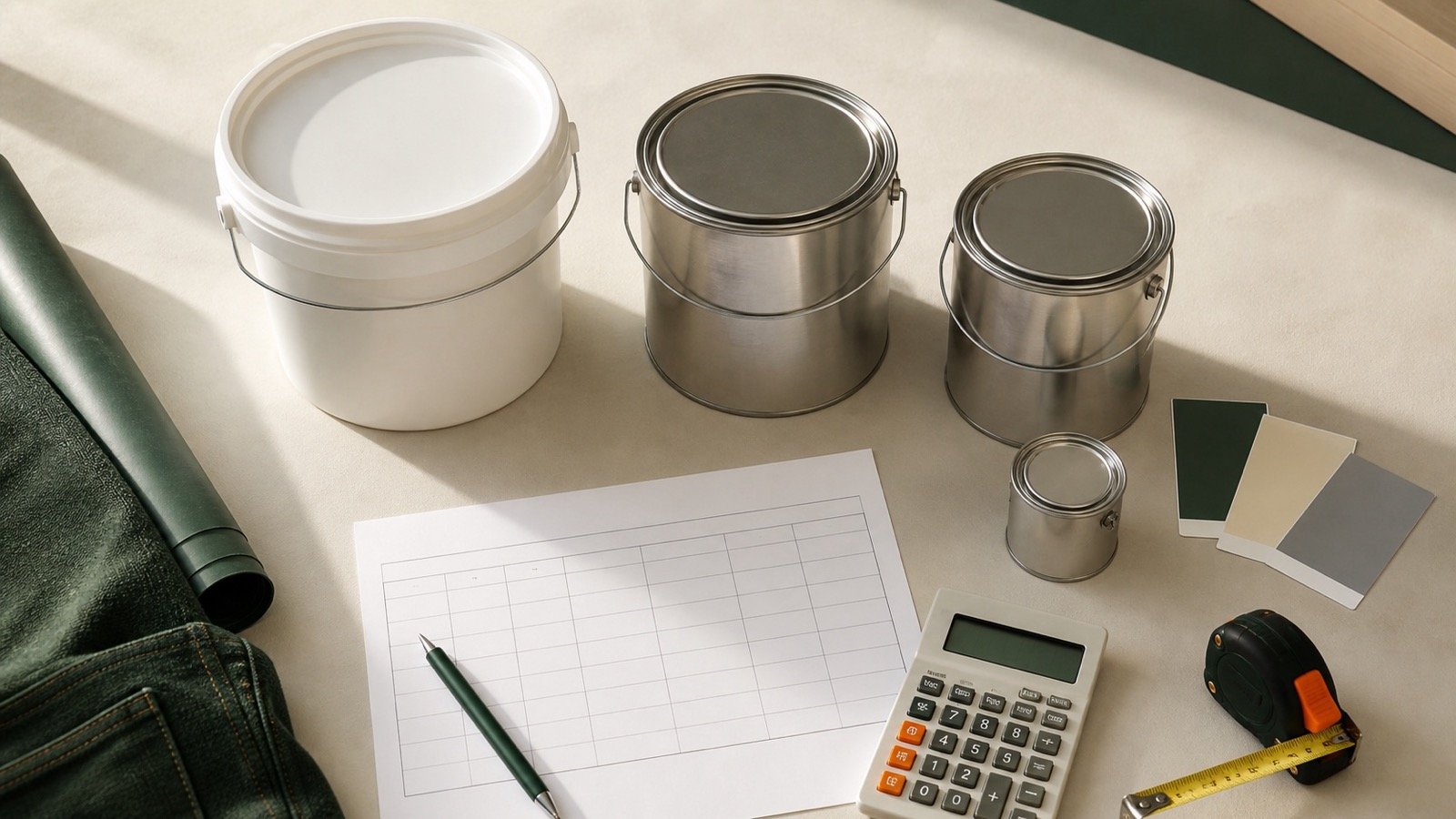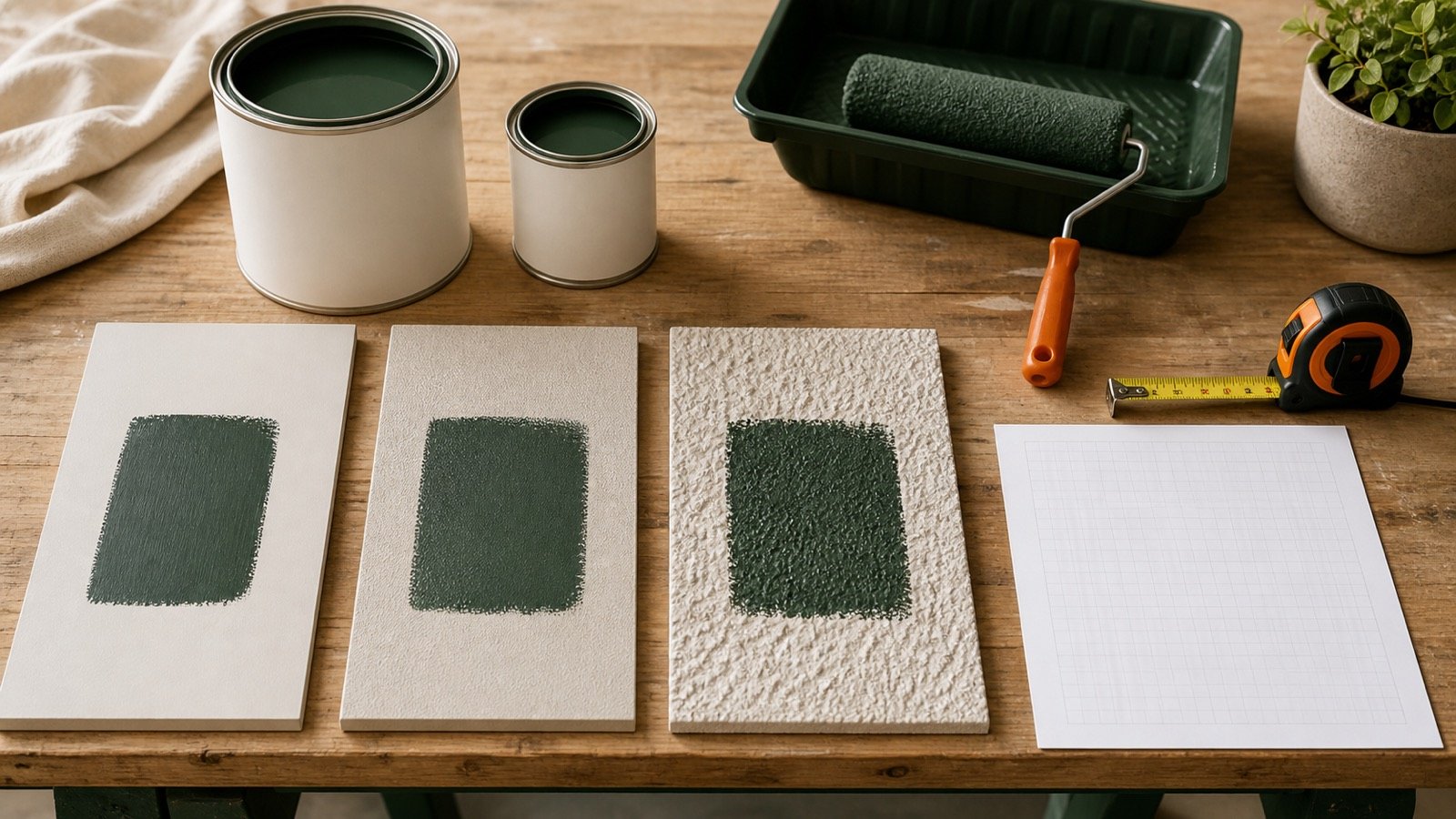
A paint coverage rate belongs to one current product record. Copy the number, area unit, volume unit, coat basis and stated conditions from the label or technical data sheet before using it in a quantity calculation.
General figures can help with an early check, but official product examples differ enough to make one site-wide rate unsafe. The conversion also depends on whether the source means a U.S. liquid gallon or an Imperial gallon.
How much area does one gallon or litre of paint cover?
Use the coverage printed for the exact product and planned conditions. Sherwin-Williams gives 350–400 ft² per gallon as a typical reference, while its guidance also says product need changes with application method and surface type or condition.
Current product records show why the qualification matters. Behr Premium Plus Interior Flat lists 250–400 ft² per gallon. Behr Granite Grip lists 40–60 ft² per gallon. Dulux Weathershield Multisurface Quick Dry Satin lists 10 m²/L and 2 coats. Each figure belongs to that named product and its instructions.
Write down the manufacturer, product, revision or access date, coverage range, unit basis, coat instruction, surface condition and application method. Keep the source beside the quantity worksheet.
What does a paint coverage rate mean?
Coverage states the area that one unit of product can coat under the listed conditions. A rate of 350 ft²/US gal means the record assigns 350 square feet of coated area to 1 U.S. liquid gallon for the stated coat and application conditions.
The rate works as a divisor in quantity arithmetic. First multiply the net receiving area by the planned coat count. Then divide that coated area by the matching coverage unit.
Exact paint volume = net surface area × coats ÷ product coverage
A per-coat coverage rate does not absorb a 2-coat instruction. Count the passes in the numerator. Keep primer, finish paint, ceiling paint and specialty coatings on separate quantity lines when their records differ.
Which details should you copy from the label or data sheet?
Copy enough information to reproduce the quantity decision. A number without its product and test conditions leaves the estimate open to a unit or scope error.
| Field | Record | Quantity effect |
|---|---|---|
| Product identity | Manufacturer, product, base and relevant code | Prevents one coating rate from being reused for another |
| Coverage | Single rate or stated range | Sets the coated-area divisor |
| Area unit | ft² or m² | Must match the surface-area record |
| Volume unit | U.S. gallon, Imperial gallon or litre | Controls the converted rate and volume result |
| Coat basis | Per coat and any required coat count | Controls coated area |
| Surface | Prepared, smooth, rough, porous or another named condition | Defines where the published rate applies |
| Application | Brush, roller, spray and any stated loss exclusion | Defines the scope of the rate |
| Film thickness | Wet and dry film thickness where listed | Connects spread rate to the specified coating film |
| Source date | Label, TDS revision or access date | Lets a later checker identify a changed record |
How do you convert ft² per U.S. gallon to m² per litre?
Multiply ft²/US gal by 0.02454238674711116. The factor comes from 1 ft² = 0.09290304 m² and 1 U.S. liquid gallon = 3.785411784 L in NIST Handbook 44.
m²/L = ft²/US gal × 0.09290304 ÷ 3.785411784
m²/L = ft²/US gal × 0.02454238674711116
| Starting rate | Full-precision result | Practical display |
|---|---|---|
| 250 ft²/US gal | 6.1355966868 m²/L | 6.14 m²/L |
| 350 ft²/US gal | 8.5898353615 m²/L | 8.59 m²/L |
| 400 ft²/US gal | 9.8169546988 m²/L | 9.82 m²/L |
The table verifies unit conversion only. It does not assign 250, 350 or 400 ft²/US gal to a product.
How do you convert m² per litre to ft² per U.S. gallon?
Multiply m²/L by 40.74583333333333. This factor is the reciprocal of the ft²/US gal conversion factor.
ft²/US gal = m²/L × 40.74583333333333
| Starting rate | Full-precision result | Practical display |
|---|---|---|
| 8 m²/L | 325.9666666667 ft²/US gal | 325.97 ft²/US gal |
| 10 m²/L | 407.4583333333 ft²/US gal | 407.46 ft²/US gal |
| 12 m²/L | 488.95 ft²/US gal | 488.95 ft²/US gal |
Keep full precision when the converted rate feeds another calculation. Round once when you display the rate or close the final purchase record.
Why must the gallon basis be named?
NIST lists 1 U.S. liquid gallon as 3.785411784 L. It describes the Imperial gallon as about 20% larger and lists it near 4.546 L in its commonly used units table.
A rate written only as “ft² per gallon” remains ambiguous outside a clear market and product record. Write `ft²/US gal` for a U.S. liquid-gallon rate. If a source uses an Imperial gallon, convert with that volume and label the result. Do not apply the U.S.-gallon factor.
How does film thickness affect the coverage record?
A product data sheet may tie its spread rate to a wet and dry film thickness. The Behr Premium Plus Interior Flat data sheet lists 6.4 mil wet and 2.6 mil dry at 250 ft²/gal, and 4 mil wet and 1.6 mil dry at 400 ft²/gal.
Those paired values show that the same product range describes different applied film amounts. Selecting the high end without checking the required film can understate material. Follow the current product and project specification when film thickness controls performance.
Do not transfer those thickness values to another coating. Specialty floor, masonry, waterproofing and textured systems can have different spread rates and build requirements.
Which surface and application conditions change usable coverage?
Read the product's own condition notes. Behr says its Premium Plus range depends on application method and substrate porosity and excludes material lost through spraying. Sherwin-Williams also tells users that application method and surface type or condition can change product need.
| Condition | Record to verify |
|---|---|
| Porous or repaired substrate | Preparation, primer or sealer system and applicable product rate |
| Heavy texture | Product rate for that surface and roller or spray instruction |
| Brush, roller or spray | Approved method, thinning limits and whether transfer loss is included |
| Strong color change | Approved primer, base and coat instruction |
| Specified film build | Wet film, dry film and spread-rate relationship |
| Several products | Separate rate and coat line for each product |
A general surface adjustment percentage can hide the product decision. Record a changed rate or added amount only when the selected product, supplier, specification or responsible project decision supports it.
Worked example: use a converted rate in the Paint Calculator
A checked wall schedule has 594 ft² of net surface. The selected product record uses 2 coats and 350 ft²/US gal for the planned conditions.
- Coated area: 594 × 2 = 1,188 ft².
- Exact paint volume: 1,188 ÷ 350 = 3.3942857143 US gal.
- Converted coverage check: 350 ft²/US gal = 8.5898353615 m²/L.
- Converted area: 594 ft² = 55.18440576 m².
- Metric volume check: 55.18440576 × 2 ÷ 8.5898353615 = 12.8487691411 L.
- Volume check: 3.3942857143 US gal × 3.785411784 = 12.8487691411 L.
The 2 calculation paths agree before display rounding. Enter the original 350 ft²/US gal rate in imperial mode or its full-precision converted rate in metric mode. Use the Paint Calculator to calculate exact volume and round through the current container size.
This example stops before package rounding because products have different container sizes and seller availability. The calculator keeps exact demand and package surplus on separate lines.
Which coverage mistakes change the paint quantity?
- Using a general 350–400 ft²/gal range as the selected product specification.
- Copying a rate without the product, surface and application conditions.
- Treating a per-coat rate as a complete 2-coat quantity.
- Converting a U.S.-gallon rate with the Imperial-gallon volume.
- Reading 10 m²/L as 10 ft²/gal after changing calculator units.
- Using the high end of a range without checking film thickness.
- Assuming the published rate includes spray or transfer loss.
- Applying one wall-paint rate to primer, trim or a textured coating.
- Rounding the converted rate before calculating several zones.
- Using an old label or data sheet after the product record changes.
What should the final coverage record contain?
- Manufacturer, exact product, base and product code.
- Label or technical data sheet title, revision and access date.
- Coverage rate or range with ft²/US gal, ft²/Imperial gal or m²/L stated in full.
- Coat basis and any required number of coats.
- Surface condition, application method and loss exclusions.
- Wet and dry film thickness where the product or specification uses them.
- Original rate, conversion factor, full-precision converted rate and display rounding.
- Net area, coated area, exact volume and current container record.
Use the room-by-room paint guide to prepare the surface ledger. Return to the Paint Quantity Planning hub for the published tool and guides. The calculation methodology explains unit and rounding checks. Report a source or arithmetic issue through the corrections route.
Sources and scope
- Sherwin-Williams paint calculator guidance: general gallon-coverage context and application and surface limits.
- Behr Premium Plus Interior Flat product record: product-specific coverage range, porosity and application scope, spray-loss exclusion and technical data.
- Behr Premium Granite Grip product record: specialty textured coating range, rough and smooth spread rates and 2-coat instruction.
- Dulux Weathershield Multisurface Quick Dry Satin product record: product-specific metric coverage, coat instruction and surface condition note.
- NIST Handbook 44, 2026, Appendix C: square-area, litre, U.S. liquid-gallon and Imperial-gallon relationships and conversion rounding.
Source scope: The manufacturer pages support only the listed products and general estimation limits. NIST supports unit relationships. The conversion tables and dual-unit worked example use checked arithmetic. These sources do not select a product, coverage rate, coat system, application allowance or container size for a reader's project.
Review note: Saleem Sial owns the research and editorial record. Source verification, independent conversion fixtures, build validation, link crawl, schema review and rendered QA form the internal publication gate. Waseem Sial, External Reviewer and Engineer, is listed for ongoing external review; no completed review date is claimed.