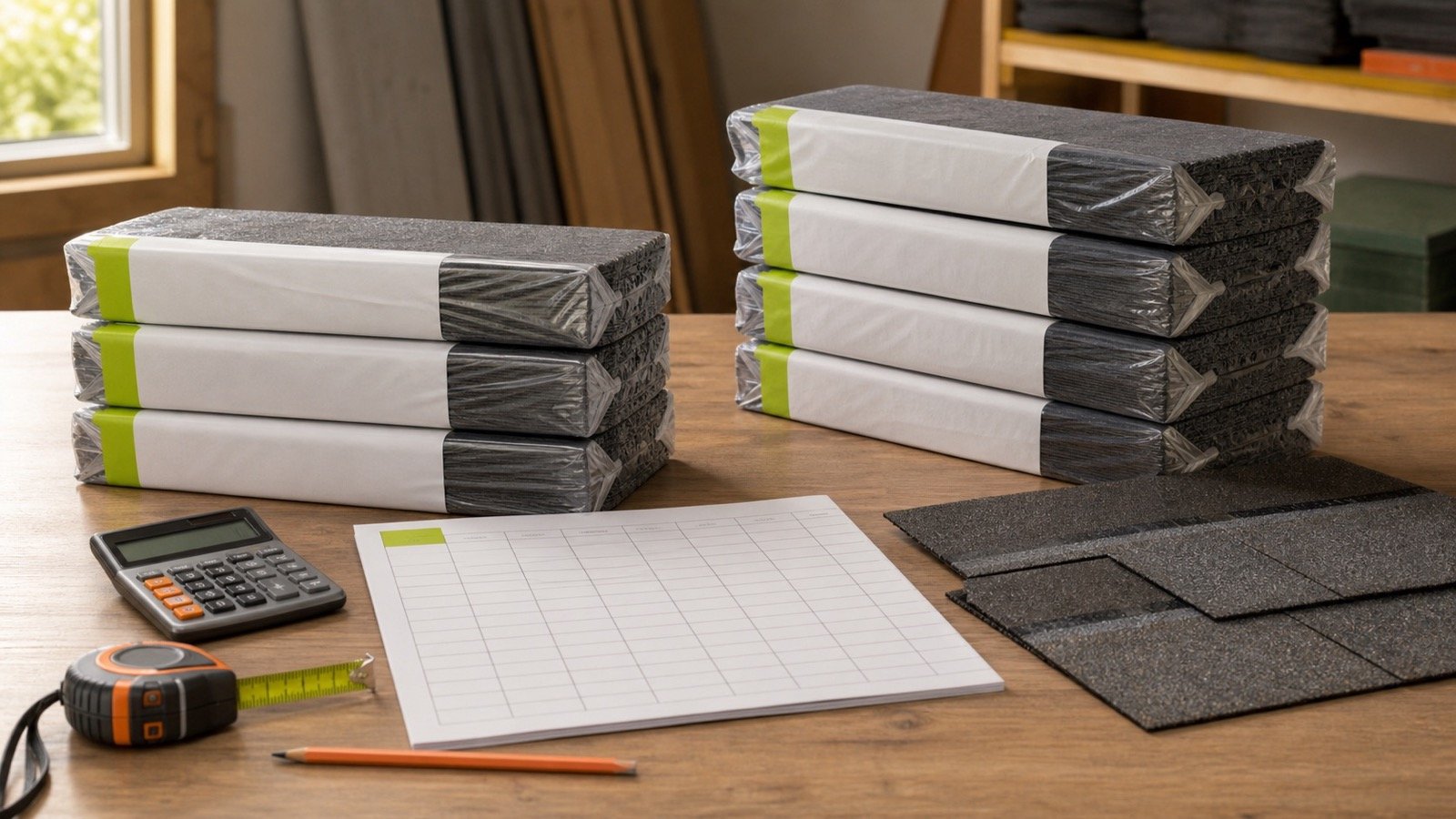
What belongs in a roofing allowance record?
The record should identify a field-shingle planning adjustment and its basis. It should also state which quantities are excluded so the order can be checked later.
| Quantity | Record it as | Why it stays separate |
|---|---|---|
| Checked sloped roof area | Base field area | Geometric surface before allowance or package rounding |
| Field cuts, handling loss and approved contingency | Documented field allowance | Project decision applied to base field area |
| Whole-bundle rounding | Package surplus | Selling-increment effect after the allowance |
| Starter strip | Linear accessory order | Uses its own compatible product and coverage |
| Hip and ridge cap | Linear accessory order | Uses measured hip/ridge length and its own coverage |
| Underlayment, valley material and flashing | Separate area or linear orders | Different laps, widths, rolls and instructions apply |
| Unopened repair bundle retained after work | Spare inventory | Future stock is not installed cut loss |
| Measured disposal or damaged pieces | Closeout waste record | Actual loss needs post-work evidence |
Do not count one quantity twice. If a dedicated starter product covers the eaves and rakes, do not also add field shingles for that same starter scope unless the selected instructions require it.
How does the allowance formula work?
Use actual sloped roof area, not an unadjusted horizontal footprint. Preserve the exact area through the allowance step and round only when the selected product reaches its selling increment.
Allowance area = checked sloped roof area × entered allowance percentage
Field planning area = checked sloped roof area + allowance area
Exact field packages = field planning area ÷ current package coverage
Whole field packages = exact field packages rounded up to the confirmed selling increment
Package surplus = purchased field coverage − field planning area
A roofing square is 100 ft², according to NIST's building-square definition. It is an area unit, not a command to buy whole squares. If the supplier sells whole bundles, calculate exact bundles from exact area and round once at the bundle step.
Use the Roof Area Calculator to preserve base area, entered allowance, roofing squares, packages and package surplus as separate outputs.
How does an imperial field-shingle example close?
A checked sloped roof area is 1,475.804865 ft². The project record uses an 8% field allowance after reviewing its layout. This percentage is a declared example input, not a recommendation for another roof.
- Allowance area: 1,475.804865 × 8% = 118.0643892 ft².
- Field planning area: 1,475.804865 + 118.0643892 = 1,593.8692542 ft².
- Roofing squares: 1,593.8692542 ÷ 100 = 15.938692542.
- The selected Timberline HDZ record lists 3 bundles per square.
- Exact field bundles: 15.938692542 × 3 = 47.816077626.
- Whole-bundle order: 48 bundles.
- Equivalent purchased coverage: 48 ÷ 3 × 100 = 1,600 ft².
- Package surplus: 1,600 − 1,593.8692542 = 6.1307458 ft².
The 118.0643892 ft² allowance and 6.1307458 ft² package surplus are different. Adding them together and calling the result waste would erase the decision sequence.
Why can rounding roofing squares early add a bundle?
Whole-square rounding before the allowance can increase the base, then the percentage increases that rounded base again. Round once at the package step when packages are the confirmed selling increment.
| Sequence | Calculation | Result |
|---|---|---|
| Exact-area sequence | 1,475.804865 ft² × 1.08 ÷ 100 × 3 | 47.816077626, rounded to 48 bundles |
| Whole-square-first sequence | 15 squares × 1.08 × 3 | 48.6, rounded to 49 bundles |
| Difference | 49 − 48 | 1 bundle added by early rounding |
Early rounding might match a contract or supplier policy. If so, label that policy. Do not present the extra package as a measured cut requirement.
How should valleys and roof cuts affect the decision?
Valleys, hips, rakes, walls, penetrations and small facets create cut locations, but their names do not supply a universal rate. Review the actual geometry and the selected installation instructions.
GAF's current steep-slope field guide lists different permitted valley constructions by shingle product. Its Timberline HDZ instructions also specify distinct open- and closed-cut valley treatments. The selected method can change overlaps, cut lines and usable offcuts, so the order record should identify the approved method rather than say only “has valleys.”
- Count roof planes and retain each exact area subtotal.
- Record eave, rake, hip, ridge and valley lengths separately.
- Mark chimneys, skylights, vents, walls, crickets and other interruptions.
- Identify the exact field shingle, exposure and approved layout.
- Record the permitted valley construction for that product and project.
- State which cut pieces can move to another compatible location.
- Keep damage or handling contingency separate when project history supports it.
- Name the estimator or responsible approver and record the decision date.
A percentage without this basis cannot explain why 2 roofs with the same area need different field orders.
Why should starter and ridge-cap packages stay outside field waste?
Dedicated accessories have their own coverage units and compatibility rules. Putting their quantities inside a field-shingle percentage makes both the field order and accessory order harder to verify.
For a named example, the March 2025 GAF Pro-Start sheet lists approximate coverage of 120.33 lineal ft per bundle when the pieces are split. The November 2024 Seal-A-Ridge sheet lists 4 bundles per 100 linear ft, equivalent to 25 linear ft per bundle. These figures apply only to those named records.
| Order line | Measured need | Named coverage record | Whole packages | Package surplus |
|---|---|---|---|---|
| Pro-Start starter strip | 210 linear ft | Approx. 120.33 linear ft/bundle | 2 bundles | Approx. 30.66 linear ft |
| Seal-A-Ridge cap | 96 linear ft | 25 linear ft/bundle | 4 bundles | 4 linear ft |
Before ordering, check current product revision, market availability, compatibility, warranty conditions, required courses, overlaps and the seller's package increment. Another starter or cap can have different coverage.
How does the same workflow work in metric units?
A checked roof area is 100 m². The project record uses a declared 7.5% allowance, and the selected field package record states 3.1 m² per package. Neither input is a universal default.
- Allowance area: 100 × 7.5% = 7.5 m².
- Field planning area: 100 + 7.5 = 107.5 m².
- Exact package ratio: 107.5 ÷ 3.1 = 34.6774193548.
- Whole-package order: 35 packages.
- Purchased coverage: 35 × 3.1 = 108.5 m².
- Package surplus: 108.5 − 107.5 = 1 m².
Keep the entered unit consistent. Do not convert a metric coverage label to an approximate imperial value and then convert the result back when the manufacturer already supplies the compatible metric record.
Is retained spare stock part of roofing waste?
No. A sealed bundle intentionally retained for compatible future repairs is inventory. Record it after the installation order so a reader can see why it was delivered.
In the imperial example, 48 bundles satisfy the documented field-planning line after whole-package rounding. If the owner approves 1 additional unopened bundle for repair stock, the delivery line becomes 49 bundles. That extra bundle is not evidence that the project needed a larger cut allowance.
Record product name, code, color or blend, manufacturing identifiers available on the wrapper, storage location and the person responsible for retention. Storage suitability and color matching can change with product instructions, weathering, production lots and time, so do not promise a future match.
Can delivered and returned bundles prove actual roofing waste?
No. A bundle count alone cannot separate installed coverage, reusable partial pieces, cut scraps, damage, retained stock, transfers and theft. Actual waste needs a closeout method and evidence.
| Closeout entry | Evidence | What it can show |
|---|---|---|
| Delivered packages | Delivery ticket and product code | Material received for the named order |
| Unopened returns | Supplier return record | Material removed from the project inventory |
| Transfers | Signed destination record | Material moved to another job or store |
| Retained repair stock | Owner handoff and storage record | Intentional future inventory |
| Reusable opened pieces | Count, size or documented equivalent | Usable material remaining after work |
| Discarded cuts and damage | Measured pieces, volume or weight under a stated method | Observed loss within that measurement scope |
Even a careful closeout must state its measurement method. Dumpster weight can include packaging and other materials. Piece counts can mix different sizes. A percentage derived from incomplete records should be labelled as an estimate.
What should be confirmed before the order is released?
- Checked sloped roof area and every included roof section.
- Selected field product, code, color, market and current coverage record.
- Allowance percentage, reason, author, approval and date.
- Exact field ratio before package rounding.
- Supplier selling increment, stock status, return terms and delivery basis.
- Separate starter, hip/ridge, underlayment, valley, flashing and fastener lines.
- Compatibility and current installation instructions for every accessory.
- Approved repair-stock quantity and storage handoff.
- Who can revise the order if field conditions change.
The roof measurement guide covers plane boundaries. The roof pitch multiplier chart converts horizontal projections, and the roofing squares and bundles guide explains product-specific package math.
Which roofing allowance mistakes change the order?
- Applying an allowance to a horizontal footprint before calculating sloped area.
- Rounding base area to whole squares before applying the percentage.
- Selecting a percentage from roof type without reviewing the actual plan and product.
- Counting starter or ridge-cap products inside field-shingle waste and again as accessories.
- Using a familiar bundles-per-square value without checking the selected product.
- Treating package surplus as cut loss.
- Calling retained repair stock waste.
- Combining different products or colors before package rounding.
- Assuming a return policy, restocking fee or package condition without a current supplier record.
- Claiming actual waste from delivered-minus-returned bundles alone.
Safety and project limits
Roof measurement and installation expose workers to serious fall hazards. OSHA's U.S. residential-construction guidance requires employers to follow applicable fall-protection duties. Use drawings, safe ground methods or a qualified measurement service when dimensions cannot be collected under a suitable access and protection plan.
This page does not select a roof system, valley construction, allowance, spare-stock quantity, installation layout or safety plan. It does not inspect the deck, design drainage or structure, interpret a warranty, set code compliance, price an order or approve substitutions. Follow current drawings, project specifications, manufacturer instructions, permits, local requirements and qualified professional direction.
Return to the Roofing Quantity Planning hub for the active cluster. The calculation methodology explains formula, source and rounding checks. Report a correction through the corrections route.
Sources and source scope
- NIST Handbook 44 (2026), Appendix C: building-square and area-unit relationships.
- GAF Timberline HDZ Shingles Spec Sheet, RESGN467HDZ-0526: the named field product's 3-bundle-per-square record.
- GAF Steep-Slope Pro Field Guide, version 2.1: product-specific valley and accessory installation context.
- GAF Pro-Start Sell Sheet, RESGN546-0325: approximate named starter coverage.
- GAF Seal-A-Ridge Sell Sheet, RESHR112-1124: named hip/ridge coverage and compatibility.
- OSHA Fall Protection in Residential Construction: U.S. workplace fall-hazard context.
Source scope: NIST supports units. GAF records support only their named products, revisions and instructions. OSHA supports U.S. workplace safety context. The 8% and 7.5% rates are declared fixtures used to test the workflow. No source establishes a universal allowance, return rule or spare-stock quantity.
Review note: Saleem Sial owns the research and editorial record. Formula fixtures, source checks, unit tests, build validation, link crawl, schema review and rendered QA form the internal publication gate. Waseem Sial, External Reviewer and Engineer, is listed for ongoing external review; no completed review date is claimed.