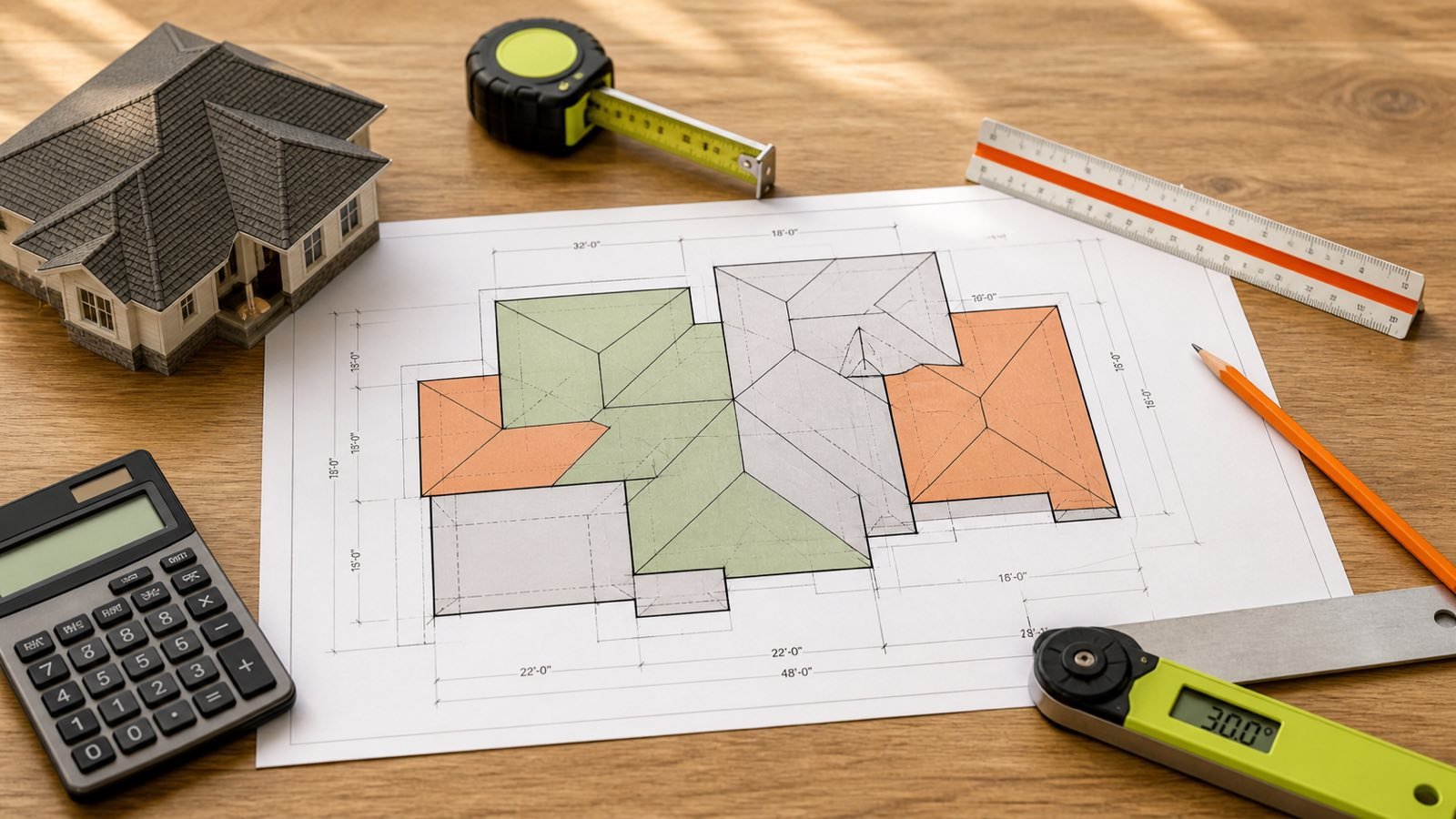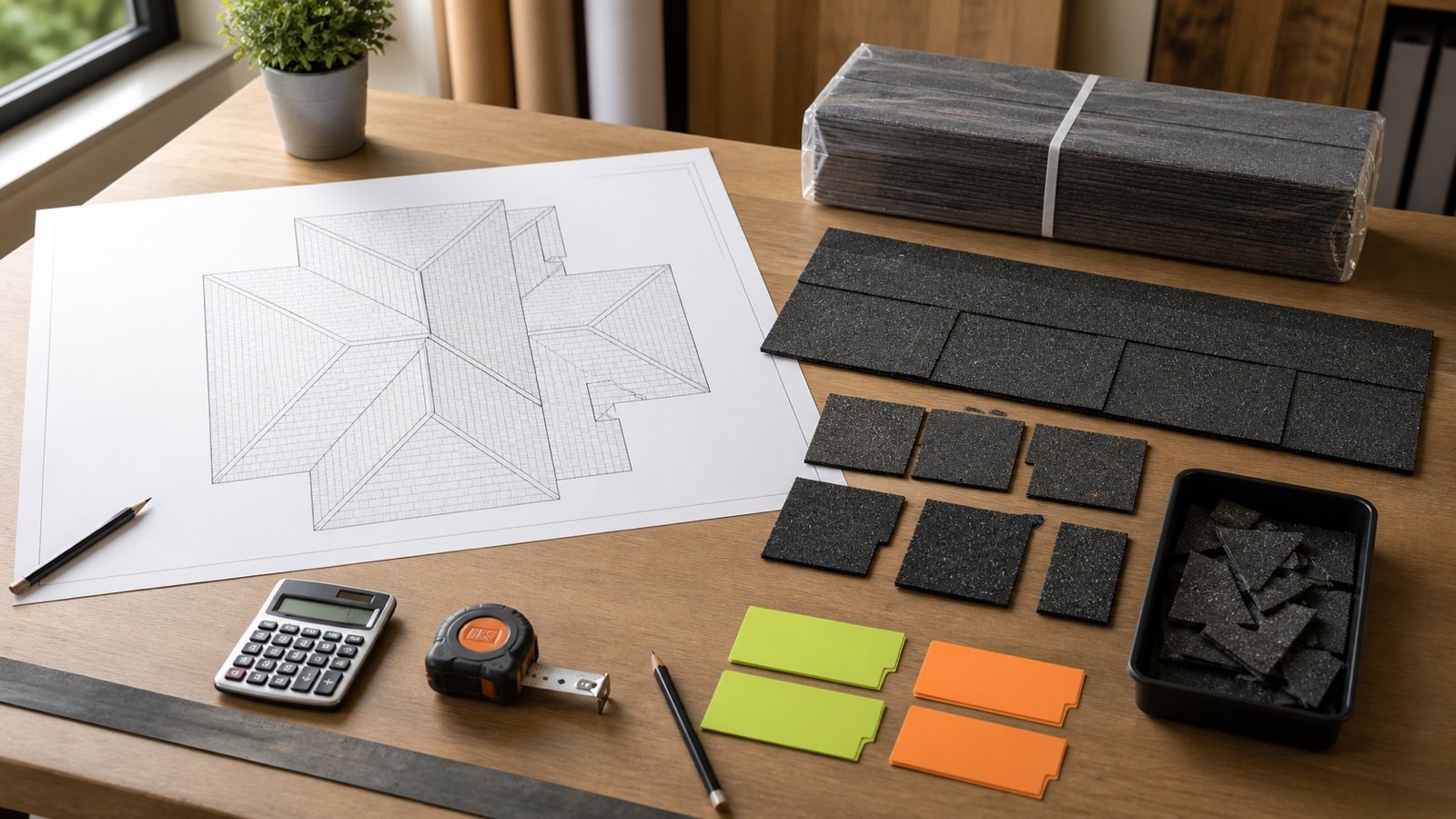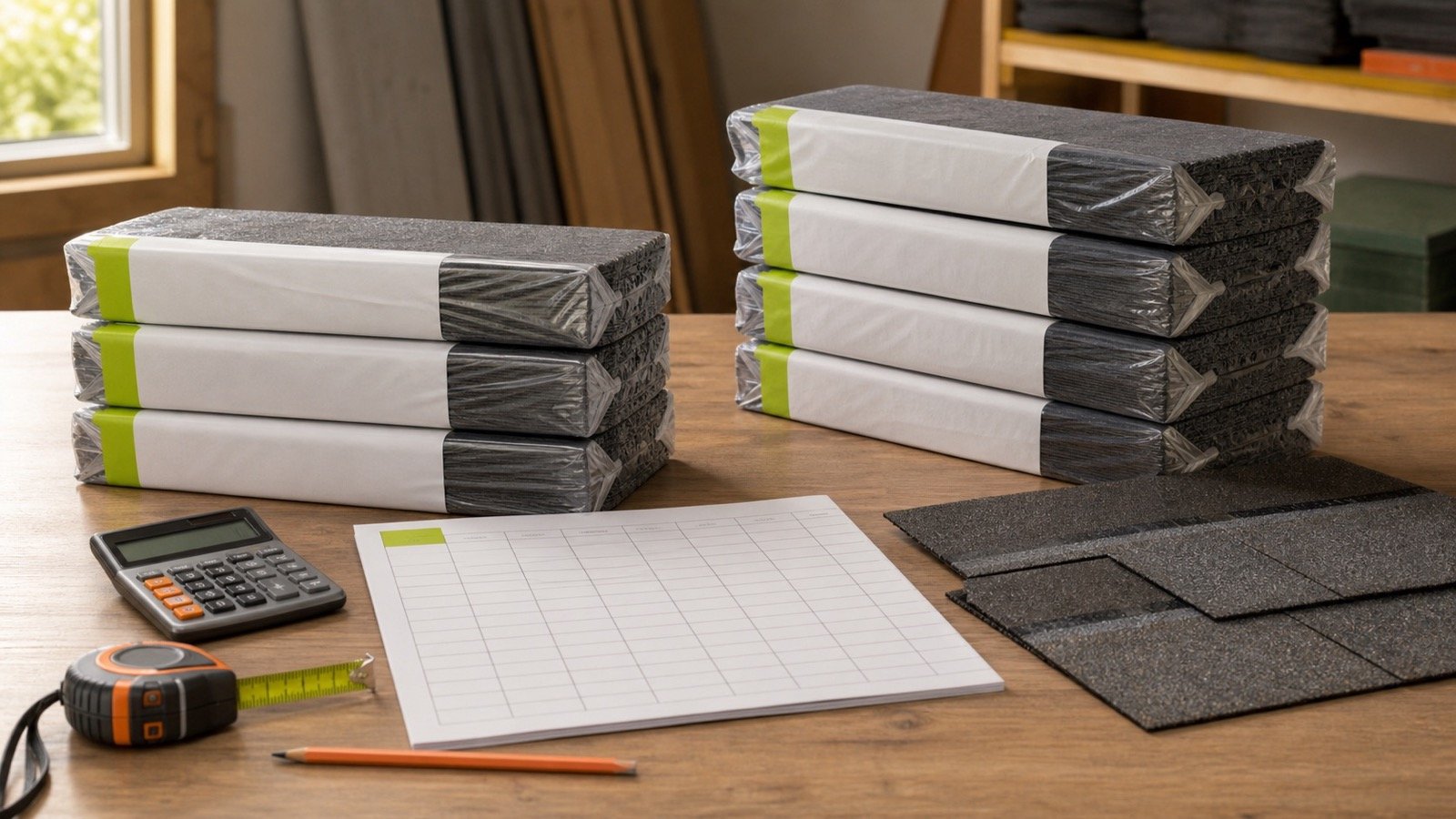
A roofing square is 100 ft² of roof surface. A shingle bundle is a package, and the number of bundles needed for one square comes from the selected product's current data sheet or package label.
Use the checked sloped planning area for the calculation. Keep the measured area, any approved allowance, exact package ratio, whole-package order and package surplus on separate lines.
How many bundles make one roofing square?
The answer depends on the product. GAF's May 2026 Timberline HDZ specification lists 3 bundles per square. Its April 2026 Woodland data sheet lists 4 bundles per square.
Both records come from the same manufacturer and both describe field shingles. The difference shows why “3 bundles per square” cannot act as a universal package rule.
| Product record | Bundles per square | Pieces per square | Area represented by one bundle |
|---|---|---|---|
| GAF Timberline HDZ, RESGN467HDZ-0526 | 3 | 64 | One-third of a square, about 33.3333 ft² |
| GAF Woodland, RESGN467WD-0426 | 4 | 56 | One-quarter of a square, 25 ft² |
The last column is derived from 100 ft² divided by the listed bundles per square. Check the current package and data sheet before ordering because product records, markets and packaging can change.
What does one roofing square measure?
One roofing square measures 100 ft² of surface area. NIST Handbook 44 (2026) lists one square (building) as 100 square feet.
Roofing squares = planning area in ft² ÷ 100
A 1,475.804865 ft² planning area equals 14.75804865 roofing squares. The decimal is useful during calculation even when the supplier eventually sells full bundles, full squares or another increment.
A roofing square is an area quantity. It does not state the roof pitch, shingle type, bundle weight, product price, installation labor or accessory quantity.
Which roof area belongs in the square calculation?
Use the actual sloped area assigned to the field-shingle scope, followed by any separately approved planning allowance. A horizontal footprint needs a pitch conversion before it can represent sloped roof surface.
- Prepare non-overlapping roof sections and assigned overhangs.
- Convert each horizontal section by its own pitch, or use an accepted sloped-area record.
- Add compatible field-shingle areas at full precision.
- Apply a documented allowance when the project requires one.
- Convert the resulting planning area to squares and packages.
The roof-area measurement guide explains section boundaries and overhangs. The roof pitch multiplier chart gives the geometric factor for a horizontal projection.
How do you convert roofing squares into bundles?
Multiply the exact square quantity by the current product's bundles-per-square value. Round upward once when the seller confirms that only full bundles can be purchased.
Exact bundle ratio = roofing squares × bundles per square
Whole bundles = round exact bundle ratio up to the selling increment
Purchased area equivalent = whole bundles ÷ bundles per square × 100 ft²
Package surplus = purchased area equivalent − planning area
Seller terms can require full squares, pallets or another increment. Replace the whole-bundle rule with the confirmed selling rule when it differs.
Worked example: the same roof with 3-bundle and 4-bundle products
A checked field-shingle planning area is 1,475.804865 ft², or 14.75804865 squares. The quantity already includes the project's documented area treatment.
| Calculation | 3 bundles/square | 4 bundles/square |
|---|---|---|
| Exact bundle ratio | 14.75804865 × 3 = 44.27414595 | 14.75804865 × 4 = 59.0321946 |
| Whole bundles | 45 | 60 |
| Purchased square equivalent | 45 ÷ 3 = 15 squares | 60 ÷ 4 = 15 squares |
| Purchased area equivalent | 1,500 ft² | 1,500 ft² |
| Package surplus | 24.195135 ft² | 24.195135 ft² |
The roof area stays the same. The product package basis changes the bundle count from 45 to 60. Listing only “60 bundles” without the product and bundles-per-square record leaves the order impossible to check.
Why should squares stay unrounded until the package step?
Rounding the square quantity first can add packages before the actual selling increment requires them. Retain the decimal squares, calculate the exact package ratio and round that result once.
Example: 1,410 ft² equals 14.1 squares. At 3 bundles per square, the exact ratio is 42.3 bundles, so a full-bundle order is 43.
Rounding 14.1 squares up to 15 before multiplying gives 45 bundles. That early rounding adds 2 bundles. A supplier selling only complete squares may require 45, so the purchase rule must be written beside the result.
Keep calculated area and decimal squares unchanged. Record whether the supplier sells by bundle, square, pallet or another unit.
What if the package lists direct coverage instead?
Divide planning area by the package coverage stated for the selected product. This path is useful when the current label or data sheet gives area per package directly.
Exact package ratio = planning area ÷ coverage per package
Purchased coverage = whole packages × coverage per package
Example: a current record states 33.3 ft² per package. A 1,475.804865 ft² planning area produces an exact ratio of 44.318464 packages. Rounding to 45 packages gives 1,498.5 ft² of stated coverage and 22.695135 ft² of package surplus.
Use one package basis for the final calculation. If a record shows both bundles per square and rounded direct coverage that produce different totals, retain both values, identify the difference and obtain the manufacturer's or supplier's ordering instruction.
Are package surplus and roofing allowance the same quantity?
They answer different questions. An approved allowance changes the planning demand before package conversion. Package surplus appears after that demand is rounded through the selling increment.
| Quantity | How it is produced | What to record |
|---|---|---|
| Calculated sloped area | Measured sections and pitch, or an accepted sloped-area record | Boundary, sections, units and pitch state |
| Allowance area | Calculated area × approved percentage or stated area | Value, reason and approving project record |
| Planning area | Calculated area + allowance area | Exact total before packaging |
| Package surplus | Purchased package coverage − planning area | Product basis and selling increment |
Package surplus describes coverage above the planning area. It does not predict intact leftover shingles after cuts, damage, exposure, laps and installation conditions.
How do metric roof areas convert to roofing squares?
Convert square metres to square feet, then divide by 100. Using the exact international-foot relationship, one roofing square equals 9.290304 m².
Roofing squares = area in m² ÷ 9.290304
A 100 m² planning area equals 10.763910417 squares. At 4 bundles per square, the exact bundle ratio is 43.05564167, so a full-bundle purchase is 44 when the seller allows individual full bundles.
Keep the product record's market and unit basis visible. A metric dimension printed on one market's data sheet does not prove that the same package is sold in another market.
Do starter and ridge-cap packages use the field-shingle square count?
Calculate each product from its own instructions and measured quantity. Field shingles cover roof faces. Starter strips, hip and ridge caps, underlayment, leak barrier, flashing and edge materials can use linear, area, roll or piece quantities.
The two GAF field-shingle sheets name separate starter and hip/ridge products. Their 3-bundle and 4-bundle field-shingle records do not supply coverage for those accessories.
Keep separate calculation groups when the product, color, package coverage, roof zone, exposure or approved treatment changes. Combine them only when the current records use the same purchasing basis and the project permits it.
What should the supplier check before the order is released?
- Manufacturer, product name, code and market.
- Data-sheet or label revision and confirmation date.
- Field-shingle planning area and roofing squares.
- Bundles per square or direct package coverage used in the calculation.
- Exact package ratio and requested whole packages.
- Seller's bundle, square, pallet or minimum-order increment.
- Separate starter, hip/ridge, underlayment, flashing and edge quantities.
- Stock, package identifiers, delivery basis, fees and return terms.
- Who confirmed the product and quantity record.
A quote can state a square quantity while the delivery ticket lists bundles. Reconcile both documents with the same product conversion before accepting the order.
Which mistakes change the bundle count?
- Using house floor area as roof surface area.
- Applying pitch to a sloped-area report that already includes it.
- Assuming every field shingle uses 3 bundles per square.
- Using one product's package record for another product.
- Calling 33.3 ft² exactly one-third of 100 ft².
- Rounding roofing squares before calculating packages.
- Adding an allowance to area and repeating it in the bundle count.
- Treating package surplus as a waste recommendation.
- Combining field shingles and accessories under one bundles-per-square value.
- Ignoring the supplier's selling increment.
- Using an undated price or package record.
Safety and project limits
Use drawings, safe ground measurements or a qualified measurement service when checking the roof boundary would require unsafe access. OSHA identifies U.S. residential roofing as fall-hazard work and requires employers to use the protection that applies to the work and site.
This guide does not inspect a roof, select a covering, approve a slope, set exposure, prepare installation instructions, calculate structural loads, decide an allowance or replace a supplier quotation. Current project documents, product instructions, local requirements and responsible qualified people control those decisions.
Use the Roof Area Calculator to calculate sloped area, roofing squares and product packages from a checked input. Return to the Roofing Quantity Planning hub for the current cluster. The calculation methodology explains rounding and source checks, and the corrections route accepts documented issues.
Sources and source scope
- NIST Handbook 44 (2026), Appendix C: building-square definition, square-area conversion and rounding guidance.
- GAF Timberline HDZ Shingles Spec Sheet, RESGN467HDZ-0526: 3 bundles and 64 pieces per square for the named product.
- GAF Woodland Shingles Data Sheet, RESGN467WD-0426: 4 bundles and 56 pieces per square for the named product.
- OSHA Fall Protection in Residential Construction: U.S. residential roofing fall-hazard context.
Source scope: NIST supports the unit and conversion. Each GAF sheet supports only its named product and dated record. OSHA supports U.S. employer safety context. These sources do not choose a product, set an allowance, confirm local stock, state a current price or approve a project order.
Review note: Saleem Sial owns the research and editorial record. Formula fixtures, source checks, build validation, link crawl, schema review and rendered QA form the internal publication gate. Waseem Sial, External Reviewer and Engineer, is listed for ongoing external review; no completed review date is claimed.