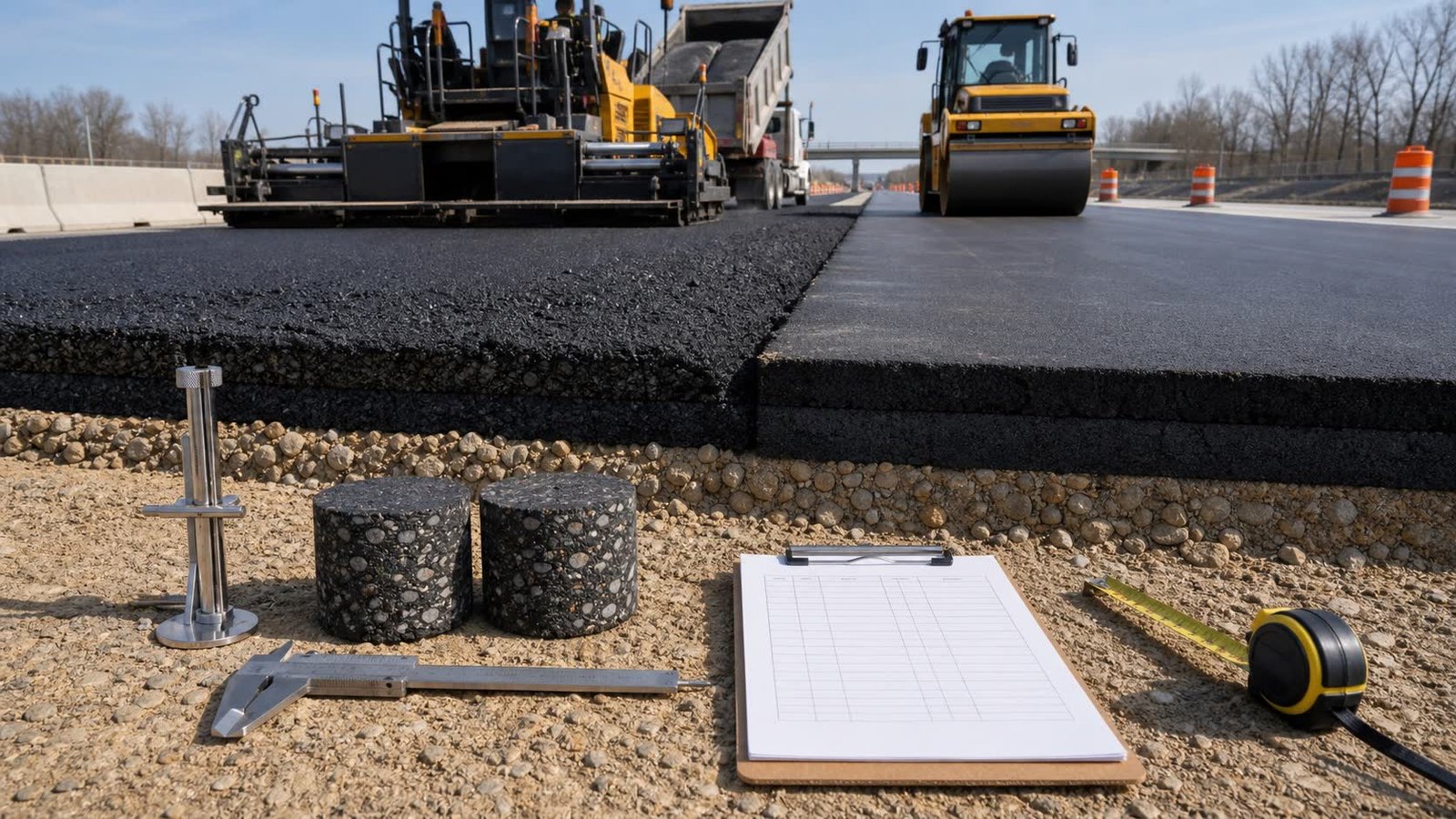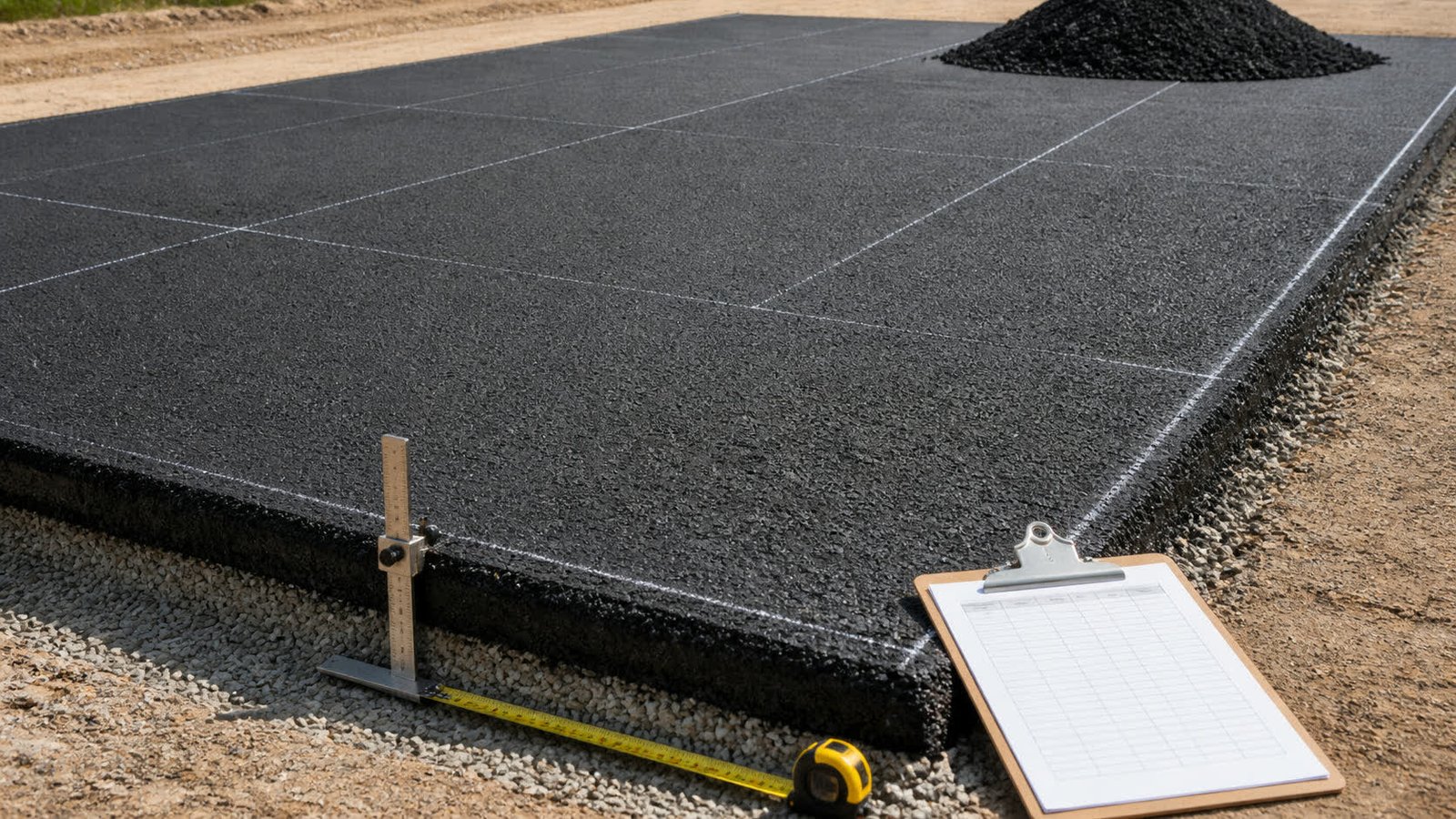
Asphalt density connects a compacted volume to a mass estimate. The value needs a unit, mixture, material state, source, and date before it can support an order.
A bare entry such as 145 or 2,320 leaves important questions unanswered. Check whether the record describes compacted unit weight, bulk specific gravity, maximum theoretical specific gravity, percent in-place density, a loose material state, or a planning assumption.
Which asphalt density should you use for a tonnage estimate?
Use the project-approved compacted unit weight for the selected mixture and lift when the estimate starts from compacted volume. Enter it in lb/ft³ or kg/m³, matching the unit requested by the Asphalt Calculator.
Ask the producer, project specification, mix record, or responsible project contact which value controls the quantity check. Preserve the mixture designation, lift, source document, record date, unit, material state, and any stated use restriction.
Record the value, unit, mixture, lift, compacted or loose state, source, effective date, and approved use. Keep a planning assumption labelled until a project record replaces it.
What does an asphalt density number mean?
The label tells you whether a number can enter a mass-per-volume calculation. Unit weight or density has mass-per-volume units. Gmb, Gmm, and percent density belong to mixture testing and specification records.
| Record field | Meaning | Estimator action |
|---|---|---|
| Compacted unit weight | Mass per unit of compacted mixture volume, commonly recorded in lb/ft³ or kg/m³ | Use with the matching compacted volume when the project record approves it |
| Gmb | Bulk specific gravity of a compacted mixture specimen or core | Keep the test result and method; obtain or calculate unit weight through the approved project procedure |
| Gmm | Maximum theoretical specific gravity for the mixture without air voids | Use within the specified density or air-void calculation; do not enter it as lb/ft³ or kg/m³ |
| Percent in-place density | Gmb ÷ Gmm × 100 within the FHWA specification context | Compare it through the governing acceptance procedure; do not enter the percentage as unit weight |
| Loose material density | Mass per loose or uncompacted volume under a stated condition | Use only for a matching loose-volume task |
| Planning assumption | A provisional mass-per-volume value used before a controlling record is available | Label it, show the sensitivity, and replace it before final ordering when required |
FHWA Protocol P02 covers bulk specific gravity testing for compacted bituminous cores and states that bulk specific gravity may be used to calculate mixture unit weight. The protocol also separates methods according to water absorption and connected voids. The applicable testing procedure belongs to the project laboratory or specification.
How are Gmb, Gmm and percent density connected?
FHWA describes in-place density as the ratio of the compacted mixture bulk specific gravity, Gmb, to maximum theoretical specific gravity, Gmm. Multiply the ratio by 100 to express a percentage.
Percent in-place density = Gmb ÷ Gmm × 100
FHWA-HIF-22-063 reports that effective agency specifications used roadway-core Gmb measurements and regular mixture Gmm measurements. It also states that production Gmm can change by ±0.030, so a static mix-design value can introduce density error.
A percentage such as 92 or 94 cannot enter a lb/ft³ field. A specific gravity such as 2.300 also lacks mass-per-volume units. Use the project procedure to obtain the compacted unit weight required for quantity planning.
How do you convert asphalt density units?
Convert the density value before calculating mass. NIST's exact pound and international-foot relationships produce the lb/ft³-to-kg/m³ factor used below.
kg/m³ = lb/ft³ × 16.01846337396014
lb/ft³ = kg/m³ ÷ 16.01846337396014
U.S. short tons per yd³ = lb/ft³ × 27 ÷ 2,000
Metric tonnes per m³ = kg/m³ ÷ 1,000
| Entered value | Converted density | Calculated mass per volume |
|---|---|---|
| 135 lb/ft³ | 2,162.4926 kg/m³ | 1.8225 U.S. short tons/yd³ |
| 140 lb/ft³ | 2,242.5849 kg/m³ | 1.8900 U.S. short tons/yd³ |
| 145 lb/ft³ | 2,322.6772 kg/m³ | 1.9575 U.S. short tons/yd³ |
| 150 lb/ft³ | 2,402.7695 kg/m³ | 2.0250 U.S. short tons/yd³ |
| 155 lb/ft³ | 2,482.8618 kg/m³ | 2.0925 U.S. short tons/yd³ |
These rows are conversion checks for entered values. They do not assign a density to a mixture or recommend a project input.
How does density change an asphalt weight estimate?
Mass changes in direct proportion to the entered density when compacted volume stays fixed. A 5% increase in density creates a 5% increase in calculated mass.
Calculated mass = compacted volume × entered compacted density
Example: a checked paving takeoff has 18 m³ of compacted asphalt volume. An entered value of 2,250 kg/m³ gives 40,500 kg, or 40.50 t. An entered value of 2,350 kg/m³ gives 42,300 kg, or 42.30 t.
The 100 kg/m³ input difference changes the result by 1.80 t. Keep both cases in a sensitivity record when the controlling density is unresolved. Do not hide the difference inside an allowance.
What is a complete density handoff record?
A density handoff lets another person identify the exact input and decide whether it belongs in the estimate. Use one row for each mixture, lift, source, and effective period.
| Field | What to record |
|---|---|
| Project and estimate revision | Project identifier, location, estimate version, and date |
| Mixture and lift | Exact mixture designation and surface, binder, leveling, or base lift |
| Quantity state | Compacted in-place, loose delivery, stockpile, sample, or another defined state |
| Density value and unit | Full numeric value with lb/ft³, kg/m³, or another documented unit |
| Record type | Unit weight, Gmb, Gmm, percent density, or planning assumption |
| Source and date | Drawing, specification, mix record, laboratory result, supplier communication, and effective date |
| Approved use | Quantity estimate, acceptance, payment, quality control, or another stated purpose |
| Owner and status | Person responsible for resolving provisional or conflicting information |
Save the source document with the estimate. A copied value loses its test method, mixture, location, date, and approval status when the supporting record is missing.
How should different lifts or mixtures be handled?
Calculate each lift with its own compacted volume and density record. Combine masses after the separate calculations when the quantity and commercial records permit aggregation.
Example: a binder lift uses density record A and a surface lift uses density record B. Calculate binder volume × density A and surface volume × density B. One average density can distort the result when the 2 lifts occupy different volumes.
A revised mixture, aggregate source, production period, or accepted density basis may require a new row. Preserve the previous input so the change in tonnage can be explained.
Can delivery tickets verify asphalt density?
Delivery tickets can support a yield reconciliation when accepted ticket mass and measured compacted volume cover the same defined work. The quotient is an apparent mass-per-volume ratio for that record set.
Apparent delivery yield = accepted ticket mass ÷ measured compacted volume
Example: accepted ticket mass is 41.2 t and the checked compacted volume is 18 m³. The apparent yield is 41.2 ÷ 18 = 2.2889 t/m³, or 2,288.9 kg/m³.
This ratio does not prove accepted in-place density. Unpaved leftovers, rejected loads, returned material, tack or other materials, measurement boundaries, thickness variation, scale records, ticket status, and paving outside the measured area can change the reconciliation. Use the specified tests and acceptance records for density compliance.
Which density mistakes change the tonnage?
- Entering Gmb, Gmm, or a percent as though it were lb/ft³ or kg/m³.
- Using loose density with compacted volume.
- Applying one density record to several mixtures or lifts without approval.
- Copying a value without its unit, source, mixture, state, or date.
- Mixing U.S. short tons, metric tonnes, and long tons.
- Using 27 ft³ per yd³ without converting pounds to U.S. short tons.
- Adding a compaction factor after volume and density already describe the compacted state.
- Treating a delivery-yield ratio as an acceptance test result.
- Refreshing a density assumption without recording the resulting mass change.
Safety and specification limits
Core cutting, laboratory handling, hot asphalt, fumes, traffic, moving equipment, water, electricity, rotating equipment, and open test holes require the applicable safety plan, training, guarding, PPE, traffic control, equipment instructions, and site controls. OSHA identifies asphalt-fume exposure as a worker-safety concern.
This guide does not select a mixture, pavement structure, lift thickness, target density, acceptance band, test method, sampling location, payment rule, allowance, order increment, truck payload, or work method. Current project documents and qualified decisions control those items.
Enter the approved compacted mass-per-volume value in the Asphalt Calculator. Use the asphalt compacted versus loose thickness guide to identify the depth state and record separate lifts before calculating volume. Browse the Asphalt planning tools and guides for the category record. The calculation methodology explains source, assumption, precision, and rounding controls. Report an issue through the corrections route.
Sources and source scope
- FHWA-HIF-22-063, Enhanced In-Place Density: roadway-core Gmb, mixture Gmm, the Gmb/Gmm density relationship, production variation, and highway-agency specification context.
- FHWA LTPP Protocol P02: compacted asphalt-core bulk specific gravity, test-method boundaries, and use of bulk specific gravity to calculate unit weight.
- FHWA Mobile Asphalt Technology Center technical documents: in-place density specification context and the role of Gmb and Gmm.
- NIST Handbook 44 (2026), Appendix C: exact length, volume, pound, kilogram, U.S. short-ton, and metric-tonne relationships used in the conversions.
- OSHA Asphalt Fumes: worker-exposure context for asphalt operations.
Source scope: FHWA supports the test-record distinctions and density specification context. NIST supports the unit relationships. OSHA supports the exposure warning. The conversion table and examples are independently checked arithmetic. These sources do not assign a universal asphalt density or approve a project mixture, density target, estimate input, acceptance method, or supplier order.
Review responsibility: Saleem Sial owns the research and editorial record. Formula checks, source verification, build validation, and rendered QA form the internal publication gate. Waseem Sial, External Reviewer and Engineer, remains listed for ongoing external review; no completed external-review date is claimed.