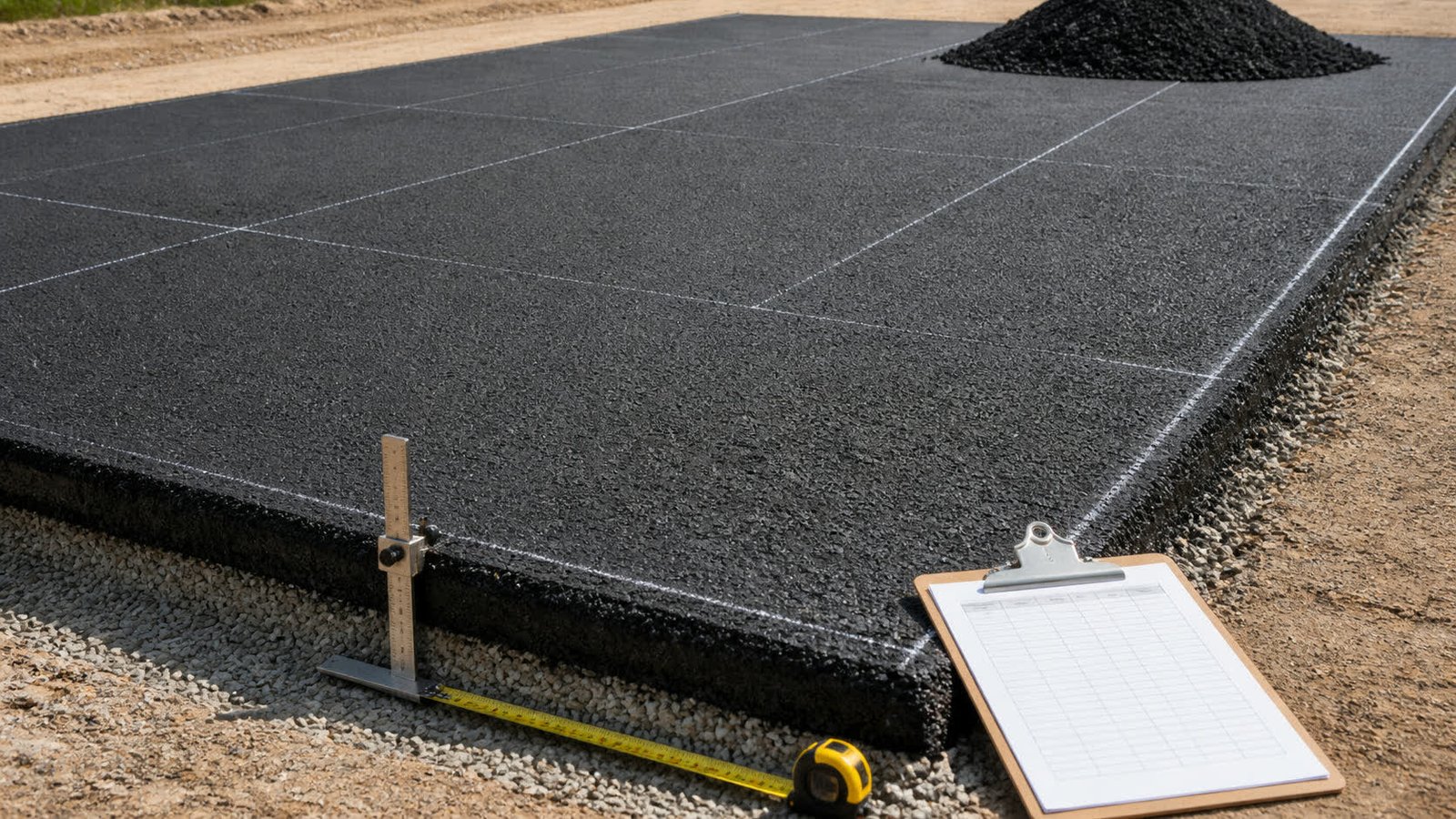
Asphalt thickness affects volume, tonnage, lift planning, finished elevations, and the meaning of a paving quote. Each thickness needs a state: loose behind the paver, compacted after rolling, or measured from a finished core.
Record each asphalt lift separately when the mixture, compacted depth, paved area, density, or acceptance basis changes. A total such as 3 in gives too little information for a checkable takeoff unless the record also explains how that total is built.
Which asphalt thickness belongs in the quantity calculation?
Use the specified or accepted compacted thickness for the lift whose finished volume you are calculating. Enter that compacted depth with the matching paved area in the Asphalt Calculator.
Keep loose placement thickness in a separate field. Loose thickness is a paving-control input tied to a mixture and rolldown basis; it does not replace the compacted depth used to define finished pavement volume.
Record the lift name, mixture, paved limits, thickness value, unit, loose or compacted state, source document, revision, and measurement or acceptance method.
What do loose, compacted, lift and total thickness mean?
These terms describe different parts of the paving record. Treating them as interchangeable can duplicate a lift or apply a placement factor twice.
| Term | Meaning | Quantity treatment |
|---|---|---|
| Loose thickness | Mat depth after the paver screed and before final rolling | Use for placement setup only with the documented mixture-specific rolldown basis |
| Compacted lift thickness | Finished depth of one placed and compacted asphalt layer | Multiply by that lift's paved area to calculate compacted volume |
| Total compacted asphalt thickness | Sum of the compacted asphalt lifts in the defined pavement section | Use only when every lift covers the same area and a combined-volume check is suitable |
| Core length | Measured length of an extracted pavement core | Keep the sample location, condition and governing procedure with the reading |
| Individual core-layer thickness | Measured depth between identified interfaces within a core | Compare each layer through the project sampling and acceptance procedure |
| Nominal or quoted thickness | A stated value whose compacted state, lift split and tolerance may be undefined | Clarify the contract meaning before ordering or checking payment |
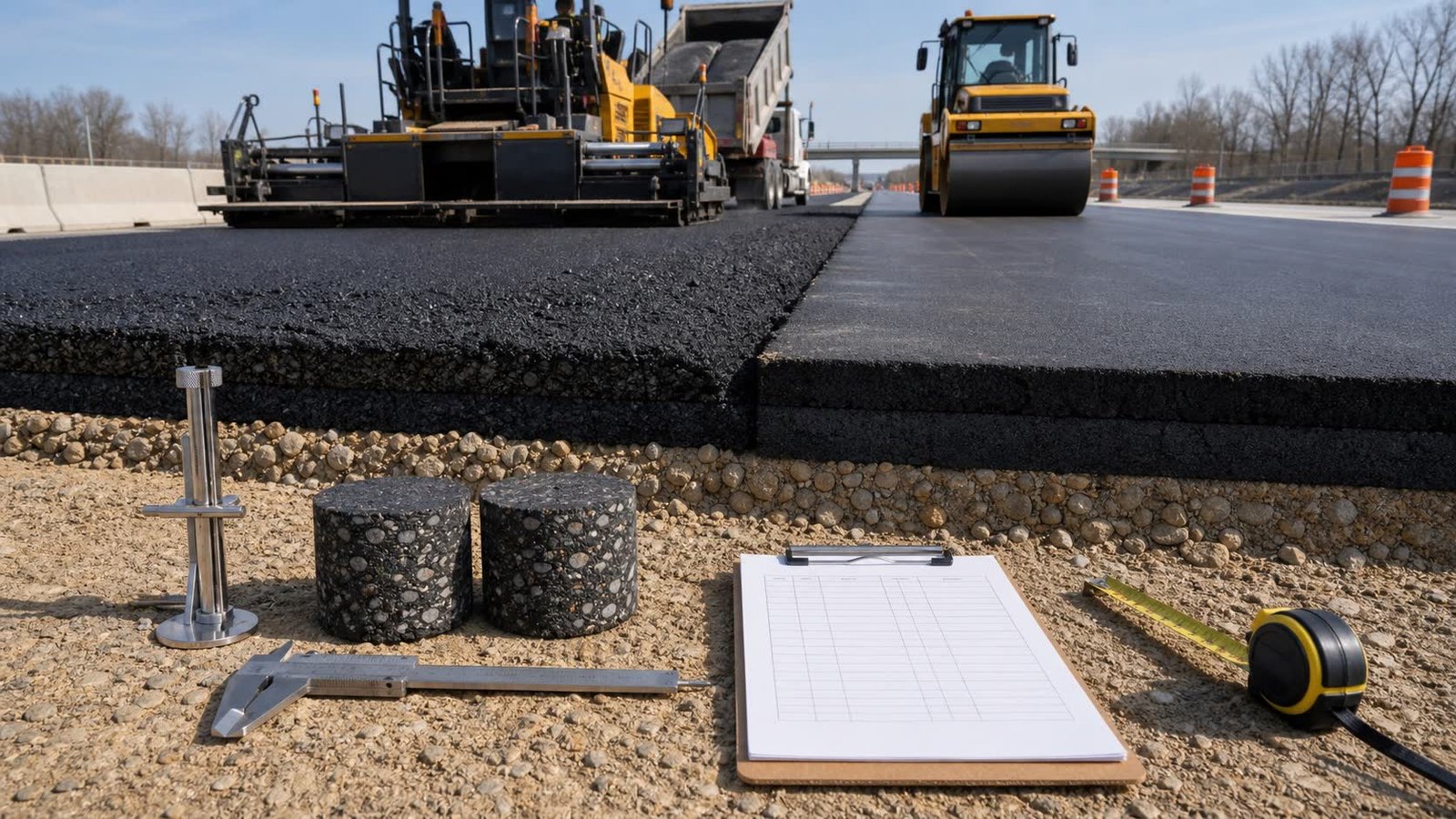
The NAPA Asphalt Paving Handbook describes the mat behind the screed as loose even though the screed provides some initial compaction. The same section says the loose mat must allow consolidation to the finished thickness stated in the project plans.
How do you calculate asphalt volume from compacted thickness?
Multiply the net paved area by the compacted thickness after converting both measurements to compatible units. Calculate lifts separately when their areas or depths differ.
Compacted volume = net paved area × compacted lift thickness
Total compacted asphalt volume = sum of each lift volume
Metric example: a 30 m by 12 m section has a 50 mm compacted lift. The area is 360 m², the depth is 0.05 m, and the compacted volume is 18 m³.
- Area: 30 × 12 = 360 m².
- Depth: 50 mm ÷ 1,000 = 0.05 m.
- Volume: 360 × 0.05 = 18 m³.
Imperial example: a 1,800 ft² paving area has a 2.5 in compacted lift. The volume is 1,800 × 2.5 ÷ 12 = 375 ft³, or 13.889 yd³.
These examples calculate finished geometric volume. Tonnage also needs a compacted density record for the selected mixture. The asphalt density guide explains the density handoff and unit conversions.
How much does a thickness change affect asphalt quantity?
Volume changes in direct proportion to compacted thickness when area stays fixed. A small depth revision across a large plan area can change the order by several tonnes.
For the 360 m² metric area, changing the compacted depth from 50 mm to 55 mm changes the volume from 18 m³ to 19.8 m³. The added compacted volume is 1.8 m³.
If a checked project record uses 2,320 kg/m³ for this mixture, the 1.8 m³ difference equals 4,176 kg, or 4.176 t. The density belongs to this arithmetic fixture and does not set a mixture value for another project.
| Compacted thickness | Compacted volume | Change from 50 mm |
|---|---|---|
| 45 mm | 16.2 m³ | −1.8 m³ |
| 50 mm | 18.0 m³ | Reference |
| 55 mm | 19.8 m³ | +1.8 m³ |
| 60 mm | 21.6 m³ | +3.6 m³ |
Keep the original and revised thickness records beside the quantity change. Do not hide a design revision inside a waste or planning allowance.
How does a rolldown factor connect loose and compacted thickness?
A rolldown factor can set an initial loose mat thickness when the project team has approved a factor for the selected mixture and paving conditions. Define the percentage basis before doing the arithmetic.
Loose thickness = target compacted thickness × (1 + rolldown factor ÷ 100)
Target compacted thickness = loose thickness ÷ (1 + rolldown factor ÷ 100)
The NAPA handbook gives a stated example: a 25% rolldown factor applied to a 2 in compacted target gives 2.5 in loose thickness. This example defines 25% as an addition to the compacted target.
The reverse calculation divides 2.5 in by 1.25 and returns 2 in. Subtracting 25% from the 2.5 in loose measurement returns 1.875 in because that method changes the percentage base. Record the formula with the factor so another person can reproduce the result.
The handbook also says the factor varies with mixture type. Confirm the project method through the approved paving plan, test strip, mixture record, screed setup procedure, or responsible project personnel. Do not turn the handbook example into a universal order or acceptance value.
Why should binder, surface and leveling lifts have separate rows?
Each lift may cover a different area, use a different mixture, or follow a different depth record. A single total can conceal these changes and prevent a density or delivery check by lift.
| Record field | What to enter |
|---|---|
| Section and paved limits | Station range, lot zone, driveway segment, drawing area, and exclusions |
| Lift | Surface, binder, leveling, asphalt base, overlay, or the exact project designation |
| Mixture | Approved mixture identifier and relevant production period |
| Compacted thickness | Specified or accepted value, unit, source, revision, and applicable tolerance clause |
| Loose setup | Initial loose thickness, factor, formula basis, and field adjustment record where used |
| Net area | Area occupied by that lift after checked deductions |
| Quantity | Unrounded compacted volume and mass from the matching density record |
| Verification | Core, yield, survey, elevation, ticket, or another project-defined check and location |
Example: a binder lift covers 360 m² at 50 mm while a surface lift covers only 330 m² at 30 mm because 30 m² remains outside the resurfacing limit. Their volumes are 18 m³ and 9.9 m³. Multiplying the full 360 m² by a combined 80 mm would overstate the finished volume by 0.9 m³.
What should a paving quote say about thickness?
A checkable quote identifies the compacted result being purchased and separates asphalt from the aggregate base. Ask for a written clarification when the state or layer split is absent.
- Net paved area and defined project limits.
- Total compacted asphalt thickness.
- Number of lifts and compacted thickness of each lift.
- Mixture designation for each lift.
- Separate aggregate-base material and compacted depth record.
- Loose-thickness or rolldown language, if it controls placement setup.
- Thickness measurement, sampling, tolerance and acceptance basis.
- Edges, tie-ins, transitions, milling, leveling and excluded areas.
- Quantity, price and change-order treatment for revised limits or depths.
A phrase such as “install 3 inches of asphalt” leaves the compacted state and lift split unresolved. Resolve the wording before comparing bids because 3 in loose and 3 in compacted describe different finished quantities.
How can finished asphalt thickness be checked?
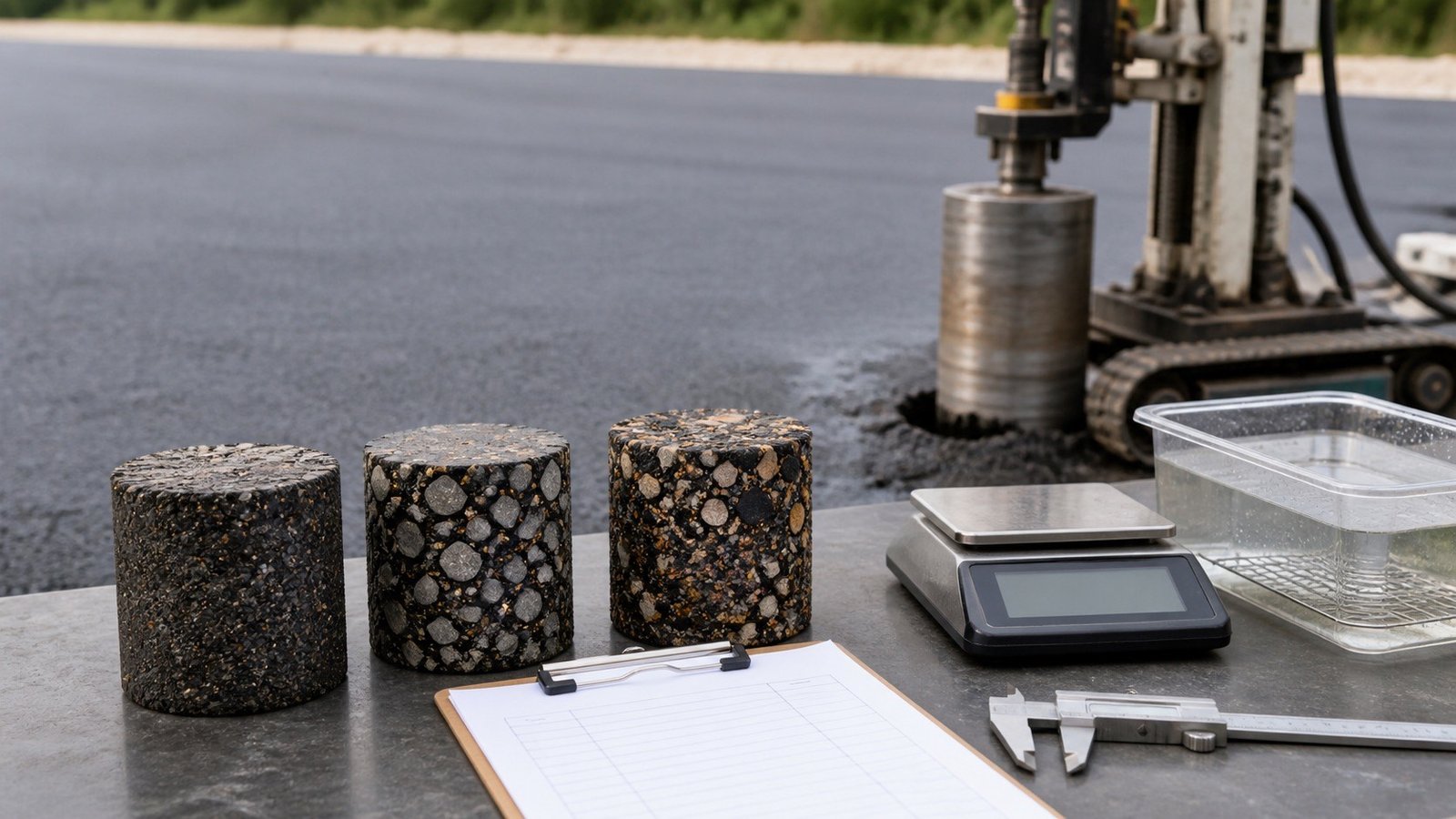
Use the measurement and sampling procedure required by the project. Finished cores can identify total asphalt thickness and individual layer interfaces when the procedure, locations and sample condition support that use.
FHWA's LTPP Protocol P01 covers visual examination and thickness measurement of asphalt concrete cores. Its laboratory procedure takes 4 axial measurements, records them to the nearest 0.1 in (2.5 mm), and reports their average to the same resolution. It also assigns separate layer thicknesses after inspecting and marking visible interfaces.
That FHWA procedure belongs to the Long Term Pavement Performance program. It illustrates why a core record needs several measurements, sample identification, layer identification and condition notes. The governing contract or agency procedure controls sampling frequency, locations, tolerances, acceptance, payment and repair of core holes.
Delivery tickets and area can support a yield check, but they do not prove thickness at each location. Unpaved material, leftovers, rejected loads, variable density, changed limits and measurement error can all affect the comparison.
How should variable-depth and tapered asphalt areas be measured?
Split the work into zones or station intervals supported by plans, survey, milling records, screed records, cores, or another accepted method. Preserve the calculation for each zone.
A leveling course, wedge, crown correction, intersection tie-in, driveway apron, utility repair, or transition may have changing depth. An arithmetic average depth is valid only when it represents the measured geometry. Separate abrupt changes and areas that do not share the same profile.
Finished elevations may control drainage, curb reveal, thresholds, utility covers and tie-ins. Quantity arithmetic does not approve those elevations. Check the relevant design and field records before changing a lift depth.
Which thickness mistakes change the asphalt order?
- Entering loose thickness as compacted depth.
- Applying a rolldown factor to a compacted volume a second time.
- Subtracting a percentage from loose thickness when the stated factor uses compacted thickness as its base.
- Adding binder and surface depths when the lifts cover different areas.
- Combining asphalt and aggregate-base thickness in one asphalt volume.
- Using one density for several mixtures without a supporting record.
- Rounding each zone before adding compatible unrounded volumes.
- Treating ticket yield as proof of thickness acceptance.
- Checking one edge or one core as though it represents every location.
- Using a generic driveway table as the project pavement design.
Safety, design and specification limits
Hot asphalt, fumes, moving pavers and rollers, delivery traffic, core drills, water, electricity, open holes and live roadways require the applicable safety plan, traffic control, training, PPE, equipment instructions and site controls. OSHA identifies asphalt-fume exposure as a worker-safety concern.
This guide does not design pavement, select a mixture, prescribe asphalt or base thickness, set a rolldown factor, establish lift limits, choose a test method, locate cores, set tolerances, approve drainage or determine payment. Project drawings, specifications, pavement design, producer information and qualified decisions control those tasks.
Use the Asphalt Calculator after confirming the compacted depth for each lift. Browse the Asphalt planning tools and guides for the category record. The calculation methodology explains source, unit and rounding controls. Report an issue through the corrections route.
Sources and source scope
- NAPA Asphalt Paving Handbook, Section 7.5 Layer Thickness: loose mat state, mixture-dependent rolldown, the stated 2 in compacted and 2.5 in loose example, loose-thickness field checks, and spread-rate context.
- FHWA LTPP Protocol P01: asphalt-core condition, total thickness, individual layer identification, 4-point measurement and reporting procedure within the LTPP program.
- NIST Handbook 44 (2026), Appendix C: foot, inch, yard and metre relationships used in the examples.
- OSHA Asphalt Fumes: worker-exposure context for asphalt operations.
Source scope: NAPA supports the loose-to-compacted placement concepts and its stated example. FHWA supports the cited LTPP core-measurement procedure. NIST supports unit relationships. OSHA supports the exposure warning. These sources do not select a pavement section, project thickness, mixture, tolerance, sampling plan, payment rule or field acceptance decision.
Review responsibility: Saleem Sial owns the research and editorial record. Formula checks, source verification, build validation and rendered QA form the internal publication gate. Waseem Sial, External Reviewer and Engineer, remains listed for ongoing external review; no completed external-review date is claimed.