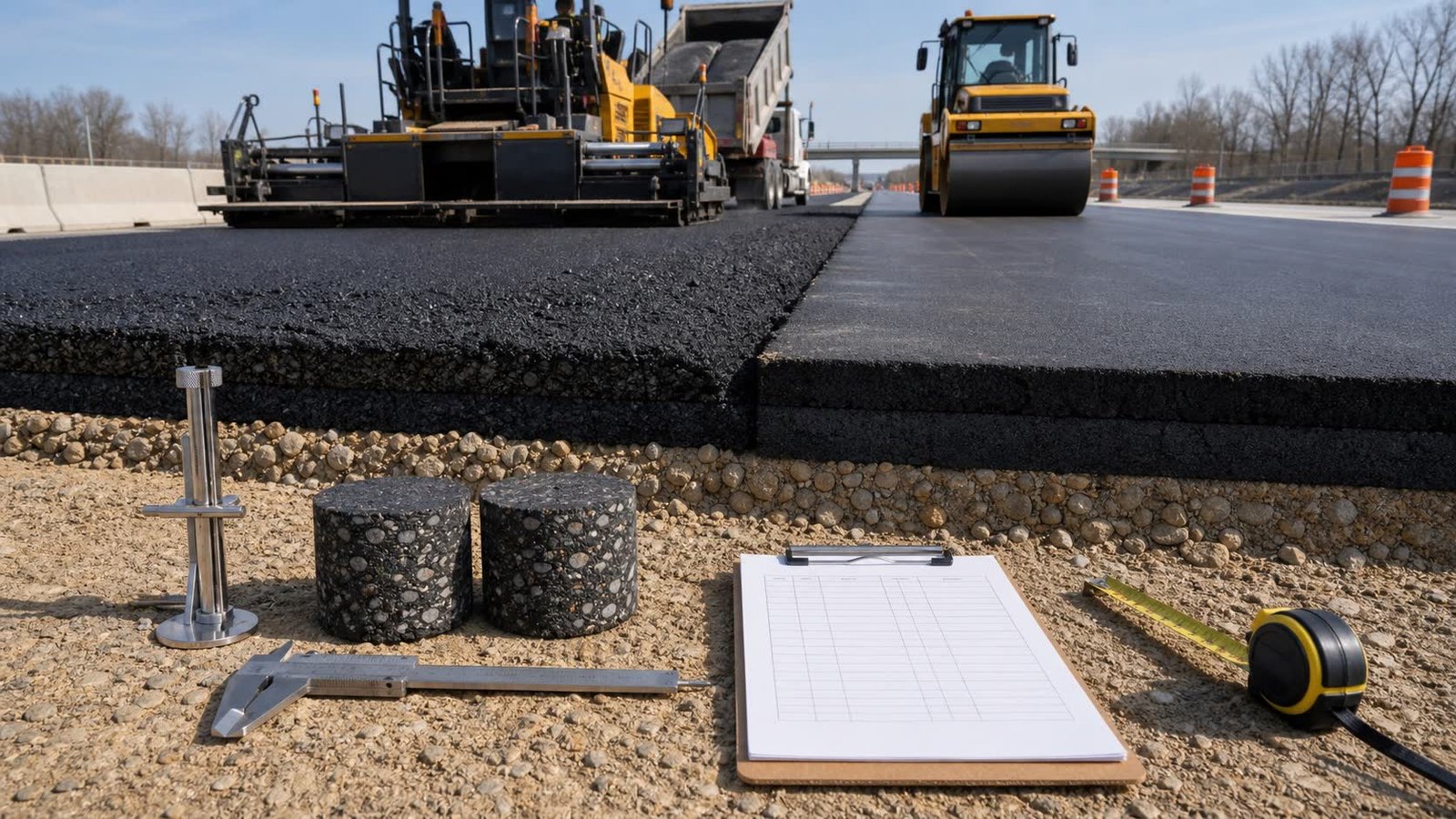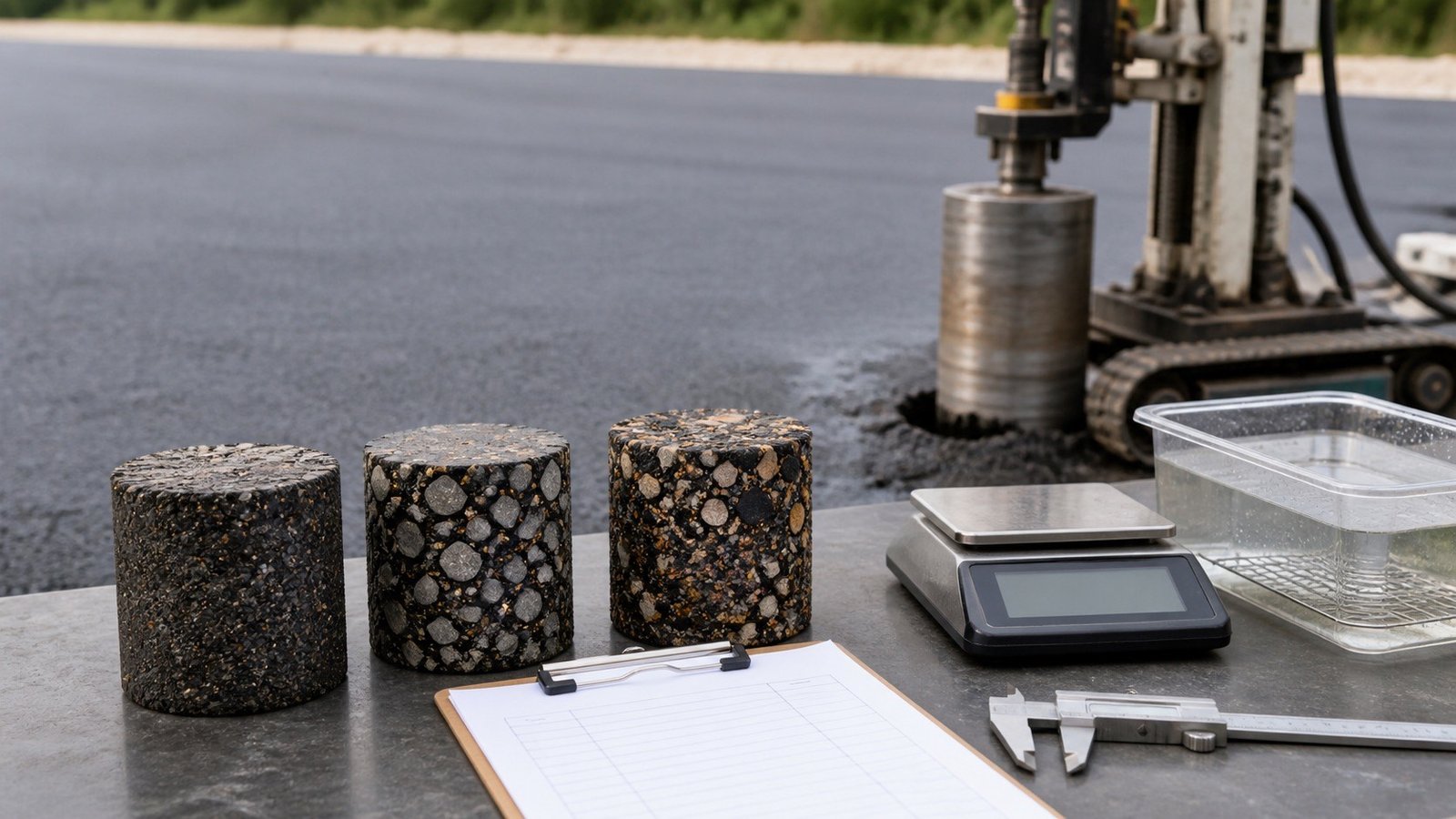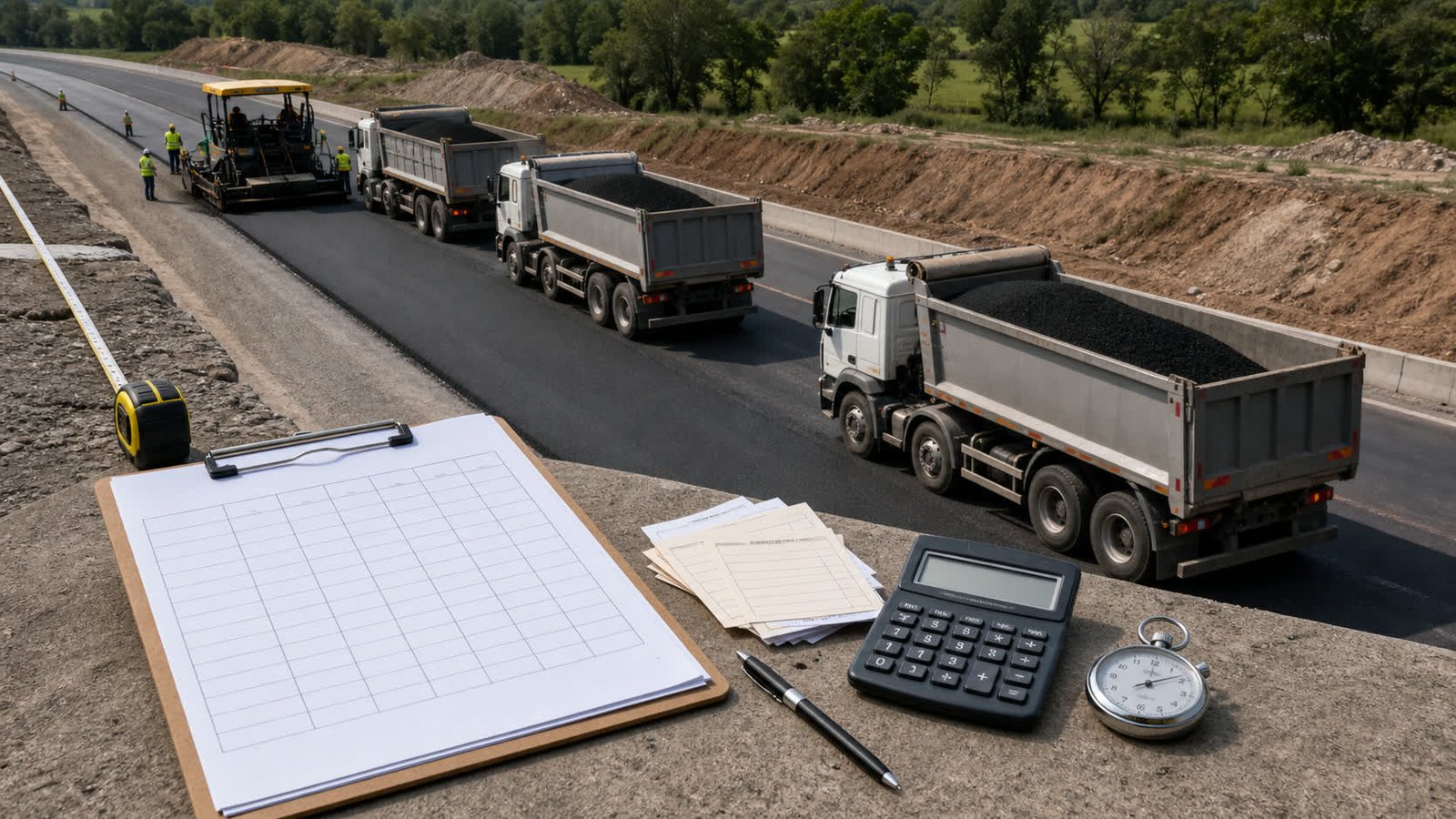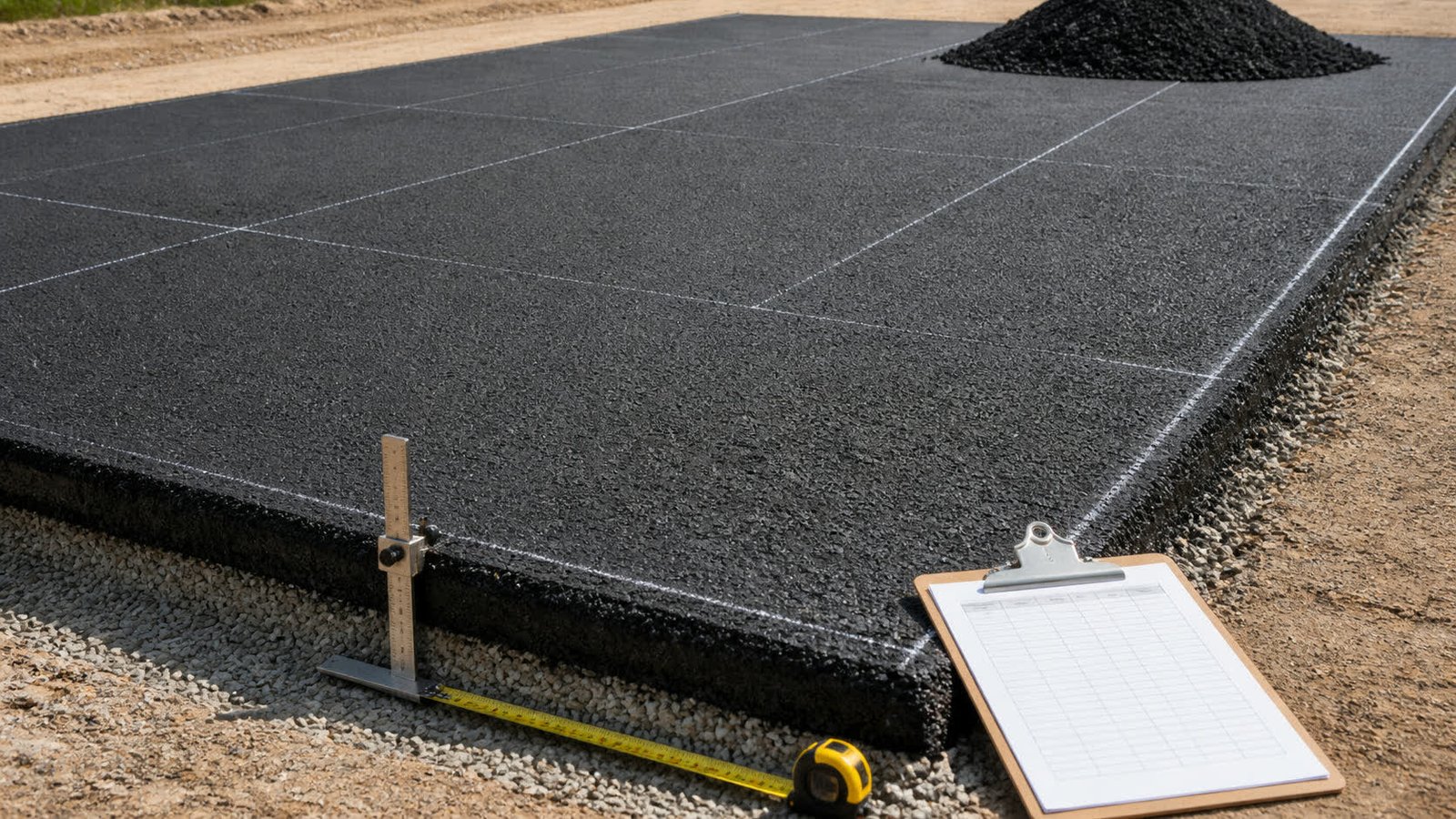
Asphalt coverage per ton depends on 2 project inputs: the compacted depth and the compacted density of the selected mixture. The mass unit also matters because a U.S. short ton, metric tonne, and long ton contain different amounts of material.
Use a coverage calculation when the available or delivered mass is known and you need its theoretical finished area. Keep the density, lift, paved limits, ticket status, and compacted depth with the result so another person can check it.
How much area does one ton of asphalt cover?
At an example compacted density of 145 lb/ft³, 1 U.S. short ton calculates to 82.8 ft² at 2 in compacted depth. It calculates to 165.5 ft² at 1 in and 55.2 ft² at 3 in.
At an example compacted density of 2,320 kg/m³, 1 metric tonne calculates to 8.62 m² at 50 mm compacted depth. These answers change when density or depth changes, so use the tables as arithmetic fixtures and replace the example density with the selected project value.
Record mass unit, accepted mass, selected mixture, compacted density, compacted lift depth, paved limits, exclusions, calculation date, and source documents.
What information do you need before calculating coverage?
Collect a mass, compacted depth, and compacted density that describe the same asphalt lift. Resolve the unit and status of each input before using the formula.
| Input | Record | Why it changes coverage |
|---|---|---|
| Mass | Quoted, ordered, dispatched, delivered, accepted, rejected, returned, diverted, or remaining | Only mass assigned to the defined paving work belongs in its coverage check |
| Mass unit | U.S. short ton, metric tonne, long ton, pound, or kilogram | The unit sets the mass conversion |
| Mixture and lift | Exact mixture identifier and surface, binder, leveling, base, or project lift name | Different mixtures and lifts can use different density and depth records |
| Compacted density | Value, unit, source, date, material state, and approved use | Higher entered density gives less area for the same mass and depth |
| Compacted depth | Selected value, unit, source, revision, and applicable paved limits | Deeper compacted placement gives less area for the same mass and density |
| Area limits | Stations, lot zone, lane, driveway section, lift boundary, deductions, and overlaps | A total area is useful only when it covers the same work as the mass record |
The Asphalt Density and Weight Guide explains how to identify a usable compacted density record. The Asphalt Thickness: Loose vs Compacted guide identifies the depth state and separates lifts.
How is asphalt coverage calculated from mass?
Divide mass by compacted density to get compacted volume. Divide that volume by compacted depth to get theoretical area.
Compacted volume = asphalt mass ÷ compacted density
Theoretical coverage area = compacted volume ÷ compacted depth
For U.S. customary inputs, convert short tons to pounds and inches to feet:
Area (ft²) = short tons × 2,000 × 12 ÷ (density in lb/ft³ × depth in)
For metric inputs, convert metric tonnes to kilograms and millimetres to metres:
Area (m²) = metric tonnes × 1,000 ÷ (density in kg/m³ × depth in m)
Retain full precision through the calculation, then round the displayed coverage to a practical measurement resolution. Keep supplier mass rounding outside the geometry formula.
What area does one U.S. short ton cover by depth?
The table uses 145 lb/ft³ only as a stated calculation input. It does not assign that density to an unnamed mixture or project.
| Compacted depth | Coverage (ft²) | Coverage (yd²) | Mass per yd² |
|---|---|---|---|
| 1 in | 165.5 | 18.39 | 108.75 lb |
| 1.5 in | 110.3 | 12.26 | 163.13 lb |
| 2 in | 82.8 | 9.20 | 217.50 lb |
| 2.5 in | 66.2 | 7.36 | 271.88 lb |
| 3 in | 55.2 | 6.13 | 326.25 lb |
| 4 in | 41.4 | 4.60 | 435.00 lb |
One short ton at 145 lb/ft³ first converts to 2,000 ÷ 145 = 13.793 ft³ of compacted volume, or 0.5109 yd³. At 2 in, the depth is 2 ÷ 12 = 0.1667 ft, so coverage is 13.793 ÷ 0.1667 = 82.759 ft².
NAPA describes asphalt spread rate in pounds per square yard for each inch of compacted thickness and ties it to laboratory unit-weight information. At the stated 145 lb/ft³ input, 1 yd² by 1 in contains 9 × 1 ÷ 12 = 0.75 ft³ and calculates to 108.75 lb.
What area does one metric tonne cover by depth?
The metric table uses 2,320 kg/m³ only as a stated calculation input. Replace it with the selected compacted density for the mixture and lift.
| Compacted depth | Coverage (m²) | Mass per m² |
|---|---|---|
| 25 mm | 17.24 | 58.0 kg |
| 40 mm | 10.78 | 92.8 kg |
| 50 mm | 8.62 | 116.0 kg |
| 60 mm | 7.18 | 139.2 kg |
| 75 mm | 5.75 | 174.0 kg |
| 100 mm | 4.31 | 232.0 kg |
One metric tonne at 2,320 kg/m³ converts to 1,000 ÷ 2,320 = 0.431034 m³. At 50 mm, or 0.05 m, coverage is 0.431034 ÷ 0.05 = 8.6207 m².
The 145 lb/ft³ and 2,320 kg/m³ tables use close, though not identical, density inputs. Do not compare a rounded row across unit systems as though both tables describe the same exact density.
How does density change the coverage result?
Coverage decreases when the entered compacted density increases and mass and depth stay fixed. A density sensitivity check shows how much an unresolved input can move the planned area.
| Entered compacted density | Calculated coverage | Difference from 145 lb/ft³ case |
|---|---|---|
| 140 lb/ft³ | 85.71 ft² | +2.96 ft² |
| 145 lb/ft³ | 82.76 ft² | Reference |
| 150 lb/ft³ | 80.00 ft² | −2.76 ft² |
FHWA Protocol P02 covers bulk specific gravity of compacted asphalt cores and states that the result may be used to calculate mixture unit weight within the stated method. Obtain the density basis required by the current project, producer, laboratory, or responsible project contact.
How do you calculate coverage for several tons?
Multiply the one-ton coverage by the mass only when density and compacted depth remain unchanged. A 10-short-ton quantity at 145 lb/ft³ and 2 in calculates to 10 × 82.7586 = 827.586 ft².
Use the Asphalt Calculator when the paved area is known and the required volume or tonnage is the unknown. Use the coverage formula on this page when mass is known and area is the unknown. Both directions need the same compacted depth and density definitions.
Keep exact calculations until compatible areas or masses are combined. Rounding every small section to a supplier increment can add the increment several times.
Are a ton, tonne and long ton interchangeable?
No. The unit distinction is factual: a U.S. short ton is 2,000 lb, a metric tonne is 1,000 kg, and a long ton is 2,240 lb. NIST lists these relationships in Handbook 44.
| Label | Defined mass | Estimator action |
|---|---|---|
| U.S. short ton | 2,000 lb | Use the imperial formula with lb/ft³ and compacted inches |
| Metric tonne | 1,000 kg | Use the metric formula with kg/m³ and compacted metres |
| Long ton | 2,240 lb | Convert explicitly before using a short-ton table |
| Unlabelled ton | Unresolved | Confirm the unit on the quote, scale ticket, contract, or supplier record |
Country, contract terminology, and supplier system can change the intended unit. Preserve the original unit on the calculation record instead of relying on the word ton alone.
How should delivery tickets be checked against paved area?
Add accepted ticket mass assigned to the same mixture, lift, and paved limits. Keep rejected, returned, diverted, duplicate, or unresolved tickets outside the accepted total until the project record decides their status.
Example: accepted tickets of 18.2 t and 17.8 t total 36.0 t. If the current approved order is 43.5 t, the remaining accepted requirement is 7.5 t.
Remaining accepted mass = current approved mass − accepted ticket mass to date
A ticket-to-area check needs matching boundaries. Record the accepted mass, net area, lift, density basis, depth basis, paving date, station or zone, rejected material, leftovers, and work outside the measured area.
| Record | Entry to preserve |
|---|---|
| Planned basis | Current approved mass, selected density, compacted depth, and calculated area |
| Ticket set | Ticket IDs, units, mixture, delivery date, gross or net basis, and acceptance status |
| Installed limits | Same-scope net paved area, lift, stations, deductions, overlaps, repairs, and tie-ins |
| Excluded mass | Rejected, returned, diverted, sampled, spilled, retained, leftover, or unresolved quantity |
| Difference | Planned mass minus accepted assigned mass, with the reason and responsible follow-up |
| Verification | Applicable density, core, survey, elevation, yield, scale, and acceptance records |
Accepted ticket mass divided by the same-scope area gives an apparent installed mass per area. Dividing accepted mass by density and area gives an inferred average depth. Neither calculation proves thickness at every location, density compliance, smoothness, elevation, or pavement acceptance.
How should different lifts and variable-depth areas be handled?
Allocate mass and calculate coverage separately when mixture, density, compacted depth, paved limits, or ticket grouping changes. Add compatible results only after each row is complete.
- Surface and binder lifts need separate depth, density, mass, and area records.
- A lift that covers only part of the pavement needs its own net area.
- A leveling course with variable depth needs accepted sections, survey, yield, or another project method.
- Tapers, crowns, tie-ins, utility repairs, aprons, widened ends, and intersections need measured zones.
- Material placed outside the measured limits needs a separate record before ticket mass is assigned.
An average depth is valid only when it represents the measured geometry. A single one-ton coverage number cannot show where deep and wide portions occur together.
Should allowance change the coverage table?
Keep theoretical coverage and a documented planning allowance on separate lines. The formula shows the area produced by the stated mass, density, and compacted depth. An allowance changes the quantity ordered for a defined reason.
Measurement uncertainty, irregular edges, leveling variation, retained material, sampling, startup, handwork, changed scope, and supplier increments have different causes. Record the applicable reason and approved treatment instead of hiding several unresolved items in one percentage.
A supplier minimum or order increment changes the purchasable mass. Truck capacity divides the order for delivery planning. Neither value changes the geometric coverage per unit of accepted mass.
Which asphalt coverage mistakes change the answer?
- Giving one fixed square-foot value without density and compacted depth.
- Using loose placement thickness in a finished-coverage calculation.
- Using a loose density with compacted volume.
- Treating a U.S. short ton as a metric tonne or long ton.
- Applying one density to different mixtures or lifts without a supporting record.
- Counting rejected, returned, diverted, or duplicate tickets as accepted installed mass.
- Comparing ticket mass with an area that excludes related tie-ins or includes another lift.
- Using a theoretical coverage result as proof of field thickness or density acceptance.
- Applying an allowance twice, once to mass and again to coverage.
- Rounding every section before combining compatible quantities.
- Using a generic depth table as pavement design.
Safety, design and specification limits
Hot asphalt, fumes, delivery traffic, pavers, rollers, reversing equipment, live roadways, sampling, cores, heat, noise, and visibility require the applicable safety plan, traffic control, training, PPE, exclusion zones, communication procedure, and equipment instructions. OSHA identifies asphalt-fume exposure as a worker-safety concern.
This guide does not design pavement, select a mixture, prescribe lift depth, assign compacted density, set an allowance, approve truck payload, calculate cost, establish sampling, set tolerance, determine payment, or verify acceptance. Current project documents, producer records, field measurements, tickets, specifications, and qualified decisions control those tasks.
Use the Asphalt Calculator when you need mass from measured area and depth. Browse the Asphalt planning tools and guides for the category record. The calculation methodology explains source, unit, assumption, precision, and rounding checks. Report an issue through the corrections route.
Sources and source scope
- NAPA Asphalt Paving Handbook, Section 7.5 Layer Thickness: loose and compacted layer context, laboratory-unit-weight basis for spread rate, and spread-rate use in paving quantity checks.
- FHWA LTPP Protocol P02: compacted asphalt-core bulk specific gravity, method boundaries, and use of bulk specific gravity to calculate mixture unit weight.
- NIST Handbook 44 (2026), Appendix C: exact area, volume, pound, kilogram, U.S. short-ton, metric-tonne, and long-ton relationships used in the calculations.
- OSHA Asphalt Fumes: asphalt-fume and worker-exposure context.
Source scope: NAPA supports the compacted spread-rate concept. FHWA supports the stated LTPP density-record context. NIST supports the unit relationships. OSHA supports the exposure warning. The coverage tables and examples are independently checked arithmetic. These sources do not select a pavement section, mixture, compacted depth, density, allowance, ticket status, supplier rule, test method, or acceptance decision.
Review responsibility: Saleem Sial owns the research and editorial record. Formula checks, source verification, build validation, link crawl, schema review, and rendered QA form the internal publication gate. Waseem Sial, External Reviewer and Engineer, remains listed for ongoing external review; no completed external-review date is claimed.